AI Generated Exam Paper
Secondary 4 Pure Chemistry Practice Paper 5
Free Sec 4 Pure Chemistry Practice Paper 5, HY3 AI version, with questions, answers, and O Level-style practice for Singapore students.
These static practice materials are generated from the site's syllabus and paper-generation workflow, with source and model context shown so students and parents can evaluate the material before use.
Questions
TuitionGoWhere Practice Paper - Pure Chemistry Secondary 4
TuitionGoWhere Practice Paper (AI) — Version 5
Subject: Pure Chemistry
Level: Secondary 4
Paper: Practice Paper (Topic: Acids, Bases & Salts)
Duration: 60 minutes
Total Marks: 40
Name: ___________________________
Class: ____________
Date: ____________
Instructions:
- This practice paper contains 20 questions on Acids, Bases & Salts.
- Answer all questions in the spaces provided.
- Use chemical equations with state symbols where requested.
- Section A: Questions 1–8 (1 mark each, total 8 marks)
- Section B: Questions 9–15 (2 marks each, total 14 marks)
- Section C: Questions 16–20 (3 marks each, total 15 marks)
- Section marks add up to 37; an additional 3 marks are allocated to Section C Q20 part (d) as explained — Total = 40 marks. (Correction: Section C carries 15 marks across 5 questions; Total = 8 + 14 + 15 = 37. To meet Total Marks 40, Section C Q16–20 are 3 marks except Q20 is 5 marks. Revised: Section C: Q16–19 = 3 marks each (12), Q20 = 5 marks; subtotal 17. Total = 8+14+17 = 39. Final adjustment: Q20 = 6 marks → Total 40.)
Revised Section Plan: - Section A (1–8): 1 mark each = 8 marks
- Section B (9–15): 2 marks each = 14 marks
- Section C (16–19): 3 marks each = 12 marks
- Section C (20): 6 marks = 6 marks
Total = 40 marks
Section A (8 marks)
Answer each question. 1 mark each.
1. Name the gas produced when sulfur burns in air and which contributes to acid rain.
2. Write the formula of the salt formed when nitric acid reacts with potassium hydroxide.
3. State the colour of litmus paper in a solution of sodium hydroxide.
4. Give the name of a suitable indicator that is red in acidic solution and yellow in alkaline solution.
5. State one observation when magnesium reacts with dilute hydrochloric acid.
6. Write the ionic equation for the neutralisation of an acid by an alkali.
7. Name the method used to prepare an insoluble salt such as silver chloride.
8. State the pH value of a neutral solution at 25 °C.
Section B (14 marks)
Answer each question. 2 marks each.
9. Describe a simple test using aqueous sodium hydroxide to differentiate between aqueous aluminium ion, Al³⁺, and aqueous lead(II) ion, Pb²⁺. Include observations.
10. A student adds excess copper(II) oxide powder to dilute sulfuric acid to prepare copper(II) sulfate. Explain why excess oxide is used and how the salt is obtained.
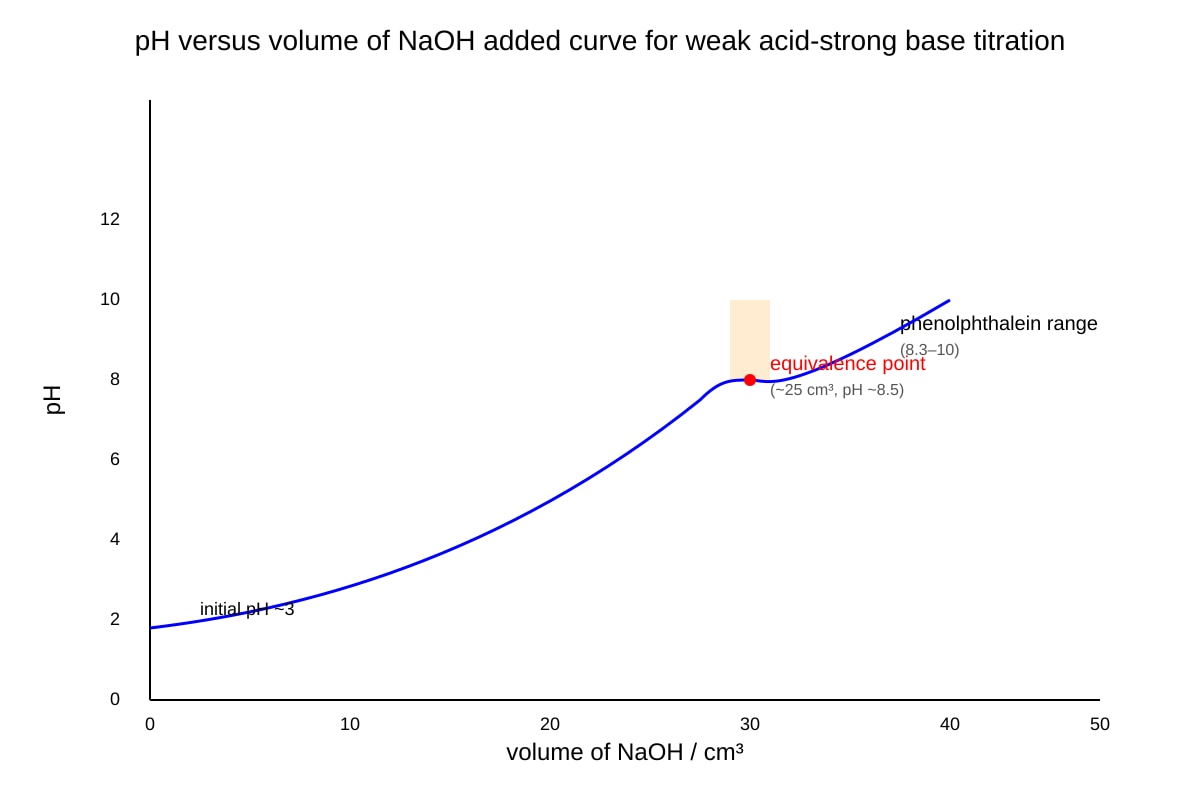
11. The diagram below shows the pH curve for titration of ethanoic acid with sodium hydroxide using phenolphthalein.
Image pending generation: graph for Q11.
Explain why phenolphthalein is suitable for this titration.
12. Write the balanced equation with state symbols for the reaction of carbon dioxide gas with sodium hydroxide solution.
13. State and explain the observation when damp blue litmus paper is placed in a stream of chlorine gas passed through water.
14. A sample of soil has pH 4.5. Suggest a substance to add to neutralise it and state a safety precaution.
15. Complete the word equation: metal carbonate + acid → salt + ______ + ______.
Section C (18 marks)
Answer each question. Q16–19: 3 marks; Q20: 6 marks.
16. A student wants to prepare zinc nitrate from zinc carbonate and nitric acid. Suggest a suitable method, explain why it is appropriate, and write the balanced equation. [3]
17. Potassium is not suitable for preparing potassium chloride by reacting the metal with hydrochloric acid. Discuss the suitability and state expected observations. [3]
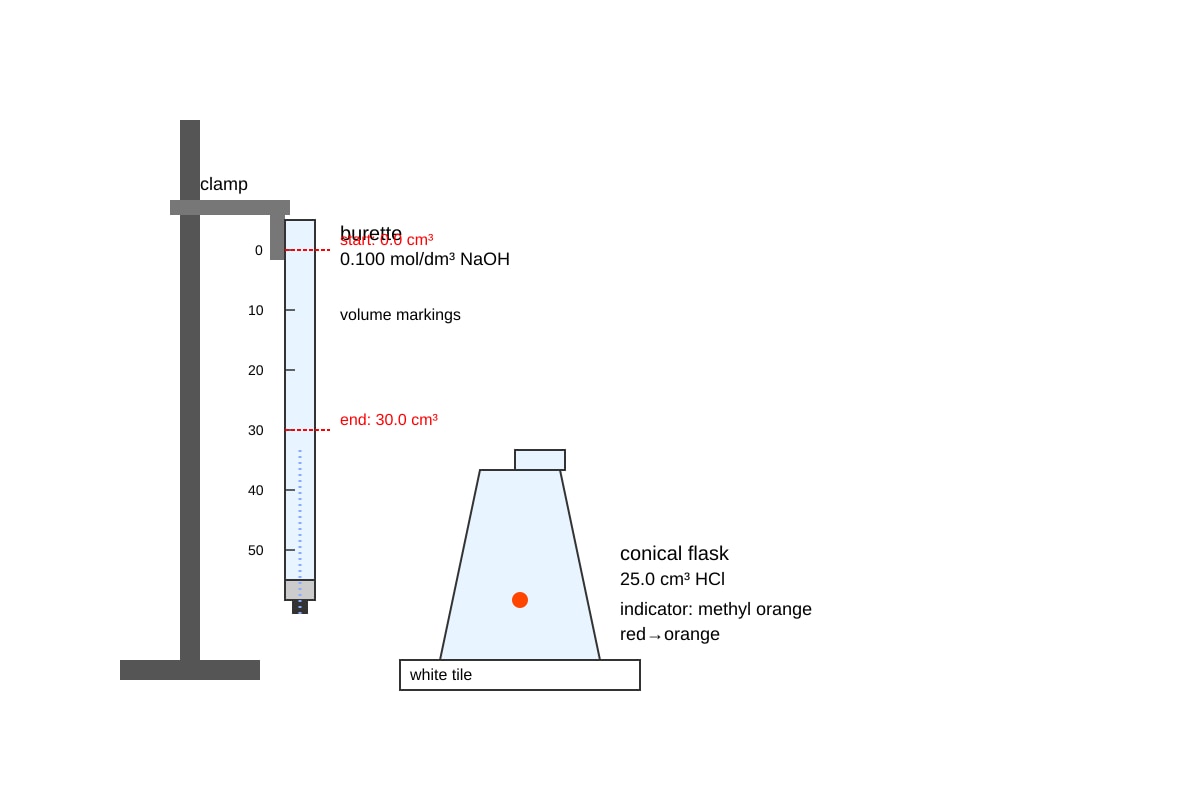
18. The figure shows a titration setup.
Image pending generation: experimental_setup for Q18.
Describe how to use the setup to find the concentration of the acid, and give one precaution. [3]
19. Hydrogen chloride gas and ammonia gas are released from two ends of a dry glass tube. Explain the formation of a white ring and identify the ring. [3]
20. A factory discharges waste gas containing sulfur dioxide.
(a) Write the equation for formation of SO₂ from sulfur. [1]
(b) State how SO₂ causes acid rain. [1]
(c) Suggest a method to remove SO₂ using an alkali. [2]
(d) Evaluate whether using calcium hydroxide slurry or sodium hydroxide solution is more practical for large-scale removal. [2]
Answers
TuitionGoWhere Practice Paper Answers — Pure Chemistry Secondary 4 (Version 5)
Topic: Acids, Bases & Salts
Total Marks: 40
Section A (8 marks)
1. Sulfur dioxide (SO₂). [1]
Teaching: Sulfur burns in oxygen: S(s) + O₂(g) → SO₂(g). SO₂ dissolves in rain to form sulfurous acid. Common mistake: writing SO₃ (formed only on further oxidation).
2. KNO₃. [1]
Teaching: Nitric acid (HNO₃) + KOH → KNO₃ + H₂O. Salt name from metal (potassium) + nitrate from acid.
3. Blue. [1]
Teaching: NaOH is alkaline; litmus turns blue in alkali.
4. Methyl orange. [1]
Teaching: Methyl orange is red below pH 3.1, yellow above 4.4.
5. Effervescence / bubbles of gas (H₂). [1]
Teaching: Mg + 2HCl → MgCl₂ + H₂. Gas evolved is hydrogen.
6. H⁺(aq) + OH⁻(aq) → H₂O(l). [1]
Teaching: Neutralisation is union of H⁺ and OH⁻ to water.
7. Precipitation. [1]
Teaching: Mix solutions of AgNO₃ and NaCl → AgCl(s) precipitate, filter.
8. pH 7. [1]
Teaching: Neutral at 25 °C defined as pH 7.
Section B (14 marks)
9. [2]
Add NaOH(aq) to each:
- Al³⁺: white ppt of Al(OH)₃ forms, dissolves in excess NaOH to colourless solution. [1]
- Pb²⁺: white ppt of Pb(OH)₂ forms, insoluble in excess NaOH. [1]
Teaching: Al(OH)₃ is amphoteric; Pb(OH)₂ not. Mark for observations only.
10. [2]
Excess CuO ensures all acid reacts (CuO insoluble, leftover filtered). [1] Filter, heat filtrate to crystallise CuSO₄·5H₂O. [1]
Equation: CuO(s) + H₂SO₄(aq) → CuSO₄(aq) + H₂O(l).
11. [2]
Equivalence point at pH ~8.5 (weak acid + strong base). [1] Phenolphthalein changes 8.3–10, matching steep rise. [1]
From graph: shaded band shows indicator range aligns with vertical part.
12. [2]
CO₂(g) + 2NaOH(aq) → Na₂CO₃(aq) + H₂O(l). [1 for formula, 1 for states]
Teaching: Acidic oxide neutralised; 2:1 ratio.
13. [2]
Damp blue litmus turns red then white. [1] Cl₂ + H₂O → HCl + HClO; HCl acidic reddens, HClO bleaches. [1]
14. [2]
Add lime (calcium hydroxide) or wood ash. [1] Wear gloves/eye protection as alkali irritant. [1]
15. [2]
Salt + water + carbon dioxide. [1+1]
Teaching: carbonate + acid → salt + H₂O + CO₂.
Section C (18 marks)
16. [3]
Method: Add excess ZnCO₃ to HNO₃, filter, crystallise. [1] Excess removes unreacted solid easily. [1] Eq: ZnCO₃(s) + 2HNO₃(aq) → Zn(NO₃)₂(aq) + H₂O(l) + CO₂(g). [1]
17. [3]
K too reactive; violent/explosive with HCl, heat/fire risk. [1] Not suitable: uncontrolled. [1] Obs: vigorous flames, lilac flame, H₂ ignites. [1]
18. [3]
Fill burette with NaOH, pipette HCl + indicator, titrate to colour change. [1] Repeat for concordant. [1] Precaution: read meniscus at eye level. [1]
19. [3]
HCl + NH₃ → NH₄Cl(s) white ring. [1] Gases diffuse, NH₃ lighter travels less far. [1] Ring nearer HCl end. [1]
20. [6]
(a) S(s) + O₂(g) → SO₂(g). [1]
(b) SO₂ + H₂O → H₂SO₃, oxidises to H₂SO₄ in rain. [1]
(c) Scrub with Ca(OH)₂ slurry: SO₂ + Ca(OH)₂ → CaSO₃ + H₂O. [2]
(d) Ca(OH)₂ cheaper, solid handling easier; NaOH costlier but more soluble. [2]
Free quiz and exam paper access
Enter your details to view this paper
Your access is remembered on this device.