AI Generated Exam Paper
Secondary 4 Pure Chemistry Practice Paper 4
Free Sec 4 Pure Chemistry Practice Paper 4, HY3 AI version, with questions, answers, and O Level-style practice for Singapore students.
These static practice materials are generated from the site's syllabus and paper-generation workflow, with source and model context shown so students and parents can evaluate the material before use.
Questions
Free quiz and exam paper access
Enter your details to view this paper
Your access is remembered on this device.
Answers
TuitionGoWhere Practice Paper - Pure Chemistry Secondary 4 (Version 4) Answer Key
Total Marks: 40
Topic: Acids, Bases & Salts
Section A (1 mark each)
1. Hydrogen, H₂
Teaching note: Reactive metals displace hydrogen from acids; Mg + 2HCl → MgCl₂ + H₂. Common mistake: writing "hydrogen gas" without formula is acceptable but formula preferred.
2. Blue
Teaching note: Litmus is red in acid, blue in alkali. KOH is alkaline so red litmus stays blue, blue litmus stays blue.
3. NaNO₃
Teaching note: HNO₃ + NaOH → NaNO₃ + H₂O. Salt = metal from base + nitrate from acid.
4. Phenolphthalein
Teaching note: Phenolphthalein is colourless below pH 8.3, pink above.
5. Solution turns milky/cloudy
Teaching note: CO₂ + Ca(OH)₂ → CaCO₃(s) + H₂O, white precipitate makes limewater cloudy.
6. Neutralisation
Teaching note: Acid + base → salt + water is neutralisation.
7. H⁺(aq) + OH⁻(aq) → H₂O(l)
Teaching note: Net ionic equation removes spectator ions Na⁺ and Cl⁻.
8. 7
Teaching note: Neutral pH at 25 °C is 7; temperature change alters this.
9. Zinc sulfate (ZnSO₄)
Teaching note: Zn + H₂SO₄ → ZnSO₄ + H₂. Salt name from metal + acid root.
10. Buffer solution
Teaching note: Buffers resist pH change via weak acid/base pairs.
Section B (2 marks each)
11. White precipitate forms: Al³⁺(aq) + 3OH⁻(aq) → Al(OH)₃(s) [1]; precipitate dissolves in excess NaOH [1].
Teaching note: Al(OH)₃ is amphoteric; excess OH⁻ forms [Al(OH)₄]⁻.
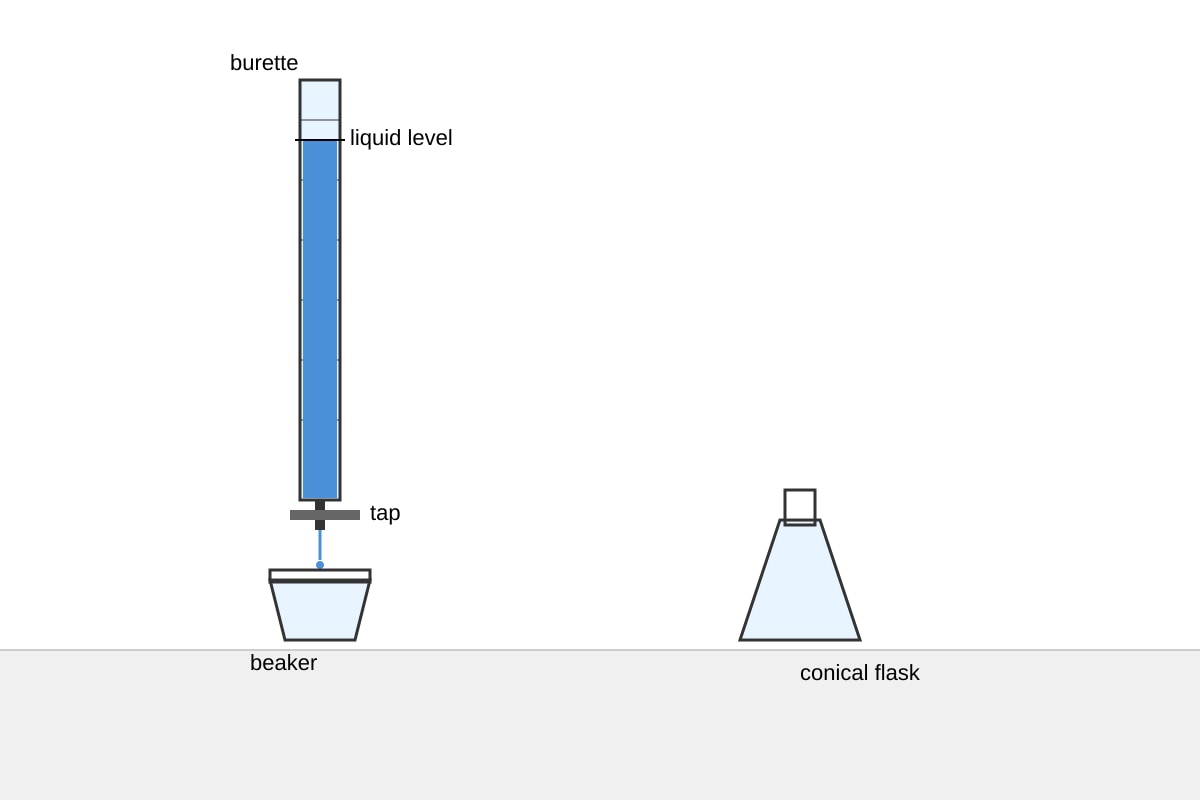
12. Errors: (1) Burette should be above conical flask not beaker [1]; (2) No funnel used / flask not under burette [1].
Teaching note: Correct setup delivers titrant into flask; funnel removed before reading.
13. Ethanoic acid partially ionises: CH₃COOH ⇌ CH₃COO⁻ + H⁺ (few ions) [1]; HCl fully ionises: HCl → H⁺ + Cl⁻ (many ions) [1].
Teaching note: Strength = extent of ionisation, not concentration.
14. Add calcium oxide / slaked lime (base) [1]; type: base / alkali [1].
Teaching note: Soil pH <7 needs base to neutralise; avoid strong alkali overdose.
15. BaCl₂(aq) + H₂SO₄(aq) → BaSO₄(s) + 2HCl(aq) [2]
Teaching note: White BaSO₄ precipitate; state symbols required for full marks.
Section C (4 marks each)
16. (a) Heat acid, add excess CuO, filter, evaporate, crystallise [2]; (b) CuO(s) + H₂SO₄(aq) → CuSO₄(aq) + H₂O(l) [1]; (c) Evaporate then cool to crystallise [1].
Marking: Method 2 marks, equation 1, crystals 1.
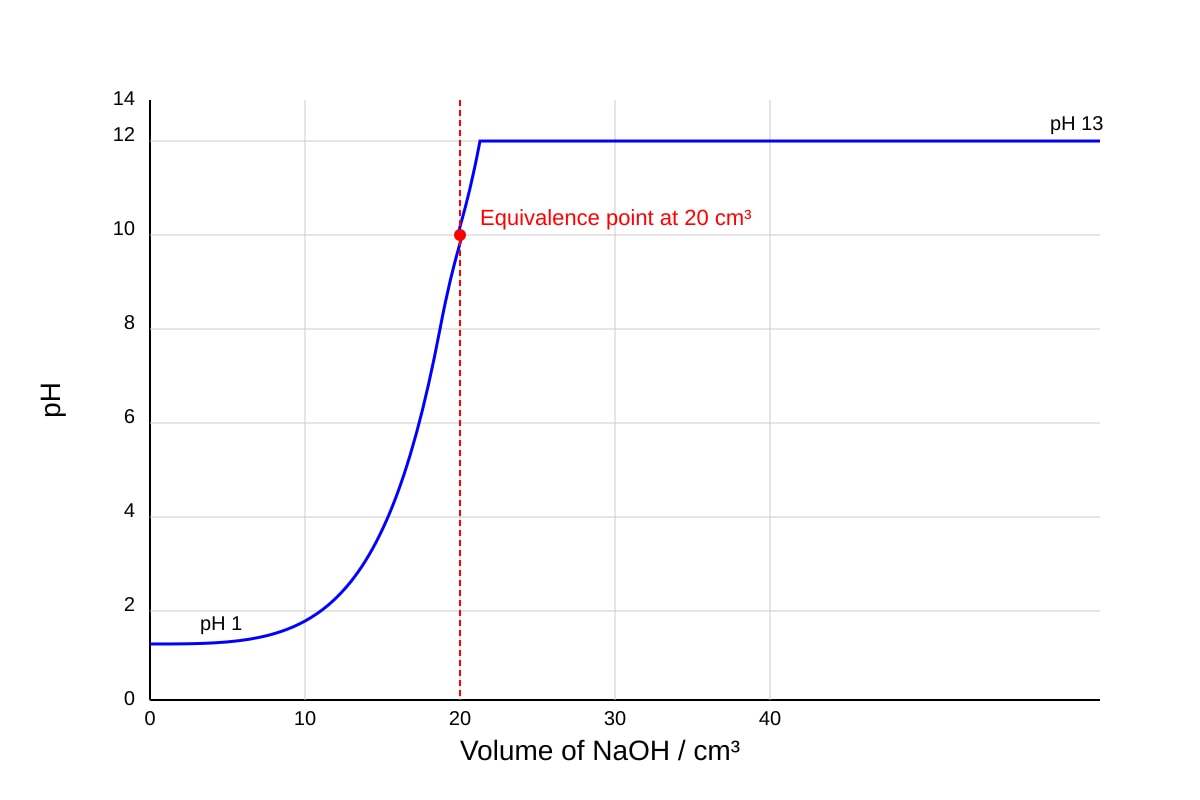
17. (a) 20.0 cm³ [1]; (b) n(NaOH)=0.100×0.0200=0.00200 mol [1]; n(HCl)=0.00200 mol [1]; c(HCl)=0.00200/0.0250=0.0800 mol/dm³ [1].
Teaching note: Moles equal at equivalence; show unit conversion.
18. (a) Precipitation using Pb(NO₃)₂ + NaCl [2]; (b) Pb²⁺ + 2Cl⁻ → PbCl₂(s) [1]; (c) Filter, wash with water [1].
Teaching note: Insoluble salt by mixing soluble salts.
19. Pure ethanoic acid has few ions (covalent molecules) so poor conductivity [2]; dilution increases ionisation slightly raising conductivity [2].
Teaching note: Weak acid equilibrium shifts right on dilution.
20. Problems: kills aquatic life, corrodes structures [2]; reduce by neutralising with CaCO₃ / CaO before release [2].
Teaching note: Acid harms ecosystem; neutralisation prevents damage.