AI Generated Exam Paper
Secondary 4 Pure Chemistry Practice Paper 3
Free Sec 4 Pure Chemistry Practice Paper 3, HY3 AI version, with questions, answers, and O Level-style practice for Singapore students.
These static practice materials are generated from the site's syllabus and paper-generation workflow, with source and model context shown so students and parents can evaluate the material before use.
Questions
TuitionGoWhere Practice Paper - Pure Chemistry Secondary 4
TuitionGoWhere Practice Paper (AI)
Version: 3 of 5
Subject: Pure Chemistry
Level: Secondary 4
Paper: Practice Paper (Topic: Acids, Bases & Salts)
Duration: 60 minutes
Total Marks: 40
Name: __________________________
Class: ____________
Date: ____________
Instructions
- Answer all questions in the spaces provided.
- Use blue or black pen.
- Show all working clearly where calculations are involved.
- State symbols should be included in chemical equations where requested.
- This practice paper is generated from syllabus-first templates and is not derived from any official past-year paper.
Section A: Multiple Choice and Short Structured (Questions 1–10) [12 marks]
-
[1 mark] Which of the following is a weak acid?
A. Hydrochloric acid
B. Ethanoic acid
C. Sulfuric acid
D. Nitric acid -
[1 mark] Write the formula of the salt formed when magnesium reacts with hydrochloric acid.
-
[1 mark] State the colour of litmus paper in a solution of sodium hydroxide.
-
[1 mark] Name the gas produced when zinc reacts with dilute sulfuric acid.
-
[1 mark] Give the ionic equation for the neutralisation of an acid by an alkali.
-
[1 mark] Which indicator would be suitable for a titration between strong acid and strong base?
-
[1 mark] State one observation when carbon dioxide is bubbled through limewater.
-
[1 mark] What is the pH of a neutral solution at 25 °C?
-
[2 marks] Describe a test to show that a given solution is acidic.
-
[2 marks] Explain why ethanoic acid is classified as a weak acid but hydrochloric acid is strong.
Section B: Structured Response and Data (Questions 11–15) [14 marks]
-
[3 marks] A student prepares copper(II) sulfate from copper(II) oxide and dilute sulfuric acid. Describe the method and write the balanced equation with state symbols.
-
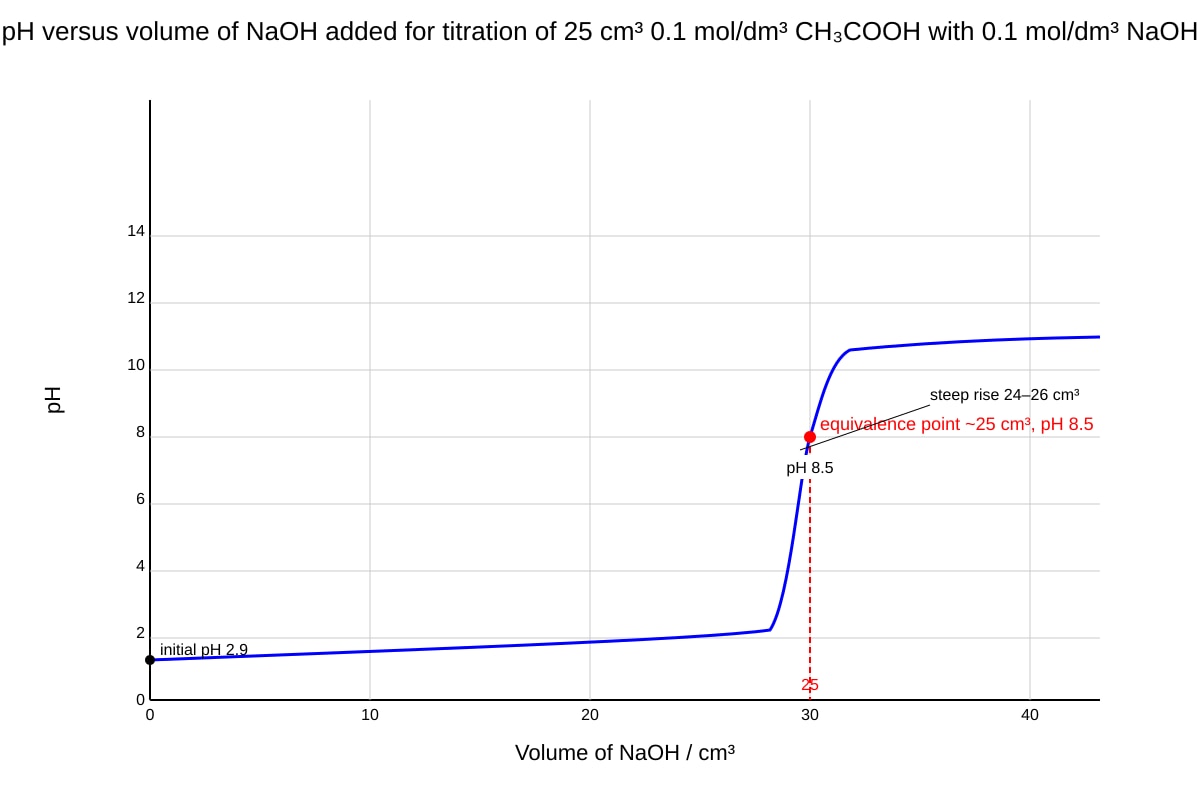
[3 marks] The diagram below shows a pH curve for titration of ethanoic acid with sodium hydroxide. Explain why phenolphthalein is a suitable indicator.
Image pending generation: graph for Q12.
-
[3 marks] A student wants to prepare lead(II) chloride, an insoluble salt. State the method and write the equation.
-
[2 marks] Explain why excess reactant is used when preparing a soluble salt from an insoluble metal carbonate.
-
[3 marks] The table shows pH of solutions A–D. Identify which are acids/bases and suggest one possible substance for each.
| Solution | pH |
|---|---|
| A | 2 |
| B | 7 |
| C | 9 |
| D | 13 |
Section C: Extended Application (Questions 16–20) [14 marks]
-
[3 marks] Potassium reacts violently with dilute hydrochloric acid. Discuss why this method is unsuitable for preparing potassium chloride. State observations.
-
[3 marks] A farmer finds soil with pH 4.5. Suggest a substance to treat it and explain the chemistry involved.
-
[3 marks] Gas X reacts with sodium hydroxide to form sodium sulfite and water. Identify X and write the equation.
-
[2 marks] Differentiate between Al³⁺ and Pb²⁺ using sodium hydroxide solution.
-
[3 marks] A titration uses 25.0 cm³ of 0.100 mol/dm³ HCl neutralised by 20.0 cm³ NaOH. Calculate concentration of NaOH and identify if acid/base is strong/weak from context. Show working.
Answers
TuitionGoWhere Practice Paper - Pure Chemistry Secondary 4 (Answers)
Version: 3 of 5
Total Marks: 40
Section A Answers
- B [1] Ethanoic acid (CH₃COOH) is a weak acid as it partially dissociates.
- MgCl₂ [1] Magnesium chloride formed: Mg + 2HCl → MgCl₂ + H₂.
- Blue [1] Bases turn red litmus blue; NaOH is alkaline.
- Hydrogen, H₂ [1] Zn + H₂SO₄ → ZnSO₄ + H₂.
- H⁺(aq) + OH⁻(aq) → H₂O(l) [1]
- Any of methyl orange, phenolphthalein, universal indicator [1]
- Milky white precipitate (CaCO₃) formed [1]
- 7 [1]
- [2] Add litmus/Universal indicator: turns red (1). Or react with metal carbonate: effervescence (1).
- [2] Ethanoic acid partially ionises in water (1); HCl fully ionises (1).
Section B Answers
- [3] Add excess CuO to H₂SO₄, heat, filter, crystallise (1). Eq: CuO(s) + H₂SO₄(aq) → CuSO₄(aq) + H₂O(l) (2, state symbols 1, balanced 1).
- [3] Equivalence at pH 8.5 (1); phenolphthalein changes 8.3–10 (1); matches steep rise (1).
- [3] Mix Pb(NO₃)₂(aq) + NaCl(aq) → PbCl₂(s) + 2NaNO₃(aq) (2); filter/wash/dry (1).
- [2] Ensures all acid reacted (1); excess removed by filtration (1).
- [3] A pH2 acid e.g. HCl (1); B neutral water (1); C pH9 base e.g. NaOH (1); D pH13 strong base e.g. Ca(OH)₂ (1) – max 3.
Section C Answers
- [3] Too reactive, explosive (1); violent effervescence, heat, possible ignition (1); unsafe, not controlled (1).
- [3] Add lime (CaO) or Ca(OH)₂ (1); neutralises acid (1); raises pH toward 7 (1).
- [3] X = SO₂ (1); SO₂ + 2NaOH → Na₂SO₃ + H₂O (2).
- [2] Add NaOH: Al³⁺ gives white ppt dissolving in excess (1); Pb²⁺ white ppt insoluble (1).
- [3] n(HCl)=0.025×0.100=0.00250 mol; n(NaOH)=same; c=0.00250/0.0200=0.125 mol/dm³ (2). Strong from titration context (1).
Free quiz and exam paper access
Enter your details to view this paper
Your access is remembered on this device.