AI Generated Exam Paper
Secondary 4 Pure Chemistry Practice Paper 2
Free Sec 4 Pure Chemistry Practice Paper 2, HY3 AI version, with questions, answers, and O Level-style practice for Singapore students.
These static practice materials are generated from the site's syllabus and paper-generation workflow, with source and model context shown so students and parents can evaluate the material before use.
Questions
TuitionGoWhere Practice Paper - Pure Chemistry Secondary 4
TuitionGoWhere Practice Paper (AI) — Version 2 of 5
Subject: Pure Chemistry
Level: Secondary 4
Paper: Practice Paper (Topic: Acids, Bases & Salts)
Duration: 60 minutes
Total Marks: 40
Name: ________________________
Class: ________
Date: ________
Instructions
- Answer all questions in the spaces provided.
- Use blue or black pen.
- Show all working where calculation is required.
- State symbols should be included in chemical equations where requested.
- This practice paper is generated from syllabus-first LLM-inferred templates. It is not derived from any official past-year paper.
Section A: Multiple Choice and Short Answer (Questions 1–10) [12 marks]
1. [1 mark] Which of the following gases formed when sulfur burns in air contributes to acid rain?
A. SO3
B. SO2
C. H2S
D. CO2
2. [1 mark] Write the balanced equation, with state symbols, for the reaction of carbon dioxide gas with sodium hydroxide solution.
3. [1 mark] Name the indicator that changes from red to yellow as the pH rises from 4.4 to 6.2.
4. [1 mark] State the colour of litmus paper in a solution of household ammonia (NH3 aqueous).
5. [1 mark] Give the formula of the salt formed when nitric acid reacts with potassium hydroxide.
6. [1 mark] Which metal is too reactive to safely prepare a salt by reacting it directly with dilute hydrochloric acid in a school lab: potassium or zinc?
7. [1 mark] State one observation when magnesium ribbon reacts with dilute sulfuric acid.
8. [1 mark] What is the name of the process of adding an acid to a base gradually using a burette until neutralisation is complete?
9. [1 mark] Give the name of a suitable drying agent for a collected gas of hydrogen chloride.
10. [1 mark] State the pH of a 0.01 mol dm−3 solution of a strong acid (to the nearest whole number).
Section B: Structured Response (Questions 11–15) [16 marks]
11. [3 marks] A student wants to prepare copper(II) sulfate from copper(II) oxide and dilute sulfuric acid.
(a) Suggest a suitable method and explain why it is appropriate.
(b) Write the balanced equation with state symbols.
12. [3 marks] Describe a simple test using aqueous sodium hydroxide to differentiate between Al3+ and Pb2+ ions in solution. Include observations and one equation.
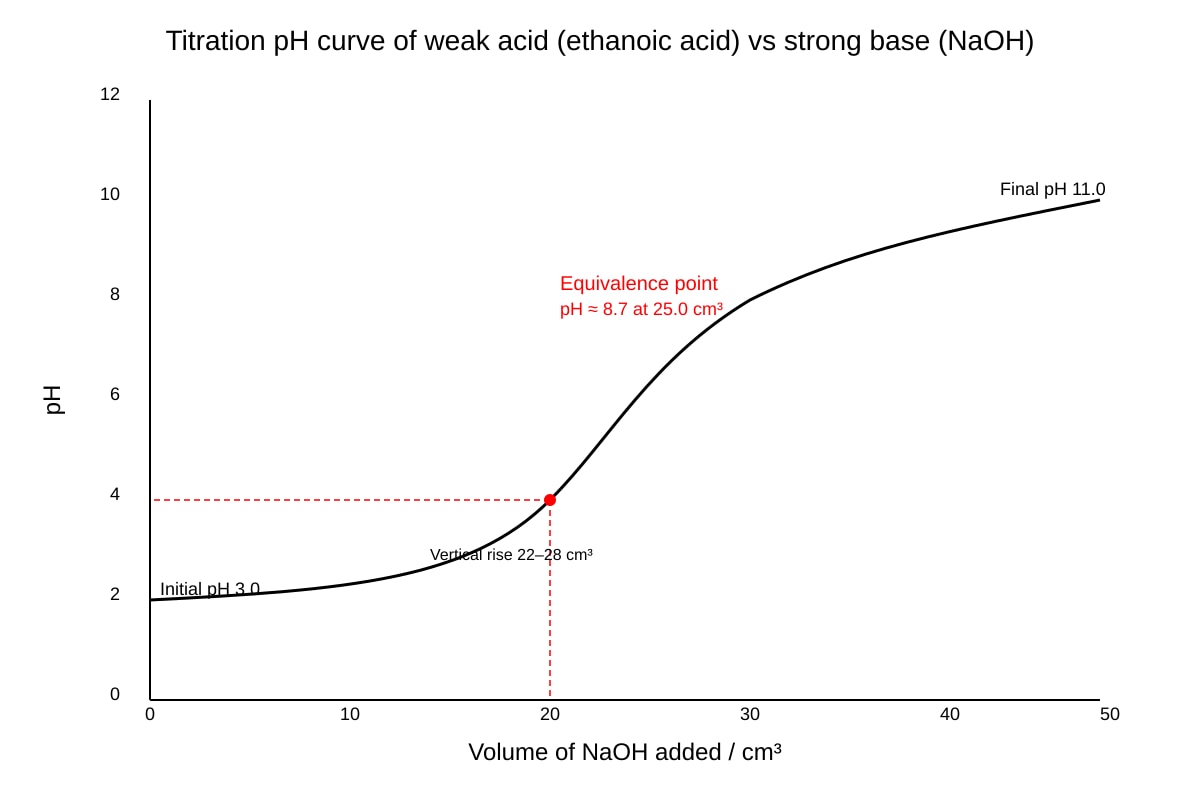
13. [3 marks] The diagram below shows the pH curve for the titration of ethanoic acid with sodium hydroxide.
Image pending generation: graph for Q13.
Explain why phenolphthalein is a suitable indicator for this titration.
14. [4 marks] Discuss the suitability of reacting sodium metal with dilute hydrochloric acid to prepare sodium chloride. State the expected observations and conclude on suitability.
15. [3 marks] A student adds excess zinc carbonate to dilute nitric acid to prepare zinc nitrate.
(a) Why is excess zinc carbonate used?
(b) What is the next step after filtration to obtain the solid salt?
(c) Write the balanced equation with state symbols.
Section C: Data Interpretation and Extended Reasoning (Questions 16–20) [12 marks]
16. [2 marks] The table shows pH values after adding 10 g of four oxides to separate 100 cm³ water samples.
| Oxide | pH of solution |
|---|---|
| Na2O | 12.5 |
| CO2 | 4.0 |
| SO3 | 1.5 |
| Al2O3 | 7.0 |
Classify each oxide as acidic, basic, or amphoteric.
17. [3 marks] A factory flue gas contains SO2. Explain how SO2 leads to acid rain and suggest one method to remove it before release.
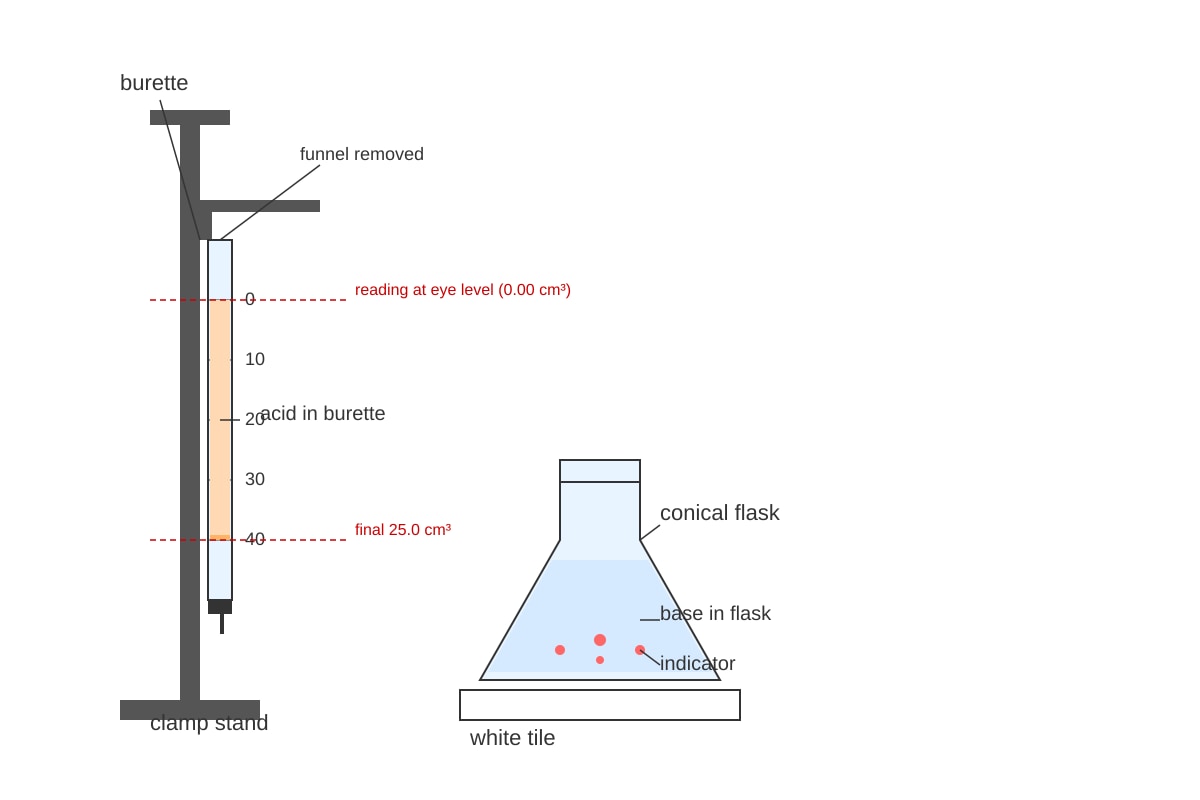
18. [2 marks] The diagram shows a burette and conical flask setup for a titration.
Image pending generation: experimental_setup for Q18.
State two precautions to ensure accurate titre volume.
19. [3 marks] A student prepares lead(II) chloride by mixing lead(II) nitrate solution with sodium chloride solution.
(a) Name the type of reaction.
(b) Write the ionic equation.
(c) How is the precipitate separated and purified?
20. [2 marks] Explain why a weak acid like ethanoic acid conducts electricity less well than a strong acid like hydrochloric acid of the same concentration.
End of Paper
Answers
TuitionGoWhere Practice Paper — Answer Key (Version 2 of 5)
Subject: Pure Chemistry
Level: Secondary 4
Topic: Acids, Bases & Salts
Total Marks: 40
Section A (12 marks)
1. [1] B
Answer: SO2.
Teaching note: Sulfur burns in air to form sulfur dioxide (S+O2→SO2). SO2 dissolves in rain to form sulfurous acid (H2SO3), contributing to acid rain. SO3 forms only with catalyst/extra oxygen; not direct product. Common mistake: choosing SO3.
2. [1] CO2(g)+2NaOH(aq)→Na2CO3(aq)+H2O(l)
Teaching note: Acidic oxide + alkali → salt + water. 2:1 ratio needed for carbonate. State symbols required.
3. [1] Methyl orange.
Teaching note: Methyl orange changes red (pH<3.1) to orange/yellow (pH>4.4).
4. [1] Blue.
Teaching note: Ammonia is alkaline (NH₃ + H₂O ⇌ NH₄⁺ + OH⁻), turns red litmus blue.
5. [1] KNO3 (potassium nitrate).
Teaching note: HNO3+KOH→KNO3+H2O. Salt from acid (nitrate) and base (potassium).
6. [1] Potassium.
Teaching note: K is above Na/Mg/Zn in reactivity series; reacts explosively with dilute acid — unsafe.
7. [1] Effervescence / bubbles of gas (hydrogen).
Teaching note: Mg+H2SO4→MgSO4+H2. Any one observation accepted.
8. [1] Titration.
Teaching note: Gradual addition from burette to find exact neutralisation point.
9. [1] Concentrated sulfuric acid (or anhydrous calcium chloride).
Teaching note: HCl is acidic gas; dried by conc. H2SO4 in drying tower.
10. [1] pH 2.
Teaching note: Strong acid fully dissociates: [H+]=0.01=10−2, pH = 2.
Section B (16 marks)
11. [3]
(a) [2] Add excess CuO to dilute H2SO4, warm, filter, crystallise. Suitable because CuO insoluble, excess removed by filtration; no titration needed.
(b) [1] CuO(s)+H2SO4(aq)→CuSO4(aq)+H2O(l)
Marking: method 1, reason 1, equation 1.
12. [3]
Add NaOH(aq) to each:
- Al3+: white ppt of Al(OH)3 dissolves in excess NaOH to colourless solution. [1]
- Pb2+: white ppt of Pb(OH)2 insoluble in excess. [1]
Equation: Al3+(aq)+3OH−(aq)→Al(OH)3(s) [1]
Teaching: amphoteric vs not.
13. [3]
Equivalence point at pH ~8.7 (>7) because weak acid + strong base. [1] Phenolphthalein changes 8.3–10 (colourless→pink). [1] This range covers the steep rise on curve. [1] Therefore suitable.
14. [4]
Na is highly reactive (group 1). [1] Reaction violent: 2Na+2HCl→2NaCl+H2. [1] Observations: vigorous effervescence, heat, possible flame. [1] Unsuitable: uncontrolled, hazardous. Use neutralisation instead. [1]
15. [3]
(a) [1] Ensure all acid reacted (ZnCO₃ insoluble, easy remove).
(b) [1] Evaporate filtrate + crystallise.
(c) [1] ZnCO3(s)+2HNO3(aq)→Zn(NO3)2(aq)+H2O(l)+CO2(g)
Section C (12 marks)
16. [2]
Na2O basic [0.5], CO2 acidic [0.5], SO3 acidic [0.5], Al2O3 amphoteric [0.5].
17. [3]
SO2 dissolves in water → H2SO3 (acid rain) [1]; oxidises to H2SO4 [1]; remove by scrubbing with alkali (e.g., Ca(OH)2) [1].
18. [2]
Read at eye level [1]; remove funnel before titrating [1]; (or rinse burette, no air bubble). 1 mark each.
19. [3]
(a) Precipitation [1]
(b) Pb2+(aq)+2Cl−(aq)→PbCl2(s) [1]
(c) Filter, wash with cold water, dry [1]
20. [2]
Weak acid partially ionised → fewer ions [1]; strong acid fully ionised → more ions → better conduction [1].
End of Answer Key
Free quiz and exam paper access
Enter your details to view this paper
Your access is remembered on this device.