AI Generated Exam Paper
Secondary 4 Pure Chemistry Practice Paper 1
Free Sec 4 Pure Chemistry Practice Paper 1, HY3 AI version, with questions, answers, and O Level-style practice for Singapore students.
These static practice materials are generated from the site's syllabus and paper-generation workflow, with source and model context shown so students and parents can evaluate the material before use.
Questions
TuitionGoWhere Practice Paper - Pure Chemistry Secondary 4
TuitionGoWhere Practice Paper (AI) — Version 1 of 5
Subject: Pure Chemistry
Level: Secondary 4
Paper: Practice Paper (Topic: Acids, Bases & Salts)
Duration: 60 minutes
Total Marks: 40
Name: ________________________
Class: ________
Date: ____________
Instructions:
- This practice paper contains 20 questions on Acids, Bases & Salts.
- Answer all questions in the spaces provided.
- Show all working where calculation or reasoning is required.
- Use appropriate chemical symbols, formulae, and state symbols.
- Section A: Questions 1–8 (1 mark each, total 8 marks)
- Section B: Questions 9–15 (2 marks each, total 14 marks)
- Section C: Questions 16–20 (3 or 4 marks each, total 18 marks)
Section A (8 marks)
1. Name the gas produced when sulfur burns in air that contributes to acid rain. [1]
2. Write the formula of the ion present in all aqueous acids. [1]
3. State the colour of litmus paper in a solution of sodium hydroxide. [1]
4. Give the name of a suitable indicator that is red in acid and yellow in alkali. [1]
5. Write the chemical formula of sodium chloride. [1]
6. Name the salt formed when nitric acid reacts with potassium hydroxide. [1]
7. State one observation when magnesium reacts with dilute hydrochloric acid. [1]
8. What is the pH of a neutral solution at 25 °C? [1]
Section B (14 marks)
9. A student adds dilute sodium hydroxide to a solution containing Al³⁺ ions, then adds excess sodium hydroxide. Describe what is observed and write the equation for the change in excess NaOH. [2]
10. Carbon dioxide gas reacts with sodium hydroxide solution to form a salt and water. Write the balanced equation with state symbols. [2]
11. Explain why phenolphthalein is a suitable indicator for the titration of ethanoic acid with sodium hydroxide. [2]
12. A student wants to prepare copper(II) sulfate from copper(II) oxide and dilute sulfuric acid. State the method and give the equation. [2]
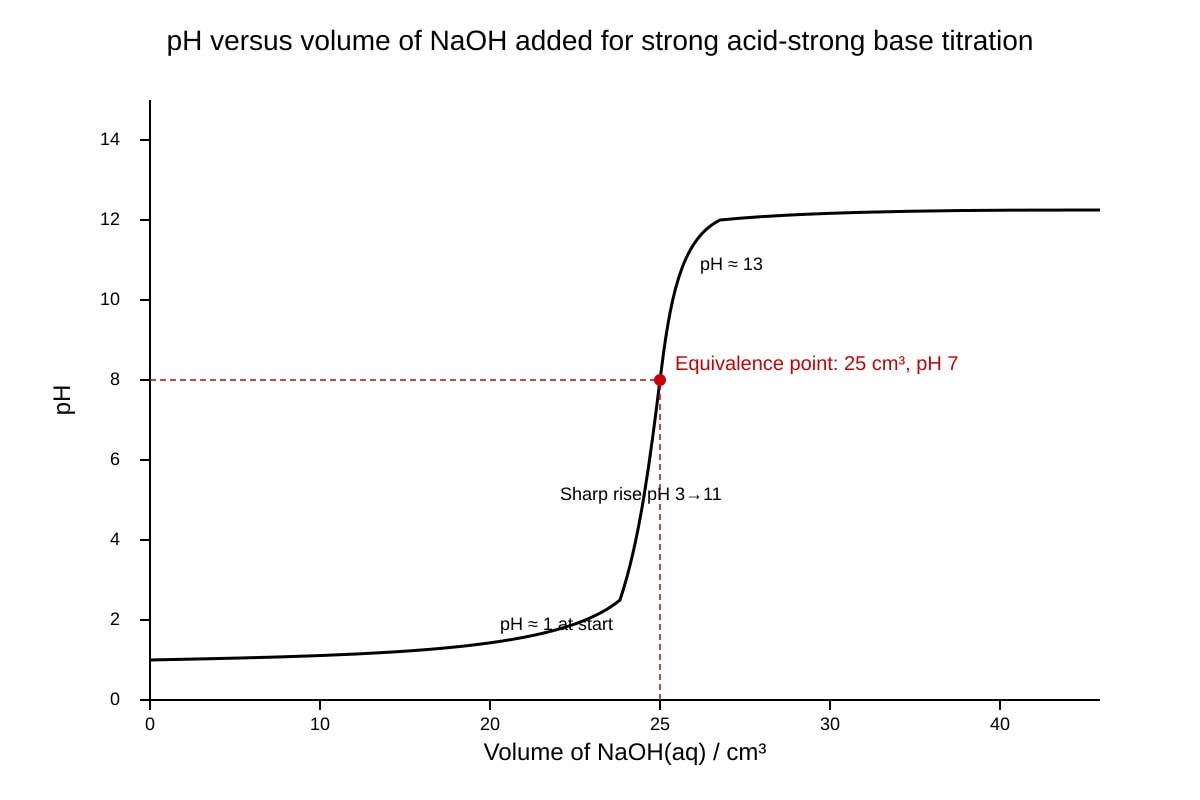
13. The diagram shows a pH curve for titration of HCl with NaOH.
Image pending generation: graph for Q13.
State the volume of NaOH at the equivalence point and the pH there. [2]
14. Give two differences between a strong acid and a weak acid. [2]
15. Write the ionic equation for the reaction of hydrochloric acid with sodium hydroxide. [2]
Section C (18 marks)
16. A student wants to prepare zinc sulfate from zinc carbonate and sulfuric acid.
(a) Suggest a suitable method. [1]
(b) Explain why this method is appropriate. [1]
(c) Write the balanced equation. [1]
17. Potassium is not suitable for preparing potassium chloride by reacting the metal with hydrochloric acid. Discuss the suitability and state the expected observation. [3]
18. A titration uses 25.0 cm³ of 0.100 mol/dm³ HCl neutralised by NaOH of unknown concentration. 20.0 cm³ of NaOH is required. Calculate the concentration of NaOH. [3]
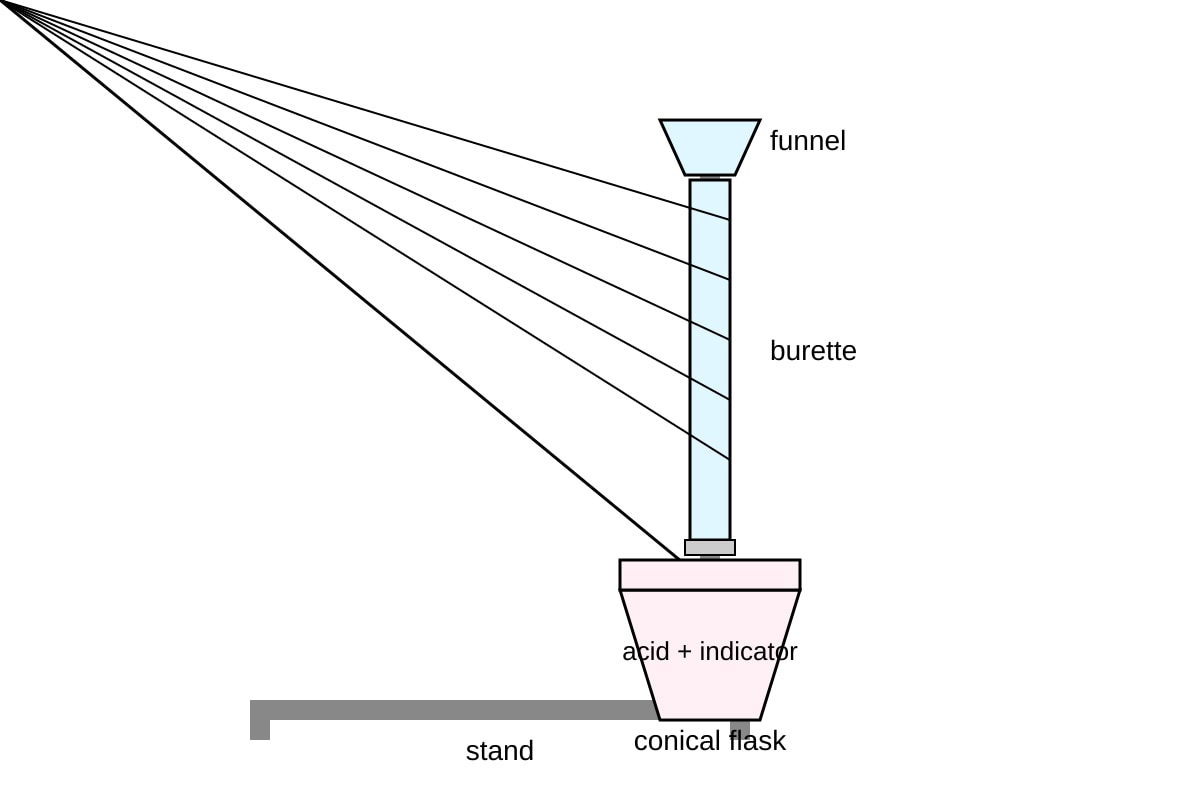
19. The diagram shows a setup for preparing a soluble salt by titration.
Image pending generation: experimental_setup for Q19.
Describe how you would use this setup to prepare sodium chloride from HCl and NaOH, including final step. [3]
20. A farmer finds soil with pH 4.5. He adds calcium hydroxide to neutralise it.
(a) State the type of reaction. [1]
(b) Explain why calcium hydroxide is suitable. [2]
(c) Write the equation. [1]
Answers
TuitionGoWhere Practice Paper - Pure Chemistry Secondary 4 (Answers)
Version 1 of 5 — Answer Key
Total Marks: 40
Section A
1. Sulfur dioxide (SO₂) [1]
Teaching note: Sulfur burns in air: S + O₂ → SO₂. SO₂ dissolves in rain to form sulfurous acid, causing acid rain. Common mistake: writing SO₃ (formed only on catalytic oxidation).
2. H⁺(aq) [1]
All aqueous acids contain hydrogen ions. In water, acids release H⁺(aq).
3. Blue [1]
Litmus is blue in alkalis (NaOH is alkaline).
4. Methyl orange [1]
Methyl orange is red below pH 3.1 and yellow above pH 4.4.
5. NaCl [1]
Sodium chloride formula from Na⁺ and Cl⁻.
6. Potassium nitrate (KNO₃) [1]
Acid + alkali → salt + water; HNO₃ + KOH → KNO₃ + H₂O.
7. Effervescence / bubbles of gas (H₂) [1]
Mg + 2HCl → MgCl₂ + H₂; gas seen as bubbles.
8. 7 [1]
Neutral pH at 25 °C is 7.
Section B
9. White precipitate of Al(OH)₃ forms, then dissolves in excess NaOH to colourless solution. [1]
Equation: Al(OH)₃(s) + OH⁻(aq) → [Al(OH)₄]⁻(aq) [1]
Teaching: Al³⁺ + 3OH⁻ → Al(OH)₃; amphoteric hydroxide dissolves in excess alkali.
10. CO₂(g) + 2NaOH(aq) → Na₂CO₃(aq) + H₂O(l) [2]
Marks: 1 for correct products, 1 for balancing/state symbols.
11. Equivalence point is above pH 7 (~8.5) because weak acid + strong base. [1] Phenolphthalein changes at pH 8.3–10, matching the sharp rise. [1]
12. Add excess CuO to acid, filter, crystallise. [1]
CuO(s) + H₂SO₄(aq) → CuSO₄(aq) + H₂O(l) [1]
13. Volume = 25 cm³, pH = 7 [2] (1 each) From graph, equivalence at midpoint of steep rise.
14. Strong acid fully ionises in water; weak acid partially ionises. [1] Strong has lower pH for same concentration. [1]
15. H⁺(aq) + OH⁻(aq) → H₂O(l) [2]
Section C
16. (a) Add excess ZnCO₃ to H₂SO₄, filter, crystallise. [1]
(b) ZnCO₃ insoluble, excess removed by filtration. [1]
(c) ZnCO₃ + H₂SO₄ → ZnSO₄ + H₂O + CO₂ [1]
17. Unsuitable: K is very reactive, violent/explosive reaction with HCl. [1] Observation: vigorous effervescence, heat, possible explosion. [1] Safety/control not achievable. [1]
18. n(HCl) = 0.100 × 25.0/1000 = 2.50×10⁻³ mol [1]
n(NaOH) = same = 2.50×10⁻³ [1]
c = n/V = 2.50×10⁻³ / 0.0200 = 0.125 mol/dm³ [1]
19. Rinse burette with NaOH, fill, note level. [1] Pipette 25 cm³ HCl + indicator into flask. [1] Titrate to endpoint, repeat, crystallise salt. [1]
20. (a) Neutralisation [1]
(b) Ca(OH)₂ is alkali, cheap, insoluble so not over-neutralise quickly. [2]
(c) Ca(OH)₂ + 2H⁺ → Ca²⁺ + 2H₂O [1]
Free quiz and exam paper access
Enter your details to view this paper
Your access is remembered on this device.