AI Generated Exam Paper
Secondary 4 Pure Chemistry Practice Paper 1
Free Sec 4 Pure Chemistry Practice Paper 1, DeepSeek AI version, with questions, answers, and O Level-style practice for Singapore students.
These static practice materials are generated from the site's syllabus and paper-generation workflow, with source and model context shown so students and parents can evaluate the material before use.
Questions
Free quiz and exam paper access
Enter your details to view this paper
Your access is remembered on this device.
Answers
TuitionGoWhere Practice Paper – Answer Key and Marking Scheme
Subject: Pure Chemistry (6092) Level: Secondary 4 Paper: Practice Paper – Acids, Bases & Salts Version: 1 of 5 Total Marks: 50
Section A: Multiple Choice and Short Structured Questions
[20 marks]
1. C. OH⁻ [1 mark] Explanation: Alkalis are soluble bases that produce hydroxide (OH⁻) ions in aqueous solution. While some alkalis contain Na⁺ (e.g., NaOH), not all do (e.g., KOH, aqueous ammonia). The defining ion is OH⁻.
2. D. 13 [1 mark] Explanation: Universal indicator turns violet in strongly alkaline solutions. A pH of 13 corresponds to a strong alkali. pH 1 is strongly acidic (red), pH 4 is weakly acidic (orange/yellow), and pH 7 is neutral (green).
3. B. Ethanoic acid ionises partially in water, while hydrochloric acid ionises completely. [1 mark] Explanation: The strength of an acid refers to the extent of ionisation in water, not the number of hydrogen atoms per molecule or the rate of reaction. Strong acids ionise completely; weak acids ionise partially.
4. C. Precipitation by mixing lead(II) nitrate solution and sodium sulfate solution [1 mark] Explanation: Lead(II) sulfate is an insoluble salt (refer to solubility rules: all sulfates are soluble except lead(II) sulfate, barium sulfate, and calcium sulfate). Insoluble salts are best prepared by precipitation—mixing two soluble salt solutions, filtering, washing, and drying the precipitate. Titration is for soluble SPA salts. Reacting excess solid with acid is for soluble non-SPA salts. Lead metal reacts very slowly with dilute sulfuric acid due to the formation of an insoluble lead(II) sulfate coating.
5. C. Carbon dioxide [1 mark] Explanation: Carbonates react with acids to produce carbon dioxide gas, a salt, and water. Copper(II) carbonate + nitric acid → copper(II) nitrate + water + carbon dioxide. Hydrogen is produced when acids react with reactive metals. Nitrogen dioxide is produced when nitric acid decomposes or reacts in specific redox reactions.
6. D. Zn²⁺ and Cl⁻ [1 mark] Explanation:
- White precipitate with NaOH, soluble in excess → Zn²⁺ (zinc hydroxide is amphoteric and dissolves in excess NaOH to form zincate ions). Al³⁺ and Pb²⁺ also give white precipitates soluble in excess NaOH, but the ammonia test distinguishes them.
- White precipitate with aqueous ammonia, insoluble in excess → Zn²⁺ (zinc hydroxide does not dissolve in excess ammonia, unlike copper(II) hydroxide which dissolves to form a deep blue solution). Al³⁺ gives a white precipitate insoluble in excess ammonia, but the anion test confirms Cl⁻.
- White precipitate with acidified silver nitrate → Cl⁻ (silver chloride is a white precipitate).
7. B. Calcium oxide [1 mark] Explanation: To raise the pH of acidic soil, a base is needed to neutralise the excess acid. Calcium oxide (quicklime) is a basic oxide that reacts with acids in the soil. Ammonium nitrate is an acidic salt. Citric acid is an acid. Sodium chloride is a neutral salt.
8. B. 2NaOH(aq) + H₂SO₄(aq) → Na₂SO₄(aq) + 2H₂O(l) [1 mark] Explanation: Sulfuric acid is diprotic (contains two ionisable H⁺ ions per molecule). Therefore, 2 moles of NaOH are required to neutralise 1 mole of H₂SO₄, producing sodium sulfate and water. This is a neutralisation reaction, not a redox reaction, so hydrogen gas is not produced.
9. Concentration of NaOH = 0.125 mol/dm³ [2 marks] Working:
- Moles of HCl = concentration × volume = 0.100 × (25.0 / 1000) = 0.00250 mol [1]
- Equation: HCl + NaOH → NaCl + H₂O. Mole ratio HCl : NaOH = 1 : 1.
- Moles of NaOH = 0.00250 mol.
- Concentration of NaOH = moles / volume = 0.00250 / (20.0 / 1000) = 0.125 mol/dm³ [1]
Marking notes:
- Award [1] for correct calculation of moles of HCl.
- Award [1] for correct final answer with appropriate significant figures (3 s.f.).
- Accept working in dm³ or cm³ with correct conversion.
- Deduct [1] if answer is not expressed to 3 s.f. or if units are missing.
10. Hydrogen chloride exists as covalent molecules in methylbenzene (an organic solvent). There are no mobile ions to carry charge, so the solution does not conduct electricity. In water, hydrogen chloride ionises completely to form H⁺(aq) and Cl⁻(aq) ions. These mobile ions can carry charge, so the solution conducts electricity. [2 marks] Marking notes:
- Award [1] for stating that HCl does not ionise in methylbenzene / exists as molecules / no mobile ions.
- Award [1] for stating that HCl ionises in water to produce mobile H⁺ and Cl⁻ ions.
- Accept "dissociates" for "ionises".
Section B: Structured Questions
[18 marks]
11. (a) Hydrogen [1 mark]
(b) Mg(s) + 2HCl(aq) → MgCl₂(aq) + H₂(g) [2 marks] Marking notes:
- Award [1] for correct formulae of reactants and products.
- Award [1] for correct state symbols and balancing.
- Accept Mg(s) + 2H⁺(aq) → Mg²⁺(aq) + H₂(g) as the ionic equation if the question does not specify "full equation".
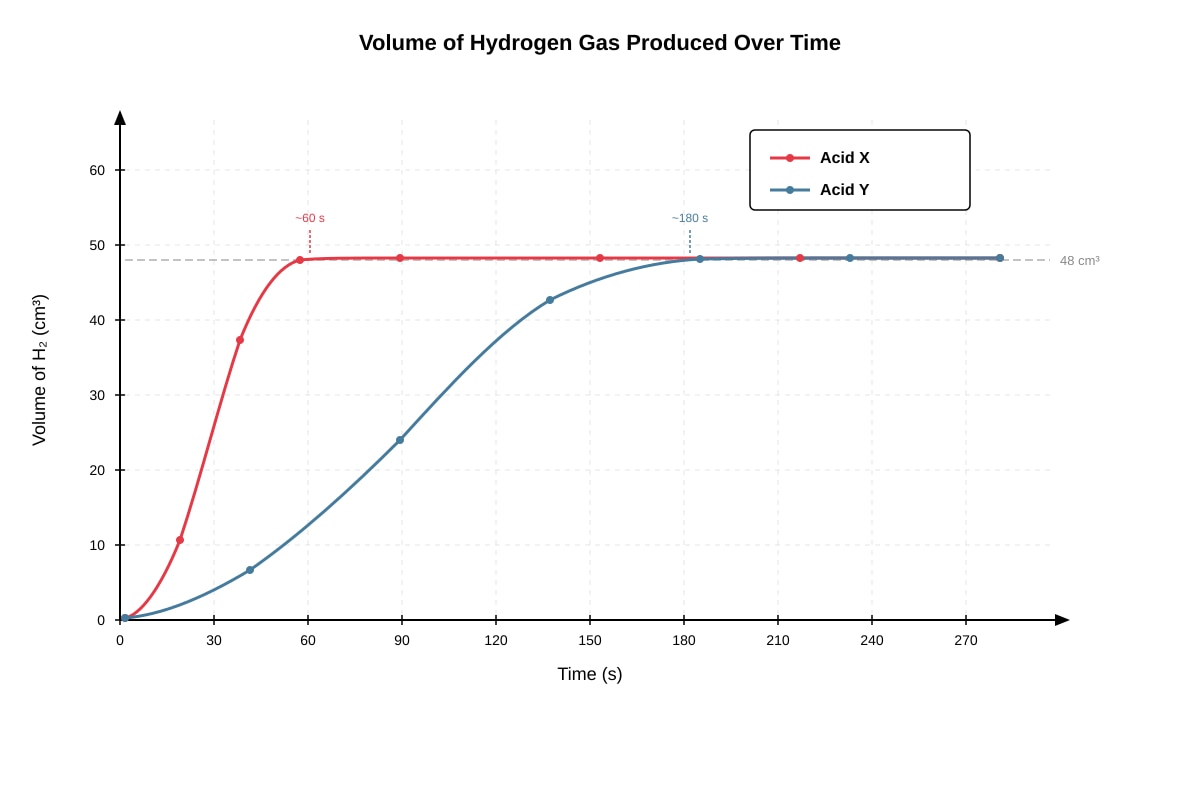
(c) Acid X is a strong acid (e.g., hydrochloric acid) and acid Y is a weak acid (e.g., ethanoic acid). A strong acid ionises completely in water, producing a higher concentration of H⁺ ions. This results in a faster rate of reaction and a steeper initial gradient. A weak acid ionises partially, producing a lower concentration of H⁺ ions, so the reaction is slower. [2 marks] Marking notes:
- Award [1] for identifying that acid X is a strong acid and acid Y is a weak acid (or that X has a higher [H⁺]).
- Award [1] for explaining that higher [H⁺] leads to faster reaction rate / more frequent effective collisions.
(d) Sketch: Curve Z should start at the origin, rise more steeply than curve X initially, and level off at the same final volume (48 cm³), reaching the plateau earlier than curve X (e.g., at around 20–30 seconds). [2 marks] Marking notes:
- Award [1] for a steeper initial gradient than curve X.
- Award [1] for levelling off at the same final volume (48 cm³) and reaching the plateau earlier.
(e) The same mass of magnesium was used in both experiments. Since magnesium is the limiting reactant in both cases, the same number of moles of magnesium reacts, producing the same number of moles of hydrogen gas. Therefore, the total volume of hydrogen gas collected is the same. [1 mark] Marking notes:
- Award [1] for stating that the same mass/moles of magnesium produces the same moles/volume of hydrogen.
- Accept: The amount of magnesium determines the amount of hydrogen produced; the acid is in excess in both cases.
12. (a) Neutralisation (reaction) [1 mark] Accept: Acid-base reaction.
(b) 2NH₃(aq) + H₂SO₄(aq) → (NH₄)₂SO₄(aq) [2 marks] Marking notes:
- Award [1] for correct formulae of reactants and product.
- Award [1] for correct state symbols and balancing.
- Note: Ammonia solution is NH₃(aq), not NH₄OH(aq), though NH₄OH is sometimes accepted.
(c) Step 1: Carry out a titration using aqueous ammonia and dilute sulfuric acid with a suitable indicator (e.g., methyl orange or screened methyl orange) to determine the exact volumes required for complete neutralisation. [1] Step 2: Repeat the titration without the indicator, using the exact volumes determined. [0.5] Step 3: Heat the solution to evaporate some of the water until a saturated solution is obtained (crystals begin to form on cooling or a glass rod dipped in the solution shows signs of crystallisation). [0.5] Step 4: Allow the saturated solution to cool slowly. Crystals of ammonium sulfate will form. [0.5] Step 5: Filter the crystals, wash with a little cold distilled water, and dry between filter papers. [0.5] [3 marks] Marking notes:
- Award marks for clear, logical steps.
- Accept alternative wording that conveys the same procedure.
- The key steps are: titration to find volumes → mix without indicator → heat to saturate → cool to crystallise → filter, wash, dry.
(d) A salt is an ionic compound formed when the hydrogen ion(s) of an acid is/are replaced by a metal ion or an ammonium ion. [1 mark] Accept: A salt is the product of a neutralisation reaction between an acid and a base (other than water).
(e) Observation: A pungent gas is produced that turns moist red litmus paper blue. [1] Gas: Ammonia (NH₃). [1] [2 marks] Marking notes:
- Award [1] for the observation (effervescence / gas produced + effect on litmus).
- Award [1] for naming ammonia.
- Equation (not required but useful): (NH₄)₂SO₄ + 2NaOH → Na₂SO₄ + 2NH₃ + 2H₂O.
13. (a) Barium nitrate (or barium chloride) solution and sodium sulfate (or any soluble sulfate, e.g., potassium sulfate, magnesium sulfate) solution. [1 mark] Accept: Any two soluble salts, one containing Ba²⁺ and the other containing SO₄²⁻.
(b) Ba²⁺(aq) + SO₄²⁻(aq) → BaSO₄(s) [1 mark] Marking notes:
- Award [1] for correct ionic equation with state symbols.
- Deduct [0.5] if state symbols are missing or incorrect.
(c) Step 1: Filter the mixture to obtain the white precipitate of barium sulfate as the residue. [1] Step 2: Wash the residue with distilled water to remove any soluble impurities (e.g., sodium nitrate). [0.5] Step 3: Dry the residue between sheets of filter paper or in a warm oven. [0.5] [2 marks] Marking notes:
- Award [1] for filtration step.
- Award [1] for washing and drying steps (0.5 each).
Section C: Data-Based and Free-Response Questions
[12 marks]
14. (a) Solution P contains the highest concentration of hydrogen ions. [1 mark] Explanation: pH is a measure of the hydrogen ion concentration. The lower the pH, the higher the concentration of H⁺ ions. Solution P has the lowest pH (1.0), so it has the highest [H⁺]. [1 mark] Marking notes:
- Award [1] for identifying P.
- Award [1] for linking low pH to high [H⁺].
(b) Hydrochloric acid (P) is a strong acid; it ionises completely in water, producing a high concentration of H⁺ ions. Ethanoic acid (Q) is a weak acid; it ionises only partially in water, producing a lower concentration of H⁺ ions. Since pH = –log[H⁺], the strong acid has a lower pH. [2 marks] Marking notes:
- Award [1] for stating HCl is a strong acid (complete ionisation) and ethanoic acid is a weak acid (partial ionisation).
- Award [1] for linking degree of ionisation to [H⁺] and pH.
- Do not award marks for answers that confuse strength with concentration.
(c) Volume of P required = 25.0 cm³ [2 marks] Working:
- Moles of NaOH in 25.0 cm³ of 0.1 mol/dm³ solution = 0.1 × (25.0 / 1000) = 0.00250 mol. [0.5]
- Equation: HCl + NaOH → NaCl + H₂O. Mole ratio = 1:1. [0.5]
- Moles of HCl required = 0.00250 mol. [0.5]
- Volume of HCl (P) = moles / concentration = 0.00250 / 0.1 = 0.0250 dm³ = 25.0 cm³. [0.5] Marking notes:
- Award marks for correct step-by-step working.
- Accept alternative methods that arrive at the correct answer.
- Deduct [0.5] if units are missing or incorrect.
(d) Methyl orange is red in acidic solution. Solution Q has a pH of 2.9, which is acidic. Therefore, the colour observed is red. [1 mark] Accept: Red / pink-red.
15. (a) Suitable substance: Calcium oxide (quicklime) / calcium carbonate (limestone) / calcium hydroxide (slaked lime). [1 mark] Explanation: Calcium oxide is a base that reacts with sulfuric acid to form calcium sulfate (which is sparingly soluble) and water, neutralising the acid. It is relatively cheap and readily available in large quantities. [1 mark] Marking notes:
- Award [1] for naming a suitable basic substance.
- Award [1] for a valid explanation (neutralises acid, cheap, readily available, produces harmless products).
- Accept other suitable substances with valid justification (e.g., calcium carbonate, calcium hydroxide).
(b) Using calcium oxide: CaO(s) + H₂SO₄(aq) → CaSO₄(s) + H₂O(l) [2 marks] Marking notes:
- Award [1] for correct formulae.
- Award [1] for correct state symbols and balancing.
- Accept equations for other suitable substances named in (a).
(c) Calcium oxide (or calcium carbonate) is cheaper than sodium hydroxide. / Calcium oxide is less corrosive and safer to handle in large quantities than concentrated sodium hydroxide. / The product (calcium sulfate) is sparingly soluble and can be easily removed, whereas sodium sulfate is soluble and would remain dissolved in the water. [1 mark] Marking notes:
- Award [1] for any one valid reason.
- Accept: cost, safety, ease of handling, nature of products.
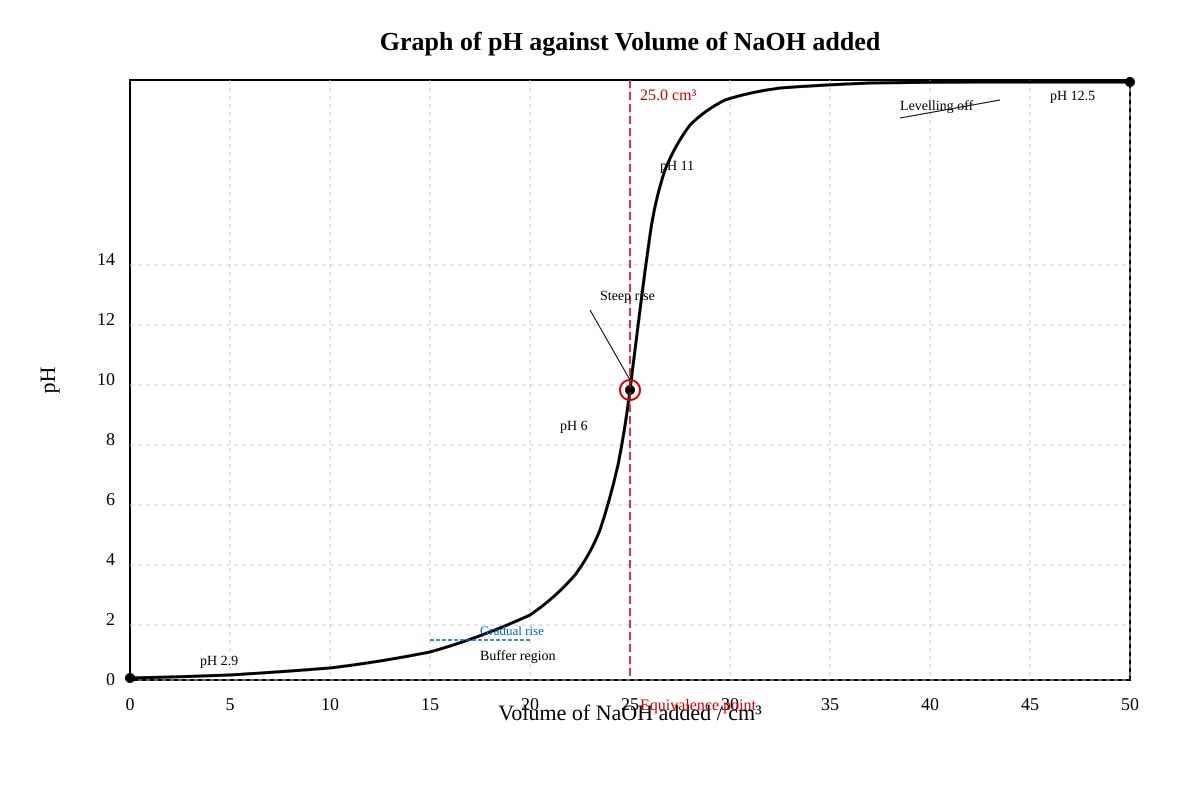
16. (a) 25.0 cm³ [1 mark] Explanation: The equivalence point is at the midpoint of the vertical portion of the pH curve, which occurs at 25.0 cm³ of NaOH added.
(b) The initial pH of the acid is approximately 2.9, which is higher than the pH of a strong acid of the same concentration (which would be pH = 1.0 for 0.1 mol/dm³ strong acid). / The pH rises gradually at first rather than sharply, indicating the presence of a buffer region characteristic of a weak acid–strong base titration. [1 mark] Marking notes:
- Award [1] for any one valid piece of evidence.
- Accept: The pH at the start is not 1.0 / The vertical jump is less steep and shorter than for a strong acid–strong base titration.
(c) Suitable indicator: Phenolphthalein. [1 mark] Explanation: The vertical portion of the pH curve spans from approximately pH 6 to pH 11. Phenolphthalein changes colour over the pH range 8.3–10.0, which falls entirely within the vertical portion of the curve. Therefore, the indicator will change colour sharply at the endpoint. [1 mark] Marking notes:
- Award [1] for naming phenolphthalein.
- Award [1] for explaining that its pH range falls within the vertical portion of the curve.
- Do not accept methyl orange (pH range 3.1–4.4), as this does not fall within the vertical portion (pH 6–11) for a weak acid–strong base titration.
End of Answer Key
Total Marks: 50