From Real Exams Exam Paper
Secondary 4 Pure Chemistry Preliminary Examination Paper 5
Free Sec 4 Pure Chemistry Prelim Paper 5, HY3 Exam version, with questions, answers, and O Level-style practice for Singapore students.
These static practice materials are generated from the site's syllabus and paper-generation workflow, with source and model context shown so students and parents can evaluate the material before use.
Questions
TuitionGoWhere Practice Paper - Pure Chemistry Secondary 4 (PRELIM)
TuitionGoWhere Exam Practice (AI)
Subject: Pure Chemistry
Level: Secondary 4
Paper: Prelim Practice (Version 5 of 5)
Duration: 60 minutes
Total Marks: 60
Name: ___________________________
Class: ____________
Date: ____________
Instructions
- Answer all questions in the spaces provided.
- Use blue or black pen.
- Show all working where calculation is required.
- State symbols should be included in chemical equations where requested.
- The quiz contains 20 questions across three sections.
Section A: Multiple Choice and Short Answer (Questions 1–8) [16 marks]
Answer all questions. For MCQ, write the letter. For short answer, write the response.
1. [1 mark] When sulphur burns in air, it combines with oxygen to form a gas that contributes to acid rain. Name this gas.
2. [1 mark] Write the balanced equation, with state symbols, for carbon dioxide gas reacting with sodium hydroxide solution to form sodium carbonate and water.
3. [1 mark] Which of the following is a weak acid?
A. HCl
B. HNO₃
C. CH₃COOH
D. H₂SO₄
4. [1 mark] Give the colour of litmus paper in a solution of pH 9.
5. [2 marks] Describe a simple test using aqueous sodium hydroxide to differentiate between Al³⁺(aq) and Pb²⁺(aq) ions. State one observation for each.
6. [2 marks] Magnesium ribbon reacts with dilute hydrochloric acid. State two observations you would see.
7. [2 marks] A student adds universal indicator to a sample of pure water. State the expected colour and explain why pure water is neutral.
8. [2 marks] Write the ionic equation for the neutralisation of hydrochloric acid by sodium hydroxide solution.
Section B: Structured Response and Data Interpretation (Questions 9–15) [24 marks]
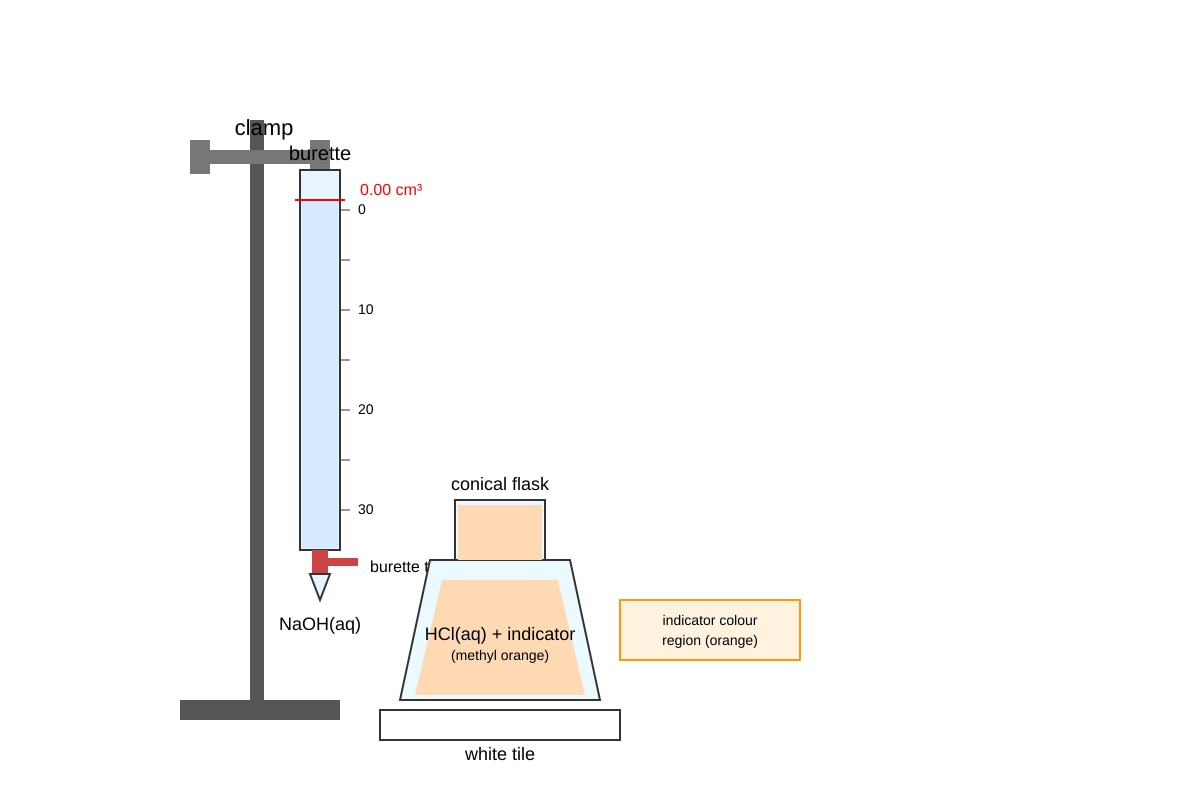
9. [3 marks] The diagram below shows a titration setup used to find the concentration of an unknown hydrochloric acid solution using standard sodium hydroxide.
Image pending generation: experimental_setup for Q9.
State the name of the indicator used and describe the colour change at the endpoint when NaOH is added to HCl. Explain why the white tile is used.
10. [3 marks] Potassium is a very reactive metal. Discuss the suitability of reacting potassium with dilute hydrochloric acid to prepare potassium chloride. State the expected observation.
11. [3 marks] The following table shows pH values of solutions from soil samples.
| Sample | pH |
|---|---|
| A | 4.5 |
| B | 7.0 |
| C | 8.5 |
Classify each sample as acidic, neutral, or alkaline. Suggest one substance that could be added to Sample A to raise its pH towards neutral.
12. [4 marks] A factory emits nitrogen dioxide (NO₂) gas. This gas dissolves in rainwater to form acid rain.
(a) Write the equation for the formation of nitric acid from NO₂ and water. [2]
(b) State one environmental effect of acid rain. [1]
(c) Name one method to reduce NO₂ emission. [1]
13. [4 marks] A student prepares a salt by adding excess copper(II) oxide powder to sulphuric acid, heating, filtering, and crystallising.
(a) Write the balanced equation with state symbols. [2]
(b) Explain why excess copper(II) oxide is used. [1]
(c) Why is filtration carried out before crystallisation? [1]
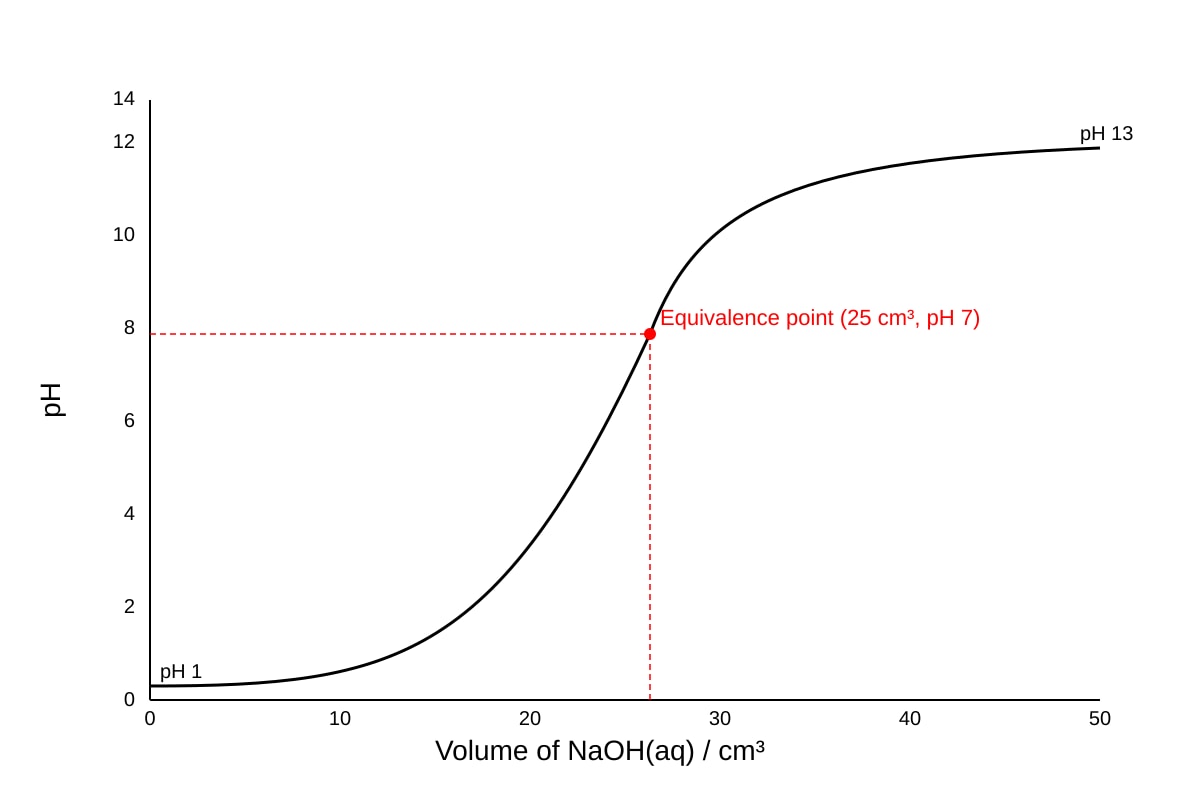
14. [4 marks] The graph shows the pH change when sodium hydroxide is added to hydrochloric acid.
Image pending generation: graph for Q14.
(a) State the volume of NaOH at neutralisation. [1]
(b) Calculate the concentration of HCl if 25.0 cm³ of 0.100 mol/dm³ NaOH was used. [3]
15. [3 marks] State and explain the observation when carbon dioxide is bubbled through limewater (calcium hydroxide solution). Write the equation.
Section C: Extended Application (Questions 16–20) [20 marks]
16. [4 marks] Compare the conduction of electricity in solid sodium chloride and molten sodium chloride. Explain using the particulate model.
17. [4 marks] A farmer has acidic soil (pH 5). He uses calcium hydroxide to neutralise it.
(a) Write the equation for the reaction. [2]
(b) Explain why calcium hydroxide is preferred over sodium hydroxide for large-scale soil treatment. [2]
18. [4 marks] A student mixes equal volumes of 0.10 mol/dm³ HCl and 0.10 mol/dm³ NaOH.
(a) State the resulting pH. [1]
(b) Calculate the amount, in mol, of HCl in 50.0 cm³ of the acid. [3]
19. [4 marks] Ammonia gas is used to make fertilisers. It dissolves in water to form an alkaline solution.
(a) Name the ion responsible for alkalinity. [1]
(b) Write the equation for ammonia in water. [2]
(c) State how you would test the gas for ammonia. [1]
20. [4 marks] A sample of vinegar is tested with a pH meter and gives pH 3. A sample of bleach gives pH 12.
(a) Which has higher hydrogen ion concentration? Show by calculation the ratio. [3]
(b) State a safety precaution when handling bleach. [1]
End of Paper
Answers
Answer Key – TuitionGoWhere Practice Paper Pure Chemistry Sec 4 (PRELIM V5)
Total Marks: 60
Section A
1. [1] Sulphur dioxide / SO₂.
Teaching note: Non-metal S + O₂ → SO₂; SO₂ dissolves to form H₂SO₃ (acid rain). Common trap: writing SO₃ (formed only on further oxidation in air, not direct burn).
2. [1] CO₂(g) + 2NaOH(aq) → Na₂CO₃(aq) + H₂O(l)
Teaching note: Acidic oxide + alkali → salt + water. Stoichiometry 1:2. State symbols required.
3. [1] C (CH₃COOH).
Teaching note: Weak acids partially dissociate; others are strong mineral acids.
4. [1] Blue.
Teaching note: pH > 7 is alkaline; litmus turns blue in alkali.
5. [2] Add NaOH(aq) dropwise: Al³⁺ gives white ppt soluble in excess NaOH; Pb²⁺ gives white ppt insoluble in excess.
Marking: 1 mark observation for Al³⁺, 1 mark for Pb²⁺.
Teaching note: Al(OH)₃ amphoteric; Pb(OH)₂ not amphoteric.
6. [2] Effervescence (H₂ gas); ribbon disappears / solution warms.
Marking: 1 mark each.
Teaching note: Mg + 2HCl → MgCl₂ + H₂; exothermic.
7. [2] Green; pure water has [H⁺] = [OH⁻] so pH 7 neutral.
Marking: 1 colour, 1 explanation.
8. [2] H⁺(aq) + OH⁻(aq) → H₂O(l)
Teaching note: Net ionic equation for strong acid–strong base.
Section B
9. [3] Indicator: methyl orange (1). Colour: red to orange/yellow at endpoint (1). White tile used to see colour change clearly (1).
Image: burette with NaOH, flask with HCl + MO, tile under. Endpoint ~ pH 4.4.
10. [3] Unsuitable (1): too violent/exothermic/explosive (1). Observation: vigorous flame, explosion-like reaction, lilac flame, H₂ gas (1).
Teaching note: K very high in reactivity series; unsafe for lab prep.
11. [3] A acidic (1), B neutral (1), C alkaline (1). Add lime/calcium hydroxide (1) – but only 3 marks allocated; actually 1+1+1=3, substance suggestion included in C? Recount: A class 1, B 1, C 1 = 3 marks. Substance suggestion is extra; per mark scheme: classify all three (3 marks). Suggested substance: Ca(OH)₂.
Correction: Q11 marks = 3 for classification; substance suggestion is guidance. We allocate: A 1, B 1, C 1.
12. [4] (a) 2NO₂(g) + H₂O(l) → HNO₃(aq) + HNO₂(aq) OR 4NO₂ + 2H₂O + O₂ → 4HNO₃ (2). (b) damages trees/lakes (1). (c) catalytic converter (1).
13. [4] (a) CuO(s) + H₂SO₄(aq) → CuSO₄(aq) + H₂O(l) (2). (b) ensure all acid reacted (1). (c) remove excess CuO solid (1).
14. [4] (a) 25 cm³ (1). (b) n(NaOH)=0.100×25/1000=0.00250 mol; 1:1 so n(HCl)=0.00250; c=0.00250/(25/1000)=0.100 mol/dm³ (3).
Image: equivalence at 25 cm³, pH 7.
15. [3] White ppt of CaCO₃ forms (1); ppt dissolves if excess CO₂ (not needed) (1); CO₂ + Ca(OH)₂ → CaCO₃ + H₂O (1).
Section C
16. [4] Solid NaCl: no conduction (1) ions fixed (1). Molten: conducts (1) ions free to move (1).
17. [4] (a) Ca(OH)₂ + 2HCl → CaCl₂ + 2H₂O (2). (b) cheaper, less soluble/handle safer, adds Ca nutrients (2).
18. [4] (a) pH 7 (1). (b) n=0.10×50/1000=0.0050 mol (3).
19. [4] (a) OH⁻ (1). (b) NH₃ + H₂O ⇌ NH₄⁺ + OH⁻ (2). (c) turns damp red litmus blue (1).
20. [4] (a) Vinegar pH 3, [H⁺]=10⁻³; bleach pH 12, [H⁺]=10⁻¹²; ratio 10⁹ (3). (b) wear gloves/eye protection (1).
End of Answer Key
Free quiz and exam paper access
Enter your details to view this paper
Your access is remembered on this device.