From Real Exams Exam Paper
Secondary 4 Pure Chemistry Preliminary Examination Paper 4
Free Sec 4 Pure Chemistry Prelim Paper 4, HY3 Exam version, with questions, answers, and O Level-style practice for Singapore students.
These static practice materials are generated from the site's syllabus and paper-generation workflow, with source and model context shown so students and parents can evaluate the material before use.
Questions
TuitionGoWhere Practice Paper - Pure Chemistry Secondary 4 (PRELIM)
School: TuitionGoWhere Exam Practice (AI)
Subject: Pure Chemistry
Level: Secondary 4
Paper: PRELIM Practice Paper (Version 4 of 5)
Duration: 60 minutes
Total Marks: 60
Name: ___________________________
Class: ____________
Date: ____________
Instructions
- Answer all questions in the spaces provided.
- Use blue or black pen.
- Show all working where calculation is required.
- State symbols should be included in all chemical equations where requested.
- The total marks for this paper are 60.
Section A: Multiple Choice and Short Answer (Questions 1–8) [16 marks]
1. [1 mark] When sulphur burns in air, it combines with oxygen to form a gas that contributes to acid rain. Name this gas.
2. [1 mark] Write the balanced chemical equation, including state symbols, for carbon dioxide gas reacting with sodium hydroxide solution to form sodium carbonate and water.
3. [1 mark] A sample of vinegar has pH 3. State whether vinegar is an acid, base, or neutral substance.
4. [1 mark] Give the formula of the salt formed when nitric acid reacts with potassium hydroxide.
5. [2 marks] Describe a simple test using aqueous sodium hydroxide to differentiate between aqueous aluminium ions (Al³⁺) and aqueous lead(II) ions (Pb²⁺). Include the observations for each.
6. [2 marks] Magnesium oxide is described as a base. Explain, in terms of its reaction with acids, why it is classified as a base.
7. [2 marks] A student adds universal indicator to a solution of hydrochloric acid. State the colour observed and explain why the indicator shows this colour.
8. [2 marks] State two observations when sodium metal is added to dilute hydrochloric acid. Explain why this reaction is not suitable for preparing sodium chloride in a school laboratory.
Section B: Structured Response and Data Interpretation (Questions 9–15) [24 marks]
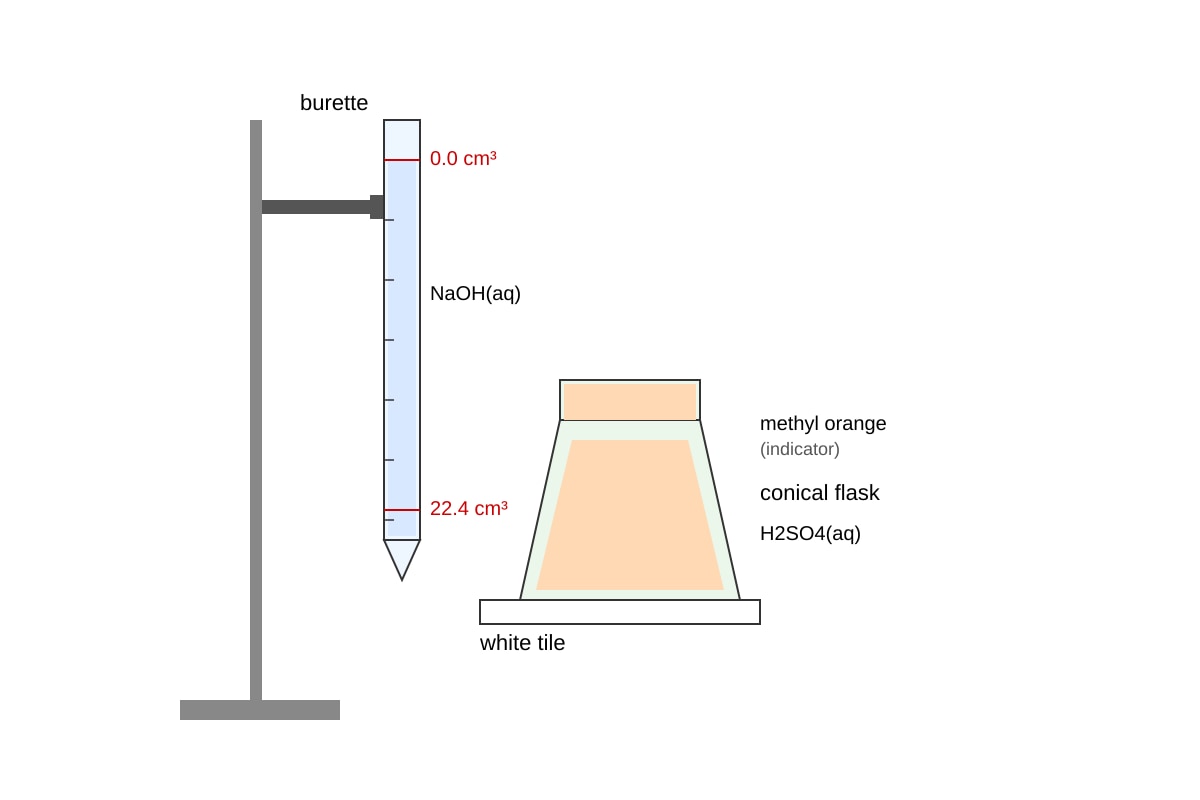
9. [3 marks] The diagram below shows a titration setup used to find the concentration of an unknown sulphuric acid solution using sodium hydroxide.
Image pending generation: experimental_setup for Q9.
(a) State the colour change at the endpoint. [1]
(b) Calculate the volume of NaOH used. [1]
(c) State why a white tile is placed under the flask. [1]
10. [3 marks] Nitrogen dioxide (NO₂) is an acidic oxide formed from vehicle exhausts. It dissolves in rainwater to form an acid.
(a) Name the acid formed when NO₂ dissolves in water. [1]
(b) Write a balanced equation for NO₂ reacting with water. [2]
11. [4 marks] A student prepares zinc sulphate by adding excess zinc oxide to dilute sulphuric acid.
(a) Write the balanced equation with state symbols. [2]
(b) Describe how the student should obtain pure, dry zinc sulphate crystals from the mixture. [2]
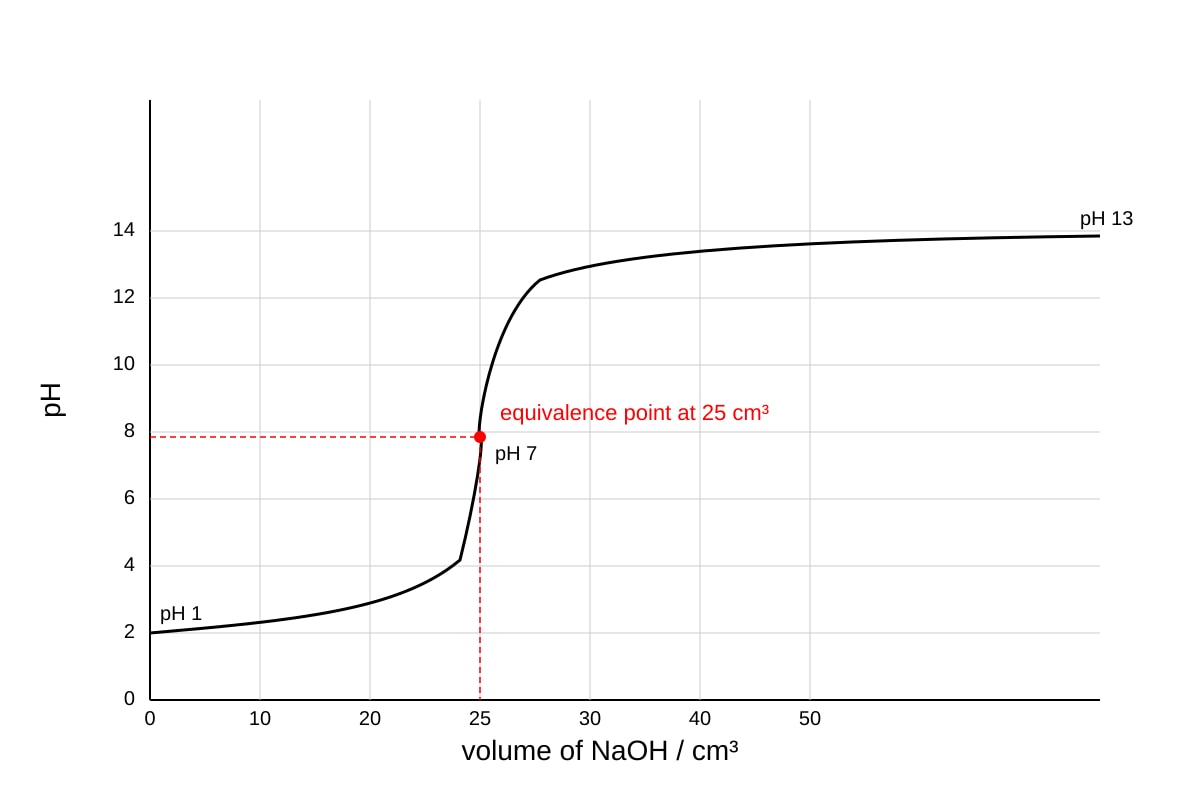
12. [3 marks] The graph shows pH change during titration of HCl with NaOH.
Image pending generation: graph for Q12.
(a) State the volume of NaOH at neutralisation. [1]
(b) State the pH at the equivalence point. [1]
(c) Explain why the pH rises sharply near this volume. [1]
13. [3 marks] State and explain the observation when damp blue litmus paper is placed in a gas jar of hydrogen chloride gas.
14. [4 marks] A farmer finds his soil is too acidic for crops. He decides to add calcium hydroxide.
(a) State the type of substance calcium hydroxide is. [1]
(b) Explain how adding it improves the soil. [2]
(c) Give one reason why he should not add too much. [1]
15. [4 marks] A solution contains aqueous ions of copper(II) and iron(II). A student adds excess NaOH.
(a) State the colour of the precipitate formed from Cu²⁺. [1]
(b) State the colour of the precipitate formed from Fe²⁺. [1]
(c) Write the ionic equation for the formation of the iron(II) precipitate. [2]
Section C: Extended Response (Questions 16–20) [20 marks]
16. [4 marks] Discuss the suitability of using potassium metal to react with dilute hydrochloric acid to prepare potassium chloride. State the expected observations and conclude on suitability.
17. [4 marks] Explain the difference between a strong acid and a weak acid in terms of ionisation. Use hydrochloric acid and ethanoic acid as examples, with equations.
18. [4 marks] A student prepares lead(II) nitrate by reacting lead(II) oxide with nitric acid.
(a) Write the balanced equation with state symbols. [2]
(b) State a suitable method to purify the salt and explain one key step. [2]
19. [4 marks] The table shows pH of solutions A–D.
| Solution | pH |
|---|---|
| A | 2 |
| B | 7 |
| C | 9 |
| D | 13 |
(a) Identify which are acids, bases, neutral. [2]
(b) Arrange A, B, C, D in increasing H⁺ concentration. [1]
(c) State which solution has highest OH⁻ concentration. [1]
20. [4 marks] Describe how to test for the presence of carbonate ions in a solid sample using dilute acid and limewater. Include observations and equations.
End of Paper
Answers
TuitionGoWhere Practice Paper - Pure Chemistry Secondary 4 (PRELIM) Answer Key
Version 4 of 5
Section A
1. [1 mark] Sulphur dioxide, SO₂.
Teaching note: Burning sulphur: S + O₂ → SO₂. SO₂ dissolves in rain to form H₂SO₃ (sulphurous acid), contributing to acid rain. Common mistake: writing SO₃ (formed only on catalytic oxidation).
2. [1 mark] CO₂(g) + 2NaOH(aq) → Na₂CO₃(aq) + H₂O(l)
Teaching note: CO₂ is an acidic oxide; with excess NaOH it forms carbonate. State symbols required. Mistake: writing NaHCO₃ instead of Na₂CO₃ when NaOH is in excess.
3. [1 mark] Acid.
Teaching note: pH < 7 indicates acidity. Vinegar contains ethanoic acid.
4. [1 mark] KNO₃
Teaching note: HNO₃ + KOH → KNO₃ + H₂O. Salt = metal from base + nitrate from nitric acid.
5. [2 marks] Add NaOH(aq) dropwise. With Al³⁺: white precipitate forms, dissolves in excess NaOH to colourless solution. With Pb²⁺: white precipitate forms, insoluble in excess NaOH.
Marking: 1 mark observation for Al³⁺, 1 mark for Pb²⁺.
Teaching note: Al(OH)₃ is amphoteric; Pb(OH)₂ is not. Equations: Al³⁺ + 3OH⁻ → Al(OH)₃(s); Al(OH)₃ + OH⁻ → [Al(OH)₄]⁻.
6. [2 marks] A base is a substance that reacts with an acid to form a salt and water only. MgO + 2HCl → MgCl₂ + H₂O.
Marking: 1 mark definition, 1 mark example.
Teaching note: Bases include metal oxides, hydroxides, carbonates; MgO neutralises acid.
7. [2 marks] Red. HCl is acidic (pH < 7); universal indicator turns red in strong acid.
Marking: 1 mark colour, 1 mark explanation.
8. [2 marks] Observations: vigorous effervescence (H₂ gas), heat released / metal moves. Not suitable: reaction too violent, exothermic, unsafe.
Marking: 1 mark observations, 1 mark unsuitability.
Teaching note: Na is above H in reactivity series; reaction uncontrolled.
Section B
9. [3 marks]
(a) [1] Yellow to orange (methyl orange in acid red, endpoint orange/yellow in alkali).
(b) [1] 22.4 – 0.0 = 22.4 cm³.
(c) [1] To help see colour change clearly.
Teaching note: White tile improves contrast.
10. [3 marks]
(a) [1] Nitric acid (HNO₃).
(b) [2] 3NO₂(g) + H₂O(l) → 2HNO₃(aq) + NO(g) (or 4NO₂ + 2H₂O + O₂ → 4HNO₃). Allow simplified: 2NO₂ + H₂O → HNO₂ + HNO₃.
Marking: 1 mark products, 1 mark balanced.
11. [4 marks]
(a) [2] ZnO(s) + H₂SO₄(aq) → ZnSO₄(aq) + H₂O(l)
(b) [2] Heat mixture to evaporate water until saturated, leave to crystallise, filter crystals, dry between paper.
Marking: 1 mark crystallisation, 1 mark filtration/drying.
12. [3 marks]
(a) [1] 25 cm³
(b) [1] 7
(c) [1] At equivalence, acid neutralised; small added alkali causes large pH rise.
Teaching note: Steep part = neutralisation point.
13. [3 marks] Blue litmus turns red. HCl(g) dissolves in dampness to form HCl(aq) acid, which is acidic.
Marking: 1 mark observation, 2 marks explanation.
14. [4 marks]
(a) [1] Base (alkali as aqueous).
(b) [2] Neutralises acid: Ca(OH)₂ + 2H⁺ → Ca²⁺ + 2H₂O, raises pH.
(c) [1] Excess makes soil too alkaline, harms plants.
15. [4 marks]
(a) [1] Blue
(b) [1] Green (dirty green)
(c) [2] Fe²⁺(aq) + 2OH⁻(aq) → Fe(OH)₂(s)
Teaching note: Fe(OH)₂ is green; Cu(OH)₂ blue.
Section C
16. [4 marks]
- K very reactive (above H). [1]
- Violent reaction, explosion, heat. [1]
- Observations: vigorous effervescence, flame, splashing. [1]
- Unsuitable: unsafe, uncontrolled. [1]
Teaching note: Use KOH + HCl instead.
17. [4 marks]
- Strong acid fully ionises: HCl → H⁺ + Cl⁻. [1]
- Weak acid partial: CH₃COOH ⇌ H⁺ + CH₃COO⁻. [1]
- Strong has more H⁺ at same concentration. [1]
- Equations shown. [1]
18. [4 marks]
(a) [2] PbO(s) + 2HNO₃(aq) → Pb(NO₃)₂(aq) + H₂O(l)
(b) [2] Crystallisation: dissolve, filter, evaporate, crystallise, dry. Key: evaporate to saturation.
19. [4 marks]
(a) [2] A acid, B neutral, C base, D base.
(b) [1] D < C < B < A (increasing H⁺).
(c) [1] D.
20. [4 marks]
- Add dilute HCl to sample. [1]
- If carbonate: CO₃²⁻ + 2H⁺ → CO₂ + H₂O. [1]
- Pass gas to limewater: turns milky. [1]
- Ca(OH)₂ + CO₂ → CaCO₃(s) + H₂O. [1]
Total marks: 60. All sections sum correctly.
Free quiz and exam paper access
Enter your details to view this paper
Your access is remembered on this device.