From Real Exams Exam Paper
Secondary 4 Pure Chemistry Preliminary Examination Paper 3
Free Sec 4 Pure Chemistry Prelim Paper 3, HY3 Exam version, with questions, answers, and O Level-style practice for Singapore students.
These static practice materials are generated from the site's syllabus and paper-generation workflow, with source and model context shown so students and parents can evaluate the material before use.
Questions
TuitionGoWhere Practice Paper - Pure Chemistry Secondary 4 (PRELIM)
School: TuitionGoWhere Secondary School (AI)
Subject: Pure Chemistry
Level: Secondary 4
Paper: PRELIM Practice Paper (Version 3 of 5)
Duration: 60 minutes
Total Marks: 60
Name: ___________________________
Class: ____________
Date: ____________
Instructions
- Answer all questions in the spaces provided.
- Use blue or black pen.
- Show all working where calculation is required.
- State symbols should be included in chemical equations where requested.
- The total marks for this paper are 60.
Section A: Multiple Choice and Short Answer (Questions 1–8) [16 marks]
1. [1 mark] When sulphur burns in air, it combines with oxygen to form a gas that contributes to acid rain. Name this gas.
2. [1 mark] Write the balanced chemical equation, including state symbols, for carbon dioxide gas reacting with sodium hydroxide solution to form sodium carbonate and water.
3. [1 mark] Give the formula of the salt formed when nitric acid reacts with potassium hydroxide.
4. [1 mark] State the colour of litmus paper in a solution of household ammonia.
5. [2 marks] Describe a simple test using aqueous sodium hydroxide to differentiate between aqueous aluminium ions (Al³⁺) and aqueous lead(II) ions (Pb²⁺). Include observations for each.
6. [2 marks] A student suggests reacting potassium with dilute hydrochloric acid to prepare potassium chloride. Discuss the suitability of this method and state one expected observation.
7. [2 marks] A gas jar contains a colourless gas that turns moist blue litmus paper red and then bleaches it. Identify the gas and name one common laboratory source of this gas.
8. [2 marks] Solution X has pH = 2. Solution Y has pH = 5. Which solution is more acidic? Explain your answer in terms of hydrogen ion concentration.
Section B: Structured Response and Data Interpretation (Questions 9–15) [24 marks]
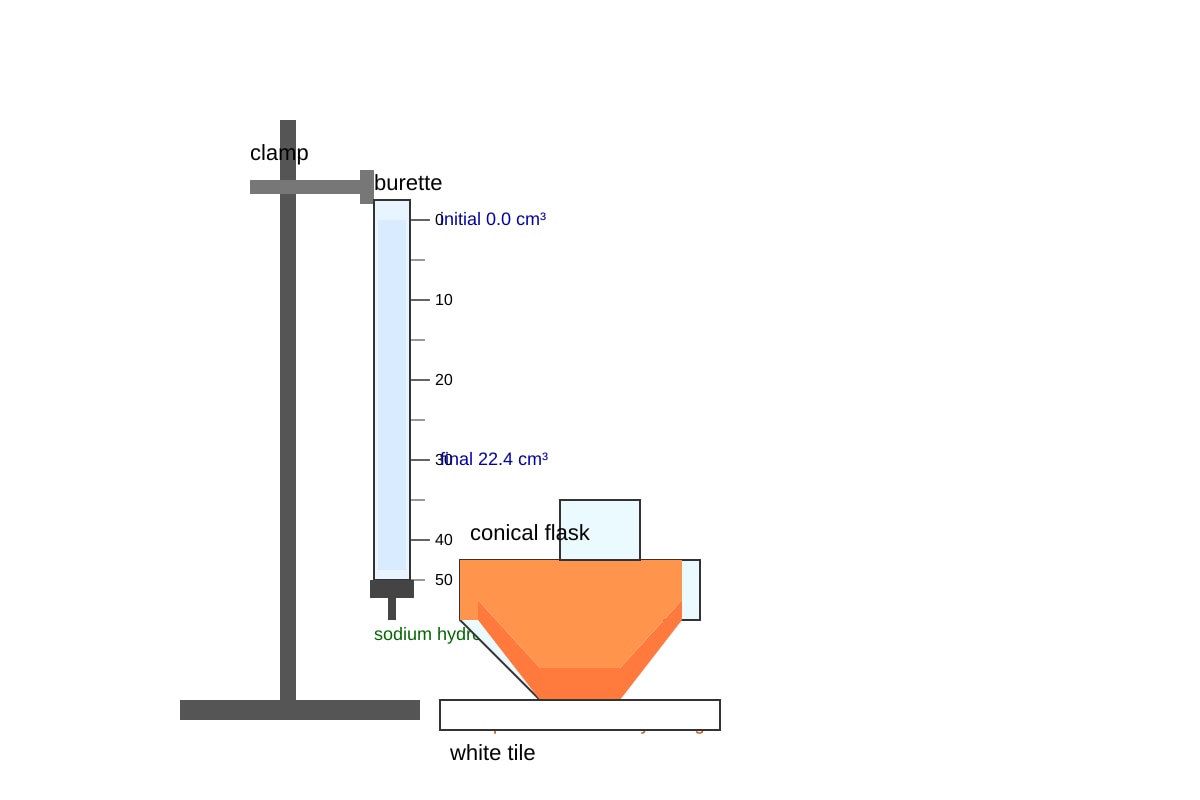
9. [3 marks] The diagram below shows a titration setup used to find the concentration of sulphuric acid using sodium hydroxide.
Image pending generation: experimental_setup for Q9.
(a) Name the indicator used if the acid is in the flask and base in burette. [1]
(b) State the colour change at the endpoint. [1]
(c) Calculate the volume of base added. [1]
10. [3 marks] A sample of soil is found to be too acidic for planting. A farmer adds powdered calcium carbonate to neutralise the acid.
(a) Write a balanced equation for the reaction of calcium carbonate with nitric acid. [2]
(b) State one observation during the reaction. [1]
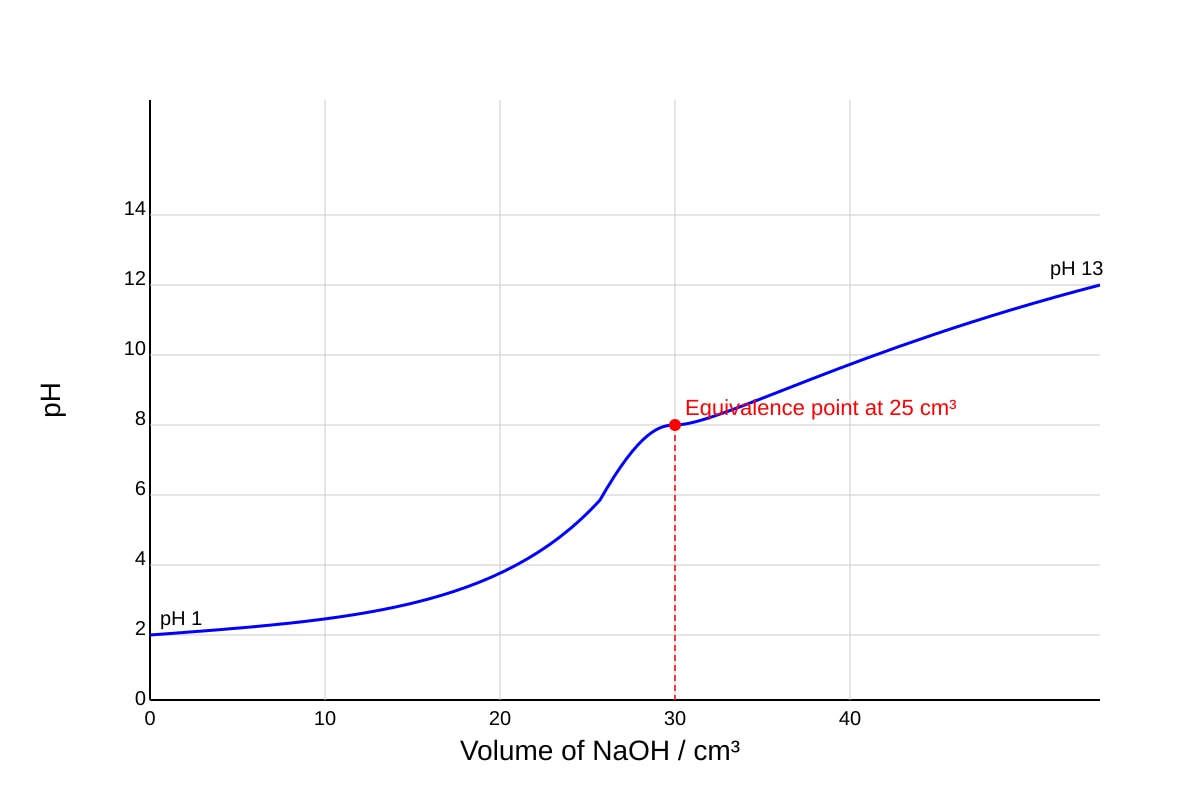
11. [4 marks] The graph shows the pH change when 0.100 mol/dm³ sodium hydroxide is added to 25.0 cm³ of dilute hydrochloric acid.
Image pending generation: graph for Q11.
(a) State the volume of NaOH at the equivalence point. [1]
(b) Calculate the moles of HCl in the flask. [2]
(c) State the pH at the equivalence point and give a reason. [1]
12. [3 marks] State and explain the observation when excess aqueous ammonia is added to a test tube containing copper(II) sulphate solution.
13. [4 marks] A student prepares zinc sulphate by adding zinc oxide to warm dilute sulphuric acid until no more dissolves.
(a) Why is zinc oxide added until no more dissolves? [1]
(b) Describe how the salt is obtained as a solid from the resulting solution. [2]
(c) Write the equation for the reaction. [1]
14. [3 marks] The table shows the pH of solutions A–D.
| Solution | pH |
|---|---|
| A | 3 |
| B | 7 |
| C | 10 |
| D | 1 |
(a) Which solution is a strong acid? [1]
(b) Which solution is alkaline? [1]
(c) Arrange A, B, C, D from most to least acidic. [1]
15. [4 marks] Hydrogen chloride gas and ammonia gas are released from two ends of a dry glass tube. A white ring forms nearer the ammonia end.
(a) Name the white substance formed. [1]
(b) Write the equation for its formation. [1]
(c) Explain why the ring forms closer to the ammonia end. [2]
Section C: Extended Response and Calculations (Questions 16–20) [20 marks]
16. [4 marks] A 25.0 cm³ sample of vinegar (ethanoic acid) is neutralised by 20.0 cm³ of 0.100 mol/dm³ sodium hydroxide.
(a) Calculate the moles of NaOH used. [1]
(b) Write the equation and find moles of ethanoic acid. [1]
(c) Calculate concentration of ethanoic acid in mol/dm³. [1]
(d) Explain why ethanoic acid is a weak acid. [1]
17. [4 marks] Compare the reactions of magnesium and copper with dilute sulphuric acid.
(a) State the observation for magnesium. [1]
(b) State the observation for copper. [1]
(c) Explain the difference using the reactivity series. [2]
18. [4 marks] A student adds barium nitrate solution to a sample of dilute sulphuric acid.
(a) State the observation. [1]
(b) Write the ionic equation. [2]
(c) Name the precipitate. [1]
19. [4 marks] Explain, with equations, how sulphur dioxide from burning fossil fuels causes acid rain. Include the oxidation step.
20. [4 marks] A 2.65 g sample of anhydrous sodium carbonate is dissolved and titrated with 0.200 mol/dm³ hydrochloric acid. 25.0 cm³ of acid is required.
(a) Calculate moles of HCl used. [1]
(b) Calculate moles of Na₂CO₃ reacted. [1]
(c) Find the molar mass of the sample and comment on purity. [2]
End of Paper
Answers
TuitionGoWhere Practice Paper - Pure Chemistry Secondary 4 (PRELIM) Answer Key (Version 3)
Total Marks: 60
Section A Answers (16 marks)
1. [1 mark] Sulphur dioxide / SO₂.
Teaching note: Burning sulphur: S + O₂ → SO₂. SO₂ dissolves in rain to form sulphurous acid (H₂SO₃), contributing to acid rain. Common mistake: writing SO₃ (formed only on further catalytic oxidation).
2. [1 mark] CO₂(g) + 2NaOH(aq) → Na₂CO₃(aq) + H₂O(l)
Teaching note: CO₂ is an acidic oxide; with excess NaOH it forms carbonate. State symbols required. Mistake: writing NaHCO₃ instead of Na₂CO₃ when NaOH is in excess.
3. [1 mark] KNO₃
Teaching note: Nitric acid (HNO₃) + KOH → KNO₃ + H₂O. Salt = metal from base + nitrate from acid.
4. [1 mark] Blue
Teaching note: Ammonia is alkaline; it turns red litmus blue.
5. [2 marks] Add NaOH(aq) dropwise. Al³⁺: white precipitate forms, dissolves in excess NaOH to colourless solution. Pb²⁺: white precipitate forms, insoluble in excess NaOH. [1 for correct reagent and Al observation, 1 for Pb observation]
Teaching note: Al(OH)₃ is amphoteric, Pb(OH)₂ is not. Equations: Al³⁺ + 3OH⁻ → Al(OH)₃(s); Al(OH)₃ + OH⁻ → [Al(OH)₄]⁻. Pb²⁺ + 2OH⁻ → Pb(OH)₂(s).
6. [2 marks] Unsuitable [1] because potassium is very high in reactivity series; reaction with acid is violent/explosive, hard to control. Observation: vigorous effervescence, heat released, possible flame [1].
Teaching note: Suitability ≠ feasibility. Safe method: use less reactive metal like Zn or Mg.
7. [2 marks] Chlorine, Cl₂ [1]. Source: reacting HCl with MnO₂ on heating, or electrolysis of brine [1].
Teaching note: Cl₂ is acidic and a bleaching agent due to HOCl formation.
8. [2 marks] Solution X (pH 2) is more acidic [1]. Lower pH means higher [H⁺]; pH 2 has 10³ = 1000 times more H⁺ than pH 5 [1].
Teaching note: pH = –log[H⁺]; each unit is ×10.
Section B Answers (24 marks)
9. [3 marks]
(a) Methyl orange [1] (acid in flask, base in burette; MO suitable).
(b) Red to orange/yellow [1].
(c) 22.4 – 0.0 = 22.4 cm³ [1].
Visual: Burette shows 22.4 cm³ delivered.
10. [3 marks]
(a) CaCO₃(s) + 2HNO₃(aq) → Ca(NO₃)₂(aq) + CO₂(g) + H₂O(l) [2]
(b) Effervescence / bubbles of CO₂ [1]
11. [4 marks]
(a) 25.0 cm³ [1]
(b) n(NaOH) = 0.100 × 25.0/1000 = 2.50×10⁻³ mol; 1:1 with HCl so n(HCl)=2.50×10⁻³ mol [2]
(c) pH 7; strong acid + strong base neutralisation gives neutral salt [1]
12. [3 marks] Blue precipitate of Cu(OH)₂ forms initially [1]; with excess NH₃, precipitate dissolves to form deep blue solution of [Cu(NH₃)₄]²⁺ [2].
Teaching note: NH₃ is weak base; Cu²⁺ forms complex ion.
13. [4 marks]
(a) Ensure all acid reacted / excess oxide removed by filtration [1]
(b) Filter hot mixture, evaporate filtrate to saturation, cool to crystallise, filter crystals, dry [2]
(c) ZnO + H₂SO₄ → ZnSO₄ + H₂O [1]
14. [3 marks]
(a) D [1]
(b) C [1]
(c) D > A > B > C [1]
15. [4 marks]
(a) Ammonium chloride, NH₄Cl [1]
(b) NH₃ + HCl → NH₄Cl [1]
(c) NH₃ has lower molar mass (17) than HCl (36.5), so diffuses faster in tube, ring nearer NH₃ end [2]
Section C Answers (20 marks)
16. [4 marks]
(a) n = 0.100 × 20.0/1000 = 2.00×10⁻³ mol [1]
(b) CH₃COOH + NaOH → CH₃COONa + H₂O; 1:1 so n(acid)=2.00×10⁻³ [1]
(c) c = 2.00×10⁻³ / (25.0/1000) = 0.0800 mol/dm³ [1]
(d) Weak acid partially ionises only; equilibrium lies left [1]
17. [4 marks]
(a) Bubbles of H₂, metal dissolves, warmth [1]
(b) No visible reaction [1]
(c) Mg above H in series, displaces H⁺; Cu below H, cannot [2]
18. [4 marks]
(a) White precipitate [1]
(b) Ba²⁺(aq) + SO₄²⁻(aq) → BaSO₄(s) [2]
(c) Barium sulphate [1]
19. [4 marks]
S + O₂ → SO₂ [1]; 2SO₂ + O₂ → 2SO₃ [1]; SO₃ + H₂O → H₂SO₄ [1]; rain becomes acidic [1].
Teaching note: Also SO₂ + H₂O → H₂SO₃.
20. [4 marks]
(a) n(HCl)=0.200×25.0/1000=5.00×10⁻³ mol [1]
(b) Na₂CO₃ + 2HCl → 2NaCl + CO₂ + H₂O; n(Na₂CO₃)=2.50×10⁻³ mol [1]
(c) M = 2.65 / 2.50×10⁻³ = 106 g/mol; matches Na₂CO₃ (106), pure [2]
End of Answer Key
Free quiz and exam paper access
Enter your details to view this paper
Your access is remembered on this device.