From Real Exams Exam Paper
Secondary 4 Pure Chemistry Preliminary Examination Paper 2
Free Sec 4 Pure Chemistry Prelim Paper 2, HY3 Exam version, with questions, answers, and O Level-style practice for Singapore students.
These static practice materials are generated from the site's syllabus and paper-generation workflow, with source and model context shown so students and parents can evaluate the material before use.
Questions
TuitionGoWhere Practice Paper - Pure Chemistry Secondary 4 (PRELIM)
School: TuitionGoWhere Exam Practice (AI)
Subject: Pure Chemistry
Level: Secondary 4
Paper: Prelim Practice Version 2 of 5
Duration: 60 minutes
Total Marks: 60
Name: ___________________________
Class: ____________
Date: ____________
Instructions:
- Answer all questions in the spaces provided.
- Use blue or black ink.
- Show all working where calculation is required.
- State symbols should be included in all chemical equations where requested.
- The total marks for this paper are 60.
Section A: Multiple Choice and Short Structured (Questions 1–8) [16 marks]
1. [1 mark] Which gas produced by the burning of fossil fuels combines with oxygen to form a gas that contributes to acid rain?
A. CO2
B. SO2
C. N2
D. O2
2. [1 mark] Write the balanced equation, with state symbols, for carbon dioxide gas reacting with sodium hydroxide solution to form sodium carbonate and water.
3. [2 marks] Describe a simple test using aqueous sodium hydroxide to differentiate between Al3+ and Pb2+ ions in solution. State the observation for each.
4. [1 mark] Name the indicator that changes colour gradually over a wide pH range and is used to estimate the pH of a solution.
5. [2 marks] A student adds dilute hydrochloric acid to solid calcium carbonate. Write the balanced equation with state symbols and state one observation.
6. [2 marks] Explain why a strong acid conducts electricity better than a weak acid of the same concentration.
7. [3 marks] A sample of oxide X reacts with water to form a solution with pH 2. When X is heated with copper(II) oxide, a salt and water are formed.
(a) State whether X is acidic, basic, or amphoteric. [1]
(b) Write a balanced equation for X with water. [1]
(c) Name the salt formed with copper(II) oxide. [1]
8. [4 marks] A farmer finds his soil is too acidic for planting. He decides to add calcium hydroxide.
(a) State the type of reaction occurring. [1]
(b) Write a balanced equation for calcium hydroxide with nitric acid. [2]
(c) Give one reason why calcium hydroxide is preferred over sodium hydroxide for this use. [1]
Section B: Data and Diagram Interpretation (Questions 9–14) [20 marks]
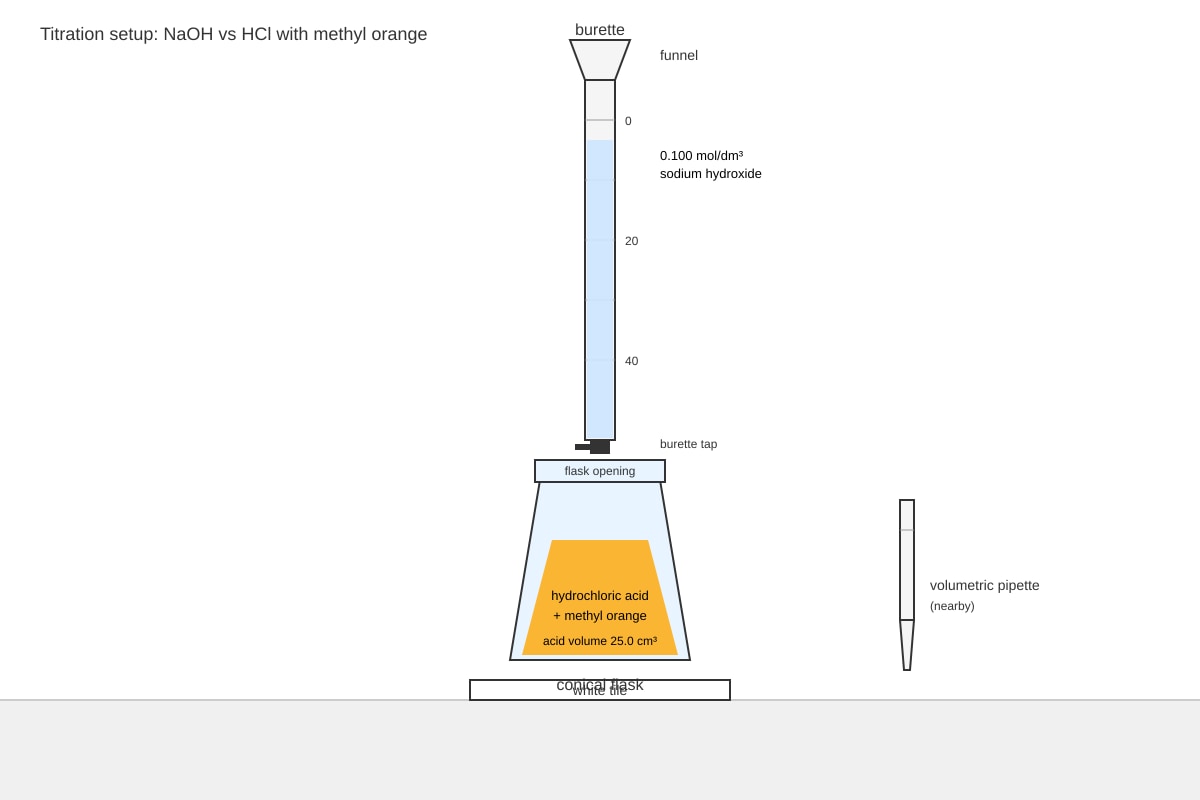
9. [3 marks] The diagram below shows a titration setup.
Image pending generation: experimental_setup for Q9.
(a) Name the piece of equipment used to measure exactly 25.0 cm³ of acid. [1]
(b) State the colour change at the endpoint. [1]
(c) Calculate the concentration of the hydrochloric acid if 20.0 cm³ of NaOH is used. [1]
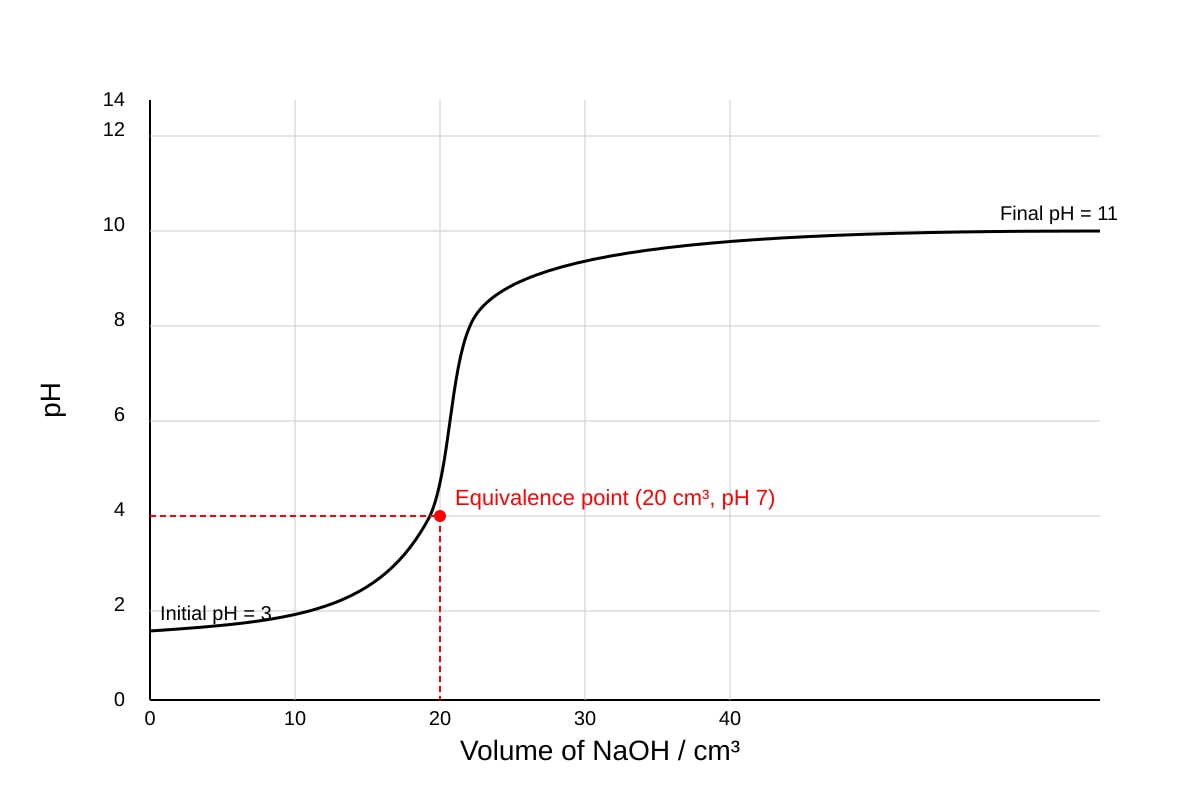
10. [3 marks] The graph shows pH change during titration of ethanoic acid with sodium hydroxide.
Image pending generation: graph for Q10.
(a) State the volume at equivalence point. [1]
(b) Explain why the initial pH is not 1. [1]
(c) Suggest a suitable indicator. [1]
11. [4 marks] A student prepares copper(II) sulfate by reacting excess copper(II) oxide with dilute sulfuric acid.
(a) Write the balanced equation with state symbols. [2]
(b) Describe how to obtain pure dry crystals from the mixture. [2]
12. [3 marks] The table shows results of adding NaOH to three solutions.
| Ion | Observation with NaOH |
|---|---|
| Cu2+ | Blue precipitate |
| Fe2+ | Green precipitate |
| Mg2+ | White precipitate |
State the formula of each precipitate and whether it dissolves in excess NaOH.
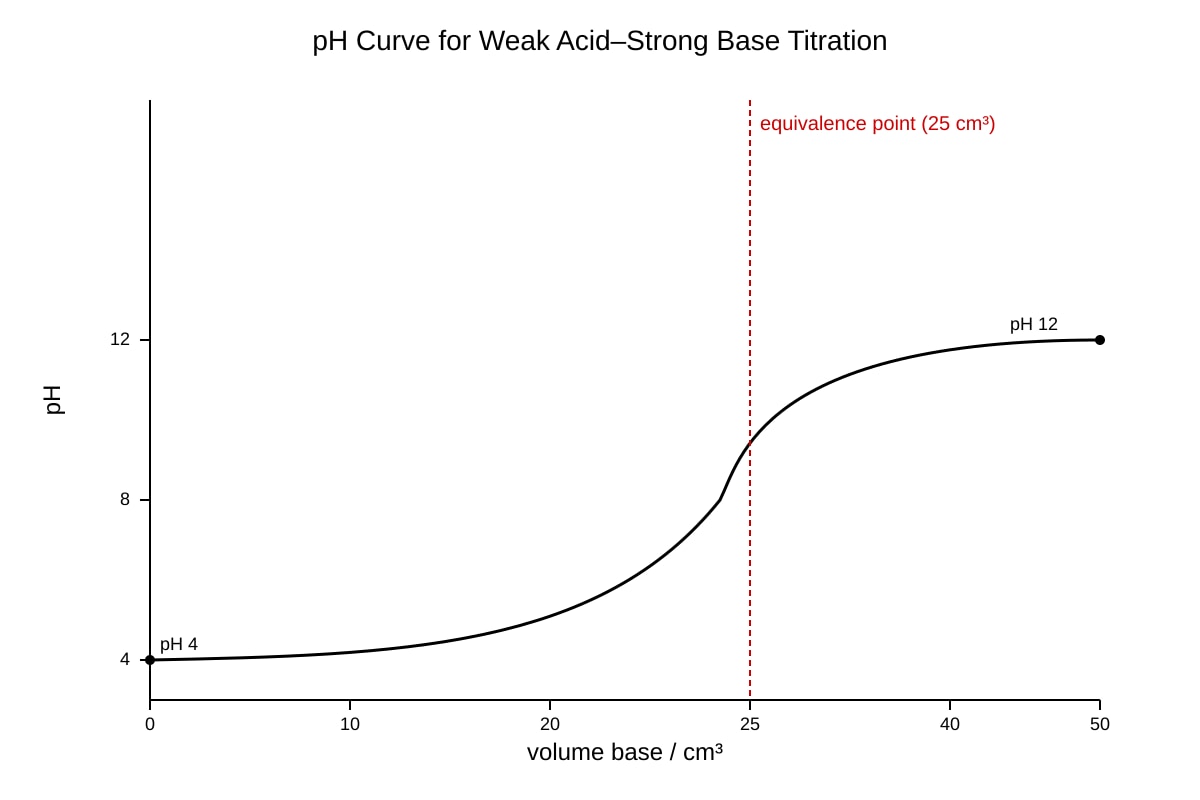
13. [4 marks] A pH curve for a weak acid–strong base titration is shown.
Image pending generation: graph for Q13.
(a) Deduce if acid is strong or weak. [1]
(b) Write the ionic equation for neutralization. [1]
(c) Calculate moles of acid if 25 cm³ of 0.1 M base used. [2]
14. [3 marks] A salt is prepared by reacting zinc with dilute sulfuric acid.
(a) State the name of the salt. [1]
(b) Write the equation. [1]
(c) Why is zinc suitable but potassium not? [1]
Section C: Extended Response (Questions 15–20) [24 marks]
15. [3 marks] Discuss the suitability of using potassium metal to prepare potassium chloride from hydrochloric acid. State expected observations.
16. [4 marks] A student neutralizes 25.0 cm³ of 0.080 mol/dm³ sulfuric acid with 0.100 mol/dm³ sodium hydroxide.
(a) Write balanced equation. [1]
(b) Calculate volume of NaOH required. [3]
17. [4 marks] Compare the preparation of soluble and insoluble salts. Use examples and methods.
18. [4 marks] Explain the difference between strong and weak acids in terms of dissociation and conductivity. Include equations.
19. [4 marks] A gas Y turns moist blue litmus red and decays in air. It reacts with NaOH to form a salt.
(a) Identify Y. [1]
(b) Write equation with NaOH. [2]
(c) Name the salt. [1]
20. [5 marks] A factory discharges waste gas containing SO2.
(a) Explain how SO2 causes acid rain. [2]
(b) Suggest a method to remove SO2 using an alkali. Write equation. [2]
(c) State one environmental impact of acid rain. [1]
Answers
Answer Key: TuitionGoWhere Practice Paper - Pure Chemistry Secondary 4 (PRELIM) Version 2
Total Marks: 60
Section A (16 marks)
1. [1] B. SO2
Teaching note: Fossil fuels contain sulfur; burning forms SO2, which oxidizes to SO3 and dissolves to make acid rain. CO2 is not a direct acid-rain gas in this context.
2. [1] CO2(g)+2NaOH(aq)→Na2CO3(aq)+H2O(l)
Mark: equation correct with state symbols. Common mistake: missing 2 before NaOH.
3. [2] Add NaOH(aq) dropwise. Al3+: white ppt of Al(OH)3 forms, dissolves in excess NaOH. Pb2+: white ppt of Pb(OH)2 forms, insoluble in excess.
Marking: 1 mark test described, 1 mark observations.
4. [1] Universal indicator (or pH paper).
Note: Accept "universal indicator".
5. [2] CaCO3(s)+2HCl(aq)→CaCl2(aq)+CO2(g)+H2O(l) [1]; effervescence / gas evolved [1].
6. [2] Strong acid fully dissociates into ions (HA→H++A−) [1]; weak acid partially dissociates, fewer ions [1]; more ions = better conductivity.
7. [3] (a) Acidic [1] (b) X+H2O→H2XOn (e.g., SO3+H2O→H2SO4) [1] (c) Copper(II) sulfate (or named salt) [1].
Note: X is non-metal oxide.
8. [4] (a) Neutralization [1] (b) Ca(OH)2+2HNO3→Ca(NO3)2+2H2O [2] (c) Less soluble / cheaper / milder [1].
Section B (20 marks)
9. [3] (a) Volumetric pipette [1] (b) Red to yellow (methyl orange) [1] (c) nNaOH=0.100×0.0200=0.00200 mol; nHCl=0.00200; C=0.00200/0.0250=0.0800 mol/dm³ [1].
10. [3] (a) 20 cm³ [1] (b) Ethanoic acid is weak, partial dissociation [1] (c) Phenolphthalein [1].
11. [4] (a) CuO(s)+H2SO4(aq)→CuSO4(aq)+H2O(l) [2] (b) Filter excess CuO, heat filtrate to evaporate, cool to crystallize, filter crystals, dry [2].
12. [3] Cu(OH)2 blue, insol; Fe(OH)2 green, insol; Mg(OH)2 white, insol [1 each].
13. [4] (a) Weak (initial pH 4) [1] (b) H++OH−→H2O [1] (c) n=0.1×0.025=0.0025 mol [2].
14. [3] (a) Zinc sulfate [1] (b) Zn+H2SO4→ZnSO4+H2 [1] (c) Zn moderate reactivity, K explosive [1].
Section C (24 marks)
15. [3] Unsuitable [1]; K very reactive, violent/explosive with HCl [1]; observation: vigorous flame, gas, possible explosion [1].
16. [4] (a) H2SO4+2NaOH→Na2SO4+2H2O [1] (b) nacid=0.080×0.0250=0.0020 mol; nNaOH=0.0040 mol; V=0.0040/0.100=0.0400 dm³ = 40.0 cm³ [3].
17. [4] Soluble: acid + metal / base / carbonate, crystallize (e.g., ZnSO4) [2]; insoluble: precipitation by mixing solutions (e.g., AgCl from AgNO3+NaCl) [2].
18. [4] Strong: complete dissociation (HCl→H++Cl−) [1]; weak: equilibrium (CH3COOH⇌H++CH3COO−) [1]; conductivity proportional to ion conc [1]; strong conducts more [1].
19. [4] (a) SO2 (or CO2) [1] (b) SO2+2NaOH→Na2SO3+H2O [2] (c) Sodium sulfite [1].
20. [5] (a) SO2+O2→SO3, dissolves to H2SO4 [2] (b) Scrub with NaOH: SO2+2NaOH→Na2SO3+H2O [2] (c) Kills trees / corrodes buildings [1].
Free quiz and exam paper access
Enter your details to view this paper
Your access is remembered on this device.