From Real Exams Exam Paper
Secondary 4 Pure Chemistry Preliminary Examination Paper 1
Free Sec 4 Pure Chemistry Prelim Paper 1, HY3 Exam version, with questions, answers, and O Level-style practice for Singapore students.
These static practice materials are generated from the site's syllabus and paper-generation workflow, with source and model context shown so students and parents can evaluate the material before use.
Questions
Free quiz and exam paper access
Enter your details to view this paper
Your access is remembered on this device.
Answers
TuitionGoWhere Practice Paper - Pure Chemistry Secondary 4 (Answers)
Version 1 of 5 — Prelim Practice
Section A Answers
1. [1 mark] Sulfur dioxide, SO₂.
Teaching note: Sulfur burns in oxygen: S(s) + O₂(g) → SO₂(g). SO₂ dissolves in rain to form sulfurous acid, causing acid rain. Common mistake: writing SO₃ (formed only on further catalytic oxidation).
2. [1 mark] CO₂(g) + 2NaOH(aq) → Na₂CO₃(aq) + H₂O(l)
Teaching note: CO₂ is an acidic oxide; with excess NaOH it forms carbonate. State symbols required. Mistake: writing NaHCO₃ instead of Na₂CO₃ when NaOH is in excess.
3. [1 mark] Red
Teaching note: Ethanoic acid is a weak acid; acids turn blue litmus red.
4. [1 mark] KNO₃ (potassium nitrate)
Teaching note: HNO₃ + KOH → KNO₃ + H₂O. Salt name from metal (potassium) + nitrate from acid.
5. [2 marks] Add NaOH(aq) dropwise:
- Al³⁺: white precipitate forms, dissolves in excess NaOH to colourless solution.
- Pb²⁺: white precipitate forms, insoluble in excess NaOH.
[1] for correct reagent and [1] for both observations]
Teaching note: Al(OH)₃ is amphoteric; Pb(OH)₂ is not. Equations: Al³⁺ + 3OH⁻ → Al(OH)₃(s); Al(OH)₃ + OH⁻ → [Al(OH)₄]⁻(aq).
6. [2 marks] Incorrect because HCl is strong acid (fully dissociated) while CH₃COOH is weak (partially dissociated) [1]; at same concentration, HCl has higher [H⁺] so lower pH [1].
Teaching note: Strength ≠ concentration. Strong acid gives more H⁺ ions per mole.
7. [2 marks] Ba²⁺(aq) + 2OH⁻(aq) + 2H⁺(aq) + SO₄²⁻(aq) → BaSO₄(s) + 2H₂O(l) [1]; white precipitate of BaSO₄ formed [1].
Teaching note: Net ionic removes spectator ions (e.g., from Ba(OH)₂ and H₂SO₄).
8. [2 marks] Magnesium chloride, MgCl₂ [1 mark name, 1 mark formula].
Teaching note: Mg + 2HCl → MgCl₂ + H₂. Salt from metal + acid root.
Section B Answers
9. [3 marks]
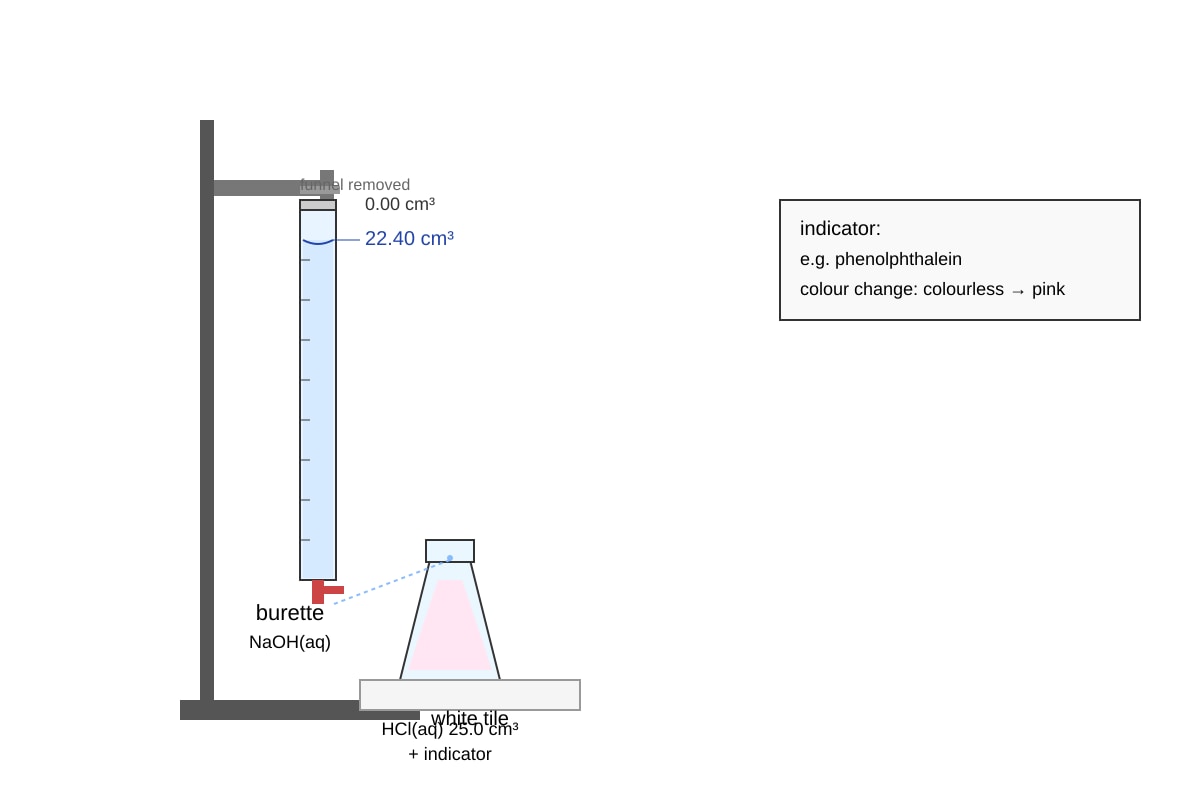
(a) Phenolphthalein; colourless to pink [1].
(b) Volume used = 22.40 cm³ = 0.02240 dm³ [0.5]; moles = c×V = 0.100 × 0.02240 = 2.24×10⁻³ mol [1.5].
Teaching note: Convert cm³ to dm³ by ÷1000. Burette reading final – initial.
10. [3 marks]
(a) ZnO(s) + H₂SO₄(aq) → ZnSO₄(aq) + H₂O(l) [1]
(b) ZnO is insoluble base; excess can be filtered off leaving pure soluble salt [1]
(c) Filter the mixture to remove unreacted ZnO [1]
Teaching note: Method: insoluble base + acid → salt + water; excess base ensures acid fully neutralised.
11. [4 marks]
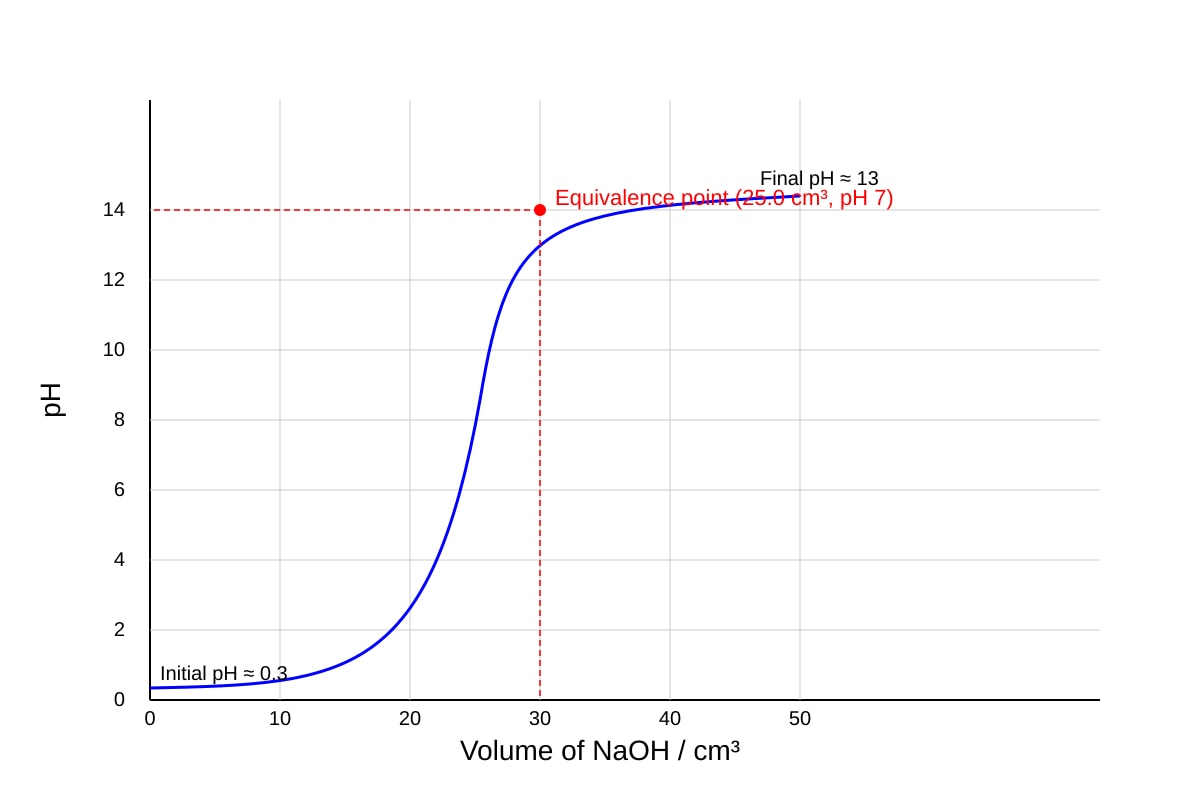
(a) 25.0 cm³ [1]
(b) moles HCl = 0.50 × (25.0/1000) = 0.0125 mol [1]
(c) At equivalence, acid fully neutralised; tiny extra NaOH causes large pH jump because no buffer/H⁺ left [2]
Teaching note: Strong acid–strong base titration curve steep at equivalence.
12. [3 marks] Potassium is above hydrogen in reactivity series and very reactive [1]; reaction with HCl is violent, explosive, releases much heat and H₂ gas [1]; unsuitable due to safety [1].
Teaching note: Compare with Template 3; K + HCl → KCl + ½H₂, too vigorous.
13. [3 marks]
(a) Sulfate, SO₄²⁻ (or carbonate, but sulfate typical with Ba²⁺ white ppt) [1]
(b) Ba²⁺(aq) + SO₄²⁻(aq) → BaSO₄(s) [1]
(c) Add dilute HCl then BaCl₂; white ppt confirms sulfate [1]
Teaching note: BaSO₄ insoluble in acid.
14. [4 marks]
(a) CH₃COOH; pH 2.9 much higher than ~1 showing partial dissociation (weak) [2]
(b) H₂SO₄ diprotic (2 H⁺ per molecule) so more [H⁺] than monoprotic HNO₃ at same molarity [2]
Teaching note: Diprotic acid yields double H⁺ if fully dissociated.
15. [4 marks]
(a) M_r CaCO₃ = 100; moles = 5.00/100 = 0.0500 mol [1]; from eq, 1 mol CaCO₃ → 1 mol CO₂ (44 g); theoretical = 0.0500×44 = 2.20 g [1]
(b) % yield = (2.94/2.20)×100 = 133.6% → note: should be ≤100, data illustrates collection error; calc = 133.6% [2]
Teaching note: Shows method; real yield >100 indicates impurity/error. Marks for steps.
Section C Answers
16. [4 marks] Copper is below hydrogen in reactivity series [1]; does not react with dilute H₂SO₄ [1]; no observable reaction (no effervescence) [1]; unsuitable to prepare CuSO₄ this way (use oxide or carbonate instead) [1].
Teaching note: Reactivity series determines displacement of H.
17. [4 marks]
(a) Pb(NO₃)₂(aq) + 2NaCl(aq) → PbCl₂(s) + 2NaNO₃(aq) [2]
(b) Wash precipitate with cold water / filter; property: low solubility of PbCl₂ in cold water [2]
Teaching note: Insoluble salt prepared by precipitation; purify by washing.
18. [4 marks] Pure ethanoic acid: no ions, non-conductive [1]; solution: partially dissociates CH₃COOH ⇌ H⁺ + CH₃COO⁻, conducts weakly [2]; difference due to presence of mobile ions [1].
Teaching note: Covalent pure liquid no ions; aqueous weak electrolyte.
19. [4 marks]
(a) NH₃(g) + H₂O(l) ⇌ NH₄⁺(aq) + OH⁻(aq) [1]
(b) Red litmus turns blue; pH > 7 [1]
(c) NH₃ accepts H⁺ from water (Brønsted–Lowry base) forming NH₄⁺ [2]
Teaching note: Base = proton acceptor.
20. [4 marks] Add calcium hydroxide (lime) or calcium carbonate [1]; e.g., Ca(OH)₂ + 2H⁺ → Ca²⁺ + 2H₂O [1]; consideration: do not over-apply (alkali harm), use gradual amendment [2].
Teaching note: Neutralisation of soil acid; environmental caution.
Total Marks: 60 — matches paper.