From Real Exams Exam Paper
Secondary 4 Pure Chemistry Preliminary Examination Paper 1
Free Sec 4 Pure Chemistry Prelim Paper 1, DeepSeek Exam version, with questions, answers, and O Level-style practice for Singapore students.
These static practice materials are generated from the site's syllabus and paper-generation workflow, with source and model context shown so students and parents can evaluate the material before use.
Questions
Free quiz and exam paper access
Enter your details to view this paper
Your access is remembered on this device.
Answers
TuitionGoWhere Practice Paper – Pure Chemistry Secondary 4
Answer Key and Marking Scheme
Paper: Preliminary Examination – Version 1 of 5
Total Marks: 80
Section A: Structured Questions (30 marks)
Question 1: Acid Rain and Environmental Chemistry (6 marks)
(a)(i) [2 marks]
| Mark | Answer |
|---|---|
| 1 | Natural source: Volcanic eruptions / decay of organic matter / forest fires |
| 1 | Man-made source: Burning of fossil fuels (coal/petroleum) in power stations / industrial processes (smelting of sulfide ores) / motor vehicles |
Accept any valid natural and man-made source. One mark each.
(a)(ii) [1 mark]
| Mark | Answer |
|---|---|
| 1 | 2SO₂(g) + O₂(g) → 2SO₃(g) |
Must have correct state symbols and balanced equation. Deduct ½ mark for missing/incorrect state symbols.
(a)(iii) [2 marks]
| Mark | Answer |
|---|---|
| 1 | SO₃(g) + H₂O(l) → H₂SO₄(aq) |
| 1 | Explanation: Sulfur trioxide dissolves in rainwater / reacts with water to form sulfuric acid, which is a strong acid that lowers the pH of rainwater, forming acid rain. |
Accept: SO₃ reacts with moisture/water droplets in the atmosphere to produce sulfuric acid.
(b) [1 mark]
| Mark | Answer |
|---|---|
| 1 | Carbon dioxide in the atmosphere dissolves in rainwater to form carbonic acid (a weak acid), giving natural rainwater a pH of about 5.6. |
Accept: CO₂ + H₂O → H₂CO₃ / natural presence of CO₂ in air.
Question 2: Acid-Base Reactions and Salt Preparation (8 marks)
(a)(i) [1 mark]
| Mark | Answer |
|---|---|
| 1 | Dilute sulfuric acid / H₂SO₄(aq) |
Accept: sulfuric acid. Do not accept hydrochloric acid (would produce copper(II) chloride, not sulfate).
(a)(ii) [4 marks]
| Mark | Answer |
|---|---|
| 1 | Add excess copper(II) oxide (black solid) to warm dilute sulfuric acid in a beaker, with stirring. |
| 1 | Observation: Black solid dissolves; solution turns blue. |
| 1 | Filter the mixture to remove unreacted/excess copper(II) oxide. Collect the filtrate (blue copper(II) sulfate solution). |
| 1 | Heat the filtrate to evaporate some water until saturation point / crystals form on cooling. Allow to cool and crystallise. Filter, wash with a little cold distilled water, and dry between filter papers. |
Must mention: excess CuO, filtration, evaporation/crystallisation, drying. Award marks for clear sequential steps with observations.
(a)(iii) [1 mark]
| Mark | Answer |
|---|---|
| 1 | CuO(s) + H₂SO₄(aq) → CuSO₄(aq) + H₂O(l) |
Must have correct state symbols and balanced equation.
(b)(i) [1 mark]
| Mark | Answer |
|---|---|
| 1 | Effervescence / bubbles of gas produced / fizzing |
Accept: carbon dioxide gas evolved.
(b)(ii) [1 mark]
| Mark | Answer |
|---|---|
| 1 | Copper(II) carbonate reacts with the acid to produce carbon dioxide gas: CuCO₃(s) + H₂SO₄(aq) → CuSO₄(aq) + H₂O(l) + CO₂(g). Copper(II) oxide does not produce a gas. |
Accept any explanation linking carbonate to CO₂ release.
Question 3: Strong and Weak Acids (5 marks)
(a)(i) [2 marks]
| Mark | Answer |
|---|---|
| 1 | A strong acid ionises/dissociates completely in water to produce H⁺ ions. |
| 1 | A weak acid ionises/dissociates partially in water to produce H⁺ ions; an equilibrium is established between the undissociated acid molecules and the ions. |
Must use "completely" vs "partially" or equivalent. Award 1 mark for each correct description.
(a)(ii) [3 marks]
| Mark | Answer |
|---|---|
| 1 | Difference 1: Reaction with HCl is faster / more vigorous / produces hydrogen gas more rapidly. Explanation: HCl has a higher concentration of H⁺ ions because it ionises completely, so there are more frequent effective collisions with magnesium. |
| 1 | Difference 2: The reaction with HCl produces more heat / the temperature rises more. Explanation: More H⁺ ions available for reaction releases more energy. |
| 1 | OR Difference: Equal volumes of both acids produce the same total volume of hydrogen gas (if Mg is in excess). Explanation: Both acids have the same concentration (0.1 mol/dm³) and are monobasic, so they contain the same total number of H⁺ ions available for reaction. |
Award 1 mark for each valid difference with correct explanation. Accept any two distinct differences. Maximum 3 marks.
Question 4: pH and Neutralisation (5 marks)
(a)(i) [1 mark]
| Mark | Answer |
|---|---|
| 1 | Calcium hydroxide / slaked lime / calcium oxide / quicklime / calcium carbonate / limestone |
Accept any suitable base used in agriculture.
(a)(ii) [1 mark]
| Mark | Answer |
|---|---|
| 1 | H⁺(aq) + OH⁻(aq) → H₂O(l) |
Accept: Ca(OH)₂(s) + 2H⁺(aq) → Ca²⁺(aq) + 2H₂O(l). Must have state symbols.
(a)(iii) [1 mark]
| Mark | Answer |
|---|---|
| 1 | Adding too much would make the soil too alkaline (pH > 7), which may be harmful to the crops / may damage plant growth. |
Accept: over-liming causes nutrient deficiency / alters soil chemistry unfavourably.
(b)(i) [1 mark]
| Mark | Answer |
|---|---|
| 1 | Indicator: Methyl orange (or phenolphthalein or screened methyl orange). Colour change: For methyl orange: yellow to orange/peach (or red to yellow depending on order). For phenolphthalein: pink/colourless to colourless/pink. |
Accept any suitable indicator with correct colour change for strong acid–strong base titration. ½ mark for indicator, ½ mark for correct colour change.
(b)(ii) [1 mark]
| Mark | Answer |
|---|---|
| 1 | H₂SO₄ + 2NaOH → Na₂SO₄ + 2H₂O. Moles H₂SO₄ = 0.100 × 20.0/1000 = 0.00200 mol. Moles NaOH = 2 × 0.00200 = 0.00400 mol. Concentration NaOH = 0.00400 / (25.0/1000) = 0.160 mol/dm³. |
1 mark for correct answer with working. Accept 0.16 mol/dm³.
Question 5: Qualitative Analysis of Salts (6 marks)
(a) [2 marks]
| Mark | Answer |
|---|---|
| 1 | Anion: Carbonate / CO₃²⁻ |
| 1 | Explanation: Addition of dilute acid produced effervescence; the gas evolved turned limewater milky, confirming carbon dioxide. This indicates the presence of carbonate ions. |
(b) [2 marks]
| Mark | Answer |
|---|---|
| 1 | Cation: Zn²⁺ / zinc ion |
| 1 | Explanation: White precipitate with NaOH(aq), soluble in excess NaOH(aq). White precipitate with NH₃(aq), soluble in excess NH₃(aq). These observations are characteristic of Zn²⁺. |
Must reference both tests (2) and (3) for full marks.
(c) [1 mark]
| Mark | Answer |
|---|---|
| 1 | ZnCO₃ |
(d) [1 mark]
| Mark | Answer |
|---|---|
| 1 | ZnCO₃(s) + 2HNO₃(aq) → Zn(NO₃)₂(aq) + H₂O(l) + CO₂(g) |
Must have correct state symbols and balanced equation. Accept ionic equation: CO₃²⁻(s) + 2H⁺(aq) → H₂O(l) + CO₂(g).
Section B: Data-Based and Diagram Interpretation (30 marks)
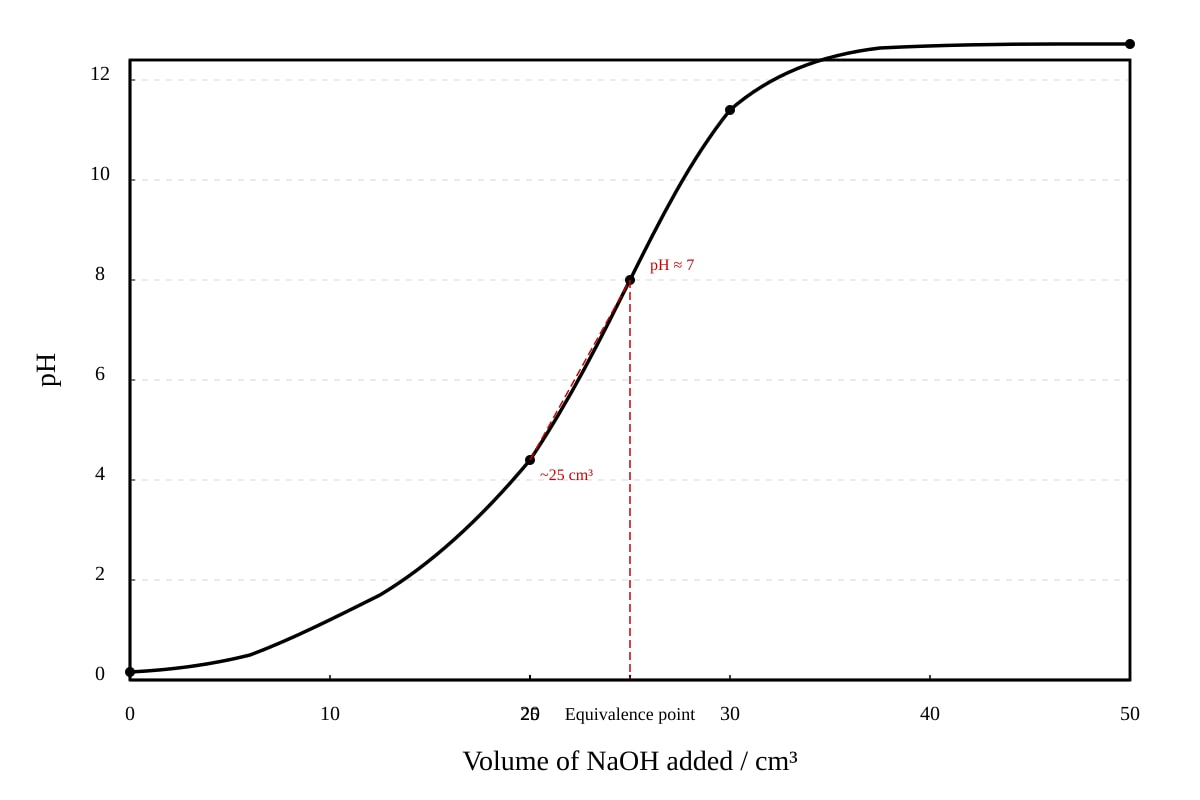
Question 6: pH Curves and Titration Analysis (8 marks)
(a) [2 marks]
| Mark | Answer |
|---|---|
| 1 | pH: 1.0 |
| 1 | Explanation: HCl is a strong acid that ionises completely. [H⁺] = 0.100 mol/dm³. pH = −log₁₀[H⁺] = −log₁₀(0.100) = 1.0. |
1 mark for correct pH, 1 mark for explanation linking complete ionisation to [H⁺] and pH calculation.
(b) [1 mark]
| Mark | Answer |
|---|---|
| 1 | Volume: 25.0 cm³ |
Accept 25 cm³. This is the equivalence point (midpoint of the vertical section of the curve).
(c) [3 marks]
| Mark | Answer |
|---|---|
| 1 | Between 0 and 20 cm³: The added OH⁻ ions are neutralised by the large excess of H⁺ ions present. The concentration of H⁺ decreases only slightly, so pH changes very little (buffer region). |
| 1 | Between 24 and 26 cm³: The amount of OH⁻ added is almost exactly equal to the amount of H⁺ remaining. |
| 1 | At the equivalence point (25.0 cm³), all H⁺ has been neutralised. A very small addition of NaOH causes a large change in [H⁺] (from acidic to alkaline), resulting in a sharp/rapid pH change. |
Award marks for clear explanation of the buffer-like behaviour initially and the rapid change near equivalence point.
(d) [2 marks]
| Mark | Answer |
|---|---|
| 1 | Sketch: Curve should start at a higher pH (around pH 3 for 0.1 mol/dm³ ethanoic acid), rise more gradually, have a less sharp vertical section, and the equivalence point should be at a higher pH (around pH 8–9). |
| 1 | Explanation: Ethanoic acid is a weak acid, so it has a lower [H⁺] initially (higher starting pH). At the equivalence point, the solution contains sodium ethanoate, which is a basic salt (hydrolysis of CH₃COO⁻ produces OH⁻), so the pH at equivalence is > 7. |
1 mark for correct sketch features, 1 mark for explanation of one key difference.
Question 7: Solubility and Precipitation Reactions (7 marks)
(a)(i) [2 marks]
| Mark | Answer |
|---|---|
| 1 | Precipitate formed? Yes |
| 1 | Name: Silver chloride. Colour: White. |
½ mark for Yes, ½ mark for name, ½ mark for colour. Total 2 marks (rounded).
(a)(ii) [2 marks]
| Mark | Answer |
|---|---|
| 1 | Precipitate formed? Yes |
| 1 | Name: Barium sulfate. Colour: White. |
(a)(iii) [2 marks]
| Mark | Answer |
|---|---|
| 1 | Precipitate formed? Yes |
| 1 | Name: Lead(II) iodide. Colour: Yellow. |
(b) [1 mark]
| Mark | Answer |
|---|---|
| 1 | Pb²⁺(aq) + 2I⁻(aq) → PbI₂(s) |
Must have correct state symbols and balanced charges.
Question 8: Ammonia and the Haber Process (8 marks)
(a) [2 marks]
| Mark | Answer |
|---|---|
| 1 | Nitrogen source: Fractional distillation of liquid air |
| 1 | Hydrogen source: Cracking of petroleum fractions / reaction of methane with steam (steam reforming) |
Accept any valid industrial source for each.
(b)(i) [2 marks]
| Mark | Answer |
|---|---|
| 1 | Yield: High pressure favours the forward reaction because there are fewer moles of gas on the product side (4 moles → 2 moles). By Le Chatelier's principle, increasing pressure shifts equilibrium to the right, increasing yield of ammonia. |
| 1 | Rate: High pressure increases the concentration of gas molecules, increasing the frequency of effective collisions, so the rate of reaction increases. |
1 mark for yield explanation, 1 mark for rate explanation.
(b)(ii) [2 marks]
| Mark | Answer |
|---|---|
| 1 | The forward reaction is exothermic (ΔH = −92 kJ/mol). By Le Chatelier's principle, a lower temperature would favour the forward reaction and give a higher equilibrium yield. |
| 1 | However, a lower temperature would make the reaction too slow (uneconomical). 450 °C is a compromise temperature that gives a reasonable rate of reaction while still producing an acceptable yield. |
Must mention both equilibrium yield and rate considerations.
(b)(iii) [2 marks]
| Mark | Answer |
|---|---|
| 1 | Role: The iron catalyst provides an alternative reaction pathway with a lower activation energy. |
| 1 | Explanation: This allows more reactant particles to possess energy greater than or equal to the activation energy, increasing the frequency of effective collisions and thus increasing the rate of reaction. The catalyst does not affect the equilibrium position or yield. |
1 mark for role, 1 mark for explanation in terms of activation energy and effective collisions.
Question 9: Electrolysis and Salt Formation (7 marks)
(a)(i) [1 mark]
| Mark | Answer |
|---|---|
| 1 | Anode product: Chlorine gas / Cl₂ |
(a)(ii) [1 mark]
| Mark | Answer |
|---|---|
| 1 | Cathode product: Hydrogen gas / H₂ |
(b) [1 mark]
| Mark | Answer |
|---|---|
| 1 | 2H₂O(l) + 2e⁻ → H₂(g) + 2OH⁻(aq) |
Accept: 2H⁺(aq) + 2e⁻ → H₂(g). Must have state symbols.
(c) [2 marks]
| Mark | Answer |
|---|---|
| 1 | In concentrated NaCl(aq), chloride ions are present in much higher concentration than hydroxide ions. |
| 1 | Although OH⁻ is more easily discharged (lower in the electrochemical series), the very high concentration of Cl⁻ means chloride ions are preferentially/selectively discharged at the anode. |
Must mention concentration effect overriding position in electrochemical series.
(d)(i) [1 mark]
| Mark | Answer |
|---|---|
| 1 | Sodium sulfate / Na₂SO₄ |
(d)(ii) [1 mark]
| Mark | Answer |
|---|---|
| 1 | Titrate the NaOH solution with dilute H₂SO₄ using a suitable indicator to determine the exact volume for neutralisation. Repeat without indicator using the determined volumes. Evaporate the water from the neutral solution to obtain sodium sulfate crystals. / OR: Add exact stoichiometric amount of H₂SO₄, evaporate to crystallisation point, cool, filter, wash, and dry crystals. |
Accept any valid method for obtaining a pure, dry sample. 1 mark for a clear, correct description.
Section C: Free-Response Questions (20 marks)
Each question is worth 10 marks. Mark any two.
Question 10: Acids, Bases, and Salt Preparation (10 marks)
(a)(i) [1 mark]
| Mark | Answer |
|---|---|
| 1 | An acid is a substance that produces hydrogen ions (H⁺) when dissolved in water / in aqueous solution. |
(a)(ii) [1 mark]
| Mark | Answer |
|---|---|
| 1 | A base is a substance that reacts with an acid to form a salt and water only / a substance that neutralises an acid / a metal oxide or hydroxide. |
Accept: A base is a proton acceptor.
(b)(i) [2 marks]
| Mark | Answer |
|---|---|
| 1 | Method: A (Titration) |
| 1 | Reason: Potassium sulfate is a soluble salt formed from a soluble base (KOH) and a soluble acid (H₂SO₄). Both reactants are soluble, so titration is needed to determine the exact volume for neutralisation. No excess reagent method can be used because both reactants are soluble. |
(b)(ii) [2 marks]
| Mark | Answer |
|---|---|
| 1 | Method: C (Precipitation) |
| 1 | Reason: Lead(II) chloride is an insoluble salt. It can be prepared by mixing solutions of two soluble salts (e.g., lead(II) nitrate and sodium chloride). The precipitate of PbCl₂ is filtered, washed, and dried. |
(b)(iii) [2 marks]
| Mark | Answer |
|---|---|
| 1 | Method: B (Reacting an insoluble base/carbonate with an acid) |
| 1 | Reason: Zinc sulfate is a soluble salt. It can be prepared by reacting excess insoluble zinc oxide or zinc carbonate with dilute sulfuric acid. The excess solid can be removed by filtration, and the filtrate evaporated to obtain crystals. |
(c)(i) [1 mark]
| Mark | Answer |
|---|---|
| 1 | Moles H₂SO₄ = concentration × volume = 0.500 × (50.0/1000) = 0.0250 mol |
(c)(ii) [1 mark]
| Mark | Answer |
|---|---|
| 1 | Moles ZnSO₄ = moles H₂SO₄ = 0.0250 mol (1:1 ratio). Mr(ZnSO₄) = 65 + 32 + 4(16) = 161. Mass = 0.0250 × 161 = 4.025 g ≈ 4.03 g. |
Accept 4.03 g or 4.0 g (2 s.f.). Must show working.
Question 11: pH, Indicators, and Neutralisation in Context (10 marks)
(a)(i) [1 mark]
| Mark | Answer |
|---|---|
| 1 | Lemon juice is the most acidic because it has the lowest pH (2). The lower the pH, the higher the concentration of H⁺ ions. |
(a)(ii) [1 mark]
| Mark | Answer |
|---|---|
| 1 | Household ammonia contains the highest concentration of hydroxide ions because it has the highest pH (12). The higher the pH, the higher the [OH⁻] and the lower the [H⁺]. |
(a)(iii) [1 mark]
| Mark | Answer |
|---|---|
| 1 | Milk has a pH of 6 because it contains dissolved carbon dioxide (or lactic acid from bacterial action), which forms a very weak acidic solution. It is only slightly acidic compared to strong acids like lemon juice (citric acid). |
Accept any reasonable explanation.
(b)(i) [2 marks]
| Mark | Answer |
|---|---|
| 1 | Correct reactants and products: Mg(OH)₂ + 2HCl → MgCl₂ + 2H₂O |
| 1 | Correct state symbols: Mg(OH)₂(s) + 2HCl(aq) → MgCl₂(aq) + 2H₂O(l) |
1 mark for balanced equation, 1 mark for correct state symbols.
(b)(ii) [2 marks]
| Mark | Answer |
|---|---|
| 1 | Magnesium hydroxide is suitable because it is insoluble in water and only reacts with the acid in the stomach. It neutralises excess acid gently without making the stomach contents strongly alkaline. |
| 1 | Sodium hydroxide is not suitable because it is a very strong, soluble base that is highly corrosive. It would react violently with stomach acid, causing burns and potentially making the stomach contents dangerously alkaline. |
Must mention solubility and corrosive nature of NaOH vs mild action of Mg(OH)₂.
(c)(i) [1 mark]
| Mark | Answer |
|---|---|
| 1 | H⁺(aq) + OH⁻(aq) → H₂O(l) |
Accept: Ca(OH)₂(s) + 2H⁺(aq) → Ca²⁺(aq) + 2H₂O(l).
(c)(ii) [2 marks]
| Mark | Answer |
|---|---|
| 1 | Mr[Ca(OH)₂] = 40 + 2(16 + 1) = 74 |
| 1 | Moles = mass / Mr = 7400 g / 74 = 100 mol |
1 mark for correct Mr, 1 mark for correct calculation. Must convert kg to g or work in kg/kmol.
Question 12: Qualitative Analysis and Identification of Unknown Substances (10 marks)
(a) [6 marks]
| Mark | Answer |
|---|---|
| 1–2 | Test 1: Add a few drops of each solution to separate portions of limewater (or add calcium carbonate / marble chips). Observation: The Na₂CO₃ solution will turn limewater milky (or produce effervescence with marble chips). The HCl and NaCl solutions will not. Conclusion: The solution that turns limewater milky is Na₂CO₃. |
| 1–2 | Test 2: To the remaining two solutions (HCl and NaCl), add a few drops of universal indicator / pH paper / blue litmus paper. Observation: HCl will turn blue litmus red / show pH 1–2. NaCl will show pH 7 / no change to litmus. Conclusion: The acidic solution is HCl; the neutral solution is NaCl. |
| 1–2 | Alternative Test 2: Add AgNO₃(aq) followed by dilute HNO₃ to both remaining solutions. Observation: Both HCl and NaCl will give a white precipitate of AgCl. This test alone cannot distinguish them. (Student must use pH or reaction with a carbonate to distinguish.) |
Award up to 6 marks for a logical, sequential testing scheme with clear reagents, observations for each solution, and correct conclusions. Marks allocated for: clear test descriptions (2m), correct observations for all three solutions (2m), logical conclusions (2m).
(b)(i) [2 marks]
| Mark | Answer |
|---|---|
| 1 | Add distilled water to the mixture and stir to dissolve both salts. Copper(II) sulfate and sodium chloride are both soluble. |
| 1 | Since both salts are soluble, separation by filtration is not possible. Use crystallisation: Heat the solution to evaporate some water. Copper(II) sulfate is less soluble and will crystallise first on cooling (as blue CuSO₄·5H₂O crystals). Filter, wash with cold water, and dry. OR: Add excess NaOH(aq) to precipitate Cu(OH)₂, filter, then react with H₂SO₄ to regenerate CuSO₄. |
Accept any chemically valid separation method. 2 marks for a clear, workable method.
(b)(ii) [2 marks]
| Mark | Answer |
|---|---|
| 1 | After removing copper(II) sulfate crystals, the remaining solution (filtrate) contains sodium chloride. |
| 1 | Evaporate the water from the filtrate to obtain sodium chloride crystals. OR: Use the difference in solubility—NaCl is more soluble than CuSO₄·5H₂O, so it remains in solution after CuSO₄ crystallises. |
2 marks for a clear method that follows logically from part (i).
End of Marking Scheme
Total: 80 marks