AI Generated Quiz
Secondary 4 Pure Biology Plant Biology Quiz
Free Sec 4 Pure Biology Plant Biology quiz, HY3 AI version, with questions, answers, and O Level-style practice for Singapore students.
These static practice materials are generated from the site's syllabus and paper-generation workflow, with source and model context shown so students and parents can evaluate the material before use.
Questions
Free quiz and exam paper access
Enter your details to view this paper
Your access is remembered on this device.
Answers
Secondary 4 Pure Biology Quiz - Plant Biology (Answer Key)
Total Marks: 40
Note: Syllabus-first practice content from LLM-inferred templates; not past-year derived.
Section A Answers (1 mark each)
1. root hair cells
Teaching note: Root hair cells are specialised epidermal cells of roots with long extensions increasing surface area for water absorption by osmosis.
2. osmosis
Teaching note: Osmosis is diffusion of water through a partially permeable membrane down a water potential gradient.
3. chlorophyll
Teaching note: Chlorophyll (mainly chlorophyll a and b) absorbs red and blue light for the light-dependent reactions.
4. carbon dioxide + water → glucose + oxygen (light, chlorophyll)
Teaching note: Word equation: . Accept word form for 1 mark.
5. transpiration
Teaching note: Transpiration is water loss as vapour from leaves, driving transpiration stream.
Section B Answers (2–3 marks each)
6. (a) [1] Transpiration is the loss of water vapour from the aerial parts of a plant, mainly through stomata.
(b) [2] Example: Higher temperature increases transpiration because water evaporates faster and humidity around leaf decreases. (Other: wind, low humidity, bright light – 1 mark factor, 1 mark reason.)
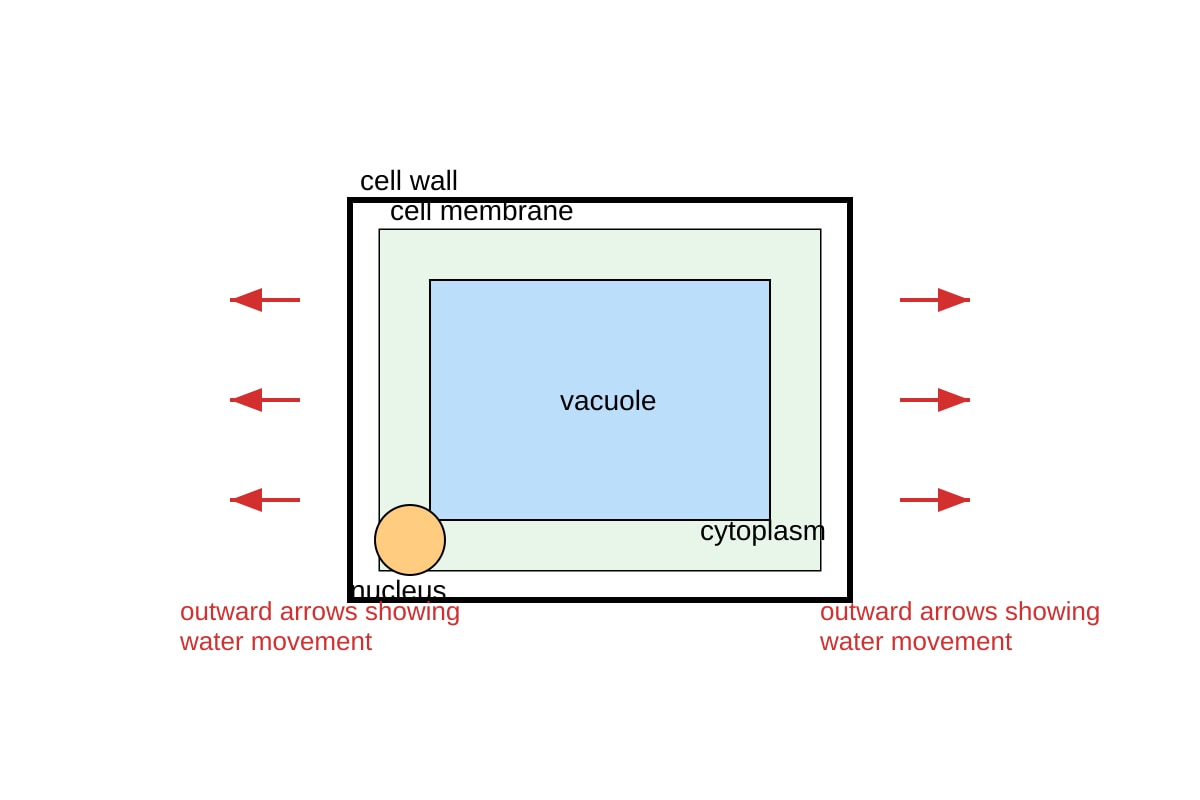
7. [2] The cell undergoes plasmolysis; water moves out by osmosis into the concentrated solution, vacuole and cytoplasm shrink, membrane pulls away from cell wall.
Marking: 1 mark name condition, 1 mark description of water loss/shrinkage.
8. [3] Root hair cells have: (1) long hair-like projection increasing surface area for absorption; (2) thin walls for short diffusion distance; (3) many mitochondria for active transport of mineral ions. (1 mark each.)
9. [3] (a) [1] Oxygen. (b) [1] Move lamp closer/further or use different distance/light intensity filter. (c) [1] Temperature / CO₂ concentration / same pondweed.
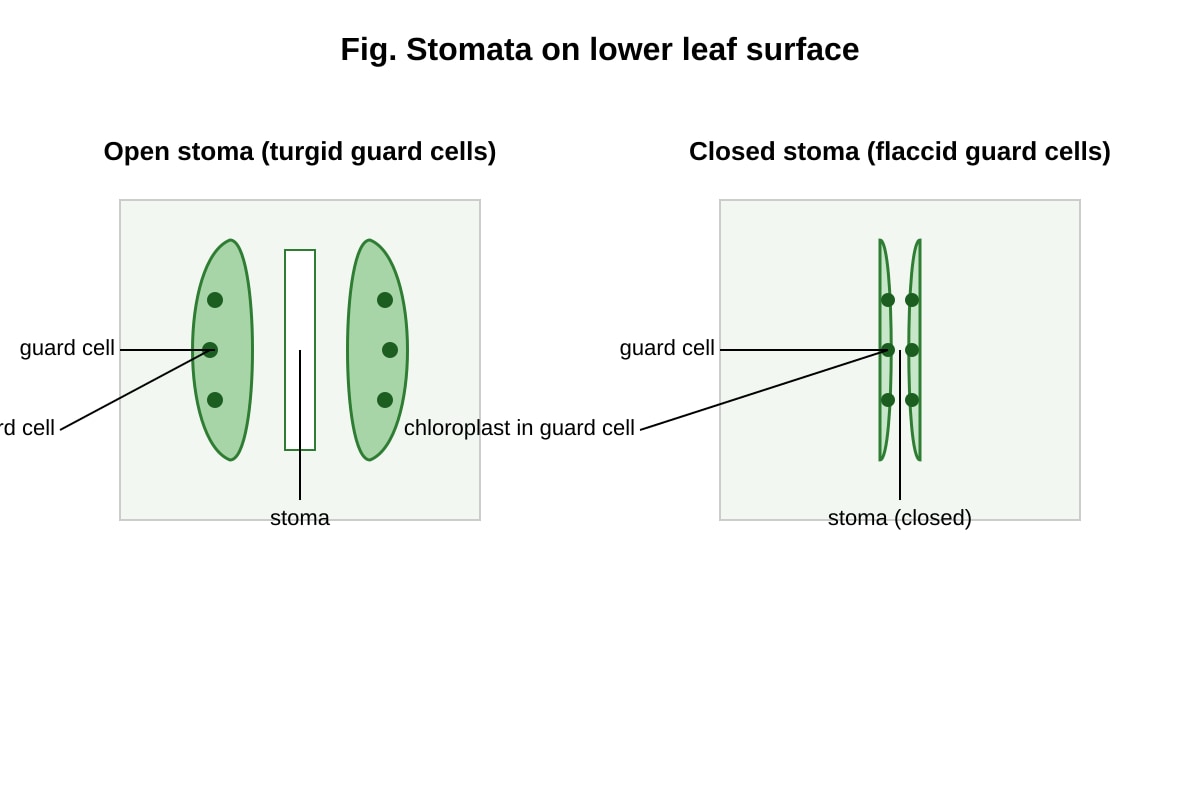
10. [3] Guard cells have chloroplasts and uneven thickening; in light they photosynthesise, accumulate sugars, water enters by osmosis, they become turgid and stoma opens; at night they lose water, become flaccid, stoma closes. (1 mark turgid open, 1 mark flaccid close, 1 mark mechanism.)
11. [2] Xylem: transports water and mineral ions from roots to leaves. Phloem: transports dissolved sugars (food) from leaves to rest of plant. (1 mark each.)
12. [2] % change = .
Marking: 1 mark correct substitution, 1 mark answer -4%.
13. [2] Fertilisers are concentrated; lower water potential outside roots than inside; water leaves root cells by osmosis; cells become plasmolysed, plant loses turgor and wilts. (1 mark cause, 1 mark effect.)
14. [2] Broad flat shape for large surface area; chloroplasts for light absorption; thin leaves short diffusion path; stomata for gas exchange. (Any 2, 1 mark each.)
15. [3] (a) [1] To use up stored starch so test starts negative. (b) [2] Iodine solution; brown/yellow → blue-black.
Section C Answers (4 marks each)
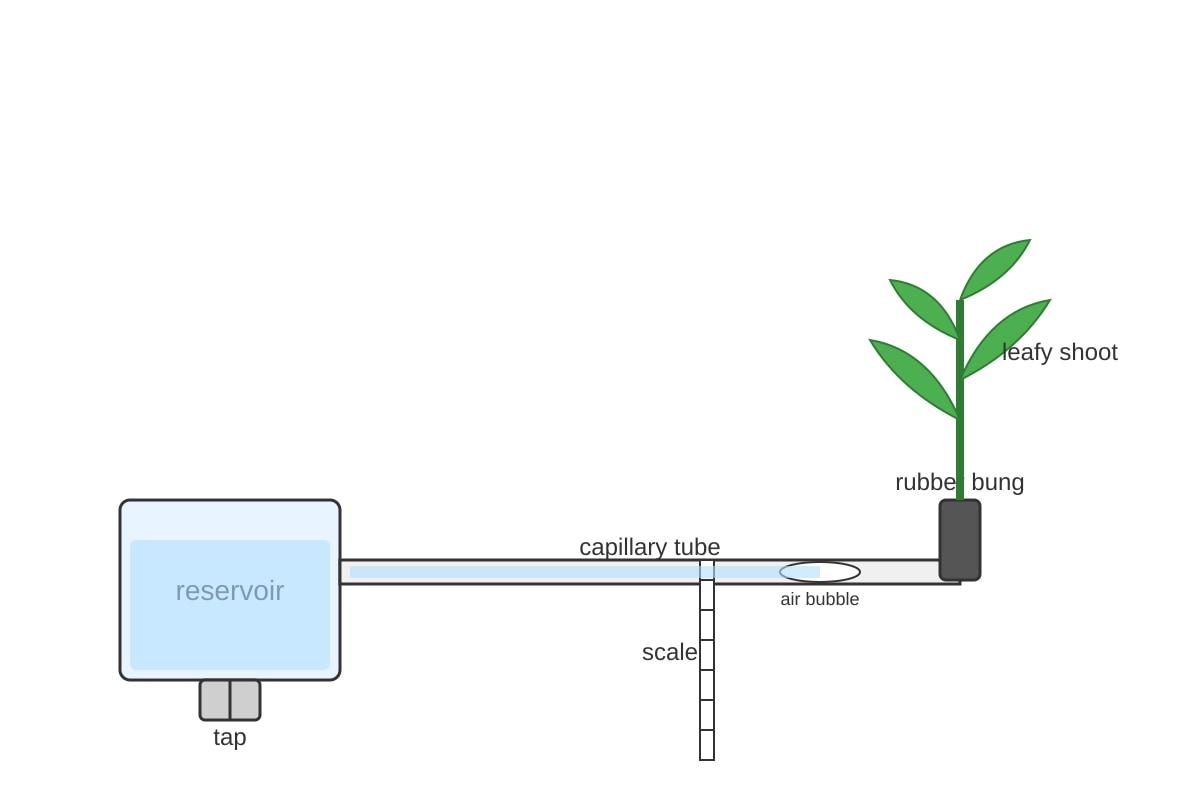
16. [4] Fill reservoir, insert shoot airtight, open tap to introduce air bubble, note bubble position on scale, measure distance moved per time. Rate = distance/time. Precaution: seal joints to prevent leaks / keep conditions constant. (2 marks method, 1 mark rate calc, 1 mark precaution.)
17. [4] Water enters root hair cells by osmosis → moves across cortex via symplast/apoplast to xylem → pulled up xylem by transpiration pull (cohesion-tension) → evaporates from mesophyll → diffuses out stomata. (1 mark each stage: entry, cortex, xylem, atmosphere.)
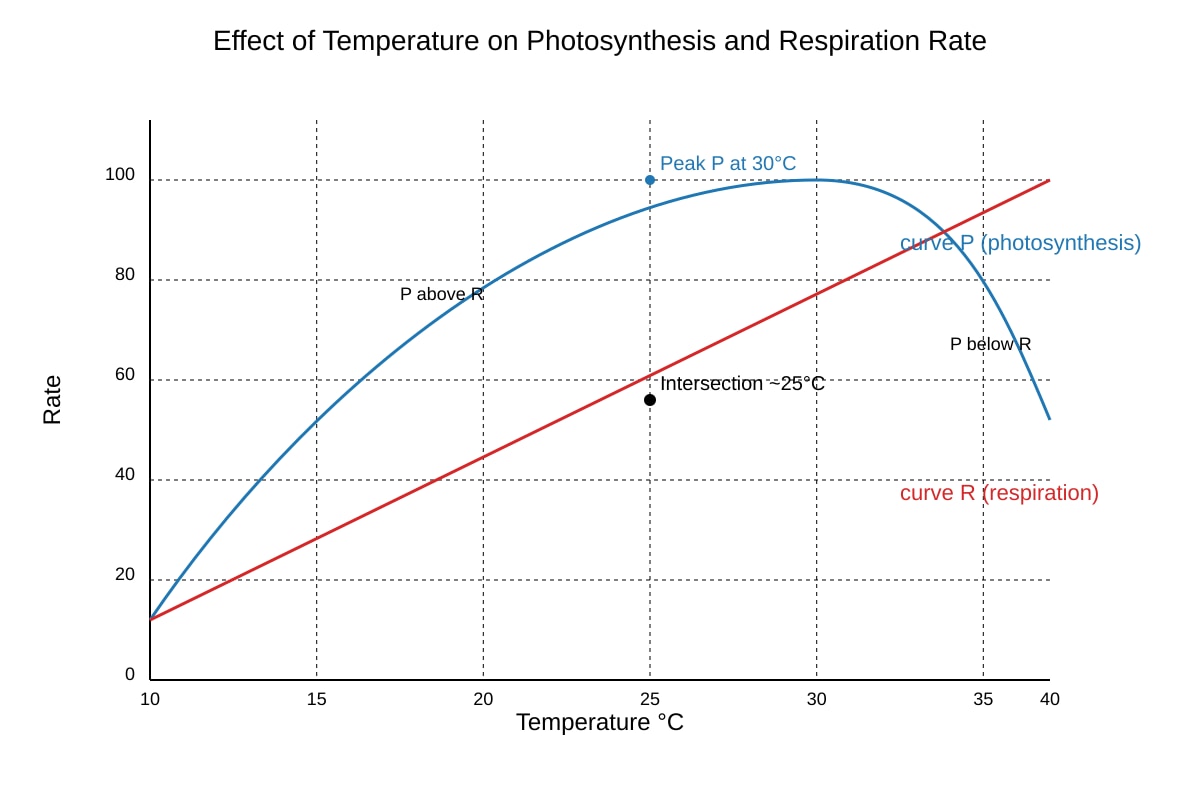
18. [4] Net productivity = photosynthesis − respiration. Below ~25°C net positive (P>R); peaks near 30°C; above 35°C respiration exceeds photosynthesis, net negative. Net photosynthesis zero at intersection ~25°C. (1 mark definition, 1 mark trend, 1 mark intersection, 1 mark interpretation.)
19. [4] (1) Increase CO₂ (e.g., paraffin heater) → more substrate for photosynthesis, higher rate. (2) Supplementary light → extend photoperiod/overcome light limit. (3) Optimal temp 25–30°C → enzymes work well. (Any 2 with explanation, 2 marks each.)
20. [4] Water: upward from root to leaf, passive (transpiration pull, cohesion), xylem. Sucrose: source to sink (e.g., leaf to root), active (pressure flow), phloem. (1 mark direction each, 1 mark mechanism each, tissue implied.)