AI Generated Quiz
Secondary 4 Pure Biology Human Physiology Quiz
Free Sec 4 Pure Biology Human Physiology quiz, HY3 AI version, with questions, answers, and O Level-style practice for Singapore students.
These static practice materials are generated from the site's syllabus and paper-generation workflow, with source and model context shown so students and parents can evaluate the material before use.
Questions


Free quiz and exam paper access
Enter your details to view this paper
Your access is remembered on this device.
Answers
Secondary 4 Pure Biology Quiz - Human Physiology (Answer Key)
Total Marks: 40
Topic: Human Physiology
Note: Content generated from LLM-inferred Stage 4 templates. Not derived from past-year exam papers; syllabus-aligned practice only.
Section A: Short Answer
1. [1] Peristalsis
Teaching note: Peristalsis is the wave-like contraction of circular and longitudinal muscles in the oesophagus (and other parts of the gut) that pushes food along. Do not confuse with chewing (mechanical digestion) or segmentation.
2. [1] Absorb nutrients (e.g. glucose, amino acids) / increase surface area for absorption.
Teaching note: Villi are finger-like projections of the small intestine wall; they increase surface area and contain capillaries and lacteals for absorption.
3. [1] Insulin
Teaching note: Insulin is released by the pancreas (β-cells of islets of Langerhans) when blood glucose is high; it lowers blood glucose by promoting uptake by liver and muscle.
4. [1] Kidney
Teaching note: Kidneys filter blood; urine is formed in nephrons. The liver detoxifies but does not form urine.
5. [1] Homeostasis
Teaching note: Homeostasis is the maintenance of a constant internal environment (e.g. temperature, pH, glucose) despite external changes.
Section B: Structured Response
6. [3 total]
(a) [1] Liver
(b) [1] Gall bladder
(c) [1] Emulsifies fats / neutralises stomach acid (accept either)
Teaching note: Bile is produced in the liver, stored in gall bladder, released to duodenum. Emulsification breaks large fat droplets into smaller ones to increase surface area for lipase.
7. [3 total]
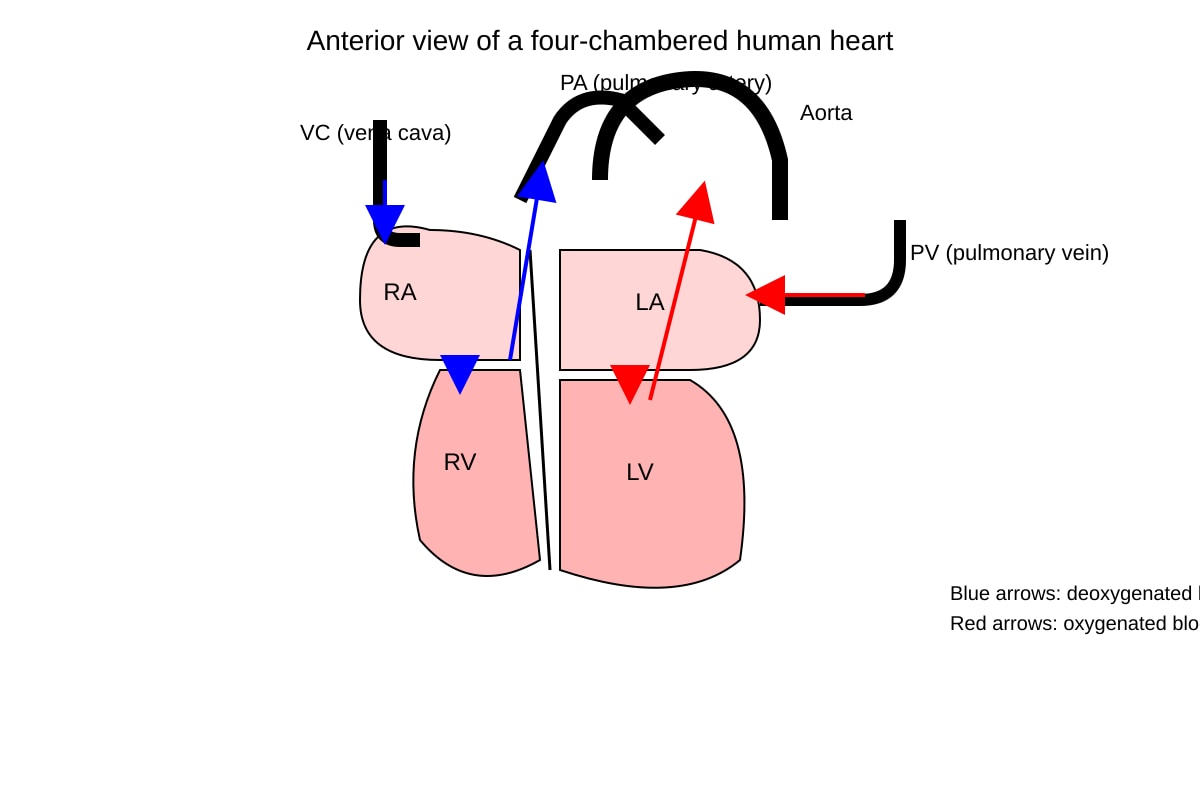
(a) [1] Left ventricle
(b) [2] Pulmonary artery carries deoxygenated blood; pulmonary vein carries oxygenated blood. (2 marks: one correct statement each)
Teaching note: Unlike most arteries, pulmonary artery carries deoxygenated blood from right ventricle to lungs. Pulmonary vein returns oxygenated blood to left atrium.
8. [3]
- Biconcave shape increases surface area for oxygen diffusion [1]
- No nucleus allows more space for haemoglobin [1]
- Contains haemoglobin to bind oxygen [1]
Teaching note: Adaptations link structure to function: more haemoglobin = more O₂ carried; biconcave = shorter diffusion distance.
9. [3]
- High blood glucose lowers water potential of blood [1]
- Water moves out of red blood cells by osmosis (down water potential gradient) [1]
- RBCs lose water, shrink (crenate), may be damaged [1]
Teaching note: Water moves from higher to lower water potential. Lower water potential in blood = water leaves cells. This is the same principle as plasmolysis in plant cells but animal cells crenate.
10. [3 total]
(a) [2] Diffusion is the net movement of particles from a region of higher concentration to a region of lower concentration (down concentration gradient).
(b) [1] Oxygen from alveoli to blood / CO₂ from blood to alveoli / glucose from gut to blood (any one).
Teaching note: Must include "net movement" and "down concentration gradient" for full marks.
11. [4]
- Osmoreceptors detect high water content [1]
- Pituitary gland releases less ADH [1]
- Kidney collecting ducts become less permeable to water [1]
- More water lost in urine (dilute urine) [1]
Teaching note: ADH = antidiuretic hormone. Low ADH = less water reabsorbed = larger volume of dilute urine. This is negative feedback.
12. [3 total]
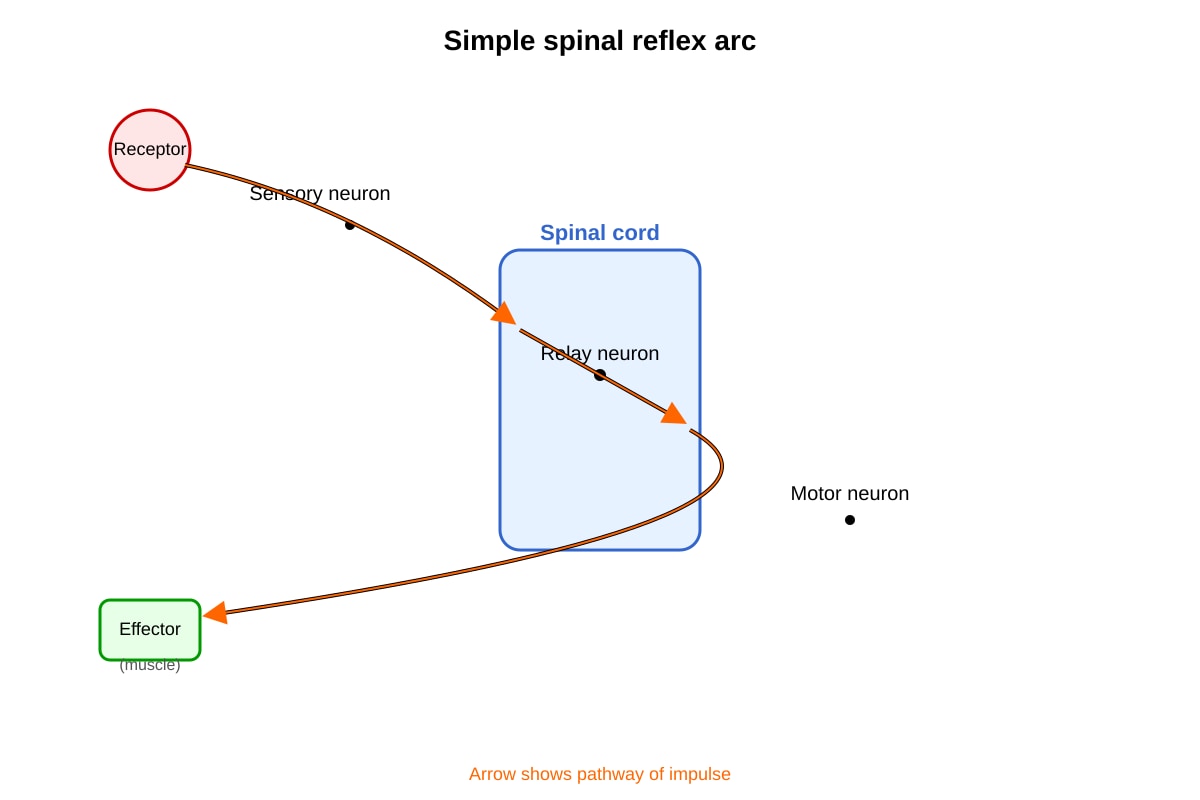
(a) [1] Sensory neuron (afferent neuron)
(b) [2] Relay neuron connects sensory to motor neuron within spinal cord allowing rapid reflex response without brain involvement.
Teaching note: Reflex arc bypasses brain for speed; relay neuron is in grey matter of spinal cord.
13. [4 total]
(a) [1] Oxygen (O₂)
(b) [3] Thin walls (short diffusion distance) [1]; large surface area (many alveoli) [1]; moist lining (gases dissolve) [1].
Teaching note: Gas exchange needs thin, moist, large surface area — same principle as villi and leaf mesophyll.
Section C: Data and Diagram Interpretation
14. [3 total]
(a) [1] Transpiration rate increases with light intensity.
(b) [2] Stomata open wider in bright light for photosynthesis; more water vapour exits leaves.
Teaching note: Light stimulates guard cells to open stomata; transpiration is water loss from stomata.
15. [4 total]
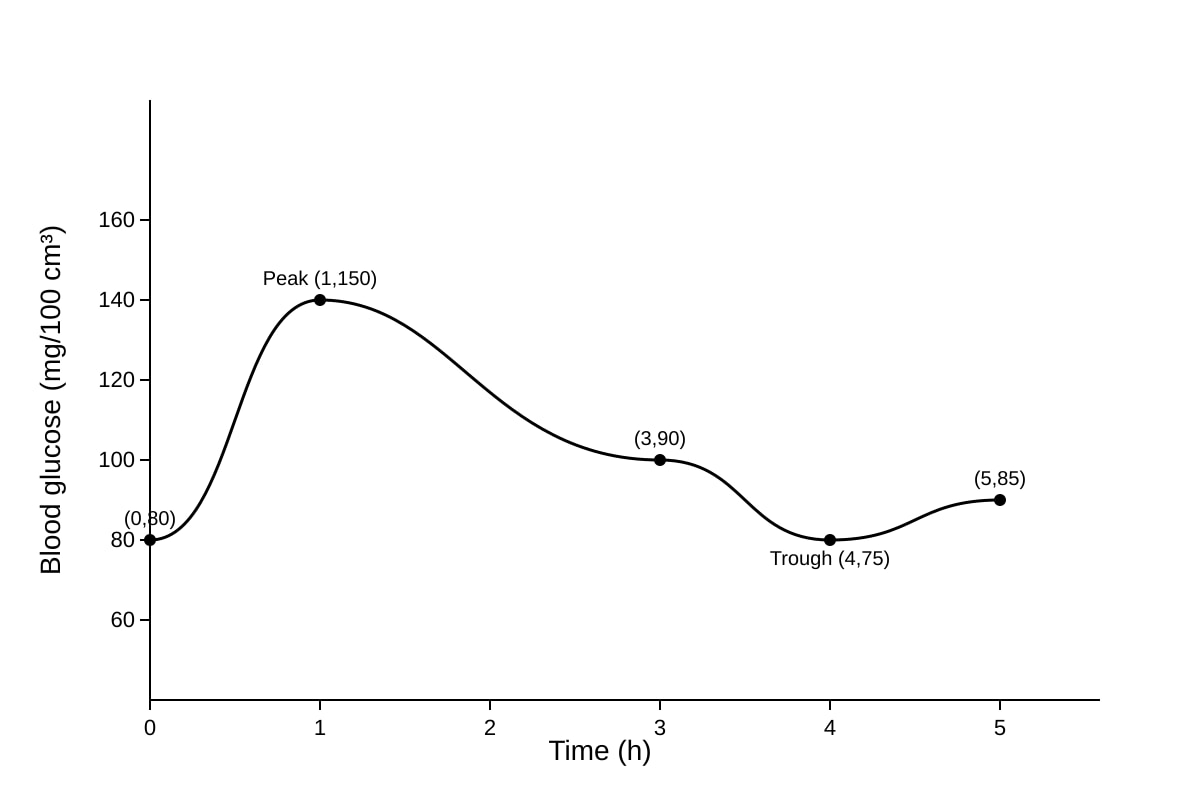
(a) [1] 150 mg/100 cm³
(b) [3] Insulin released after meal [1]; glucose absorbed by liver/muscle cells [1]; converted to glycogen so blood level falls [1].
Teaching note: Read graph at x=1 h. Drop due to insulin action (homeostasis).
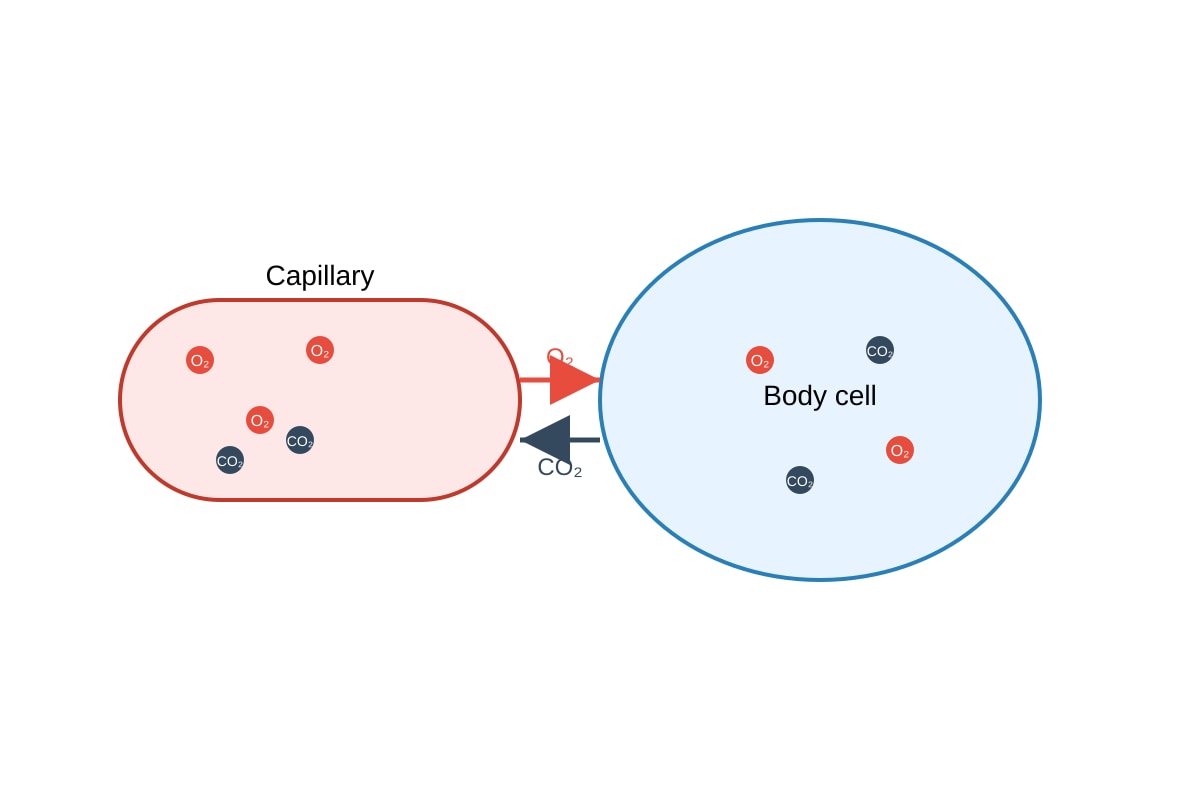
16. [1] Diffusion
Teaching note: O₂ moves from high concentration in capillary to low concentration in cell by diffusion; no energy needed.
17. [4 total]
(a) [2] % decrease = (140 − 78) / 140 × 100 = 62 / 140 × 100 = 44.3% (accept 44%).
Working:
Initial = 140, final = 78
Decrease = 62
% = 62/140 × 100 = 44.3%
(b) [2] Body still recovering; O₂ debt being repaid / remaining adrenaline / temperature still raised.
Teaching note: Show substitution clearly. Pulse stays above resting (≈70) due to continued elevated metabolism.
18. [3 total]
(a) [1] Ultrafiltration
(b) [2] Glucose, amino acids, water, salts (any two named = 2 marks; one = 1 mark).
Teaching note: Filtration forces small molecules into Bowman's capsule; PCT reabsorbs useful molecules actively.
19. [3 total]
(a) [1] Flattens / contracts downward
(b) [2] Flattening increases vertical chest dimension; rib muscles lift ribs outward; total volume increases, pressure falls, air enters.
Teaching note: Inhalation is active; diaphragm contracts. Exhalation is passive recoil.
20. [4 total]
(a) [1] Diabetes mellitus (Type 1)
(b) [3] No insulin produced [1]; glucose cannot enter cells efficiently [1]; remains in blood so concentration rises [1].
Teaching note: Type 1 = autoimmune pancreatic damage. Without insulin, cells cannot take up glucose; kidneys excrete some (glucose in urine).