AI Generated Quiz
Secondary 4 Pure Biology Genetics Inheritance Quiz
Free Sec 4 Pure Biology Genetics Inheritance quiz, HY3 AI version, with questions, answers, and O Level-style practice for Singapore students.
These static practice materials are generated from the site's syllabus and paper-generation workflow, with source and model context shown so students and parents can evaluate the material before use.
Questions
Secondary 4 Pure Biology Quiz - Genetics Inheritance
Name: ___________________________
Class: ___________________________
Date: ___________________________
Score: _______ / 40
Duration: 50 minutes
Total Marks: 40
Instructions:
- Answer all 20 questions.
- Section A: Multiple-choice style short questions (1 mark each).
- Section B: Structured short-answer questions (2 marks each).
- Section C: Extended structured questions (3–4 marks each).
- Write your answers in the spaces provided.
- This quiz is syllabus-first practice content generated from LLM-inferred templates. It is not derived from past-year exam papers.
Section A (Questions 1–5, 1 mark each)
1. In humans, the allele for free earlobes (F) is dominant over the allele for attached earlobes (f). What is the genotype of a homozygous dominant individual?
2. What term describes the position of a gene on a chromosome?
3. How many chromosomes are normally found in a human body cell?
4. During which stage of meiosis do homologous chromosomes separate?
5. What is the name of the diagram used to show the inheritance of a trait through generations of a family?
Section B (Questions 6–10, 2 marks each)
6. A pea plant with genotype Tt (tall) is crossed with a tt (short) plant. State the possible genotypes of the offspring and their ratio.
7. Explain why sex-linked traits are more commonly expressed in males than females for X-linked recessive conditions.
8. Define the term "codominance" and give one example in humans.
9. A DNA sequence has the base order ATCGGCTA. State the complementary strand sequence.
10. State two differences between mitosis and meiosis in terms of chromosome number of daughter cells.
Section C (Questions 11–20, 3–4 marks each)
11. In a certain family, the father has blood group A (genotype I^A i) and the mother has blood group B (genotype I^B i).
(a) Draw a genetic cross to show the possible blood groups of their children. [3]
(b) State the probability that a child will have blood group O. [1]
12. Haemophilia is an X-linked recessive trait. A carrier female (X^H X^h) marries a normal male (X^H Y).
(a) Show the cross using a Punnett square. [2]
(b) What is the probability that their son will have haemophilia? [1]
(c) Explain why daughters are less likely to be affected. [1]
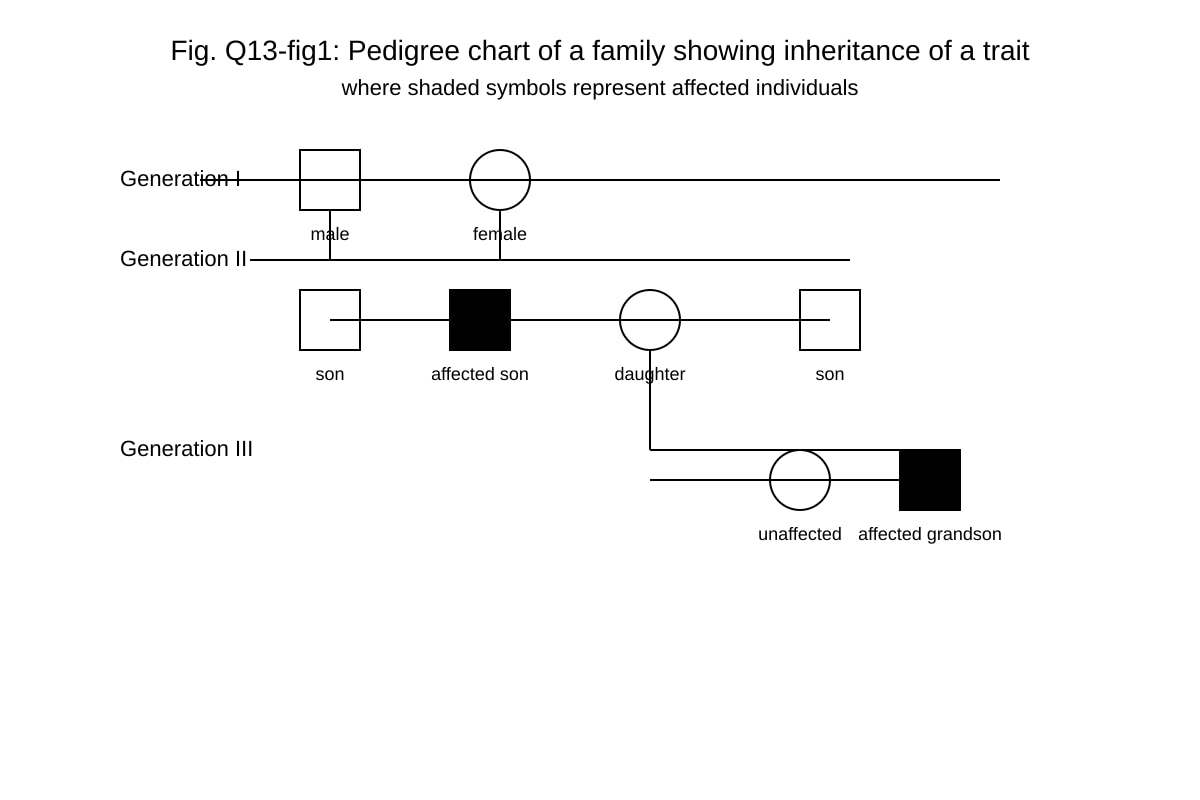
13.
Image pending generation: diagram for Q13.
The pedigree in Fig. Q13-fig1 shows a trait passed through three generations.
(a) State whether the trait is likely dominant or recessive. Give a reason. [2]
(b) If the trait is X-linked recessive, what is the genotype of the affected male in Generation II? [1]
(c) Explain how you determined your answer in (b). [1]
14. A farmer crosses a pure-breeding black goat (BB) with a pure-breeding white goat (bb). All F1 offspring are black.
(a) State the phenotype of the F1 generation and explain why. [2]
(b) If two F1 goats are crossed, what is the genotypic ratio of the F2 generation? [2]
15. In humans, the ability to roll the tongue (R) is dominant to non-rolling (r). A man who is homozygous recessive marries a heterozygous rolling woman.
(a) State the genotypes of the parents. [1]
(b) Show the cross and state the phenotypic ratio of their children. [3]
16. A student extracted DNA from a cell and found it contained 20% adenine.
(a) State the percentage of thymine, guanine, and cytosine. [2]
(b) Explain the rule you used. [2]
17.
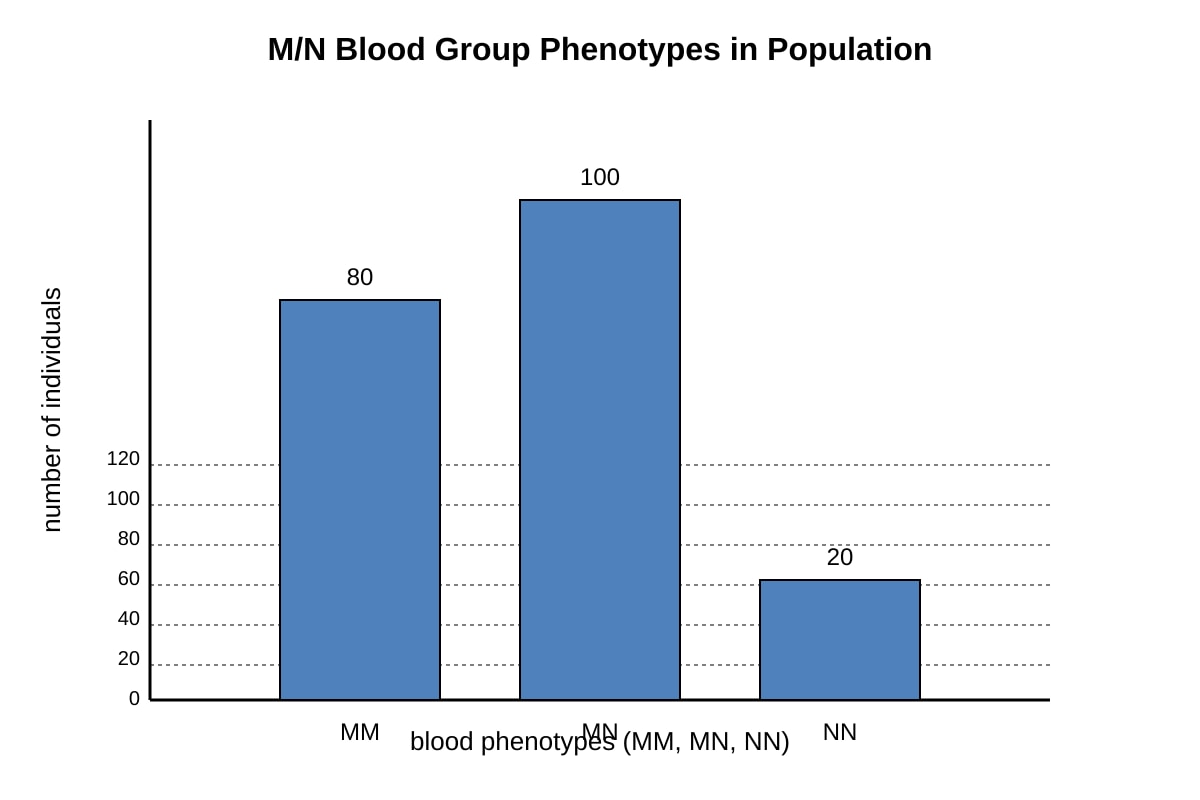
Image pending generation: graph for Q17.
The graph in Fig. Q17-fig1 shows M/N blood group phenotypes.
(a) State which phenotype is most common. [1]
(b) If M is codominant with N, explain the genotype of an MN individual. [1]
(c) Calculate the total number of alleles for M in this population. [2]
18. A genetic condition is caused by a dominant allele (D). Affected male (Dd) marries unaffected female (dd).
(a) Show the cross. [2]
(b) What is the chance their child will be unaffected? [1]
(c) State whether this condition appears in every generation if D is rare. [1]
19. Explain the difference between a gene and an allele, using an example of a trait with two alleles. [3]
20. A plant species has a diploid number of 12 chromosomes.
(a) How many chromosomes are in a gamete? [1]
(b) Explain why gamete chromosome number is halved. [2]
(c) State the process that produces gametes. [1]
Answers
Secondary 4 Pure Biology Quiz - Genetics Inheritance (Answer Key)
Total Marks: 40
Topic: Genetics Inheritance (syllabus-first, LLM-inferred; not past-year derived)
Section A (1 mark each)
1. FF
Teaching note: Homozygous dominant means two identical dominant alleles. F = free earlobes (dominant), so FF. Common mistake: writing Ff (heterozygous).
2. Locus
Teaching note: A locus is the fixed position of a gene on a chromosome. Do not confuse with "allele" (version of gene).
3. 46
Teaching note: Human somatic cells are diploid with 23 pairs = 46 chromosomes. Gametes have 23.
4. Anaphase I
Teaching note: In meiosis I, homologous chromosomes separate at anaphase I. Sister chromatids separate at anaphase II.
5. Pedigree (chart)
Teaching note: A pedigree diagram shows trait inheritance across generations. Not to be confused with a karyotype (chromosome image).
Section B (2 marks each)
6. Genotypes: Tt and tt in equal ratio 1:1.
Working: Tt × tt → gametes T, t and t, t → offspring Tt, tt, Tt, tt.
Marking: 1 mark for genotypes (Tt, tt), 1 mark for ratio 1:1.
7. Males have one X chromosome (XY). If they inherit one recessive allele on X, they express it. Females (XX) need two copies to be affected.
Marking: 1 mark for XY explanation, 1 mark for female needing two alleles.
8. Codominance: both alleles expressed equally in heterozygote. Example: AB blood group (I^A I^B).
Marking: 1 mark definition, 1 mark example.
9. TAGCCGAT
Teaching note: A pairs with T, C with G. Complementary strand read antiparallel.
Marking: 2 marks for full correct sequence.
10. Mitosis: daughter cells diploid (2n); Meiosis: daughter cells haploid (n). Mitosis: 2 cells; Meiosis: 4 cells.
Marking: 1 mark each difference (any two valid).
Section C (3–4 marks each)
11. (a) Cross: I^A i × I^B i
Gametes: I^A, i and I^B, i
Offspring: I^A I^B (AB), I^A i (A), I^B i (B), ii (O)
[3 marks: 1 for gametes, 2 for offspring types]
(b) Probability of O = 1/4 or 25%. [1 mark]
12. (a) Punnett: X^H X^h × X^H Y → X^H X^H, X^H X^h, X^H Y, X^h Y [2]
(b) Son affected = X^h Y = 1/2 of sons = 50% [1]
(c) Daughters get X^H from father, so protected unless mother gives X^h and father affected (not here). [1]
13. (a) Recessive: skips generations / unaffected parents have affected child. [2]
(b) X^h Y [1]
(c) Males have one X from mother; affected means X^h from carrier mother + Y from father. [1]
14. (a) All F1 black (Bb); B dominant over b. [2]
(b) F1 × F1: Bb × Bb → BB:Bb:bb = 1:2:1 [2]
15. (a) Man rr, woman Rr [1]
(b) Cross: rr × Rr → Rr, rr, Rr, rr → 1 rolling : 1 non-rolling [3: 2 for cross, 1 for ratio]
16. (a) T = 20%, G = 30%, C = 30% [2]
(b) Chargaff: A=T, G=C; A+T+G+C=100%. [2]
17. (a) MN (100) [1]
(b) Genotype MN (one M, one N allele). [1]
(c) M alleles: MM=80×2=160, MN=100×1=100, total=260. [2]
18. (a) Dd × dd → Dd, dd, Dd, dd [2]
(b) 50% (dd) [1]
(c) Yes, if D rare, appears every generation via heterozygotes. [1]
19. Gene = section of DNA for trait (e.g. earlobe gene). Allele = version (F or f). [3: 1 gene, 1 allele, 1 example]
20. (a) 6 [1]
(b) Meiosis halves to keep species number after fertilisation. [2]
(c) Meiosis [1]
Free quiz and exam paper access
Enter your details to view this paper
Your access is remembered on this device.