AI Generated Quiz
Secondary 4 Pure Biology Evolution Diversity Quiz
Free Sec 4 Pure Biology Evolution Diversity quiz, HY3 AI version, with questions, answers, and O Level-style practice for Singapore students.
These static practice materials are generated from the site's syllabus and paper-generation workflow, with source and model context shown so students and parents can evaluate the material before use.
Questions
Free quiz and exam paper access
Enter your details to view this paper
Your access is remembered on this device.
Answers
Secondary 4 Pure Biology Quiz - Evolution Diversity (Answer Key)
Total Marks: 40
Topic: Evolution Diversity (syllabus-first, Stage 4/5 generated; no Stage 3 past-year evidence for this topic)
Section A (1 mark each)
1. Natural selection
Teaching note: Natural selection is the mechanism where individuals with advantageous traits leave more offspring. Key idea: survival of the fittest is a consequence, not the cause.
2. Charles Darwin
Teaching note: Darwin and Wallace independently conceived the theory; Darwin published "On the Origin of Species" in 1859.
3. Species
Teaching note: Biological species concept defines species by reproductive isolation (fertile offspring).
4. Sexual reproduction / recombination / mutation
(Any one acceptable) Teaching note: Fusion of gametes mixes parental genes, creating new combinations.
5. Disruptive selection
Teaching note: Opposite of stabilising selection; extremes favoured, intermediate selected against.
6. Analogous structures
Teaching note: E.g., insect wing vs bird wing – same function, different origin.
7. Co-evolution
Teaching note: E.g., flowers and their pollinators shaping each other.
8. Geographical isolation
Teaching note: Also called allopatric speciation when combined with divergence.
9. Population
Teaching note: Evolution occurs in populations, not individuals, across generations.
10. Habitat destruction / pollution / overfishing
(Any one) Teaching note: Human impact reduces biodiversity.
Section B (2 marks each)
11. [2 marks]
- Random mutation produces resistant bacteria. (1)
- Non-resistant die from antibiotic; resistant survive and reproduce, increasing frequency. (1)
Teaching note: Selection acts on existing variation; antibiotic does not create resistance.
12. [2 marks]
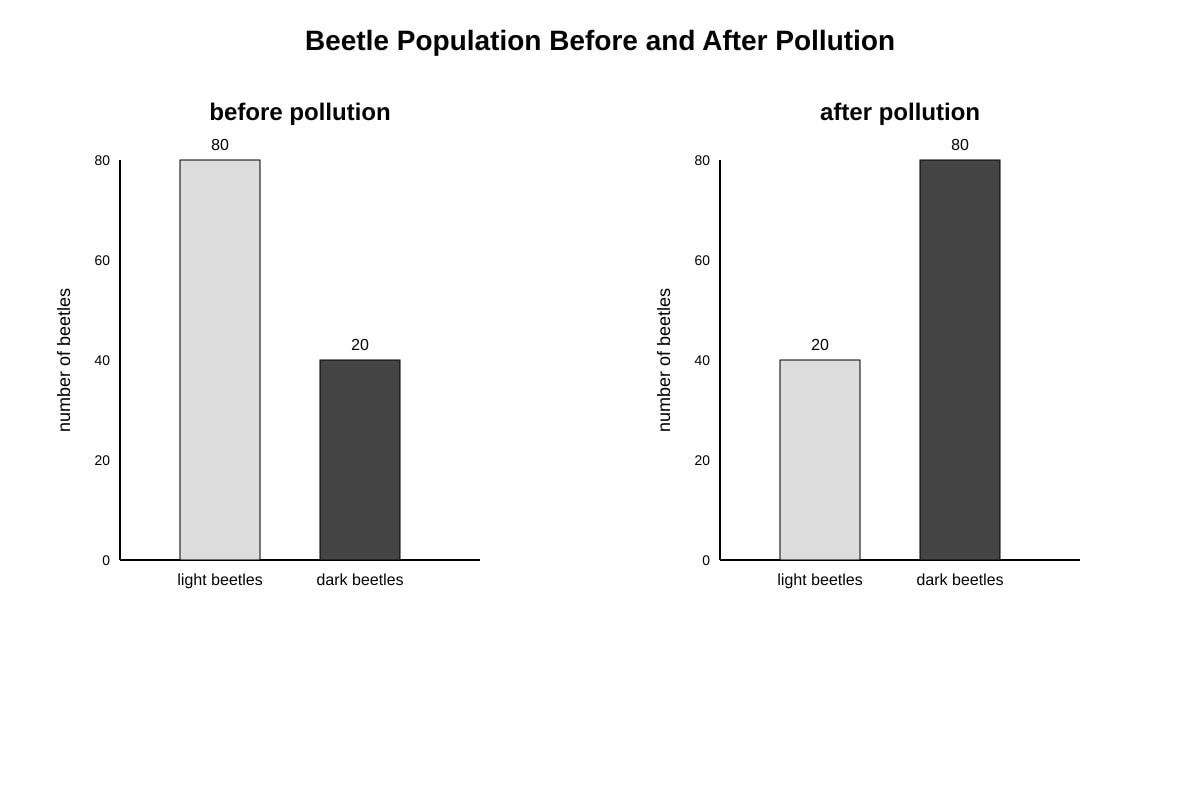
- Light beetles decreased (80→20), dark increased (20→80). (1)
- Directional selection (towards dark phenotype). (1)
Teaching note: Pollution changed background, favouring camouflage.
13. [2 marks]
- Convergent evolution: unrelated species develop similar traits due to similar environments. (1)
- Example: dolphin (mammal) and shark (fish) both have streamlined bodies. (1)
14. [2 marks]
- Genetic drift is random; natural selection is non-random. (1)
- Drift stronger in small populations; selection depends on fitness. (1)
15. [2 marks]
- Homologous structures share anatomy from common ancestor (e.g., limb bones). (1)
- Similar layout despite different functions shows descent with modification. (1)
16. [2 marks]
- Allopatric speciation. (1)
- Barrier: behavioural difference / temporal mating / sterile hybrids. (1)
Section C (3 marks each)
17. [3 marks]
- Before pollution, white moths camouflaged on light bark, avoided predators. (1)
- Pollution darkened bark; white became visible, black camouflaged. (1)
- Predation shifted; black survivors reproduced, allele frequency for black increased. (1)
Teaching note: Demonstrates differential survival by phenotype.
18. [3 marks]
- D is most closely related to C (sister group). (1)
- Cladogram shows shared branch point: C and D share derived character not in B or A. (1)
- Closer branching = more recent common ancestor. (1)
19. [3 marks]
- Variation arises by mutation/recombination within isolated groups. (1)
- Inheritance passes favourable traits to offspring. (1)
- Over time, accumulation of differences causes reproductive isolation. (1)
20. [3 marks]
- False; evolution is adaptation to environment, not progress. (1)
- Example: parasites become simpler (loss of structures). (1)
- Example: cave fish lose eyes – less complex but advantageous. (1)