AI Generated Quiz
Secondary 4 Pure Biology Ecology Quiz
Free Sec 4 Pure Biology Ecology quiz, HY3 AI version, with questions, answers, and O Level-style practice for Singapore students.
These static practice materials are generated from the site's syllabus and paper-generation workflow, with source and model context shown so students and parents can evaluate the material before use.
Questions
Free quiz and exam paper access
Enter your details to view this paper
Your access is remembered on this device.
Answers
Secondary 4 Pure Biology Quiz - Ecology (Answer Key)
Total Marks: 40
Topic: Ecology
Level: Secondary 4 Pure Biology
Note: This quiz is syllabus-first content generated from LLM-inferred patterns. It is not derived from past-year exam papers.
Section A Answers (1 mark each)
1. Population
Teaching note: A population is a group of individuals of the same species living in the same habitat at the same time. Do not confuse with "community" (multiple species).
2. Abiotic factors
Teaching note: Abiotic = non-living. Examples: light, temperature, water, soil pH. Biotic = living.
3. Predation / competition / disease (any one biotic factor)
Teaching note: Biotic factors are living influences. A predator population increase would reduce herbivore numbers.
4. Photosynthesis
Teaching note: Plants and algae use CO₂ + H₂O → glucose + O₂, removing CO₂ from air.
5. Primary consumers
Teaching note: Producers (level 1) → primary consumers (level 2, herbivores).
6. Carrying capacity
Teaching note: Symbolised as K in ecology; limited by food, space, predators.
7. Bacteria / fungi (any one decomposer)
Teaching note: Decomposers break down dead organic matter, returning nutrients.
8. Pyramid of numbers
Teaching note: Pyramid of numbers counts organisms; pyramid of biomass measures mass; pyramid of energy measures energy flow.
Section B Answers (2–4 marks each)
9. [2]
Definition: An ecosystem is a community of living organisms (plants, animals, microbes) interacting with each other and with the non-living (abiotic) components of their environment in a particular area.
Marking: 1 mark for community of organisms, 1 mark for interaction with abiotic environment.
Teaching note: Must include both biotic and abiotic parts and their interaction.
10. [3]
- Water shortage reduces plant growth and survival (1).
- Fewer plants → less food for herbivores (1).
- Herbivore population declines due to starvation / emigration (1).
Teaching note: Shows interdependence; link abiotic (water) → producer → primary consumer.
11. [2]
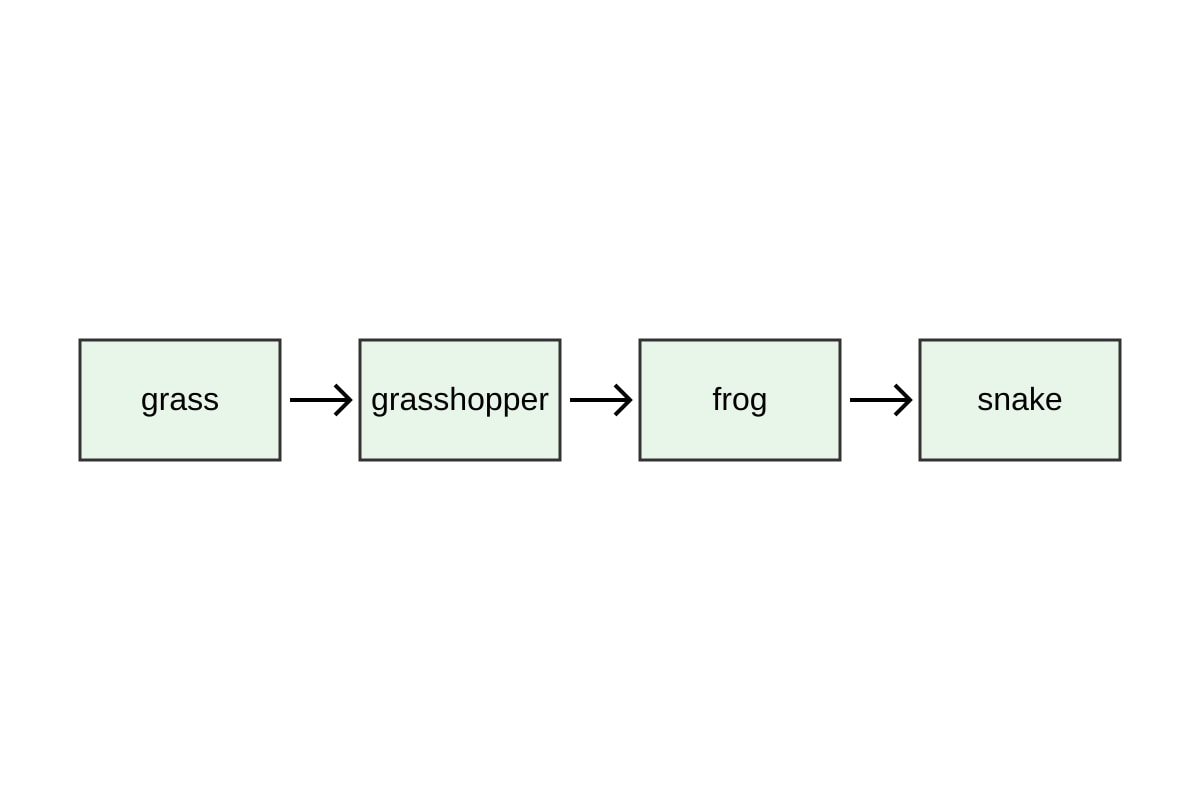
Trophic level of frog: Secondary consumer / Level 3 (1)
Secondary consumer: frog (1)
Teaching note: grass = producer (L1), grasshopper = primary consumer (L2), frog = secondary (L3), snake = tertiary (L4).
12. [2]
Any two: burning fossil fuels (1), deforestation (1), cement production, livestock farming (methanogenesis also adds GHG but CO₂ from respiration/land use).
Teaching note: Must be human activities that raise atmospheric CO₂.
13. [3]
- Population = group of same species (algae or fish) in the pond (1).
- Algae produce food/oxygen via photosynthesis (1).
- Fish depend on algae for food; fish waste/decay returns nutrients to algae (1).
Teaching note: Interdependence = mutual resource linkage.
14. [2]
Working: (1 200 / 12 000) × 100 = 10% (1)
Answer: 10% (1)
Teaching note: Energy transfer % = (energy at level n / energy at previous level) × 100.
Section C Answers (3–5 marks each)
15. [5 total: (a) 2, (b) 3]
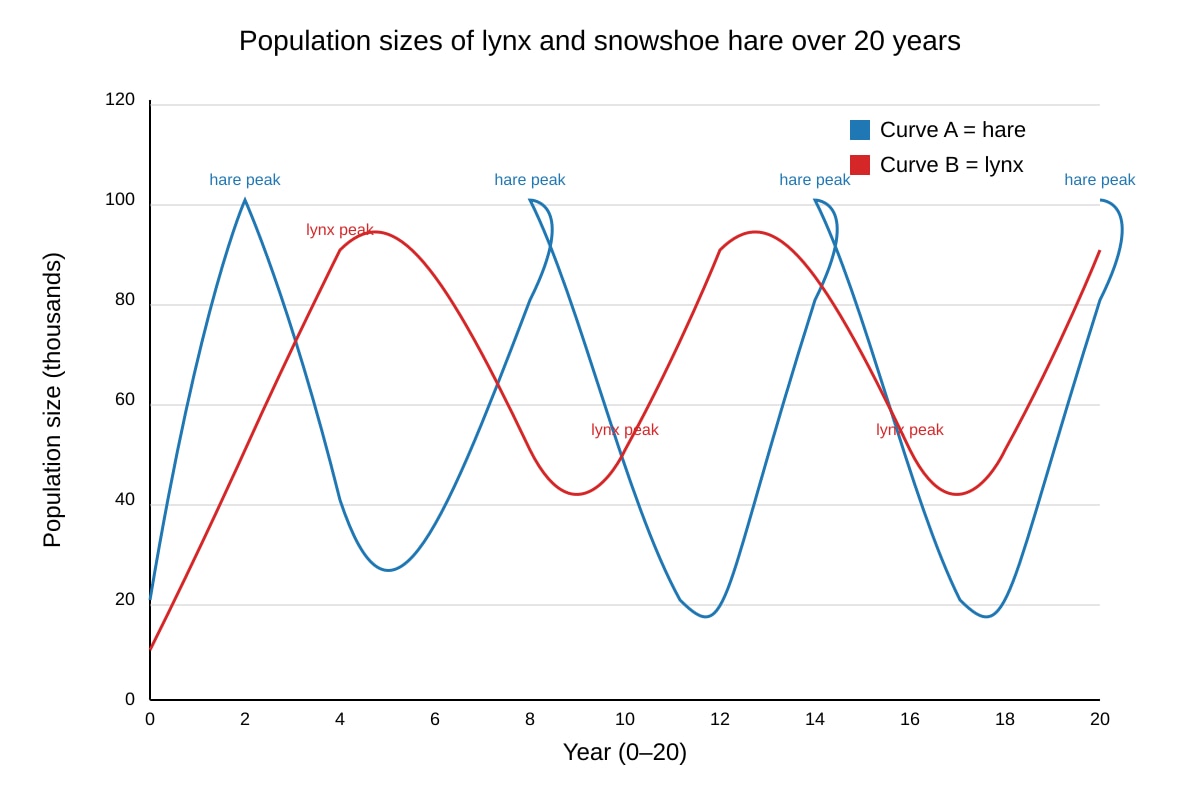
(a) [2] Hare population rises first, then lynx follows about 2 years later (1). Both show cyclical rises and falls (1).
(b) [3] Lynx eat hares, so when hares are plentiful lynx have more food and reproduce (1). Lynx numbers increase, causing more hare predation (1). Hare numbers then drop, reducing lynx food, so lynx decline (1). This predator-prey cycle repeats.
16. [5]
- Nitrogen gas (N₂) fixed by nitrogen-fixing bacteria in soil/roots into nitrates (1).
- Plants absorb nitrates to make proteins (1).
- Consumers eat plants, passing nitrogen through food chain (1).
- Decomposers break down dead organisms, releasing ammonia ( ammonification ) (1).
- Nitrifying bacteria convert ammonia to nitrates; denitrifying bacteria return N₂ to air (1).
Teaching note: Must name bacterial roles: nitrogen-fixing, decomposer/ammonifying, nitrifying, denitrifying.
17. [3]
- Earthworms burrow, aerating soil (1).
- They mix organic matter with soil, aiding decomposition (1).
- Worm casts add nutrients, improving fertility for tomato plants (1).
18. [5 total: (a) 1, (b) 4]
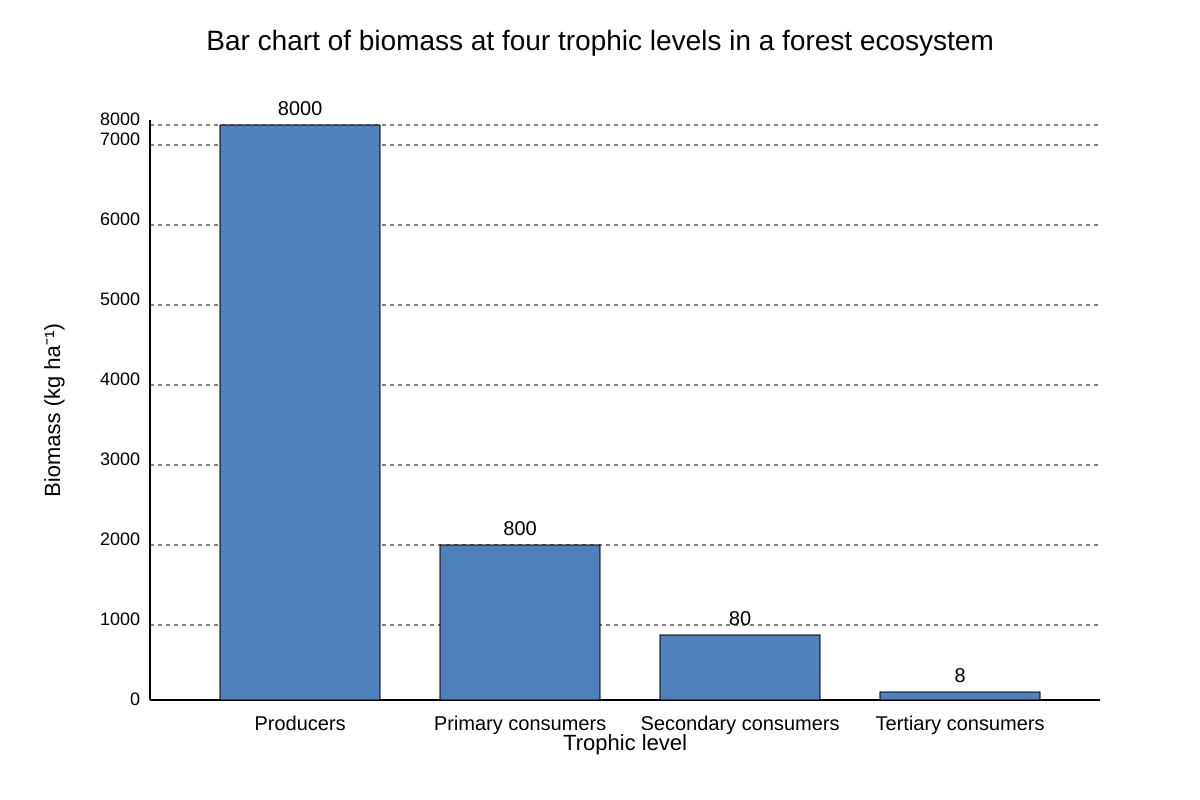
(a) [1] Biomass decreases from producers to tertiary consumers (pyramid shape).
(b) [4] Not all energy transferred: ~10% rule (1). Much energy lost as heat in respiration (1). Some parts not eaten / not digested (1). So less biomass supported at higher levels (1).
19. [4]
- Fertilisers add nitrates to river (1).
- Algae grow rapidly (algal bloom) = eutrophication (1).
- Algae die, decomposers multiply using O₂ (1).
- Oxygen depletion kills fish/aquatic life (1).
20. [5]
- Energy enters as sunlight, flows unidirectionally through trophic levels (1).
- Energy lost as heat at each level, not recycled (1).
- Nutrients (C, N, water) are recycled within ecosystem (1).
- Decomposers return nutrients to soil/air (1).
- Thus energy is unidirectional, nutrients are recycled (1).