AI Generated Quiz
Secondary 4 Pure Biology Cells Biomolecules Quiz
Free AI-Generated Secondary 4 Pure Biology Cells Biomolecules quiz with questions and answers for Singapore students. This page is rendered as a direct URL so the questions and answers can be discovered without pressing in-page buttons.
These static practice materials are generated from the site's syllabus and paper-generation workflow, with source and model context shown so students and parents can evaluate the material before use.
Questions
Secondary 4 Pure Biology Quiz - Cells Biomolecules
Name: _________________ Class: _________ Date: _________
Score: _____ / 50 Duration: 45 minutes
Instructions:
- Answer all questions in the spaces provided
- Show all working for calculations
- Use appropriate scientific terminology
Section A: Multiple Choice [10 marks]
Choose the best answer for each question. Write the letter in the box provided.
-
Which organelle is the site of protein synthesis? a) Mitochondrion b) Ribosome c) Golgi apparatus d) Nucleus
Answer: [ ]
-
The movement of water molecules across a semi-permeable membrane is called: a) Active transport b) Diffusion c) Osmosis d) Facilitated diffusion
Answer: [ ]
-
Which enzyme breaks down starch into maltose? a) Pepsin b) Lipase c) Amylase d) Catalase
Answer: [ ]
-
Root hair cells are specialized for: a) Photosynthesis b) Water absorption c) Support d) Protection
Answer: [ ]
-
The lock-and-key model explains: a) DNA replication b) Enzyme action c) Cell division d) Osmosis
Answer: [ ]
Section B: Structured Questions [25 marks]
6. Cell Structure and Function [8 marks]
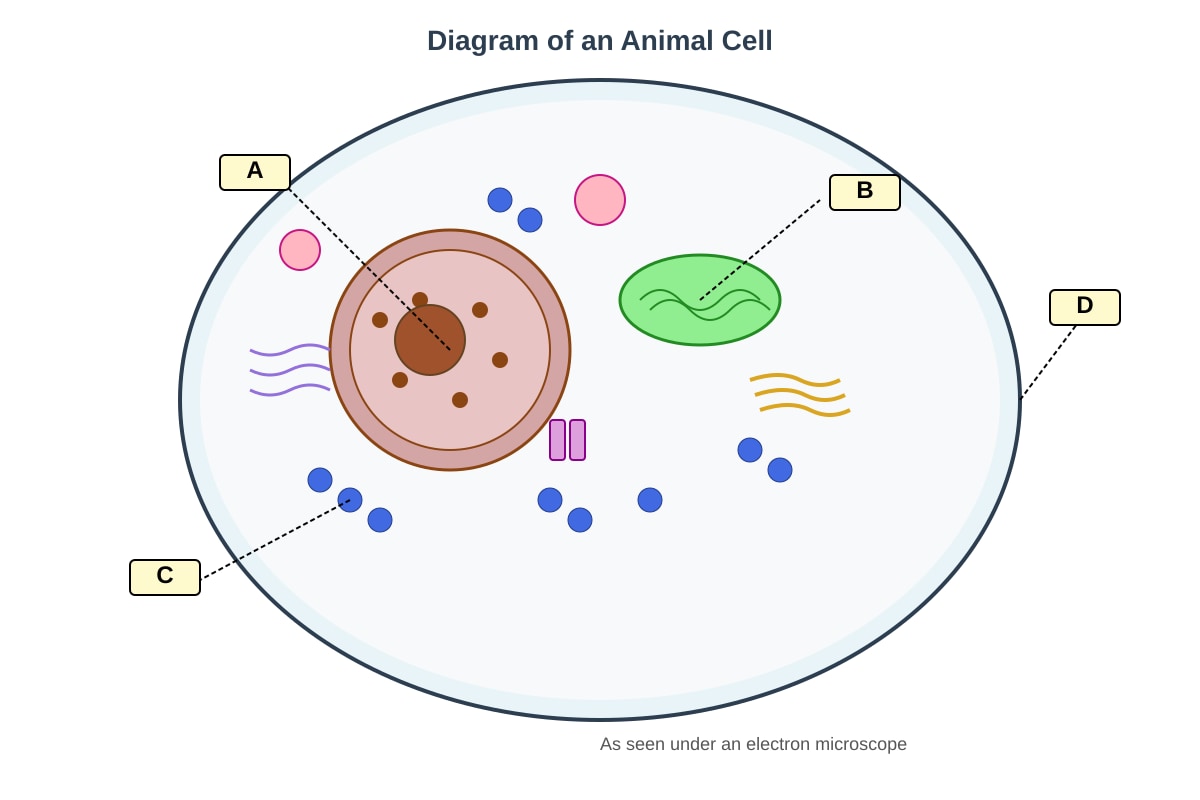
The diagram below shows an animal cell as seen under an electron microscope.
[Diagram shows cell with labeled structures A, B, C, D representing nucleus, mitochondrion, ribosome, and cell membrane respectively]
a) Name the structures labeled A to D. [4 marks]
A: _________________________
B: _________________________
C: _________________________
D: _________________________
b) State the function of structure B. [2 marks]
c) Explain why structure C appears as small dots in the diagram. [2 marks]
7. Enzyme Investigation [9 marks]
An investigation was carried out to study the effect of temperature on catalase activity. The enzyme catalase breaks down hydrogen peroxide into water and oxygen. The results are shown in the table below.
| Temperature (°C) | Volume of oxygen produced in 2 minutes (cm³) |
|---|---|
| 10 | 5 |
| 20 | 12 |
| 30 | 28 |
| 40 | 35 |
| 50 | 20 |
| 60 | 8 |
| 70 | 0 |
a) Calculate the rate of oxygen production at 30°C. Show your working. [2 marks]
Working: _________________________________
Rate: _____________ cm³/minute
b) Describe the relationship between temperature and enzyme activity shown in the results. [3 marks]
c) Explain why the enzyme activity decreases above 40°C. [2 marks]
d) Predict what would happen to enzyme activity at 80°C. Give a reason for your answer. [2 marks]
Prediction: ________________________________
Reason: ___________________________________
8. Transport Across Membranes [8 marks]
A student placed potato strips in solutions of different concentrations and measured the change in length after 2 hours. The results are shown below.
| Solution concentration (%) | Change in length (mm) |
|---|---|
| 0 (distilled water) | +8 |
| 5 | +3 |
| 10 | 0 |
| 15 | -4 |
| 20 | -7 |
a) Name the process responsible for the changes in length. [1 mark]
b) Explain why the potato strip increased in length in distilled water. [3 marks]
c) What can you conclude about the concentration of the cell sap in the potato cells? [2 marks]
d) Suggest what would happen to the potato cells in the 20% solution at the microscopic level. [2 marks]
Section C: Extended Response [15 marks]
9. Biological Molecules and Food Tests [15 marks]
A student wants to test different foods for the presence of starch, reducing sugars, and proteins.
a) Complete the table below to show the correct reagent and positive result for each food test. [6 marks]
| Food component | Reagent used | Positive result |
|---|---|---|
| Starch | ||
| Reducing sugars | ||
| Proteins |
b) The student tested three unknown food samples (X, Y, Z) and obtained the following results:
Sample X: Blue-black color with iodine, brick-red precipitate with Benedict's solution Sample Y: No color change with iodine, brick-red precipitate with Benedict's solution Sample Z: Purple color with biuret reagent, no color change with Benedict's solution
Identify what food components are present in each sample. [3 marks]
Sample X contains: __________________________
Sample Y contains: __________________________
Sample Z contains: __________________________
c) Explain why it is important to use a control in food tests. Give an example of a suitable control. [3 marks]
Example: ____________________________________
d) Describe the role of enzymes in the digestion of the food components tested above. [3 marks]
End of Quiz
Answers
Secondary 4 Pure Biology Quiz - Cells Biomolecules (Answer Key)
Section A: Multiple Choice [10 marks - 1 mark each]
-
b) Ribosome
- Ribosomes are the sites of protein synthesis where mRNA is translated
-
c) Osmosis
- Osmosis is specifically the movement of water molecules across a semi-permeable membrane
-
c) Amylase
- Amylase breaks down starch into maltose (a disaccharide)
-
b) Water absorption
- Root hair cells have large surface area and thin walls for efficient water uptake
-
b) Enzyme action
- The lock-and-key model explains how enzymes have specific active sites for substrates
Section B: Structured Questions [25 marks]
6. Cell Structure and Function [8 marks]
a) Name the structures [4 marks - 1 mark each]
- A: Nucleus ✓
- B: Mitochondrion ✓
- C: Ribosome ✓
- D: Cell membrane ✓
b) Function of structure B [2 marks] Site of aerobic respiration ✓ / produces ATP ✓ Accept: releases energy from glucose, cellular respiration
c) Why structure C appears as dots [2 marks] Ribosomes are very small organelles ✓ so appear as small dots under electron microscope ✓ Accept: limited resolution, small size relative to other organelles
7. Enzyme Investigation [9 marks]
a) Rate calculation [2 marks] Working: 28 ÷ 2 ✓ Rate: 14 cm³/minute ✓
b) Relationship description [3 marks] Activity increases from 10°C to 40°C ✓ then decreases from 40°C to 70°C ✓ with optimum at 40°C ✓ Accept: bell-shaped curve, increases then decreases
c) Explanation for decrease above 40°C [2 marks] High temperature denatures the enzyme ✓ active site changes shape / enzyme-substrate complex cannot form ✓ Accept: enzyme structure is damaged, loses function
d) Prediction at 80°C [2 marks] Prediction: No activity / zero oxygen production ✓ Reason: Enzyme completely denatured at this temperature ✓
8. Transport Across Membranes [8 marks]
a) Process name [1 mark] Osmosis ✓
b) Explanation for increase in distilled water [3 marks] Water potential of distilled water is higher than cell sap ✓ water moves into cells by osmosis ✓ cells become turgid and tissue expands ✓
c) Conclusion about cell sap concentration [2 marks] Cell sap concentration is approximately 10% ✓ because no change in length at this concentration ✓ Accept: isotonic at 10%, water potential equal at 10%
d) Microscopic changes in 20% solution [2 marks] Cell membrane pulls away from cell wall ✓ plasmolysis occurs ✓ Accept: cells lose water, cytoplasm shrinks
Section C: Extended Response [15 marks]
9. Biological Molecules and Food Tests [15 marks]
a) Food test table [6 marks - 2 marks per row]
| Food component | Reagent used | Positive result |
|---|---|---|
| Starch | Iodine solution ✓ | Blue-black color ✓ |
| Reducing sugars | Benedict's solution ✓ | Brick-red precipitate ✓ |
| Proteins | Biuret reagent ✓ | Purple color ✓ |
b) Food components identification [3 marks - 1 mark each]
- Sample X contains: Starch and reducing sugars ✓
- Sample Y contains: Reducing sugars only ✓
- Sample Z contains: Proteins only ✓
c) Importance of controls [3 marks] To ensure reagents are working properly ✓ and to compare with test results ✓ Example: Distilled water / known negative sample ✓ Accept: to rule out contamination, to validate method
d) Role of enzymes in digestion [3 marks] Amylase breaks down starch to maltose ✓ protease breaks down proteins to amino acids ✓ enzymes speed up breakdown of large molecules to smaller absorbable units ✓ Accept: specific enzyme names, hydrolysis reactions
Marking Notes:
- Award marks for scientifically accurate alternative phrasings
- Deduct marks for spelling errors in key scientific terms
- Accept abbreviated answers if meaning is clear
- Look for understanding of concepts rather than exact wording
Total: 50 marks