From Real Exams Quiz
Secondary 4 Pure Biology Plant Biology Quiz
Free Sec 4 Pure Biology Plant Biology quiz, HY3 Exam version, with questions, answers, and O Level-style practice for Singapore students.
These static practice materials are generated from the site's syllabus and paper-generation workflow, with source and model context shown so students and parents can evaluate the material before use.
Questions
Free quiz and exam paper access
Enter your details to view this paper
Your access is remembered on this device.
Answers
Secondary 4 Pure Biology Quiz - Plant Biology: Answer Key
Total Marks: 40
Topic: Plant Biology
Section A (1 mark each)
1. root hair cells
Teaching note: Water is absorbed from the soil by the root hair cells, which are extensions of epidermal cells in the root. Common mistake: writing "xylem" (xylem transports, does not absorb from soil).
2. transpiration
Teaching note: Transpiration is the loss of water vapour from aerial parts (mainly leaves) through stomata.
3. xylem
Teaching note: Xylem vessels carry water and dissolved minerals upward from roots to leaves.
4. carbon dioxide
Teaching note: Plants take in CO₂ from air for photosynthesis; they release O₂.
5. chlorophyll
Teaching note: Chlorophyll in chloroplasts absorbs light (mainly red and blue) for photosynthesis.
Section B (2 marks each)
6. Adaptation: long hair-like projection / large surface area. (1) Helps: increases surface area for absorption of water by osmosis. (1)
Teaching note: Root hair cell extension gives more contact with soil water.
7. Water leaves the cell by osmosis. (1) The cell becomes plasmolysed. (1)
Teaching note: In concentrated salt solution, external water potential is lower; water moves out, membrane pulls from wall.
8. It is driven by evaporation of water from leaves, not by metabolic energy from the plant. (1) No ATP is used directly to move water out. (1)
Teaching note: Passive means no energy expenditure by plant for the water loss itself.
9. carbon dioxide + water → glucose + oxygen (2)
(1 for reactants, 1 for products; arrow acceptable)
Teaching note: Light and chlorophyll required; equation often written with "light" above arrow.
10. Incorrect. (1) Water is absorbed mainly by root hair cells in roots, not leaves. (1)
Teaching note: Leaves lose water, roots absorb it.
Section C
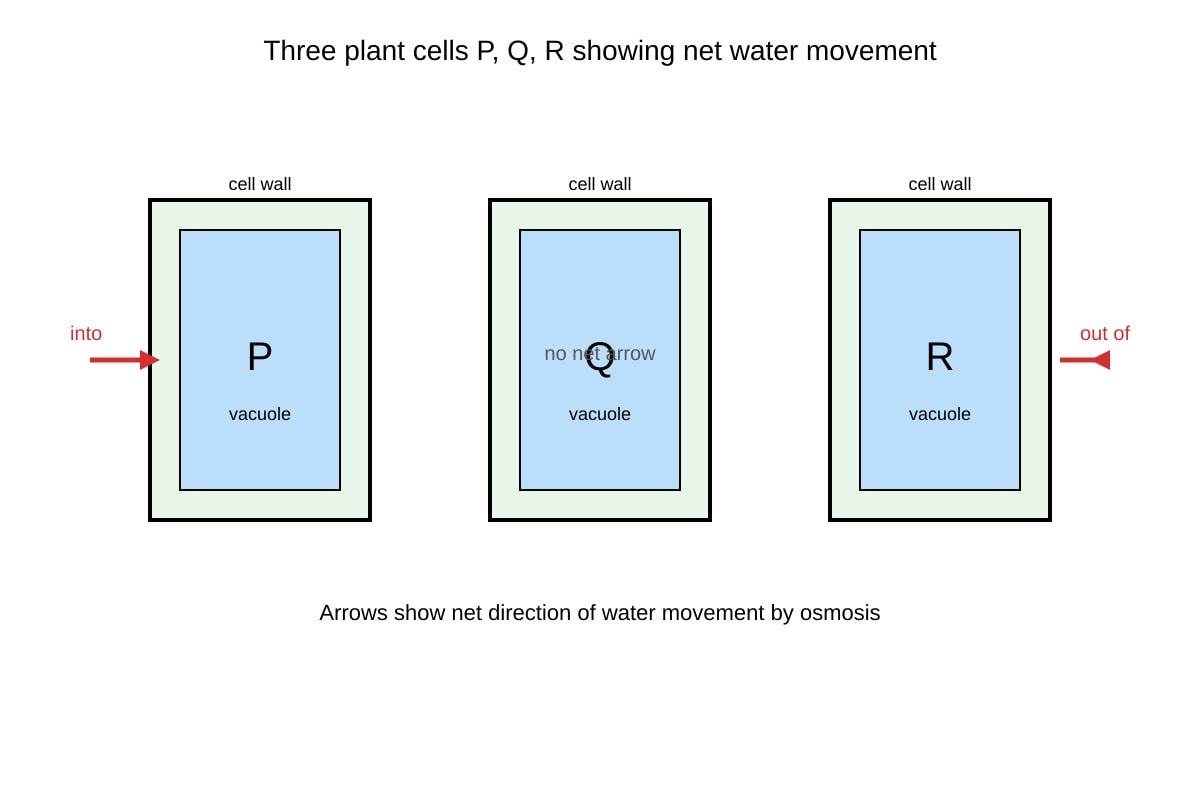
11. R is plasmolysed. (1) Arrow shows water moving out, meaning external solution has lower water potential, causing cell to lose water and shrink. (1)
Teaching note: Plasmolysis = protoplast detaches from cell wall due to water loss.
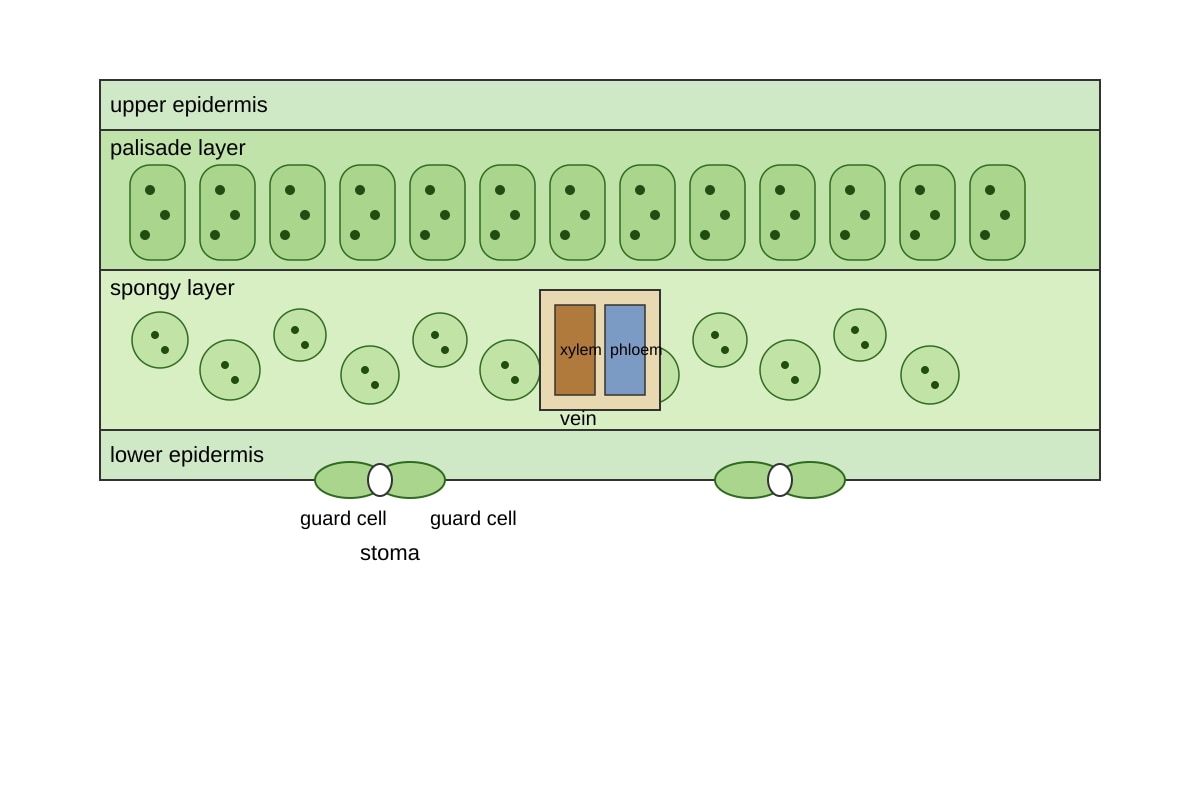
12. palisade mesophyll (1)
Teaching note: Palisade layer has many chloroplasts and is main photosynthetic site.
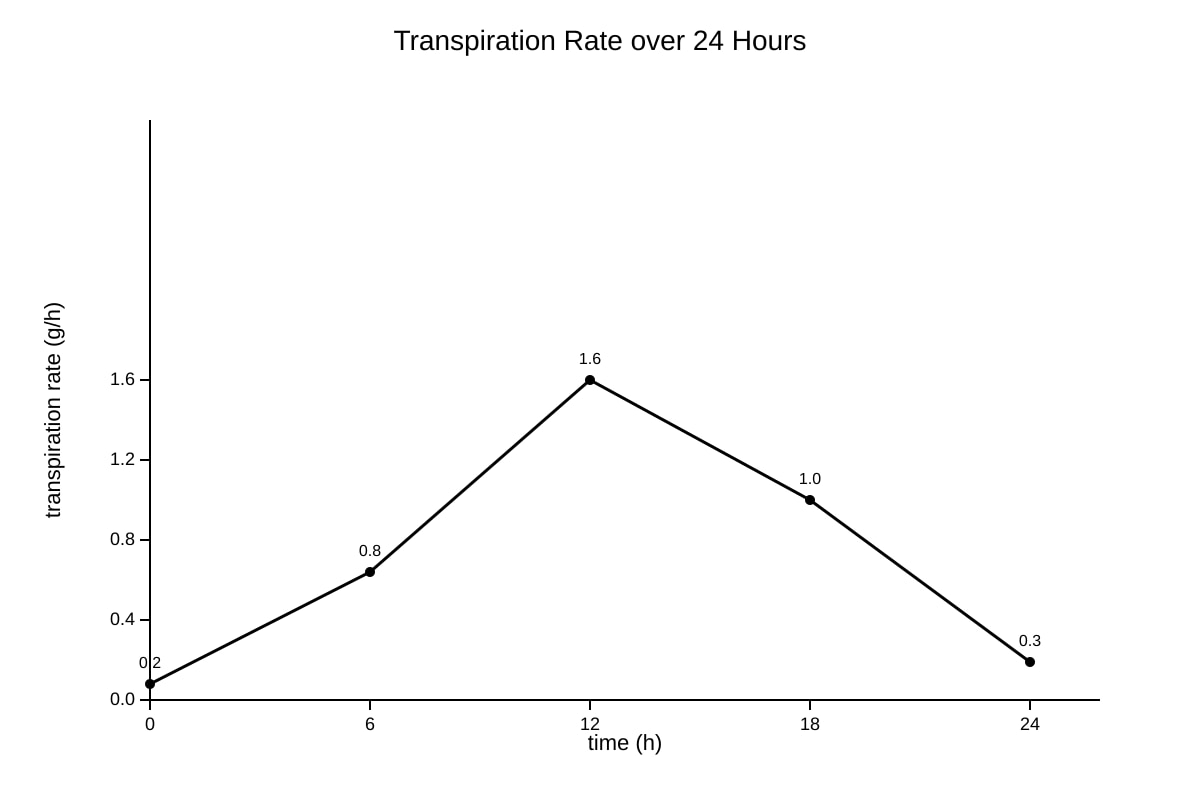
13. 12:00 (1). Higher temperature / light intensity at midday (1).
Teaching note: Transpiration peaks with heat and light opening stomata.
14. Rate = distance / time = 6.4 cm / 20 min = 0.32 cm/min (2)
(1 for method, 1 for answer with unit)
Teaching note: Potometer measures water uptake as proxy for transpiration.
15. Wind removes water vapour from around stomata. (1) This maintains a diffusion gradient, increasing transpiration. (1)
Teaching note: Lower humidity outside speeds evaporation.
16. light intensity (1)
Teaching note: Low light limits rate even if CO₂ high.
17. Both light and CO₂ are high, so neither is limiting. (1) More energy and raw material available, max rate reached. (1)
Teaching note: Limiting factor removed → higher rate.
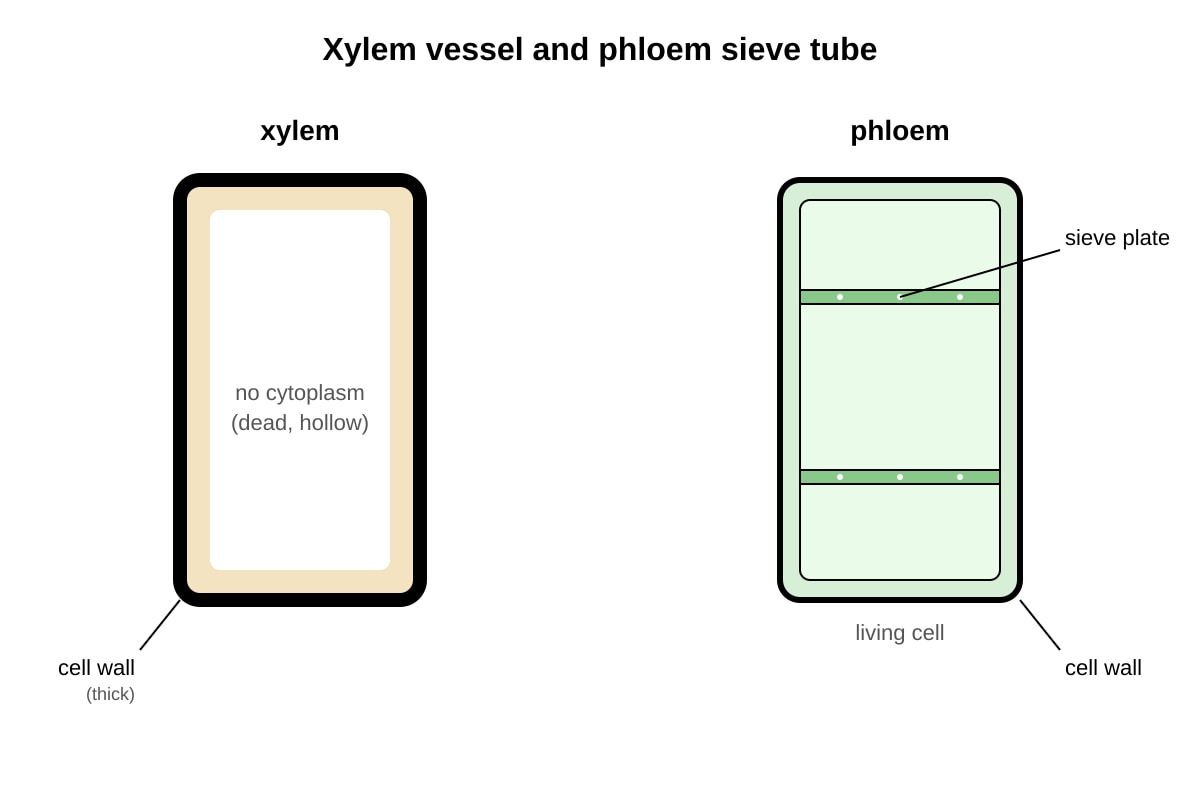
18. Xylem is dead and hollow (no cytoplasm); phloem is living with cytoplasm. (1)
Teaching note: Accept "xylem has no sieve plates" as alternative.
19. Active transport. (1) Uses energy (ATP) from respiration. (1) Moves ions from low to high concentration in root hair cell. (1)
Teaching note: Against gradient cannot be osmosis/diffusion.
20. Wilting = low water potential in cells. (1) Pure water has higher water potential. (1) Water enters cells by osmosis, making them turgid/firm. (1)
Teaching note: Turgor pressure returns; water potential gradient drives entry.