From Real Exams Quiz
Secondary 4 Pure Biology Genetics Inheritance Quiz
Free Sec 4 Pure Biology Genetics Inheritance quiz, HY3 Exam version, with questions, answers, and O Level-style practice for Singapore students.
These static practice materials are generated from the site's syllabus and paper-generation workflow, with source and model context shown so students and parents can evaluate the material before use.
Questions
Secondary 4 Pure Biology Quiz - Genetics Inheritance
Name: ___________________________
Class: ____________
Date: ____________
Score: ____________ / 40
Duration: 60 minutes
Total Marks: 40
Instructions:
- Answer all 20 questions.
- Section A: Multiple-choice style short items (1 mark each).
- Section B: Structured short-answer questions (1–3 marks each).
- Section C: Data/pedigree interpretation and extended reasoning (2–4 marks each).
- Write your answers in the spaces provided.
Section A: Recall and Basic Understanding (Questions 1–5)
1. In humans, the allele for free earlobes (F) is dominant over the allele for attached earlobes (f). What is the genotype of a homozygous recessive individual?
[____________] (1 mark)
2. Which of the following correctly describes a gamete produced by a pea plant of genotype Tt?
A. TT
B. Tt
C. T or t
D. tt
[____________] (1 mark)
3. What term describes the specific position of a gene on a chromosome?
[____________] (1 mark)
4. A pedigree shows a condition that appears in both sexes and skips generations. Which inheritance pattern is most likely?
A. Autosomal dominant
B. Autosomal recessive
C. Sex-linked dominant
D. Mitochondrial
[____________] (1 mark)
5. During meiosis, homologous chromosomes separate at which stage?
A. Prophase I
B. Metaphase I
C. Anaphase I
D. Telophase II
[____________] (1 mark)
Section B: Structured Short Answers (Questions 6–10)
6. A pea plant with purple flowers (Pp) is crossed with a white-flowered plant (pp).
(a) State the genotypes of the gametes produced by the purple-flowered parent. (1 mark)
[]
(b) What is the probability of an offspring having white flowers? (1 mark)
[]
7. Explain why sex-linked recessive disorders are more common in males than females. (2 marks)
[______________________________________________________________________]
8. Define the term "codominance" and give one example from blood groups. (2 marks)
[______________________________________________________________________]
9. A couple are both carriers for sickle cell anaemia (Hb^A Hb^S). Draw a genetic diagram to show the possible offspring. (3 marks)
[______________________________________________________________________]
10. State two differences between mitosis and meiosis. (2 marks)
- [________________________]
- [________________________]
Section C: Interpretation and Reasoning (Questions 11–20)
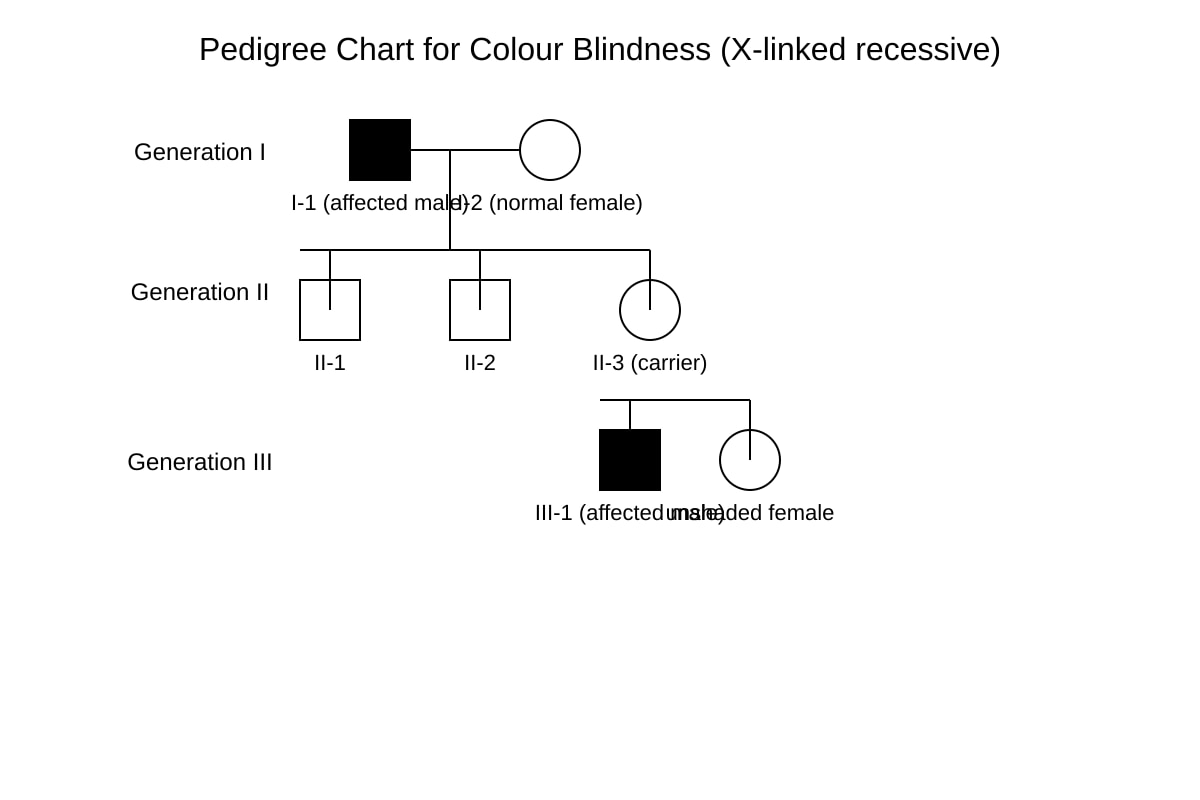
11. The diagram below shows a pedigree for a family with colour blindness (X-linked recessive).
Image pending generation: diagram for Q11.
(a) State the genotype of individual II-3. (1 mark)
[]
(b) What is the probability that III-1 is colour blind if II-3 marries a normal male? (1 mark)
[]
12. In a population of snails, shell colour is controlled by one gene with two alleles: B (brown, dominant) and b (yellow, recessive). In a sample of 200 snails, 128 are brown and 72 are yellow. Assuming Hardy-Weinberg equilibrium, calculate the frequency of allele b. (3 marks)
[______________________________________________________________________]
13. A farmer crosses a pure-breeding red cow (RR) with a white bull (WW) and all offspring are roan (RW). Explain the inheritance pattern shown. (2 marks)
[______________________________________________________________________]
14. The table shows the results of a test cross in Drosophila.
| Phenotype | Number |
|---|---|
| Red eyes | 412 |
| White eyes | 388 |
(a) Suggest the genotype of the red-eyed parent if white is recessive. (1 mark)
[__________]
(b) Explain whether the results support a 1:1 ratio. (2 marks)
[____________________________________________________________________]
15. Describe how non-disjunction during meiosis can lead to Down syndrome. (3 marks)
[______________________________________________________________________]
16. A genetic engineering technique uses restriction enzymes to cut DNA. Explain why sticky ends are useful in recombinant DNA technology. (2 marks)
[______________________________________________________________________]
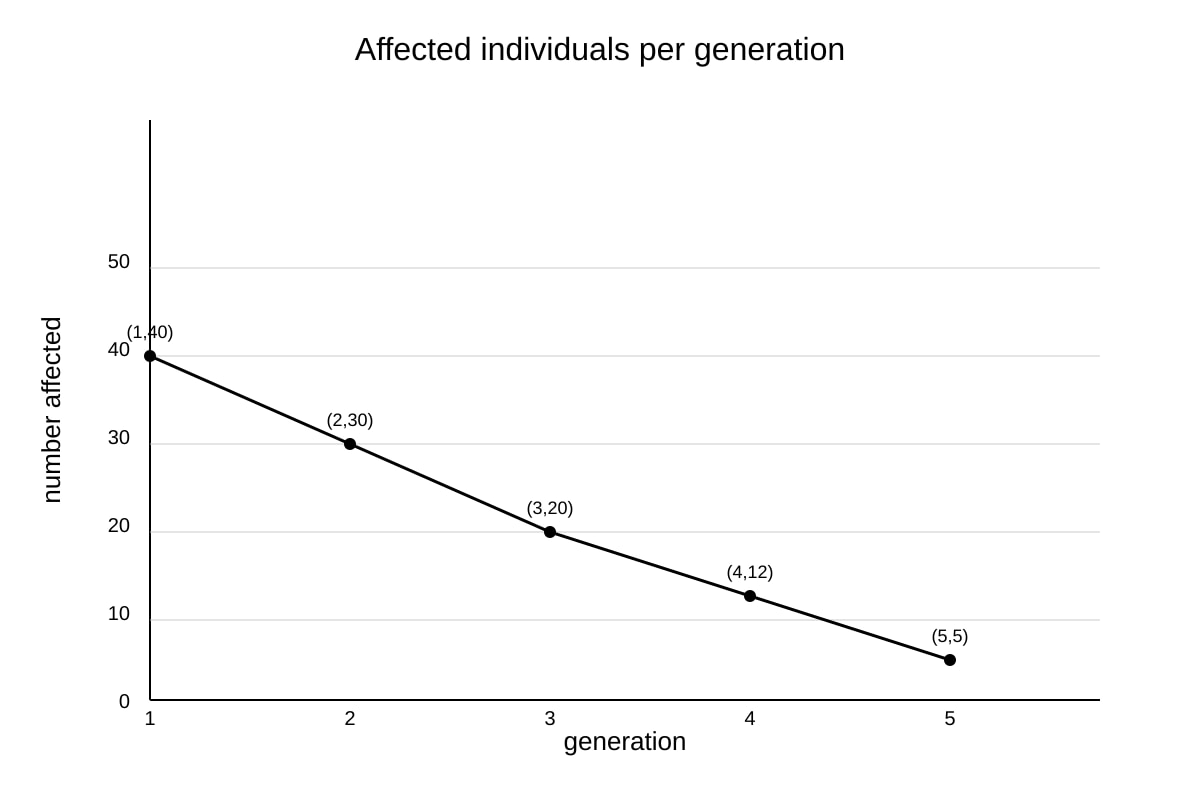
17. The graph shows the number of individuals with a genetic condition over generations.
Image pending generation: graph for Q17.
Suggest one reason for the decline in affected individuals. (2 marks)
[______________________________________________________________________]
18. A man with blood group A (genotype I^A i) marries a woman with blood group B (genotype I^B i). List all possible blood groups of their children and the probability of each. (4 marks)
[______________________________________________________________________]
19. Explain how a mutation in a gamete differs in effect from a mutation in a somatic cell. (2 marks)
[______________________________________________________________________]
20. The DNA sequence below is part of a gene:
TAC GGC AAT CCA
(a) Write the complementary mRNA strand. (1 mark)
[]
(b) Using the codon table (AUG=Met, GGC=Gly, AAU=Asn, CCA=Pro), state the amino acids produced. (2 marks)
[]
Answers
Secondary 4 Pure Biology Quiz - Genetics Inheritance (Answer Key)
Total Marks: 40
Topic: Genetics Inheritance
Section A Answers
1. ff
Teaching note: Homozygous recessive means two copies of the recessive allele (f). Dominant F would show free earlobes. [1]
2. C. T or t
Teaching note: Gametes are haploid; they carry one allele from each gene pair. Tt parent produces gametes with T or t via segregation. [1]
3. Locus
Teaching note: The locus is the fixed position of a gene on a chromosome. Avoid confusing with "allele" (version of gene). [1]
4. B. Autosomal recessive
Teaching note: Recessive traits skip generations (carriers unaffected) and affect both sexes equally. Dominant usually appears every generation. [1]
5. C. Anaphase I
Teaching note: Homologous chromosomes separate in Anaphase I of meiosis; sister chromatids separate in Anaphase II. [1]
Section B Answers
6. (a) P and p
(b) 50% (or 1/2)
Working: Pp × pp → gametes P, p and p, p. Offspring: Pp, Pp, pp, pp. White (pp) = 2/4 = 1/2. [1+1]
7. Males have one X chromosome (XY); a single recessive allele on X causes the disorder. Females (XX) need two copies to be affected, so they are usually carriers. [2]
Marking: 1 mark for XY explanation, 1 mark for female needing two alleles.
8. Codominance: both alleles expressed equally in heterozygote. Example: AB blood group (I^A I^B both expressed). [2]
Marking: 1 mark definition, 1 mark example.
9. Genetic diagram:
Parents: Hb^A Hb^S × Hb^A Hb^S
Gametes: Hb^A, Hb^S from each
Offspring: Hb^A Hb^A (normal), Hb^A Hb^S (carrier), Hb^S Hb^S (sickle cell) in ratio 1:2:1. [3]
Marking: 1 parent genotypes, 1 gametes, 1 offspring grid/correct ratios.
10.
- Mitosis produces 2 diploid cells; meiosis produces 4 haploid cells.
- Mitosis has no crossing over; meiosis has crossing over in Prophase I. (Or: mitosis for growth, meiosis for gametes) [2]
Section C Answers
11. (a) X^C X^c (carrier female)
(b) 50% (1/2)
Working: II-3 is X^C X^c × X^C Y. Sons get X from mother: 1/2 X^c Y (affected). [1+1]
12. q² = 72/200 = 0.36 → q = √0.36 = 0.6. Frequency of b = 0.6. [3]
Steps: recessive phenotype = bb = q²; solve q. Marking: 1 for q², 1 for sqrt, 1 for answer.
13. Incomplete dominance (or codominance if both shown). RR × WW → RW roan (mixed). Neither allele dominant. [2]
14. (a) Rr (red heterozygous) × rr (white)
(b) Expected 1:1 = 400:400; observed 412:388 close, supports. [1+2]
Marking: 1 genotype, 2 for ratio explanation with numbers.
15. Non-disjunction = failure of homologous chromosomes or sister chromatids to separate in meiosis. Gamete gets 2 copies of chr 21. Fertilisation → trisomy 21 (Down). [3]
16. Sticky ends are single-stranded overhangs that base-pair with complementary cut DNA, allowing gene insertion into plasmid. [2]
17. Possible: selection against affected, genetic counselling, or reduced fitness. [2]
Based on graph decline from 40 to 5.
18. Cross I^A i × I^B i:
Offspring: I^A I^B (AB, 1/4), I^A i (A, 1/4), I^B i (B, 1/4), ii (O, 1/4). [4]
Marking: all groups listed 2, probabilities 2.
19. Gamete mutation passes to offspring (hereditable); somatic mutation only affects individual, not inherited. [2]
20. (a) AUG CCG UUA GGU
(b) Met-Gly-Asn-Pro
Working: DNA T→A, A→U, C→G. Then codons to amino acids. [1+2]
Free quiz and exam paper access
Enter your details to view this paper
Your access is remembered on this device.