From Real Exams Quiz
Secondary 4 Pure Biology Ecology Quiz
Free Sec 4 Pure Biology Ecology quiz, HY3 Exam version, with questions, answers, and O Level-style practice for Singapore students.
These static practice materials are generated from the site's syllabus and paper-generation workflow, with source and model context shown so students and parents can evaluate the material before use.
Questions
Free quiz and exam paper access
Enter your details to view this paper
Your access is remembered on this device.
Answers
Secondary 4 Pure Biology Quiz - Ecology (Answer Key)
Total Marks: 40
Topic: Ecology
Section A: Multiple Choice
-
B (1 mark)
Teaching note: A community = all populations of different species living in the same habitat. A is habitat physical factors (abiotic), C is a population, D is abiotic environment. -
C (1 mark)
Teaching note: Producers (e.g. green plants) make food by photosynthesis using sunlight. Consumers eat others; decomposers break down dead matter. -
B (1 mark)
Teaching note: Respiration in plants, animals, fungi, and microbes releases CO₂. Photosynthesis removes CO₂. -
B (1 mark)
Teaching note: Population = same species, same area. A is community + abiotic; C is trophic group. -
C (1 mark)
Teaching note: Biotic = living factors. Predation involves organisms. A, B, D are abiotic (non-living).
Section B: Short Structured
-
Abiotic: temperature / dissolved oxygen / pH (1 mark)
Biotic: predation / competition / disease (1 mark)
Teaching note: Abiotic = non-living; biotic = living. Any valid example per category earns the mark. -
Photosynthesis (1 mark)
Teaching note: Light energy → chemical energy in glucose. -
Secondary consumer (1 mark)
Teaching note: Grass (prod) → grasshopper (primary cons) → frog (secondary cons) → snake (tertiary cons). -
Decomposers break down dead organisms and waste, releasing ammonia/nitrates for plants (2 marks: 1 for breakdown, 1 for nutrient return)
Teaching note: Without decomposers, nitrogen remains locked in dead matter. -
Producer: any plant (e.g. grass) (1 mark)
Primary consumer: herbivore (e.g. rabbit) (1 mark)
Teaching note: Producer makes own food; primary consumer eats producer.
Section C: Data Interpretation & Extended
-
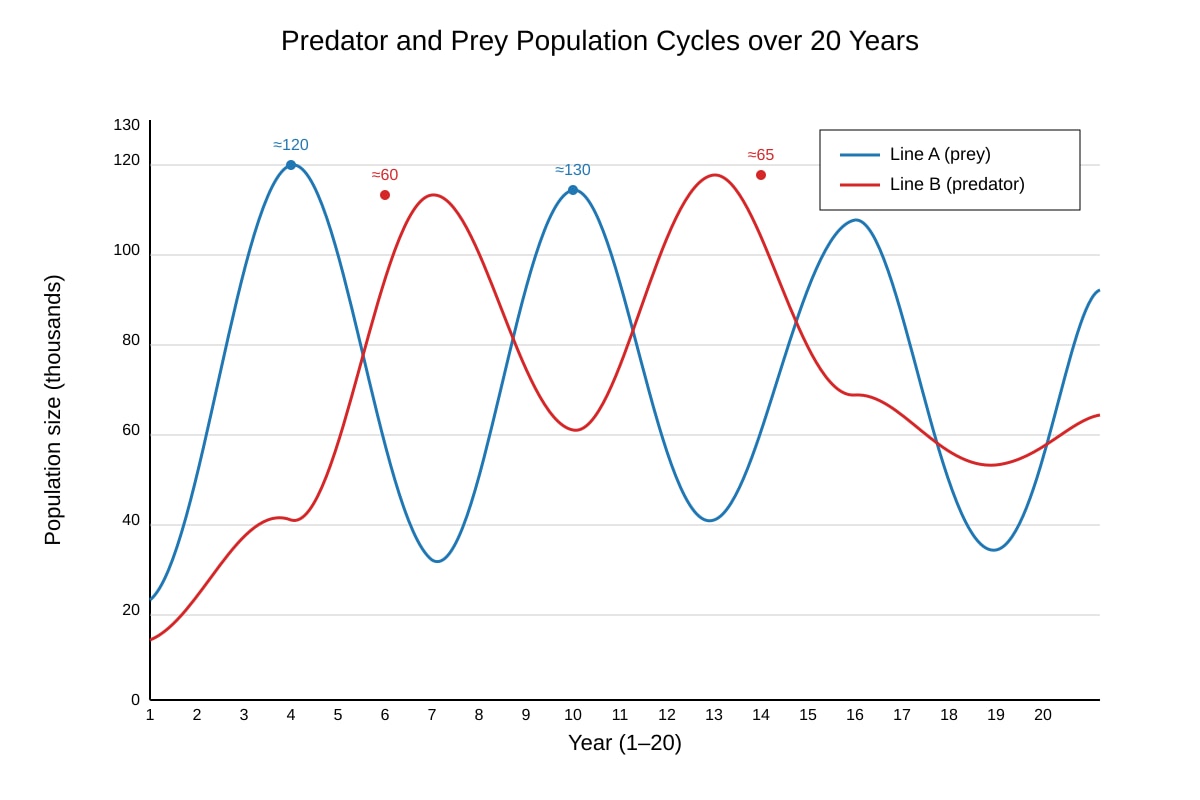
(a) Prey and predator populations show cyclical rises and falls; predator peaks occur after prey peaks (2 marks: 1 cycle described, 1 lag noted)
(b) Predator numbers depend on prey as food; when prey increases, predators reproduce and rise, but with delay (2 marks)
Teaching note: Link graph lag to food dependency. -
Role/position of a species in ecosystem including habitat, food, interactions (2 marks)
Teaching note: Niche ≠ habitat; includes function. -
(a) Pondweed (1 mark)
(b) Oxygen; used by snail for respiration (2 marks: gas 1, benefit 1)
Teaching note: Pondweed photosynthesises in light, releasing O₂. -
% = (500 / 5000) × 100 = 10% (2 marks: 1 formula, 1 answer)
Working: 500 ÷ 5000 = 0.1; ×100 = 10%. -
Trees cut → less photosynthesis to absorb CO₂ (1); burning/decomposition releases CO₂ (1); total atmospheric CO₂ rises (1) (3 marks)
Teaching note: Deforestation reduces sinks and adds source. -
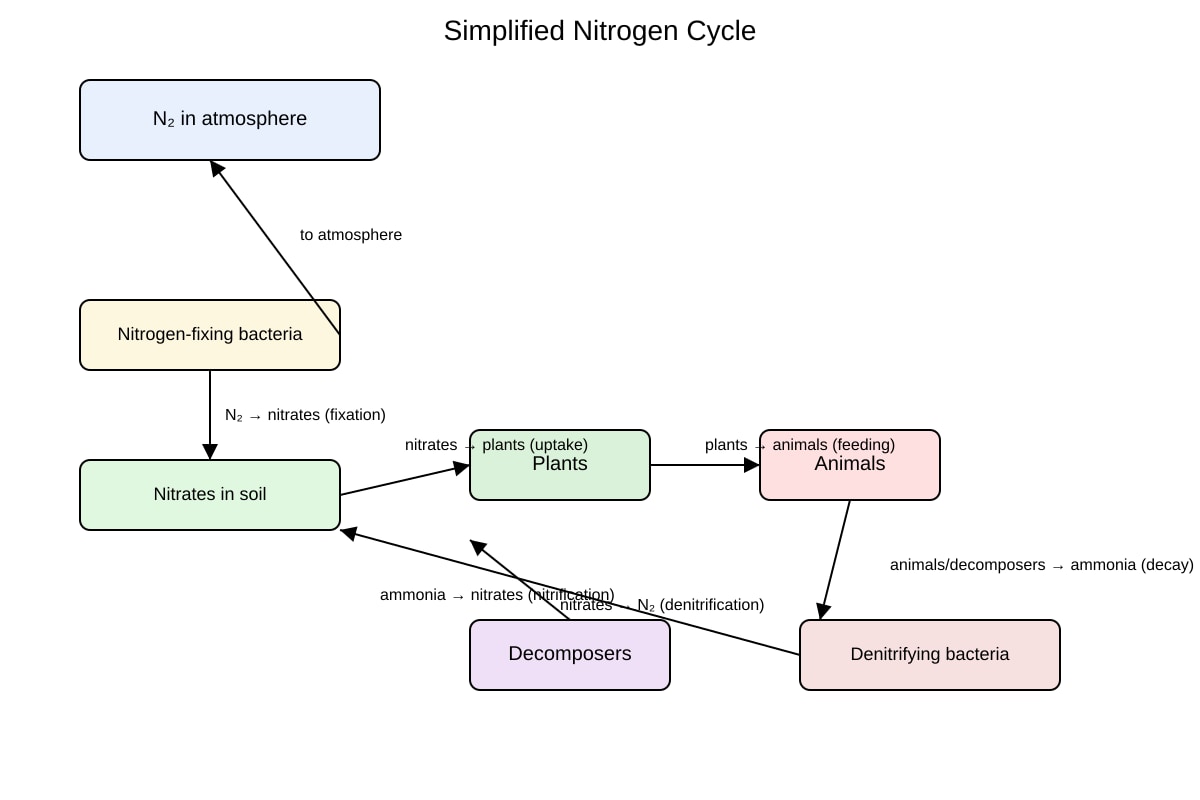
Denitrification (1 mark)
Teaching note: Nitrates → N₂ by denitrifying bacteria. -
(a) Eutrophication (1 mark)
(b) Algae block light (1); plants die (1); decomposers use O₂, fish suffocate (1) (3 marks)
Teaching note: Chain of effects from bloom to hypoxia. -
Producers make food via photosynthesis (1); decomposers recycle nutrients from dead matter (1); both maintain ecosystem energy/matter flow (1) (3 marks)
-
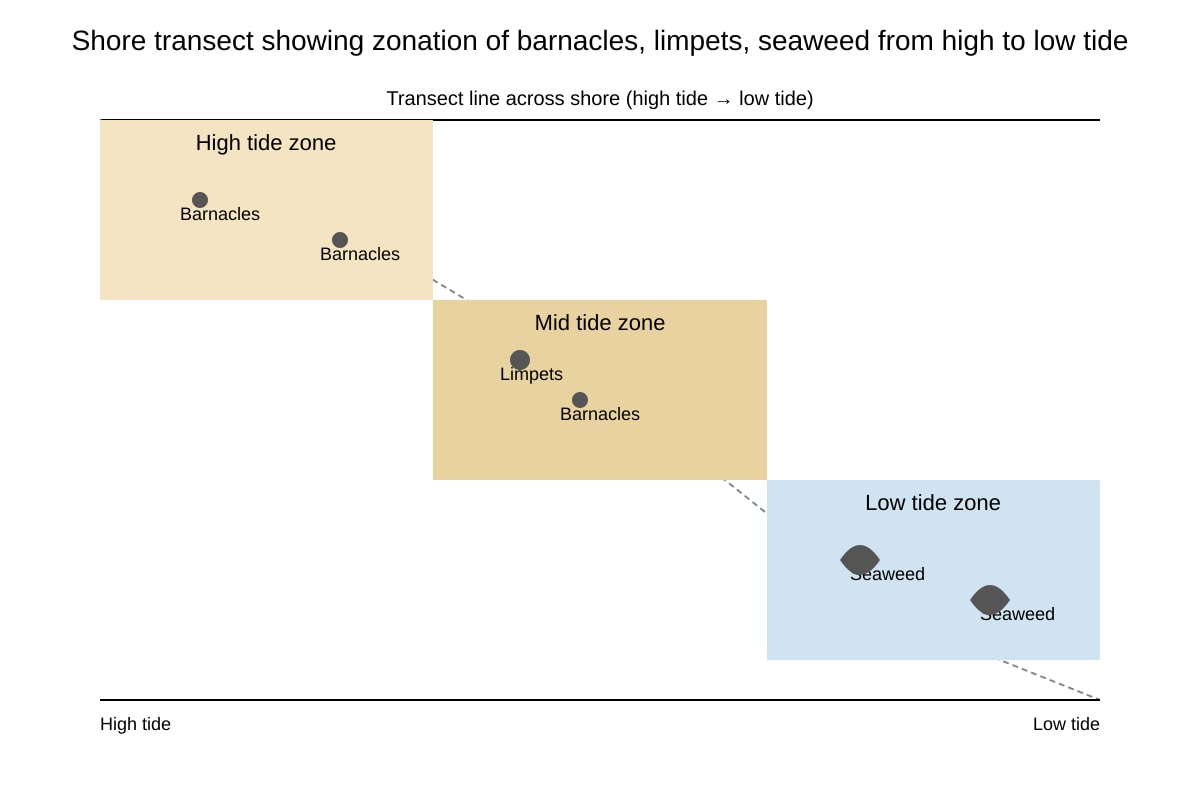
(a) Distribution of species in bands due to environmental gradient (1 mark)
(b) Low zone stays wet/submerged; seaweed needs water to avoid desiccation (2 marks)
Teaching note: Zonation caused by tolerance to exposure. -
Biological control: uses natural predators (1); less pollution (1); but slower/less predictable (1); chemical: fast but harms non-target (1); overall balanced judgement (1) (5 marks: descriptors – 2 points each side + conclusion)