From Real Exams Quiz
Secondary 4 Pure Biology Cells Biomolecules Quiz
Free Sec 4 Pure Biology Cells Biomolecules quiz, HY3 Exam version, with questions, answers, and O Level-style practice for Singapore students.
These static practice materials are generated from the site's syllabus and paper-generation workflow, with source and model context shown so students and parents can evaluate the material before use.
Questions
Secondary 4 Pure Biology Quiz - Cells Biomolecules
Name: ___________________________
Class: ___________
Date: ___________
Score: ___________ / 40
Duration: 50 minutes
Total Marks: 40
Instructions:
- Answer all 20 questions.
- Section A: Multiple Choice (1 mark each)
- Section B: Short Answer (1–2 marks each)
- Section C: Structured & Data-Based (2–4 marks each)
- Write your answers clearly in the spaces provided.
Section A: Multiple Choice (Questions 1–5)
-
Which of the following cell structures is the site of protein synthesis?
A. Mitochondrion
B. Ribosome
C. Golgi body
D. Nucleus
[ ] -
Which biomolecule is mainly used for long-term energy storage and insulation in humans?
A. Carbohydrate
B. Protein
C. Fat
D. Starch
[ ] -
The movement of water molecules from a region of higher water potential to lower water potential through a partially permeable membrane is called:
A. Diffusion
B. Active transport
C. Osmosis
D. Translocation
[ ] -
Which food test uses iodine solution to detect the presence of starch?
A. Benedict’s test
B. Biuret test
C. Ethanol test
D. Iodine test
[ ] -
According to the lock-and-key model of enzyme action, the substrate binds to the enzyme at the:
A. Active site
B. Cell membrane
C. Nucleus
D. Mitochondrion
[ ]
Section B: Short Answer (Questions 6–10)
-
Name the cells through which water is absorbed from the soil by plant roots.
_______________________________________ [1] -
State one function of the mitochondria in a cell.
_______________________________________ [1] -
Name the enzyme that breaks down starch into maltose in the human mouth.
_______________________________________ [1] -
Give one element that is present in proteins but not in carbohydrates.
_______________________________________ [1] -
What is the term for the shrinkage of an animal cell when placed in a concentrated solution?
_______________________________________ [1]
Section C: Structured & Data-Based (Questions 11–20)
- The diagram below shows an electron micrograph of a plant cell with labelled structures.
Image pending generation: diagram for Q11.
(a) Which labelled structure (A–F) is the site of ATP production? [1]
(b) Which labelled structure carries out photosynthesis? [1]
-
Explain why a decrease in the water potential of blood (due to very high glucose concentration) may damage red blood cells. [3]
-
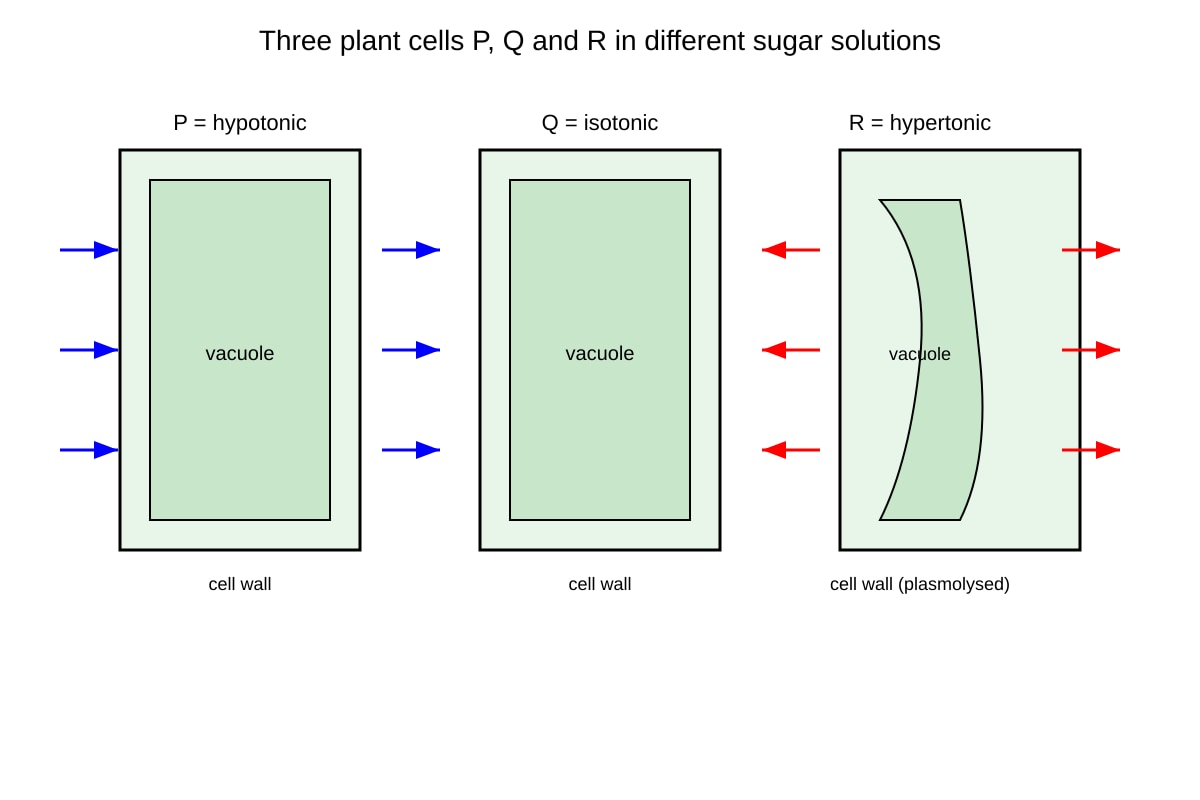
The diagram shows three plant cells P, Q and R placed in different sugar solutions. Arrows indicate net water movement by osmosis.
Image pending generation: diagram for Q13.
State the direction of net water movement for cell Q and explain your answer. [2]
-
A student tested a food sample using Benedict’s solution and obtained a green precipitate after heating. What does this indicate about the sample? [2]
-
Describe how the structure of a red blood cell is adapted to its function of transporting oxygen. [3]
-
The table below shows the effect of temperature on the rate of an enzyme-controlled reaction.
| Temperature (°C) | Rate of reaction (arbitrary units) |
|---|---|
| 20 | 12 |
| 30 | 25 |
| 40 | 40 |
| 50 | 38 |
| 60 | 10 |
(a) Plot the data on a graph (temperature on x-axis, rate on y-axis). [2]
(b) State the optimum temperature for this enzyme and explain why the rate falls after this temperature. [2]
-
Name the process by which root hair cells absorb mineral ions from a dilute soil solution against a concentration gradient, and state why it requires energy. [2]
-
Compare the structure of a typical animal cell and a typical plant cell by stating two differences. [2]
-
A protein is made of many amino acids joined together.
(a) What is the name of the bond formed between amino acids? [1]
(b) State the role of proteins in the human body. [1] -
The figure shows a graph of cell division over time.
Image pending generation: graph for Q20.
Complete the line from Time 4 to Time 6 to show formation of cell A. Label the point at which cell A is first formed with the words “formation of cell A”. [2]
Answers
Secondary 4 Pure Biology Quiz - Cells Biomolecules: Answer Key
Total Marks: 40
Topic: Cells Biomolecules
Section A: Multiple Choice
-
B [1]
Teaching note: Ribosomes are the sites of protein synthesis. Mitochondria produce ATP, Golgi body modifies proteins, nucleus stores DNA. -
C [1]
Teaching note: Fats store energy long-term and insulate. Carbohydrates are short-term energy; proteins are for growth/repair. -
C [1]
Teaching note: Osmosis is water movement through partially permeable membrane down water potential gradient. -
D [1]
Teaching note: Iodine turns blue-black with starch. Benedict’s detects reducing sugar, biuret detects protein, ethanol detects fat. -
A [1]
Teaching note: Substrate fits enzyme active site like key in lock.
Section B: Short Answer
-
Root hair cells [1]
Teaching note: Not xylem or epidermis. Root hair cells increase surface area for water uptake. -
Site of respiration / ATP production [1]
Teaching note: Mitochondria are power stations of the cell. -
Amylase [1]
Teaching note: Salivary amylase in mouth breaks starch to maltose. -
Nitrogen (or sulphur) [1]
Teaching note: Proteins contain C, H, O, N; carbohydrates only C, H, O. -
Crenation [1]
Teaching note: Animal cells shrink in hypertonic solution; plant cells plasmolyse.
Section C: Structured & Data-Based
-
(a) C [1] (b) B [1]
Teaching note: Mitochondrion (C) produces ATP; chloroplast (B) photosynthesises. Common trap: confusing ribosome with mitochondrion. -
[3 marks]
- High glucose decreases water potential of blood. [1]
- Water moves out of red blood cells by osmosis (down water potential gradient). [1]
- RBCs lose water, shrink (crenate), may be damaged / cannot function. [1]
Teaching note: Must link decreased ψ to water loss and consequence.
- [2 marks]
- No net movement (isotonic). [1]
- Water potential inside Q equals outside, so no net osmosis. [1]
Teaching note: Q is isotonic; arrows absent means equilibrium.
- [2 marks]
- Sample contains reducing sugar. [1]
- Green precipitate indicates low to moderate amount (not high which would be red/brown). [1]
Teaching note: Benedict’s green = some reducing sugar present.
- [3 marks]
- Biconcave shape increases surface area for oxygen diffusion. [1]
- No nucleus allows more space for haemoglobin. [1]
- Contains haemoglobin to bind oxygen. [1]
Teaching note: Adaptations link directly to oxygen transport.
-
(a) [2 marks] Graph plotted: points (20,12),(30,25),(40,40),(50,38),(60,10) joined. Axes labelled.
(b) [2 marks] Optimum = 40°C [1]; above this enzyme denatures, active site changes shape, rate falls. [1] -
[2 marks] Active transport [1]; requires energy (ATP) because moving against concentration gradient [1].
-
[2 marks] Any two: plant has cell wall, animal does not [1]; plant has chloroplast, animal does not [1]; plant has large vacuole, animal small/no vacuole.
-
(a) Peptide bond [1] (b) Growth and repair of tissues / make enzymes / antibodies [1]
-
[2 marks] Line from 4h to 6h rising 1→2 [1]; label “formation of cell A” at 6h [1].
Teaching note: Cytokinesis completes at 6h; mark exactly there.
Free quiz and exam paper access
Enter your details to view this paper
Your access is remembered on this device.