From Real Exams Quiz
Secondary 4 Pure Biology Cells Biomolecules Quiz
Free Sec 4 Pure Biology Cells Biomolecules quiz, DeepSeek Exam version, with questions, answers, and O Level-style practice for Singapore students.
These static practice materials are generated from the site's syllabus and paper-generation workflow, with source and model context shown so students and parents can evaluate the material before use.
Questions
Free quiz and exam paper access
Enter your details to view this paper
Your access is remembered on this device.
Answers
Secondary 4 Pure Biology Quiz - Cells Biomolecules — ANSWER KEY
Total Marks: 40
Section A: Short Answer Questions (10 marks)
1. Name the cells in the root epidermis that are responsible for the absorption of water from the soil. [1]
Answer: Root hair cells (accept: root hair cell).
Marking note: Do not accept "epidermis" alone, "xylem", or "root cap cells".
2. State the chemical elements present in carbohydrates. [1]
Answer: Carbon, hydrogen, and oxygen.
Marking note: All three elements must be stated. Accept chemical symbols: C, H, O.
3. Identify the organelle that is the site of protein synthesis in a cell. [1]
Answer: Ribosomes (accept: ribosome).
Marking note: Do not accept "rough endoplasmic reticulum" alone, though "ribosomes on rough ER" is acceptable.
4. Define the term diffusion. [2]
Answer: Diffusion is the net movement of particles/molecules (1) from a region of higher concentration to a region of lower concentration, down a concentration gradient (1).
Marking note: Award 1 mark for "net movement" or equivalent, and 1 mark for "down concentration gradient" or "from high to low concentration". Do not award marks if "active transport" or "energy required" is mentioned.
5. State one function of fats in living organisms. [1]
Answer: Any one of:
- Long-term energy storage
- Thermal insulation
- Protection of vital organs
- Component of cell membranes (phospholipids)
- Source of metabolic water
Marking note: Accept any one valid function. Do not accept "energy" alone without "storage" or "long-term".
Section B: Structured Questions (10 marks)
6. Name the reagent used to test for the presence of reducing sugars and state the colour change observed for a positive result. [2]
Answer:
- Reagent: Benedict's solution (1)
- Colour change: Blue to brick-red / orange-red / green, yellow, orange precipitate (1)
Marking note: Award 1 mark for correct reagent name. Award 1 mark for correct colour change (must indicate initial and final colour, or state "brick-red precipitate forms"). Accept "Benedict's reagent".
7. State two differences between a typical animal cell and a typical plant cell. [2]
Answer: Any two of:
- Plant cells have a cell wall; animal cells do not
- Plant cells have chloroplasts; animal cells do not
- Plant cells have a large central vacuole; animal cells have small, temporary vacuoles (or none)
- Plant cells store starch; animal cells store glycogen
- Plant cells are generally regular/fixed in shape; animal cells are irregular in shape
Marking note: Award 1 mark for each correct, clearly stated difference. Both sides of the comparison must be stated or clearly implied. Do not award marks for "plant cells are larger" without qualification.
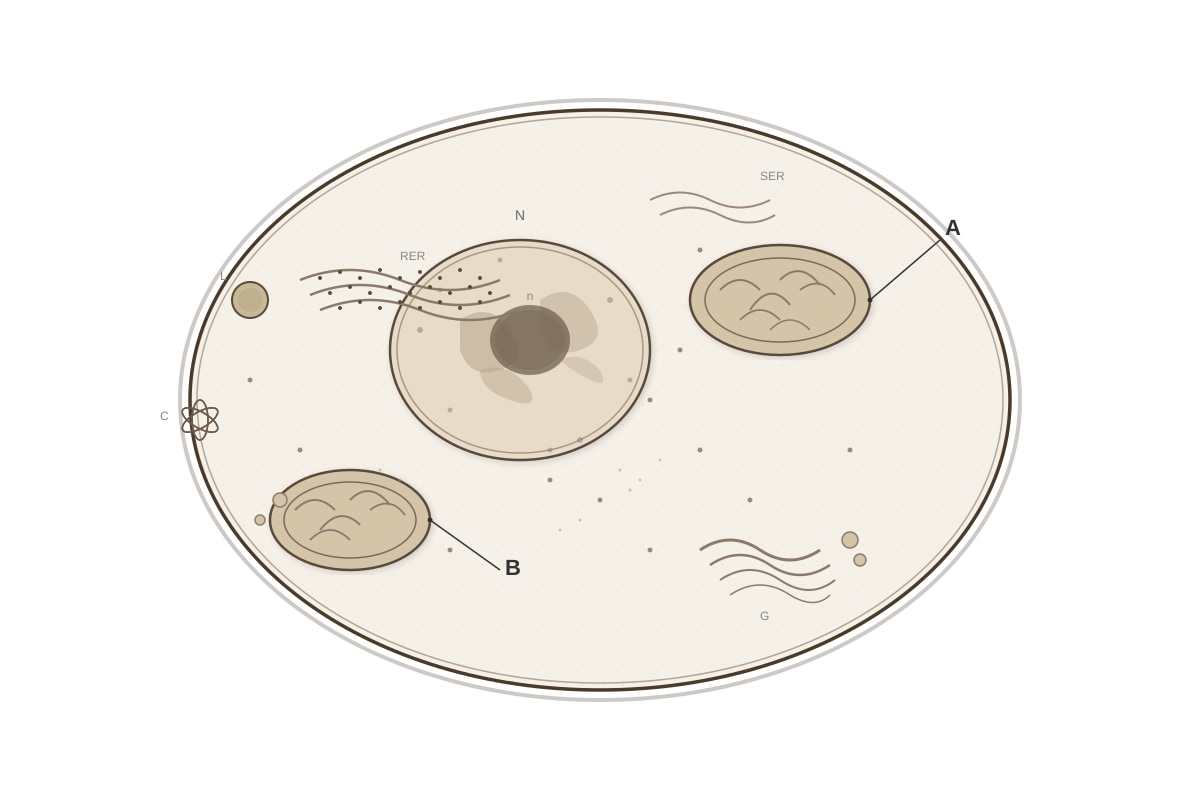
8. The diagram below shows an electron micrograph of an animal cell.
Generated diagram for this question.
(a) Identify the organelles labelled A and B. [2]
Answer:
- A: Mitochondrion / mitochondria (1)
- B: Ribosome / ribosomes (1)
Marking note: Accept singular or plural forms. Spelling must be recognisable.
(b) Organelle A is described as the "powerhouse" of the cell. Explain why this description is appropriate. [2]
Answer: Mitochondria are the site of aerobic respiration (1), where glucose is broken down to release energy in the form of ATP for cellular activities (1).
Marking note: Award 1 mark for linking to respiration, and 1 mark for linking to energy/ATP release. Do not award marks for "produces energy" alone without reference to respiration.
(c) Explain how the structure of organelle B is related to its function in protein synthesis. [2]
Answer: Ribosomes are small structures made of ribosomal RNA and protein (1). They provide a surface where mRNA is translated and amino acids are assembled into polypeptide chains / proteins (1).
Marking note: Award 1 mark for describing the structure (small, two subunits, or composition), and 1 mark for linking to protein synthesis function (translation, amino acid assembly). Accept reference to ribosomes being free in cytoplasm or attached to rough ER.
Section C: Data Analysis Questions (10 marks)
9. A student investigated the effect of temperature on the activity of the enzyme amylase.
(a) Using the lock-and-key hypothesis, explain why the enzyme activity increases as the temperature rises from 10°C to 40°C. [3]
Answer: As temperature increases, the kinetic energy of enzyme and substrate molecules increases (1). This results in more frequent collisions between enzyme and substrate molecules (1). More enzyme-substrate complexes are formed per unit time, as the substrate fits into the active site of the enzyme (1).
Marking note: Award 1 mark for increased kinetic energy, 1 mark for increased collision frequency, and 1 mark for reference to enzyme-substrate complex formation or lock-and-key fit. Must use lock-and-key terminology.
(b) Explain why no digestion was observed at 60°C. [3]
Answer: At 60°C, the high temperature causes the enzyme to denature (1). The bonds maintaining the three-dimensional shape of the enzyme (e.g., hydrogen bonds) are broken (1). The active site loses its specific shape, so the substrate can no longer fit into the active site, and no enzyme-substrate complexes can form (1).
Marking note: Award 1 mark for "denature", 1 mark for explanation of bond breaking/shape change, and 1 mark for linking to active site shape loss and inability to form enzyme-substrate complexes. Do not accept "enzyme is killed".
(c) State the substrate and product of the reaction catalysed by amylase. [2]
Answer:
- Substrate: Starch (1)
- Product: Maltose / reducing sugars (1)
Marking note: Accept "maltose" or "reducing sugars" for product. Do not accept "glucose" alone (amylase breaks starch into maltose, not glucose directly).
10. Three plant cells were placed in solutions of different water potentials.
(a) Identify the type of solution (hypotonic, isotonic, or hypertonic) that each cell was placed in. [3]
Answer:
- Cell P: Hypotonic solution (1)
- Cell Q: Hypertonic solution (1)
- Cell R: Isotonic solution (1)
Marking note: Award 1 mark for each correct answer. Must use correct terminology.
(b) Explain the changes that occurred in Cell Q, using the term water potential in your answer. [3]
Answer: Cell Q was placed in a hypertonic solution, meaning the solution has a lower water potential than the cell sap (1). Water moved out of the cell by osmosis, from a region of higher water potential (inside the cell) to a region of lower water potential (outside the cell) (1). As the cell lost water, the vacuole shrank, the cytoplasm pulled away from the cell wall, and the cell became plasmolysed (1).
Marking note: Award 1 mark for identifying the water potential gradient, 1 mark for describing the direction of water movement (must use "water potential" term), and 1 mark for describing the outcome (plasmolysis, membrane pulling away from cell wall).
Section D: Extended Response Questions (10 marks)
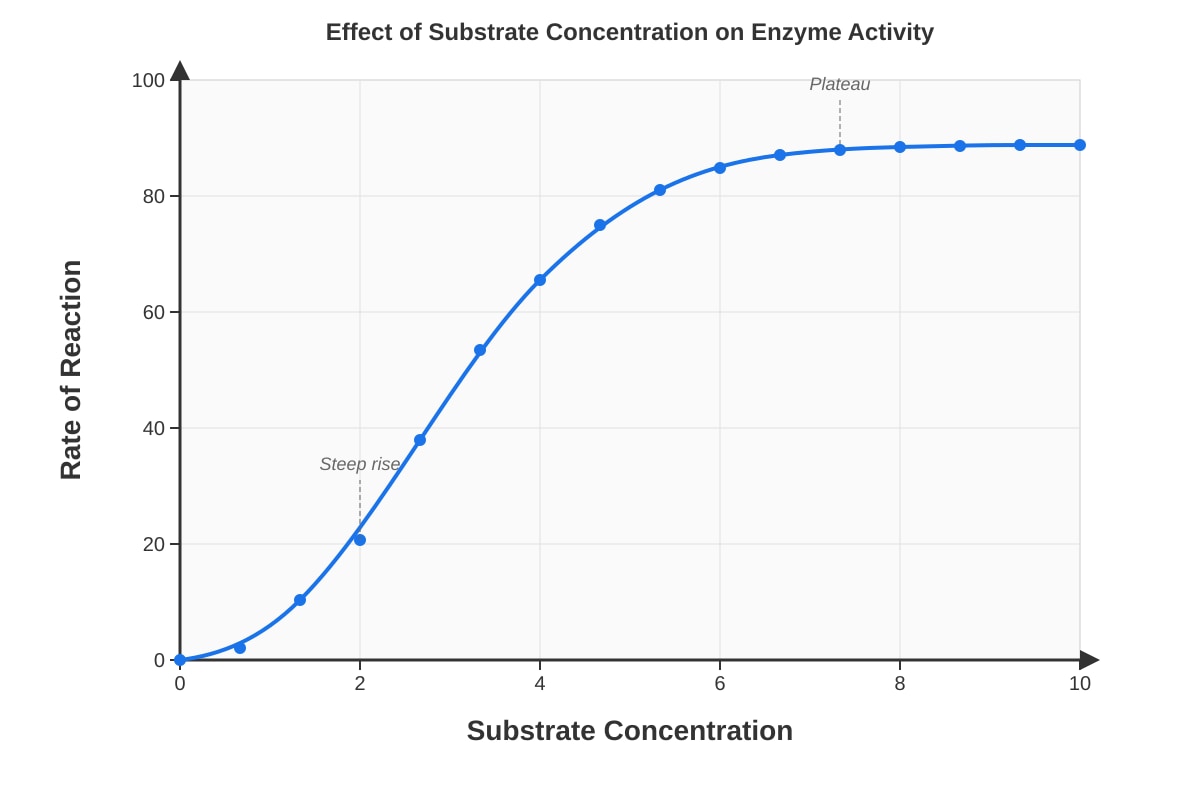
11. A student investigated the effect of substrate concentration on the rate of an enzyme-catalysed reaction.
(a) Describe the relationship between substrate concentration and the rate of reaction as shown in the graph. [3]
Answer: As substrate concentration increases, the rate of reaction initially increases rapidly / proportionally (1). The rate of increase then slows down (1). Eventually, the rate of reaction reaches a maximum / plateaus, and further increases in substrate concentration do not increase the rate (1).
Marking note: Award 1 mark for each phase of the relationship described. Must reference the graph pattern clearly. Accept "levels off" or "becomes constant" for plateau.
(b) Explain why the rate of reaction levels off at high substrate concentrations. [3]
Answer: At high substrate concentrations, all the active sites of the enzyme molecules are occupied / saturated with substrate (1). The enzyme concentration becomes the limiting factor (1). Therefore, increasing substrate concentration further has no effect on the rate of reaction because there are no free active sites available for additional substrate molecules to bind to (1).
Marking note: Award 1 mark for saturation of active sites, 1 mark for identifying enzyme concentration as limiting factor, and 1 mark for linking to no free active sites.
(c) Suggest how the student could modify the experiment to investigate whether the enzyme has been denatured at the end of the investigation. [2]
Answer: The student could add more substrate to the reaction mixture (1) and observe whether the rate of reaction increases. If the enzyme is denatured, the rate will not increase; if the enzyme is still functional, the rate may increase if substrate was limiting (1).
Marking note: Award 1 mark for suggesting addition of more substrate, and 1 mark for explaining the expected outcome and its interpretation.
12. Explain why enzymes are described as biological catalysts and discuss the importance of enzyme specificity in living organisms. [2]
Answer: Enzymes are biological catalysts because they speed up chemical reactions in living organisms without being chemically changed or used up in the process (1). Enzyme specificity is important because it ensures that each enzyme catalyses only one specific reaction or type of reaction, allowing metabolic pathways to be tightly regulated and preventing unwanted side reactions (1).
Marking note: Award 1 mark for definition of biological catalyst (speeds up reaction, unchanged). Award 1 mark for importance of specificity (regulation, prevention of unwanted reactions).
13. Compare and contrast the processes of diffusion and osmosis. [2]
Answer: Both diffusion and osmosis are passive processes involving the net movement of particles down a concentration gradient (1). However, diffusion refers to the movement of any particles (solute or solvent), while osmosis specifically refers to the net movement of water molecules across a partially permeable membrane from a region of higher water potential to a region of lower water potential (1).
Marking note: Award 1 mark for similarity (passive, down gradient). Award 1 mark for difference (water vs any particle, membrane requirement).
14. Describe the structure of a cell membrane and explain how it is adapted for its function as a selectively permeable barrier. [2]
Answer: The cell membrane consists of a phospholipid bilayer with embedded proteins (1). The hydrophobic core of the bilayer restricts the free passage of ions and large polar molecules, while allowing small non-polar molecules to pass through. Channel and carrier proteins facilitate the selective transport of specific substances, making the membrane selectively permeable (1).
Marking note: Award 1 mark for phospholipid bilayer and proteins. Award 1 mark for explanation of selective permeability (hydrophobic core, protein channels/carriers).
15. Explain the importance of mitosis in the growth and repair of tissues in a multicellular organism. [2]
Answer: Mitosis produces two genetically identical daughter cells (1). This is important for growth as it increases the number of cells in an organism, and for repair as it replaces damaged or dead cells with identical new cells, maintaining tissue function (1).
Marking note: Award 1 mark for genetically identical cells. Award 1 mark for linking to growth and repair.
16. A student placed a piece of potato in a beaker of distilled water and another piece in a beaker of concentrated salt solution. Predict and explain the changes in texture and mass of the potato pieces after one hour. [2]
Answer: In distilled water, the potato will become turgid/firm and increase in mass because water enters the cells by osmosis from a region of higher water potential (distilled water) to lower water potential (cell sap) (1). In concentrated salt solution, the potato will become flaccid/soft and decrease in mass because water leaves the cells by osmosis from a region of higher water potential (cell sap) to lower water potential (salt solution) (1).
Marking note: Award 1 mark for correct prediction and explanation for distilled water. Award 1 mark for correct prediction and explanation for salt solution. Must use water potential terminology.
17. Discuss the role of enzymes in the digestion of food in the human alimentary canal, using named examples. [2]
Answer: Enzymes break down large, insoluble food molecules into small, soluble molecules that can be absorbed into the bloodstream (1). For example, amylase in the mouth and small intestine breaks down starch into maltose, and protease in the stomach breaks down proteins into polypeptides/amino acids (1).
Marking note: Award 1 mark for general role (breakdown, absorption). Award 1 mark for at least one named enzyme with its substrate and product.
18. Explain how the structure of a red blood cell is adapted for its function in oxygen transport. [2]
Answer: Red blood cells are biconcave in shape, which increases the surface area to volume ratio for efficient diffusion of oxygen (1). They contain haemoglobin, a protein that binds reversibly with oxygen to form oxyhaemoglobin, enabling oxygen transport from the lungs to tissues (1).
Marking note: Award 1 mark for biconcave shape and surface area. Award 1 mark for haemoglobin and oxygen binding.
19. Describe the process of protein synthesis, from the transcription of DNA to the formation of a polypeptide chain. [2]
Answer: During transcription, a gene on the DNA serves as a template to synthesise a complementary mRNA molecule (1). The mRNA then moves to a ribosome, where translation occurs: tRNA molecules bring specific amino acids to the ribosome based on the mRNA codon sequence, and the amino acids are joined together by peptide bonds to form a polypeptide chain (1).
Marking note: Award 1 mark for transcription (DNA to mRNA). Award 1 mark for translation (tRNA, amino acids, polypeptide formation).
20. A student carried out an investigation to determine the effect of pH on enzyme activity. The results showed that the enzyme had an optimum pH of 7. Explain why enzyme activity decreases at pH values above and below the optimum. [2]
Answer: Changes in pH alter the charges on the amino acid side chains in the enzyme's active site (1). This disrupts the ionic and hydrogen bonds that maintain the specific three-dimensional shape of the active site, causing the enzyme to denature and reducing its ability to bind to the substrate (1).
Marking note: Award 1 mark for effect on charges/bonds. Award 1 mark for denaturation and loss of active site shape/function.
END OF ANSWER KEY