From Real Exams Quiz
Secondary 4 Pure Biology Cells Biomolecules Quiz
Free Sec 4 Pure Biology Cells Biomolecules quiz, Exam version, with questions, answers, and O Level-style practice for Singapore students.
These static practice materials are generated from the site's syllabus and paper-generation workflow, with source and model context shown so students and parents can evaluate the material before use.
Questions
Free quiz and exam paper access
Enter your details to view this paper
Your access is remembered on this device.
Answers
Secondary 4 Pure Biology Quiz - Cells Biomolecules - Answer Key
Section A: Short Answer Questions [15 marks]
1. Name the cells through which water is absorbed from the soil. [1] Answer: Root hair cells Marking: 1 mark for "root hair cells" (accept "root hair cell")
2. State the chemical elements present in proteins. [2] Answer: Carbon, hydrogen, oxygen, nitrogen (and sulfur) Marking: 1 mark for each correct element, maximum 2 marks. Must include C, H, O, N for full marks.
3. Define diffusion. [2] Answer: The net movement of particles from a region of high concentration to a region of low concentration down a concentration gradient. Marking: 1 mark for "movement of particles", 1 mark for "from high to low concentration" or "down concentration gradient"
4. Name the enzyme that breaks down starch into maltose. [1] Answer: Amylase Marking: 1 mark for "amylase"
5. State two functions of the cell membrane. [2] Answer: Any two from: Controls entry and exit of substances / Partially permeable / Maintains cell shape / Site of chemical reactions / Recognition of other cells Marking: 1 mark for each correct function, maximum 2 marks
6. Complete the word equation for aerobic respiration. [3] Answer: glucose + oxygen → carbon dioxide + water + energy Marking: 1 mark for each correct product (oxygen, carbon dioxide, water)
7. Name the organelle where photosynthesis occurs in plant cells. [1] Answer: Chloroplast Marking: 1 mark for "chloroplast"
8. State three factors that affect the rate of enzyme activity. [3] Answer: Temperature, pH, enzyme concentration, substrate concentration Marking: 1 mark for each correct factor, maximum 3 marks
Section B: Structured Questions [20 marks]
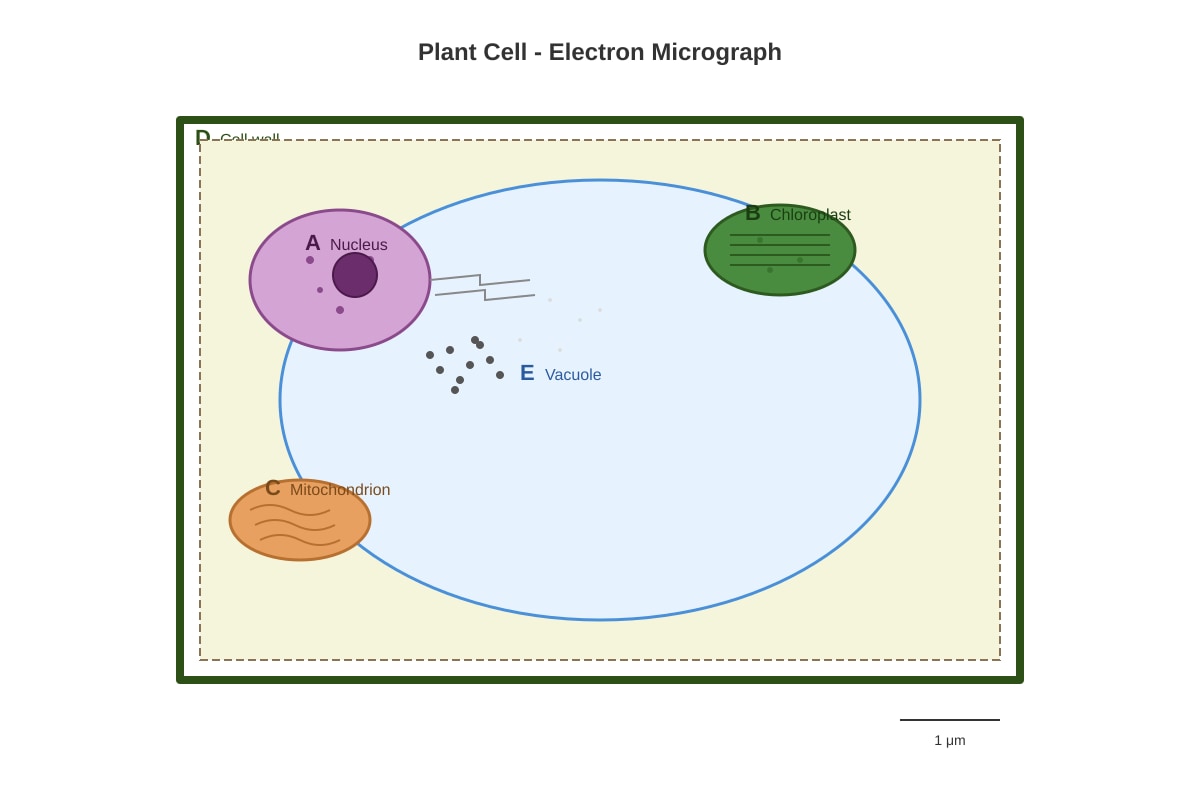
9(a) Which labeled structure is the site of protein synthesis? [1] Answer: None of the labeled structures (ribosomes not shown/labeled) Marking: 1 mark for recognizing ribosomes are not labeled, or stating "ribosomes" if that was an option
9(b) Explain why structure B is not found in animal cells. [2] Answer: Structure B is a chloroplast. Animal cells do not carry out photosynthesis / Animal cells do not need to make their own food. Marking: 1 mark for identifying chloroplast, 1 mark for explanation
9(c) State the function of structure E in maintaining cell shape. [2] Answer: Structure E is the vacuole. It maintains turgor pressure by being filled with cell sap, which pushes against the cell wall to keep the cell rigid. Marking: 1 mark for turgor pressure, 1 mark for explanation of mechanism
10(a) At which temperature was enzyme activity highest? Explain your answer. [2] Answer: 50°C. This is where the reaction was fastest (shortest time for starch to disappear). Marking: 1 mark for 50°C, 1 mark for explanation
10(b) Explain why no reaction occurred at 70°C. [3] Answer: The high temperature denatured the enzyme. The active site changed shape so the substrate could no longer bind to the enzyme. Marking: 1 mark for "denatured", 1 mark for "active site changed shape", 1 mark for "substrate cannot bind"
10(c) Suggest one variable that should be kept constant in this investigation. [1] Answer: Any one from: pH, enzyme concentration, substrate concentration, volume of solutions Marking: 1 mark for any appropriate variable
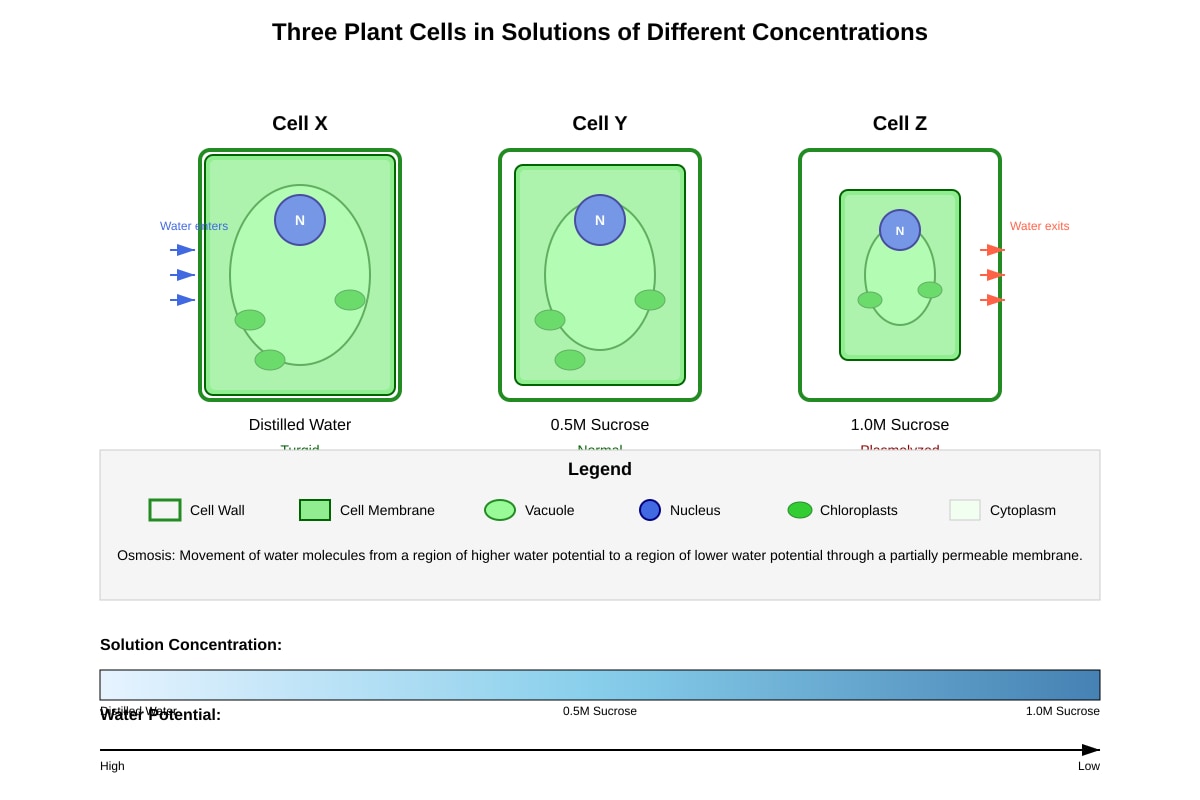
11(a) In which direction will water move by osmosis in Cell X? Explain your answer. [3] Answer: Water will move into the cell. The cell has a lower water potential than the distilled water, so water moves down the water potential gradient into the cell. Marking: 1 mark for "into the cell", 1 mark for "lower water potential", 1 mark for "down water potential gradient"
11(b) Describe what has happened to Cell Z and explain why. [3] Answer: The cell has become plasmolyzed. Water has moved out of the cell by osmosis because the external solution has a lower water potential than the cell contents. Marking: 1 mark for "plasmolyzed", 1 mark for "water moved out", 1 mark for explanation of water potential gradient
11(c) State the term used to describe the condition of Cell X. [1] Answer: Turgid Marking: 1 mark for "turgid"
11(d) Explain why animal cells would be damaged in the solution surrounding Cell X. [2] Answer: Animal cells do not have a cell wall. Water would enter by osmosis and the cell would swell and burst (lyse). Marking: 1 mark for "no cell wall", 1 mark for "cell would burst/lyse"