AI Generated Exam Paper
Secondary 4 Pure Biology Practice Paper 4
Free Sec 4 Pure Biology Practice Paper 4, LongCat AI version, with questions, answers, and O Level-style practice for Singapore students.
These static practice materials are generated from the site's syllabus and paper-generation workflow, with source and model context shown so students and parents can evaluate the material before use.
Questions
Free quiz and exam paper access
Enter your details to view this paper
Your access is remembered on this device.
Answers
TuitionGoWhere Practice Paper — Pure Biology Secondary 4
Answer Key — Cells & Biomolecules (Version 4)
Section A: Multiple Choice Questions
1. C — Mitochondrion [1]
- Marking note: The mitochondrion is the organelle where aerobic respiration occurs in both plant and animal cells. Ribosomes are for protein synthesis; Golgi body for packaging and secretion; endoplasmic reticulum for transport.
2. C — Glucose [1]
- Marking note: Glucose is a simple sugar (carbohydrate) and the primary substrate for cellular respiration to release immediate energy. Lipids store long-term energy; proteins are for growth and repair; DNA carries genetic information.
3. B — Golgi body [1]
- Marking note: The Golgi body (Golgi apparatus) consists of stacked, flattened membrane sacs (cisternae). Mitochondria have a double membrane with cristae; ribosomes are small granular structures; vacuoles are fluid-filled sacs.
4. B — Controlling the movement of substances into and out of the cell [1]
- Marking note: The cell membrane is partially permeable and regulates what enters and leaves the cell. The cell wall (not membrane) provides rigid support; the nucleus stores genetic information; chloroplasts carry out photosynthesis.
5. B — Enzymes speed up reactions by lowering the activation energy [1]
- Marking note: Enzymes are not used up in reactions (A is wrong). Different enzymes have different optimum pH values (C is wrong). Enzyme activity decreases above the optimum temperature due to denaturation (D is wrong).
6. C — Cell wall [1]
- Marking note: Plant cells have a cellulose cell wall outside the cell membrane; animal cells do not. Cell membrane, nucleus, and mitochondria are present in both plant and animal cells.
7. B — The cell will swell and may burst due to water entering by osmosis [1]
- Marking note: Distilled water has a higher water potential than the cytoplasm of the red blood cell. Water moves by osmosis from a region of higher water potential (distilled water) to a region of lower water potential (cell cytoplasm), causing the cell to swell and potentially burst (haemolysis).
8. C — Protein [1]
- Marking note: Enzymes are biological catalysts made of proteins. Starch is a carbohydrate; lipids are fats; vitamins are organic micronutrients.
9. B — Protein synthesis [1]
- Marking note: Ribosomes are the site of protein synthesis in the cell. Lipid synthesis occurs at the smooth endoplasmic reticulum; cellular respiration occurs in mitochondria; photosynthesis occurs in chloroplasts.
10. D — An increase in temperature from 37 °C to 80 °C [1]
- Marking note: High temperatures (above approximately 45–50 °C for most human enzymes) cause the enzyme's active site to change shape (denaturation), so the substrate can no longer fit. A decrease in temperature slows activity but does not denature the enzyme. A pH change from 2 to 7 may actually bring some enzymes closer to their optimum.
Section B: Structured Questions
11.
(a) Cell X: Plant cell [1] Cell Y: Animal cell [1]
- Marking note: Cell X is identified by the presence of a cell wall, chloroplasts, and a large central vacuole. Cell Y lacks these features.
(b) Any two of the following: [1 mark each, total 2]
- Cell X has a cell wall; cell Y does not.
- Cell X has chloroplasts; cell Y does not.
- Cell X has a large central vacuole; cell Y has small or no vacuoles.
- Accept other valid structural differences such as: Cell X is rectangular/fixed shape; cell Y is irregular shape.
(c) Organelle: Nucleus [1] (Accept: mitochondrion, ribosome, endoplasmic reticulum, Golgi body, cell membrane) Function: Contains DNA / controls cell activities / stores genetic information [1] (Function must match the organelle named.)
- Marking note: The organelle must be one present in both plant and animal cells. The function must correctly correspond to the organelle named.
12.
(a) Optimum pH = 2 [1]
- Marking note: The highest rate of reaction (15 units/min) occurs at pH 2.
(b) As pH increases from 1 to 2, the rate of reaction increases [1]. As pH increases from 2 to 6, the rate of reaction decreases [1].
- Award 1 mark for describing the increase, 1 mark for describing the decrease. Award 2 marks if the answer clearly describes the full trend including the peak at pH 2.
(c) At pH 6, the enzyme pepsin is denatured [1]. The shape of the active site has changed so the substrate can no longer fit into it [1].
- Marking note: Students must link denaturation to the change in active site shape. Simply stating "the enzyme is denatured" without explanation earns only 1 mark.
(d) Prediction: Between 8 and 15 units/min (accept any value in this range) [1] Reason: pH 1.5 is between pH 1 and pH 2, and the rate increases from pH 1 to pH 2, so the rate at pH 1.5 would be between the rates at pH 1 and pH 2 [1].
- Marking note: The prediction must be a value between 8 and 15. The reason must refer to the trend in the data.
13.
(a) Lock and key model [1]
- Marking note: Accept "lock-and-key hypothesis/model". Do not accept "induced fit model".
(b) The substrate fits into the active site of the enzyme like a key into a lock [1]. The enzyme-substrate complex is formed, the reaction takes place, and the products are released [1].
- Award 1 mark for describing the complementary fit, 1 mark for describing the formation of the enzyme-substrate complex and release of products.
(c) At very high temperatures, the enzyme is denatured [1]. The bonds holding the enzyme molecule together break, causing the active site to change shape so that the substrate can no longer fit [1].
- Award 1 mark for stating denaturation, 1 mark for explaining the change in active site shape. Simply saying "the enzyme is destroyed" is not sufficient for the second mark.
14.
(a) Solution: A [1] Explanation: The potato cylinder gained mass (+5.2%), meaning water moved into the cell by osmosis. This indicates solution A has a higher water potential than the potato cell [1].
- Marking note: Students must explain the direction of water movement in terms of water potential.
(b) Solution C has a lower water potential than the potato cell [1]. Water moved out of the potato cell into solution C by osmosis [1], causing the cell to lose mass [1].
- Award 1 mark for identifying the water potential difference, 1 mark for stating osmosis, 1 mark for linking to the loss of mass.
(c) Prediction: 0.0% (no change) [1] Explanation: Boiling kills the cells, destroying the partially permeable membrane [1]. Without a functioning membrane, osmosis cannot occur.
- Accept: "The potato cylinder would not change in mass because the cell membrane is no longer partially permeable after boiling."
15.
(a) Sample: W [1] Reason: It turned blue-black with iodine solution, which is the positive test for starch [1].
- Marking note: Sample Z also turned blue-black with iodine, so accept Z as well. Both W and Z contain starch. Award the mark if the student identifies either W or Z and gives the correct reason.
(b) Sample Z [1]
- Marking note: Sample Z tested positive for reducing sugar (orange-red with Benedict's) and negative for protein (blue with Biuret).
(c) Reagent: Sodium hydroxide (NaOH) and copper(II) sulphate (CuSO₄) [1] Positive result: The solution turns purple / violet [1].
- Marking note: Accept "sodium hydroxide solution and copper sulphate solution" or "alkaline copper sulphate solution". The positive result must be "purple" or "violet" — not "blue" (blue is a negative result).
16.
(a) Neuron / nerve cell [1]
- Marking note: Accept "neurone".
(b) Any two of the following: [1 mark each, total 2]
- Long axon — to transmit electrical impulses over long distances.
- Many dendrites — to receive impulses from other neurons.
- Myelin sheath — to insulate the axon and speed up impulse transmission.
- Accept other valid adaptations with correct functional links.
(c) The neuron requires a large number of mitochondria to provide energy (ATP) [1] for active transport of ions (sodium-potassium pump) to maintain and restore the resting potential / to transmit nerve impulses.
- Marking note: The answer must link mitochondria to energy production for the cell's function. Simply stating "to produce energy" without linking to nerve impulse transmission earns the mark at the examiner's discretion, but a full answer should make the link.
Section C: Data-Based Question
17.
(a) Rate of reaction = 1/time × 1000 = 1/40 × 1000 = 25.0 units [2]
- Working: 1 ÷ 40 = 0.025; 0.025 × 1000 = 25.0 [1 mark for correct working, 1 mark for correct answer]
- Award 1 mark if the formula is correctly applied but the arithmetic is wrong.
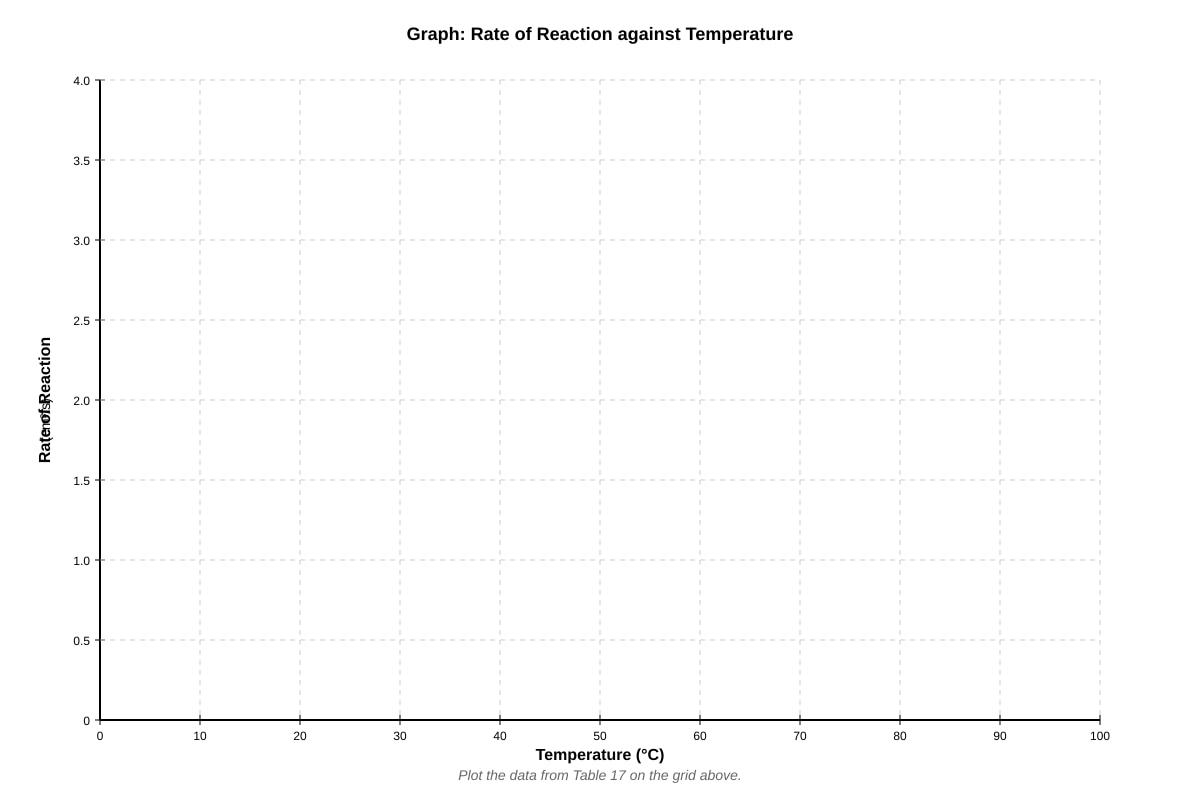
(b) Graph: (Award marks as follows:)
- Correct labelling of axes (x-axis: Temperature /°C; y-axis: Rate of reaction / units) [1]
- Appropriate scale on both axes [1]
- All points correctly plotted [1]
- Smooth curve drawn through the points [1]
- Marking note: The graph should show a peak at 37 °C with a decline on either side. Deduct 1 mark for each error, up to a maximum of 4 marks for the graph.*
(c) As temperature increases from 10 °C to 37 °C, the rate of reaction increases [1]. The rate increases from 8.3 units at 10 °C to a maximum of 50.0 units at 37 °C [1].
- Award 1 mark for describing the general trend (increase), 1 mark for using data from the table to support the description.
(d) Above 37 °C, the enzyme amylase begins to denature [1]. The high temperature breaks the bonds (hydrogen bonds / ionic bonds) that maintain the three-dimensional shape of the enzyme [1]. The active site changes shape so that the substrate (starch) can no longer fit into it [1]. As a result, fewer enzyme-substrate complexes are formed and the rate of reaction decreases [1].
- Award up to 3 marks. Key points: denaturation, bonds broken, active site shape changed, fewer enzyme-substrate complexes. Any 3 valid points earn full marks.
(e) Any two of the following: [1 mark each, total 2]
- Volume/concentration of amylase solution
- Volume/concentration of starch solution
- pH of the solution
- Time of observation
- Accept any valid controlled variable relevant to the experiment.
(f) Any one of the following: [1]
- Repeat the experiment and calculate the mean rate of reaction.
- Use a water bath to maintain a more accurate temperature.
- Use a colorimeter to measure the endpoint more objectively.
- Use a larger range of temperatures.
- Accept any valid improvement that increases reliability or accuracy.
End of Answer Key
Total marks: 40