AI Generated Exam Paper
Secondary 4 Pure Biology Practice Paper 4
Free Sec 4 Pure Biology Practice Paper 4, DeepSeek AI version, with questions, answers, and O Level-style practice for Singapore students.
These static practice materials are generated from the site's syllabus and paper-generation workflow, with source and model context shown so students and parents can evaluate the material before use.
Questions
Free quiz and exam paper access
Enter your details to view this paper
Your access is remembered on this device.
Answers
TuitionGoWhere Practice Paper - Pure Biology Secondary 4
Answer Key and Marking Scheme
Paper: Practice Paper Version 4 Total Marks: 80
Section A: Multiple Choice Questions
[10 marks — 1 mark each]
| Question | Answer | Explanation |
|---|---|---|
| 1 | B | Ribosomes are the sites of protein synthesis. Mitochondria produce ATP, Golgi body modifies and packages proteins, chloroplasts carry out photosynthesis. |
| 2 | C | Distilled water has a higher water potential than the cell contents. Water enters the red blood cells by osmosis, causing them to swell and burst (haemolysis). |
| 3 | D | Ethanol emulsion test gives a cloudy white emulsion with fats. Benedict's gives brick-red with reducing sugars, iodine gives blue-black with starch, Biuret gives purple with proteins. |
| 4 | B | The lock-and-key model states that the active site has a specific shape that is complementary to the substrate, allowing only specific substrates to bind. |
| 5 | D | Plasmolysis occurs when a plant cell loses water by osmosis in a hypertonic solution, causing the cell membrane to pull away from the cell wall. |
| 6 | D | Proteins contain carbon, hydrogen, oxygen, and nitrogen (and sometimes sulfur). Carbohydrates contain only carbon, hydrogen, and oxygen. |
| 7 | A | [Accept answer based on graph provided in question — enzyme P peaks at pH 2] |
| 8 | C | Active transport uses carrier proteins and requires energy (ATP) to move substances against the concentration gradient. |
| 9 | B | The mass of potassium permanganate must be kept constant. Temperature is the independent variable being changed. |
| 10 | C | Fats are made from glycerol and fatty acids. Starch is made from glucose, proteins from amino acids, glycogen from glucose. |
Section B: Structured Questions
[40 marks]
Question 11 [6 marks]
(a) [2 marks]
- X: Mitochondrion / Mitochondria [1 mark]
- Y: Ribosome / Ribosomes [1 mark]
(b) [2 marks]
- Mitochondria are the sites of aerobic respiration [1 mark]
- where glucose is broken down to release energy in the form of ATP, which powers cellular activities [1 mark]
(c) [2 marks]
- Ribosomes are the sites of protein synthesis [1 mark]
- Proteins synthesised by ribosomes on the rough endoplasmic reticulum are transported through the ER for modification and transport to the Golgi body [1 mark]
Question 12 [8 marks]
(a) [2 marks]
- Percentage change = (Change in mass ÷ Initial mass) × 100
- = (+0.10 ÷ 2.50) × 100 = +4.0% [1 mark for correct working, 1 mark for correct answer]
(b) [3 marks]
- The 0.0 mol/dm³ solution (distilled water) has a higher water potential than the potato cell sap [1 mark]
- Water enters the potato cells by osmosis, down the water potential gradient [1 mark]
- The cells become turgid, increasing the mass of the potato strip [1 mark]
(c) [2 marks]
- The isotonic concentration is approximately 0.4 mol/dm³ [1 mark]
- At this concentration, there is no net movement of water into or out of the cells, so there is no change in mass (0.0% change) [1 mark]
(d) [1 mark]
- Any one of: temperature, volume of sucrose solution, time of immersion, surface area of potato strips, same potato variety [1 mark]
Question 13 [8 marks]
(a) [2 marks]
- The rate of reaction increases as temperature increases from 10°C to 40°C [1 mark]
- The rate reaches a maximum at approximately 40°C (the optimum temperature) [1 mark]
(b) [2 marks]
- As temperature increases, the kinetic energy of enzyme and substrate molecules increases [1 mark]
- This increases the frequency of effective collisions between enzyme and substrate, leading to more enzyme-substrate complexes formed per unit time [1 mark]
(c) [3 marks]
- Above 50°C, the enzyme denatures [1 mark]
- High temperatures break the hydrogen bonds that maintain the enzyme's specific three-dimensional (tertiary) structure [1 mark]
- The active site loses its specific shape, so the substrate can no longer bind, and enzyme-substrate complexes cannot form [1 mark]
(d) [1 mark]
- Curve should be shifted to the right, with optimum at approximately 70°C [1 mark for correct positioning]
Question 14 [9 marks]
(a) [2 marks]
- The red blood cell has shrunk / become crenated [1 mark]
- It has a spiky, shrivelled appearance [1 mark]
(b) [3 marks]
- Solution A has a lower water potential than the cell contents (it is hypertonic) [1 mark]
- Water moves out of the red blood cell by osmosis, down the water potential gradient [1 mark]
- The cell loses water, shrinks, and becomes crenated [1 mark]
(c) [2 marks]
- An isotonic solution has the same water potential as the cell contents [1 mark]
- There is no net movement of water into or out of the cell, so the cell retains its normal shape [1 mark]
(d) [2 marks]
- If the drip solution is not isotonic, water will move into or out of the red blood cells by osmosis [1 mark]
- This could cause red blood cells to burst (in a hypotonic solution) or shrink/crenate (in a hypertonic solution), which would be harmful to the patient [1 mark]
Question 15 [9 marks]
(a) [1 mark]
- Reducing sugar (only) [1 mark]
(b) [2 marks]
- Protein [1 mark]
- Fats / Lipids [1 mark]
(c) [2 marks]
- Heating provides activation energy for the reaction [1 mark]
- This allows reducing sugars to react with copper(II) sulfate in Benedict's solution, producing a colour change from blue to brick-red precipitate [1 mark]
(d) [2 marks]
- The claim may not be entirely correct [1 mark]
- Sample W gave negative results for reducing sugar, starch, protein, and fats, but it could contain non-reducing sugars (e.g., sucrose) or other dissolved substances not tested for [1 mark]
(e) [2 marks]
- Add about 2 cm³ of the food sample to a test tube [1 mark]
- Add about 2 cm³ of ethanol and shake vigorously; then add an equal volume of water and shake again. A cloudy white emulsion indicates the presence of fats [1 mark]
Section C: Data-Based and Extended Response Questions
[30 marks]
Question 16 [9 marks]
(a) [2 marks]
- P: Phospholipid / Phospholipid bilayer [1 mark]
- Q: Protein / Carrier protein / Channel protein [1 mark]
(b) [2 marks]
- "Fluid" because the phospholipid molecules can move laterally within the membrane [1 mark]
- "Mosaic" because proteins are scattered throughout the phospholipid bilayer, forming a mosaic pattern [1 mark]
(c) [3 marks]
- Facilitated diffusion involves carrier proteins or channel proteins in the membrane, while simple diffusion does not [1 mark]
- Both processes move substances down the concentration gradient and do not require energy [1 mark]
- Facilitated diffusion allows larger or charged molecules (e.g., glucose, ions) to cross the membrane that cannot pass through the phospholipid bilayer by simple diffusion [1 mark]
(d) [2 marks]
- Active transport moves substances against the concentration gradient (from lower to higher concentration) [1 mark]
- Energy (ATP) is needed to change the shape of the carrier protein to move the substance across the membrane [1 mark]
Question 17 [12 marks]
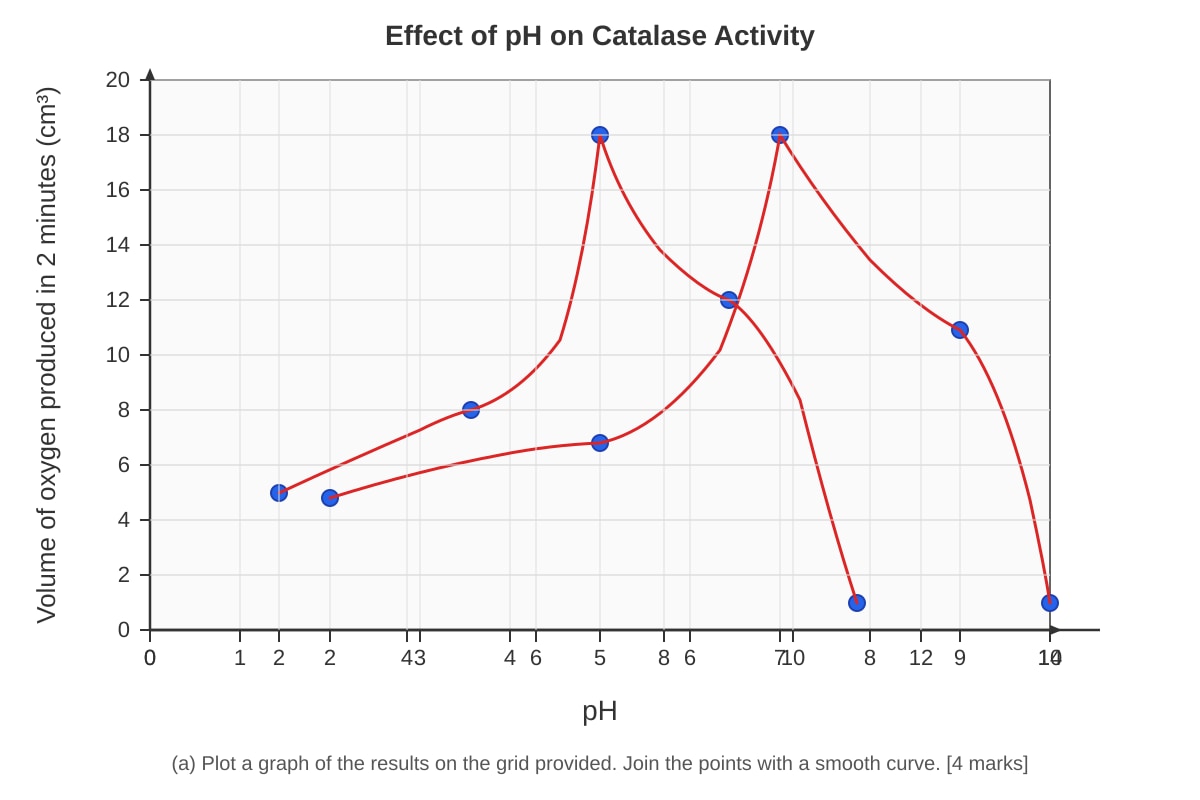
(a) [4 marks]
- Correct axes labelled with units [1 mark]
- All points plotted correctly [1 mark]
- Appropriate scales chosen [1 mark]
- Smooth curve drawn through points [1 mark]
(b) [1 mark]
- pH 7 [1 mark]
(c) [3 marks]
- At pH 3 and pH 11, the enzyme is denatured [1 mark]
- Extreme pH values disrupt the ionic and hydrogen bonds that maintain the enzyme's specific three-dimensional shape [1 mark]
- The active site loses its specific shape, so the substrate (hydrogen peroxide) can no longer bind, and few enzyme-substrate complexes are formed [1 mark]
(d) [2 marks]
- Any two of: temperature, concentration/volume of hydrogen peroxide, mass/surface area of potato tissue, time of reaction [1 mark each]
(e) [2 marks]
- Return the enzyme from pH 11 to pH 7 (the optimum pH) [1 mark]
- Measure the volume of oxygen produced. If the enzyme was permanently denatured, activity will not recover. If the change was reversible, activity will increase [1 mark]
Question 18 [9 marks]
(a) [3 marks]
- R: Phosphate group [1 mark]
- S: Deoxyribose sugar [1 mark]
- T: Nitrogenous base / Base [1 mark]
(b) [1 mark]
- Adenine (A) pairs with Thymine (T); Cytosine (C) pairs with Guanine (G) [1 mark]
(c) [2 marks]
- The sequence of nitrogenous bases along the DNA strand forms the genetic code [1 mark]
- Different sequences of bases code for different proteins, allowing DNA to store vast amounts of genetic information [1 mark]
(d) [1 mark]
- T A C G G C A T [1 mark]
(e) [2 marks]
- DNA is a long molecule that carries the genetic code [1 mark]
- A gene is a specific sequence of DNA bases that codes for one polypeptide/protein. Chromosomes are structures made of tightly coiled DNA, containing many genes [1 mark]
END OF ANSWER KEY
© TuitionGoWhere 2025. This is an AI-generated marking scheme for educational use.