AI Generated Exam Paper
Secondary 4 Pure Biology Practice Paper 2
Free Sec 4 Pure Biology Practice Paper 2, HY3 AI version, with questions, answers, and O Level-style practice for Singapore students.
These static practice materials are generated from the site's syllabus and paper-generation workflow, with source and model context shown so students and parents can evaluate the material before use.
Questions
Free quiz and exam paper access
Enter your details to view this paper
Your access is remembered on this device.
Answers
TuitionGoWhere Practice Paper - Pure Biology Secondary 4 (Answers)
Version 2 of 5 — Answer Key
Section A: Cell Structure and Organisation (18 marks)
1. [1] Ribosome(s).
Teaching note: Ribosomes are the organelles where amino acids are joined to form proteins. They may be free in the cytoplasm or attached to rough endoplasmic reticulum.
2. [1] Biconcave (disc) shape / no nucleus.
Teaching note: The biconcave shape increases surface area for oxygen diffusion; lack of nucleus also allows more space for haemoglobin.
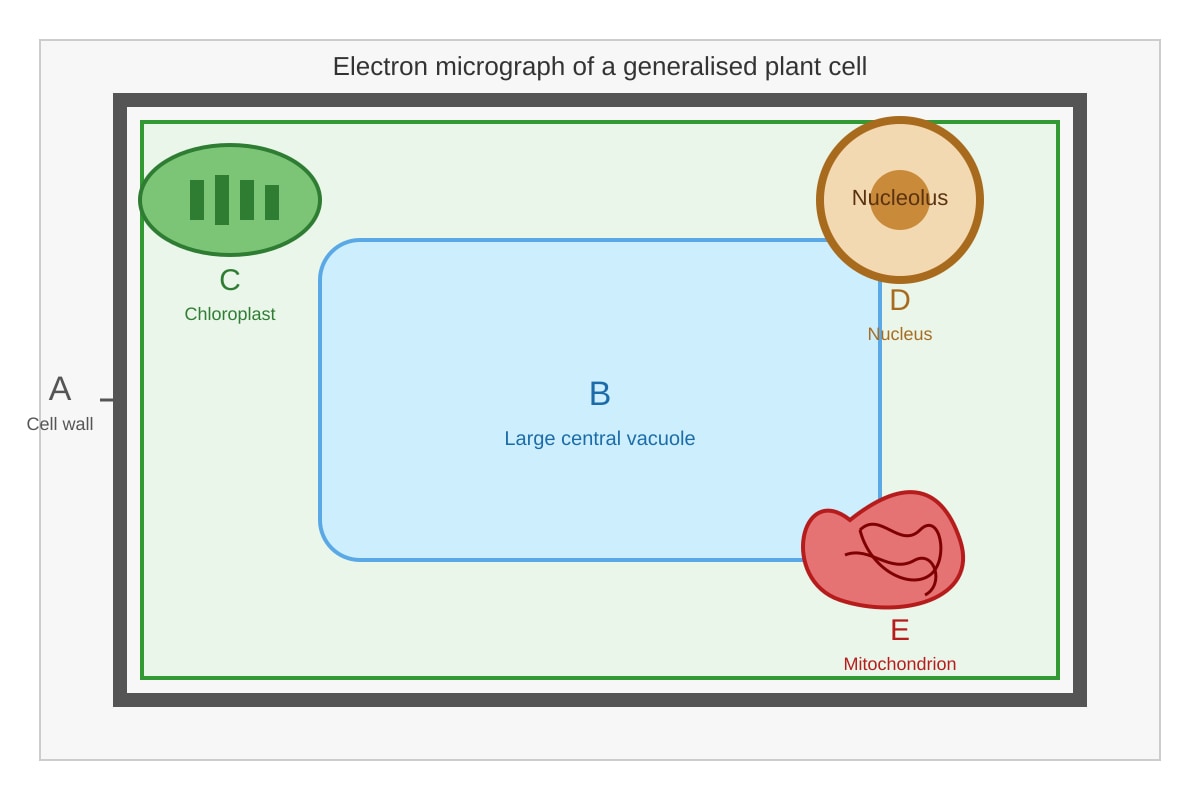
3. [1] E (mitochondrion).
Teaching note: A = cell wall, B = vacuole, C = chloroplast (photosynthesis), D = nucleus (control), E = mitochondrion (aerobic respiration / ATP production).
4. [3]
- Root hair cell has a long hair-like projection increasing surface area [1]
- This increases rate of water absorption by osmosis [1]
- Thin cell wall / large vacuole aids water uptake [1]
Teaching note: Adaptation links structure to function. More surface area = faster osmosis from soil.
5. [2] Any two:
- Plant cell has cell wall, animal cell does not [1]
- Plant cell has chloroplasts, animal cell does not [1]
- Plant cell has large central vacuole, animal cell has small/no vacuole [1]
(Max 2 marks)
6. [2]
- Muscle cells need large amounts of energy (ATP) for contraction [1]
- Mitochondria produce ATP via aerobic respiration, so many mitochondria meet energy demand [1]
Section B: Movement of Substances (18 marks)
7. [2] Osmosis is the diffusion of water molecules from a region of higher water potential to a region of lower water potential through a partially permeable membrane.
Marking: 1 mark for water movement, 1 mark for partially permeable membrane / water potential gradient.
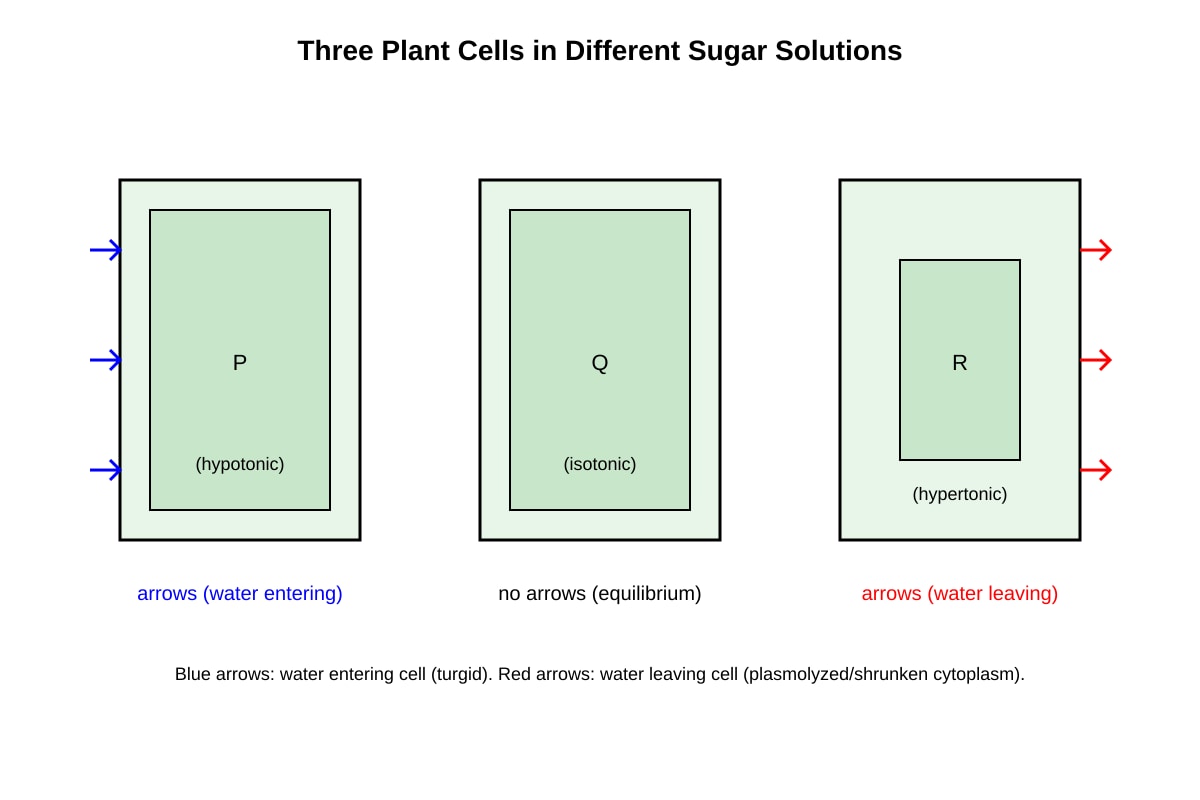
8. [1] R.
Teaching note: R shows water leaving the cell (outward arrows) = hypertonic external solution.
9. [2]
- The sugar solution around R has lower water potential than the cell sap [1]
- Water moves out of the cell by osmosis down the water potential gradient [1]
10. [3]
- Diffusion is passive (no energy) movement down concentration gradient [1]
- Active transport requires energy (ATP) [1]
- Active transport moves substances against concentration gradient [1]
11. [3]
- Water leaves the red blood cells by osmosis [1]
- Because salt solution has lower water potential than cell cytoplasm [1]
- Cells shrink / crenate and may be damaged [1]
12. [2] Example: Glucose absorption in villi of small intestine (active transport) [1]; or ion uptake by root hair cells [1]. Substance: glucose / mineral ions.
Section C: Biological Molecules and Enzymes (24 marks)
13. [1] Amino acid.
14. [2] Iodine solution [1]; blue-black colour with starch [1].
15. [2] Protein [1] and fat [1].
Teaching note: Biuret = protein; ethanol emulsion = fat. Milk contains both.
16. [3]
- Enzyme has a specific active site [1]
- Substrate fits into active site like a key into a lock [1]
- Enzyme-substrate complex forms, reaction occurs, products released [1]
17. [1+2+3 = 6 marks]
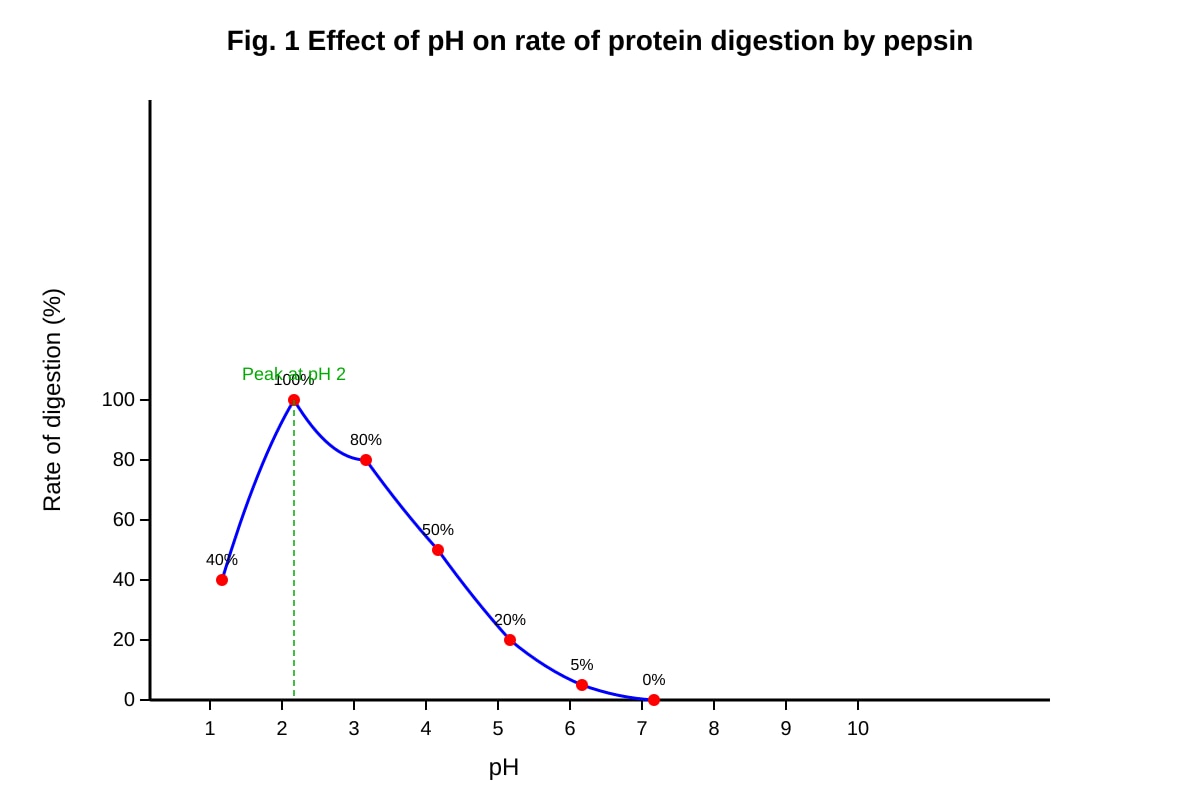
(a) [1] pH 2.
(b) [2] Rate increases from 40% at pH 1 to 100% at pH 2, then decreases steadily to 0% at pH 7 [2].
(c) [3] Above pH 3, the enzyme's active site changes shape (denatures) [1] because H+ ion concentration drops altering ionic bonds [1]; substrate can no longer bind, so activity falls [1].
18. [1+3+3 = 7 marks]
(a) [1] Temperature.
(b) [3] Higher temperature increases kinetic energy [1]; more enzyme-substrate collisions [1]; faster reaction until optimum ~45°C [1].
(c) [3] At 55°C amylase denatures [1]; active site lost [1]; starch not digested / rate near zero [1].
19. [1] Carbon, hydrogen, oxygen (C, H, O).
20. [3]
- Lactase breaks down lactose into glucose and galactose [1]
- Without lactase, lactose remains undigested in milk [1]
- Causing bloating / diarrhoea as bacteria ferment lactose in gut [1]
Total Marks: 60