AI Generated Exam Paper
Secondary 4 Pure Biology Practice Paper 2
Free Sec 4 Pure Biology Practice Paper 2, Gemma31B AI version, with questions, answers, and O Level-style practice for Singapore students.
These static practice materials are generated from the site's syllabus and paper-generation workflow, with source and model context shown so students and parents can evaluate the material before use.
Questions
Free quiz and exam paper access
Enter your details to view this paper
Your access is remembered on this device.
Answers
Answer Key - Pure Biology Secondary 4 Practice Paper (Version 2)
Section A
Question 1 (a) Ribosomes [1] (b) Golgi apparatus modifies and packages proteins/enzymes into vesicles for secretion [2]. (c) Cell membrane is partially permeable and present in both; cell wall is fully permeable, made of cellulose, and present only in plant cells [2].
Question 2 (a) The sucrose solution has a lower water potential than the potato cell sap [1]. Water moves out of the potato cells into the solution [1] by osmosis across a partially permeable membrane [1]. (b) The cell becomes turgid [1] as water enters the cell by osmosis, pushing the cytoplasm against the cell wall [1].
Question 3 (a) The enzyme has a specific 3D shape of its active site [1]. This shape is complementary to the shape of a specific substrate molecule [1], allowing them to fit together like a lock and key to form an enzyme-substrate complex [1]. (b) High temperature provides too much thermal energy, breaking bonds in the enzyme [1]. The active site changes shape (denatures), so the substrate can no longer fit [1].
Question 4 (a) Pepsin [1]; Acidic pH (approx pH 2) [1]. (b) One-cell thick epithelium/wall for short diffusion distance [1]; rich network of blood capillaries to maintain concentration gradient [1]; large surface area due to finger-like projections [1].
Question 5 (a) Arteries have thicker, more elastic walls / Veins have valves [1]. (b) The left ventricle must pump blood to the entire body (systemic circulation) [1], requiring higher pressure to overcome greater resistance compared to the right ventricle which only pumps to the lungs [1].
Question 6 (a) One-cell thick walls for short diffusion distance [1]; large surface area for maximum gas exchange [1]. (b) The process of breaking down glucose in the presence of oxygen to release energy [1]. [2].
Question 7 (a) Ultrafiltration is the non-selective forcing of small molecules out of the glomerulus due to high pressure [1]. Selective reabsorption is the active/passive recovery of useful substances (e.g., glucose) back into the blood [1]. (b) All glucose filtered into the nephron is reabsorbed into the blood [1] via active transport in the proximal convoluted tubule [1].
Question 8 (a) Hypothalamus detects increase in blood temperature [1]. It triggers effectors: sweat glands to produce sweat for evaporative cooling [1] and skin arterioles to dilate (vasodilation) to increase heat loss via radiation [1]. (b) Stimulates the liver to convert excess glucose into glycogen for storage [1], thereby lowering blood glucose levels [1].
Question 9 (a) Antibiotics target bacterial structures/processes (e.g., cell wall synthesis) [1]. Viruses lack these structures and live inside host cells, making them unaffected by antibiotics [1]. (b) A weakened/inactive pathogen is injected [1]. This stimulates the immune system to produce antibodies and memory cells [1] without causing the disease.
Question 10 (a) Evaporation of water from stomata creates a transpiration pull [1]. This pulls water up the xylem from the roots [1]. Minerals dissolved in this water are transported upwards along with the water stream [1]. (b) The transport of organic solutes (sucrose/amino acids) through the phloem from source to sink [1].
Section B
Question 11 (a) For both temperatures, as light intensity increases, the rate of photosynthesis increases [1] until it reaches a plateau [1]. (b) Higher temperature increases the kinetic energy of molecules [1]. This increases the frequency of successful collisions between enzymes and substrates [1], increasing the rate of the light-independent reactions [1]. (c) Carbon dioxide concentration [1] and Temperature [1] (or chlorophyll availability) [1].
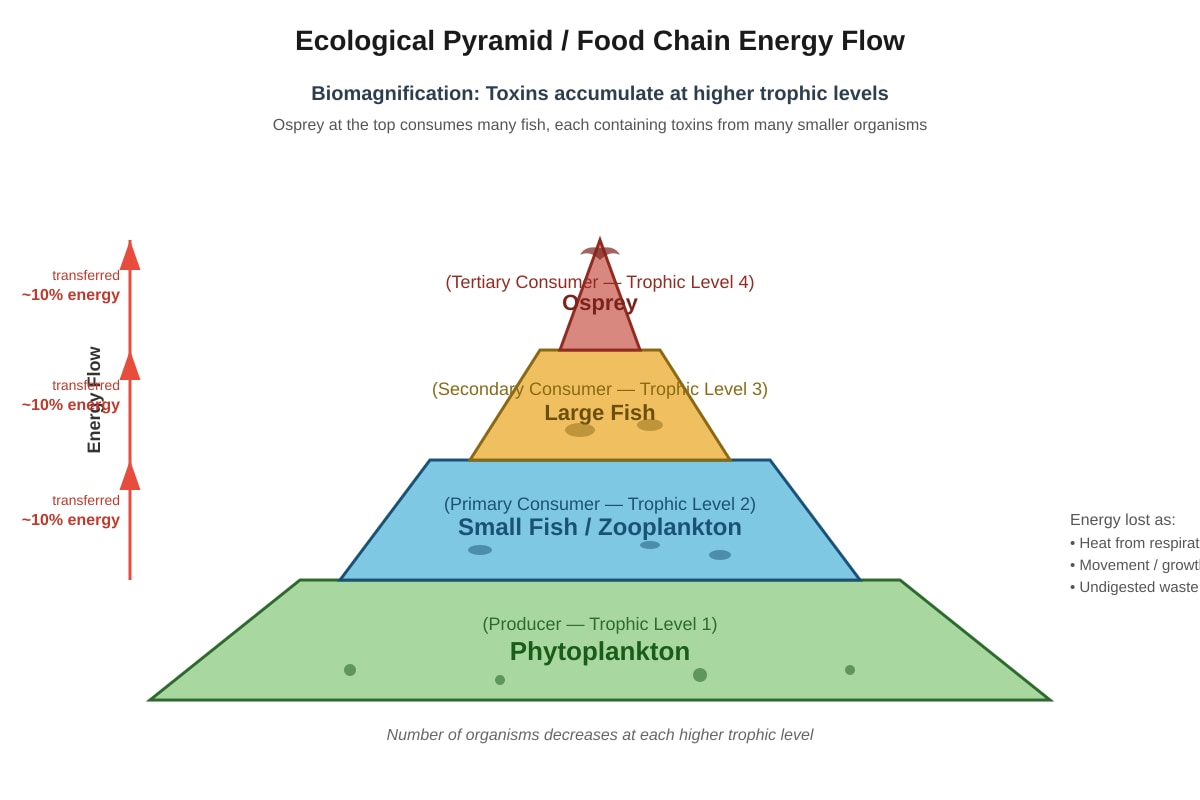
Question 12 (a) Energy is lost as heat during respiration [1], used for movement/growth [1], or lost as undigested waste/faeces [1]. (b) Toxins are non-biodegradable and accumulate in tissues [1]. Because energy is lost, the Osprey must eat many large fish, each containing toxins from many smaller fish [1]. This leads to biomagnification at the top of the food chain [1]. (c)
Generated diagram for this question.
. It is pyramid-shaped because biomass decreases at each level due to energy loss and inefficiency of transfer [2].
Question 13 (a) Isolation of human insulin gene using restriction enzymes [1]. Cutting a bacterial plasmid with the same restriction enzyme [1]. Joining the gene and plasmid using DNA ligase to form recombinant DNA [1]. Inserting the plasmid into E. coli bacteria [1]. Growing bacteria in a fermenter to express the gene and produce insulin [1]. (b) Potential for "playing God" or altering natural evolution [1]. Risk of creating "super-weeds" or unexpected ecological disruptions if transgenic organisms escape into the wild [2].
Question 14 (a) Combustion releases carbon stored in fossil fuels directly into the atmosphere as [2]. Deforestation removes trees (carbon sinks) that would otherwise absorb for photosynthesis [2]. (b) and other greenhouse gases trap infrared radiation (heat) reflecting off the Earth's surface [2]. This prevents heat from escaping into space, increasing the average global temperature [2].
Question 15 (a) Blood is passed through a partially permeable membrane [1]. Urea, being a small molecule, moves from the blood (high concentration) to the dialysis fluid (low concentration) [1] by diffusion [1]. The fluid is constantly refreshed to maintain a steep concentration gradient [1]. (b) To prevent the net movement of essential solutes like glucose and salts [1]. If the fluid had lower concentrations, these nutrients would be lost from the blood by diffusion [2], leading to nutrient deficiency in the patient [1].