AI Generated Exam Paper
Secondary 4 Pure Biology Practice Paper 1
Free Sec 4 Pure Biology Practice Paper 1, HY3 AI version, with questions, answers, and O Level-style practice for Singapore students.
These static practice materials are generated from the site's syllabus and paper-generation workflow, with source and model context shown so students and parents can evaluate the material before use.
Questions
TuitionGoWhere Practice Paper - Pure Biology Secondary 4
TuitionGoWhere Practice Paper (AI) — Version 1 of 5
Subject: Pure Biology
Level: Secondary 4
Paper: Practice Paper (Topic: Cells & Biomolecules)
Duration: 60 minutes
Total Marks: 60
Name: ___________________________
Class: ____________
Date: ____________
Instructions:
- This practice paper contains 20 questions across three sections.
- Section A: 10 short-answer questions (1–3 marks each).
- Section B: 6 structured questions (4–5 marks each).
- Section C: 4 data/interpretation questions (5–6 marks each).
- Answer all questions in the spaces provided.
- Use a pen with blue or black ink.
- Marks for each question are shown in brackets [ ].
Section A: Short Answer (Total: 20 marks)
1. Name the cells in the root epidermis through which water is mainly absorbed from the soil. [1]
2. State one function of the ribosome in a cell. [1]
3. Which cell organelle is the site of aerobic respiration and produces ATP? [1]
4. Name the biological molecule that is tested using iodine solution. [1]
5. What is the term for the movement of water molecules from a region of higher water potential to a region of lower water potential through a partially permeable membrane? [1]
6. Give the chemical formula of the basic unit (monomer) that makes up proteins. [1]
7. Which food test uses Benedict's solution to detect a specific type of sugar? [1]
8. State the word equation for photosynthesis. [1]
9. Name the process by which a cell engulfs large particles using energy (not required here, but state the transport process that requires energy to move substances against a concentration gradient). [1]
10. A red blood cell is placed in pure water. State what happens to the cell. [1]
Section B: Structured Questions (Total: 26 marks)
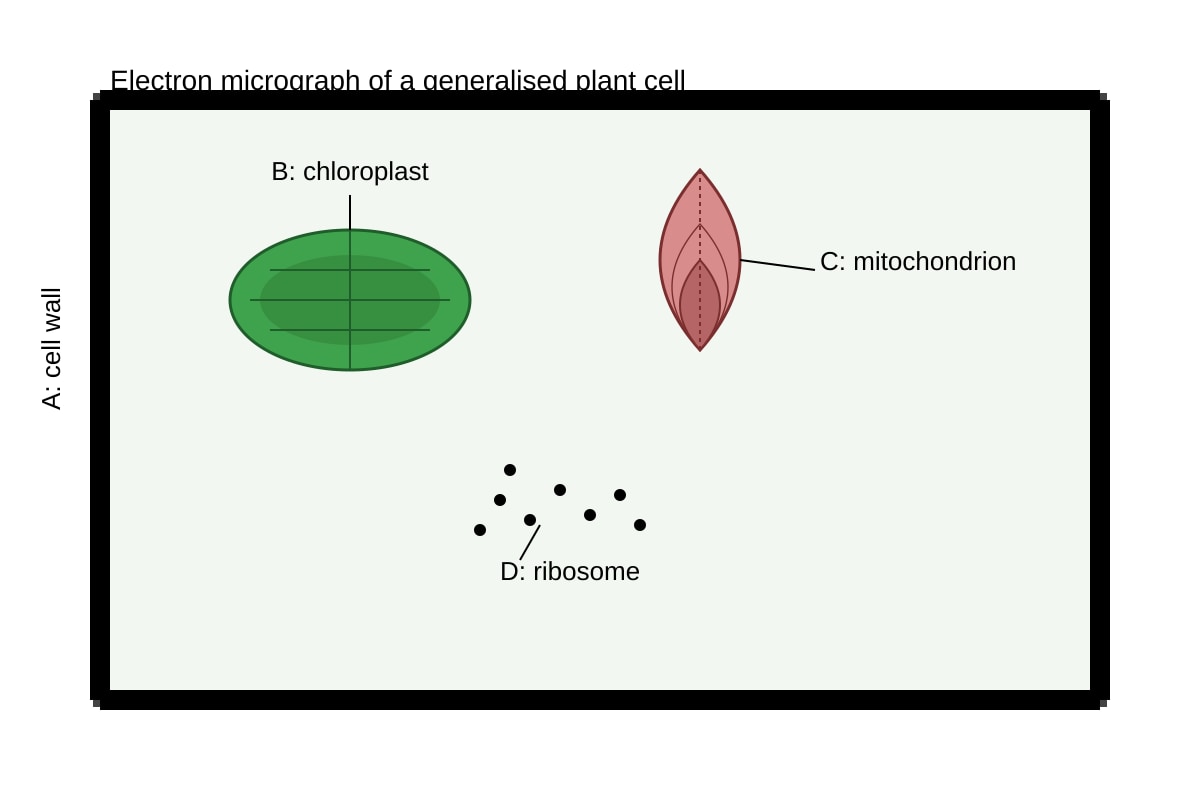
11. The diagram below shows an electron micrograph of a plant cell with labelled structures A to D.
Image pending generation: diagram for Q11.
(a) Which labelled structure is the site of protein synthesis? [1]
(b) Which labelled structure is where light energy is converted to chemical energy? [1]
(c) State one function of structure C. [1]
(d) Explain why structure A is not found in animal cells. [1]
12. Table 1 shows the movement of substances across a cell membrane.
| Substance | Direction | Mechanism |
|---|---|---|
| Oxygen | High → Low | Diffusion |
| Glucose (intestine to blood) | Low → High | Active transport |
| Water | High → Low | Osmosis |
(a) Identify the transport mechanism for water. [1]
(b) Explain why glucose absorption in the small intestine requires active transport. [2]
(c) State what would happen to oxygen movement if the concentration gradient was removed. [1]
13. A student carried out the biuret test on a food sample.
(a) State the colour change that indicates a positive result for protein. [1]
(b) Name the monomer that makes up proteins. [1]
(c) Explain why proteins are essential for growth and repair. [2]
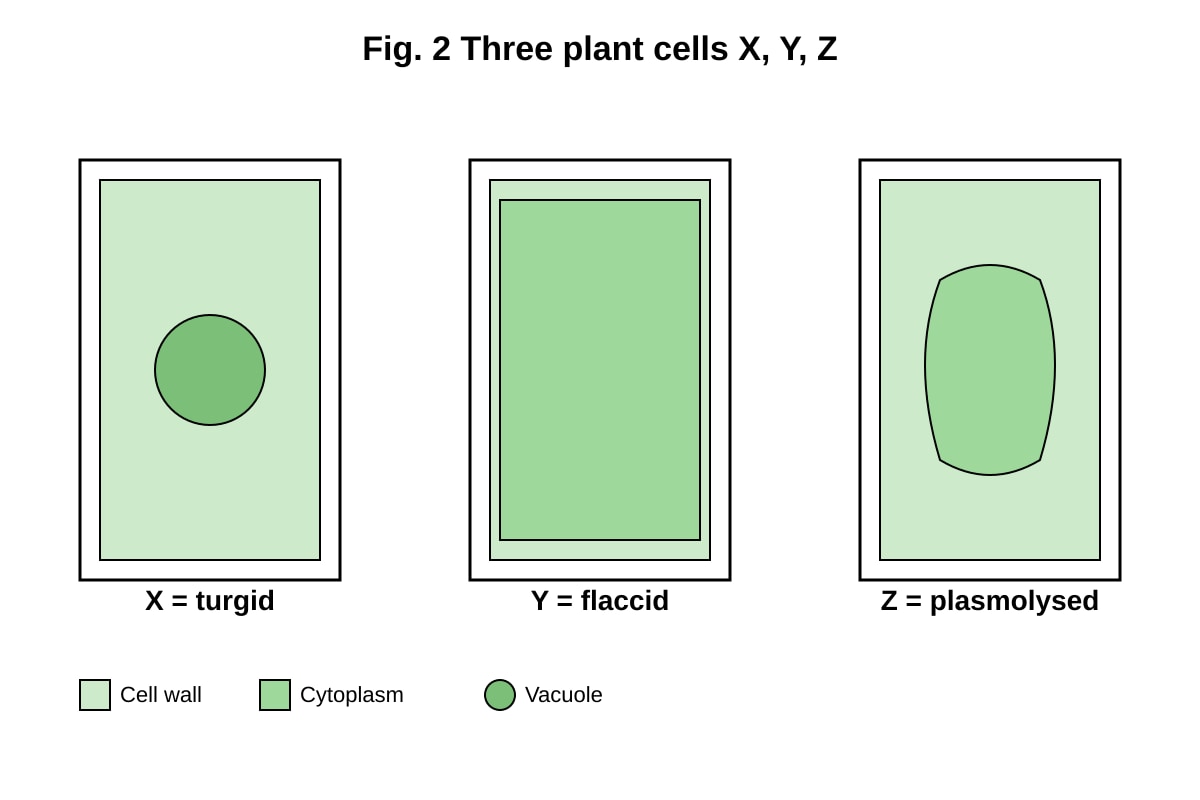
14. Fig. 2 shows three plant cells X, Y, Z in different sucrose solutions.
Image pending generation: diagram for Q14.
(a) Which cell (X, Y or Z) is plasmolysed? [1]
(b) Explain why water moved out of cell Z. [2]
(c) What term describes the pressure exerted by the cell contents against the cell wall in cell X? [1]
15. Enzymes are biological catalysts.
(a) State the lock-and-key model of enzyme action. [2]
(b) Give one reason why a high temperature of 80°C stops enzyme activity. [2]
16. A food sample was tested as follows:
- Iodine: blue-black colour observed
- Benedict's: no colour change after heating
- Ethanol: cloudy white layer formed
(a) State which biomolecule is present based on iodine result. [1]
(b) State which biomolecule is present based on ethanol result. [1]
(c) Explain why Benedict's test was negative. [2]
Section C: Data & Interpretation (Total: 14 marks)
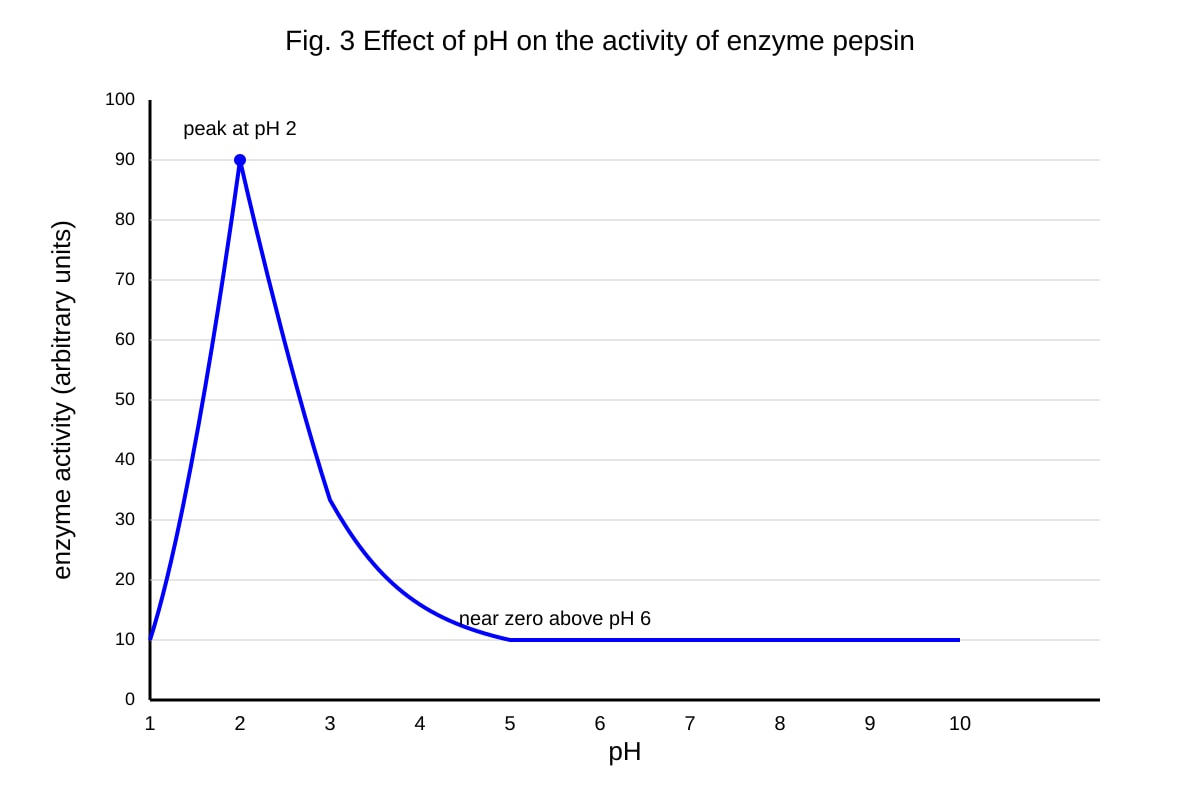
17. Fig. 3 shows the effect of pH on the activity of enzyme pepsin.
Image pending generation: graph for Q17.
(a) State the optimum pH for pepsin. [1]
(b) Describe the trend from pH 1 to pH 10. [2]
(c) Explain why pepsin has low activity at pH 8. [2]
18. An investigation studied the effect of temperature on catalase activity. Results are in Table 2.
| Temp (°C) | Bubbles in 1 min |
|---|---|
| 10 | 5 |
| 20 | 12 |
| 30 | 20 |
| 40 | 22 |
| 50 | 8 |
| 60 | 0 |
(a) Calculate the percentage increase in bubbles from 10°C to 40°C. [2]
(b) State the optimum temperature range. [1]
(c) Explain the drop to 0 at 60°C. [2]
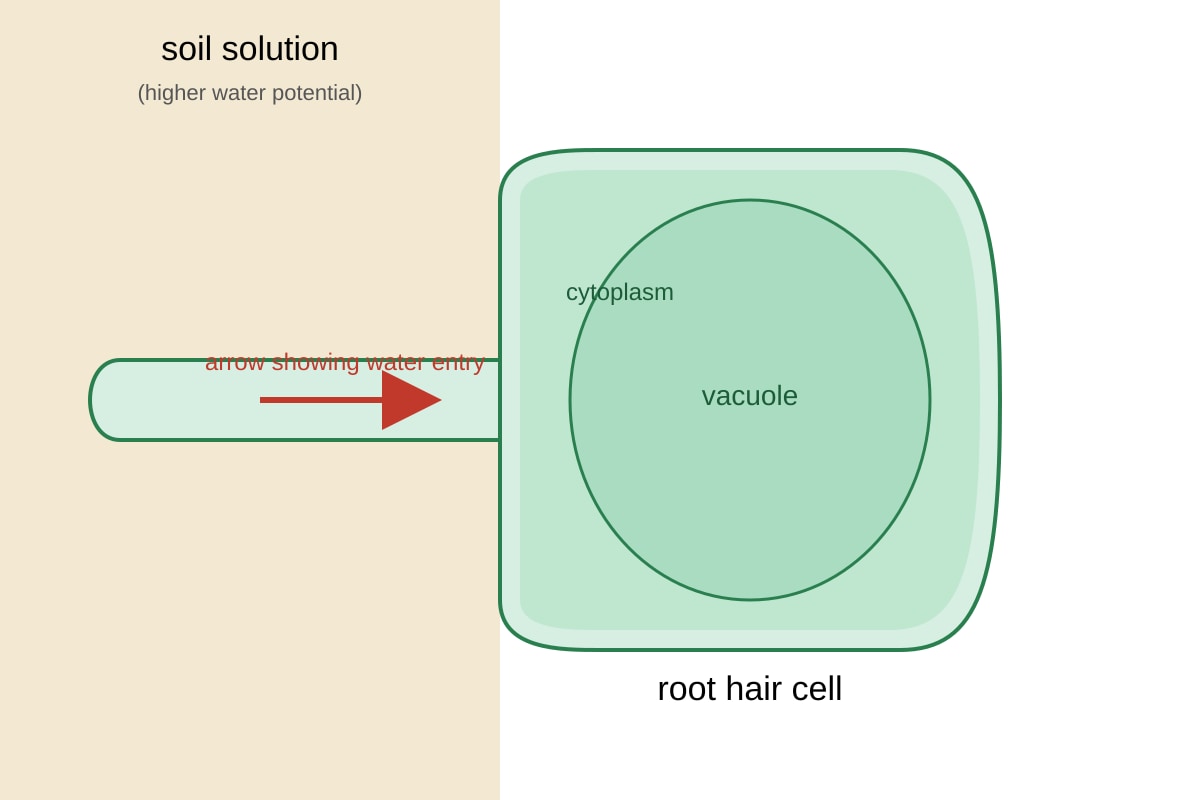
19. Fig. 4 shows a root hair cell and soil water.
Image pending generation: diagram for Q19.
(a) Explain how the root hair cell is adapted to absorb water. [2]
(b) Name the process by which water enters. [1]
(c) State what would happen if the soil solution became very concentrated (low water potential). [2]
20. A student investigated starch digestion by amylase at different temperatures.
(a) State the substrate and product of amylase. [2]
(b) Describe how the student could use iodine to test for starch disappearance. [2]
(c) Predict the result at 0°C and explain. [2]
End of Paper
Answers
TuitionGoWhere Practice Paper - Pure Biology Secondary 4 (Answers)
Version 1 of 5 — Answer Key & Teaching Notes
Section A: Short Answer
1. Root hair cells [1]
Teaching note: Water is absorbed from soil by root hair cells (extensions of epidermal cells) due to large surface area. Common mistake: writing "xylem" (xylem transports water, not absorbs).
2. Protein synthesis [1]
Teaching note: Ribosomes are the site where amino acids are joined to form proteins.
3. Mitochondrion (mitochondria) [1]
Teaching note: Aerobic respiration occurs in mitochondria, producing ATP (energy).
4. Starch [1]
Teaching note: Iodine solution turns blue-black in presence of starch.
5. Osmosis [1]
Teaching note: Osmosis is diffusion of water through partially permeable membrane.
6. Amino acid [1]
Teaching note: Proteins are polymers of amino acid monomers.
7. Reducing sugars (e.g. glucose) [1]
Teaching note: Benedict's test detects reducing sugars; positive = green to brick-red.
8. Carbon dioxide + water → glucose + oxygen [1]
Teaching note: Photosynthesis uses light energy to make glucose and release oxygen.
9. Active transport [1]
Teaching note: Active transport needs energy (ATP) to move against gradient.
10. It swells and may burst (lysis) [1]
Teaching note: Pure water has higher water potential; water enters by osmosis, animal cell has no wall.
Section B: Structured Questions
11.
(a) D [1] — ribosome is site of protein synthesis.
(b) B [1] — chloroplast converts light to chemical energy.
(c) Produces ATP / site of aerobic respiration [1].
(d) Animal cells lack cell wall; only plant/fungal/bacterial cells have it for support [1].
Visual: Q11-fig1 must show D as tiny dots, B as green ovals.
12.
(a) Osmosis [1].
(b) Glucose moves from low (intestine) to high (blood) concentration, against gradient, so needs ATP [2].
(c) No net movement / diffusion stops [1].
13.
(a) Blue to purple/violet [1].
(b) Amino acids [1].
(c) Proteins form muscle/enzymes/antibodies for building and repairing tissues [2].
14.
(a) Z [1].
(b) Soil/solution had lower water potential; water left cell by osmosis [2].
(c) Turgor pressure [1].
15.
(a) Enzyme active site fits specific substrate like key in lock; forms ESC [2].
(b) High temp denatures enzyme; active site changes shape [2].
16.
(a) Starch [1].
(b) Fats/lipids [1].
(c) No reducing sugar present; Benedict's only reacts with reducing sugars [2].
Section C: Data & Interpretation
17.
(a) pH 2 [1].
(b) Activity rises to peak at pH 2 then falls to near zero by pH 6 [2].
(c) pH 8 is far from optimum; enzyme denatured / active site altered [2].
18.
(a) Increase = (22−5)/5 ×100 = 340% [2].
(b) 30–40°C [1].
(c) 60°C denatures catalase; no active enzyme [2].
19.
(a) Long projection increases SA; thin wall short diffusion path [2].
(b) Osmosis [1].
(c) Water leaves cell; plasmolysis [2].
20.
(a) Substrate: starch; product: maltose [2].
(b) Add iodine drop; blue-black means starch present; disappearance = yellow/brown [2].
(c) At 0°C low activity; enzyme slow, starch remains [2].
Total Marks: 60 — matches paper.
Free quiz and exam paper access
Enter your details to view this paper
Your access is remembered on this device.