AI Generated Exam Paper
Secondary 4 Pure Biology Practice Paper 1
Free Sec 4 Pure Biology Practice Paper 1, DeepSeek AI version, with questions, answers, and O Level-style practice for Singapore students.
These static practice materials are generated from the site's syllabus and paper-generation workflow, with source and model context shown so students and parents can evaluate the material before use.
Questions

Free quiz and exam paper access
Enter your details to view this paper
Your access is remembered on this device.
Answers
TuitionGoWhere Practice Paper - Pure Biology Secondary 4
Answer Key and Marking Scheme
Paper: Practice Paper Version 1
Total Marks: 80
Section A: Multiple Choice Questions [20 marks]
| Question | Answer | Explanation |
|---|---|---|
| 1 | B | Ribosomes are the sites of protein synthesis. Mitochondria produce ATP, Golgi body modifies and packages proteins, chloroplasts carry out photosynthesis. |
| 2 | C | Distilled water has a higher water potential than the red blood cells. Water enters the cells by osmosis, causing them to swell and burst. |
| 3 | [Based on diagram] | The nitrogenous base is the part of the nucleotide that contains nitrogen and forms complementary base pairs. |
| 4 | C | Biuret test turns purple in the presence of protein. Benedict's test gives brick-red for reducing sugars, iodine test gives blue-black for starch, ethanol emulsion test gives a cloudy white emulsion for fats. |
| 5 | C | The optimum pH is where the enzyme activity is highest. At pH 7, 15 cm³ of oxygen was produced, which is the highest volume. |
| 6 | C | Active transport moves substances against a concentration gradient using energy from respiration. |
| 7 | C | The large, fluid-filled space in a plant cell is the vacuole, which contains cell sap. |
| 8 | D | Proteins contain carbon, hydrogen, oxygen, and nitrogen (and sometimes sulfur). Carbohydrates contain only carbon, hydrogen, and oxygen. |
| 9 | C | In the lock-and-key model, the substrate is the "key" that fits into the enzyme's active site (the "lock"). |
| 10 | B | Iodine molecules are small enough to diffuse through the Visking tubing into the starch solution, causing the blue-black colour. Starch molecules are too large to diffuse out. |
| 11 | D | Plant cells have a cell wall made of cellulose; animal cells do not. Both have cell membranes, mitochondria, and nuclei. |
| 12 | A | The active site must have a specific complementary shape to the substrate for the enzyme-substrate complex to form. |
| 13 | B | In a concentrated salt solution, the water potential is lower outside the cell. Water moves out by osmosis, causing the cell to shrink and become crenated. Plasmolysis occurs in plant cells, not animal cells. |
| 14 | A | A fat molecule consists of one glycerol molecule bonded to three fatty acid molecules. |
| 15 | B | Benedict's test requires heating in a water bath for the reducing sugar to reduce the copper(II) sulfate to copper(I) oxide, producing a brick-red precipitate. |
| 16 | C | The Golgi body modifies, sorts, and packages proteins for secretion from the cell. |
| 17 | C | Increasing temperature increases the kinetic energy of particles, causing them to move faster and diffuse more quickly. |
| 18 | C | Enzymes lower the activation energy of reactions. They are not used up, are specific to one type of reaction, and denature at high temperatures. |
| 19 | C | A chain of many glucose (hexose sugar) units joined together represents a polysaccharide such as starch. Glucose is a monosaccharide, sucrose is a disaccharide. |
| 20 | B | Muscle cells require large amounts of energy (ATP) for contraction, which is produced by mitochondria through aerobic respiration. |
Marking: 1 mark per correct answer. Total = 20 marks.
Section B: Structured Questions [40 marks]
Question 21 [10 marks]
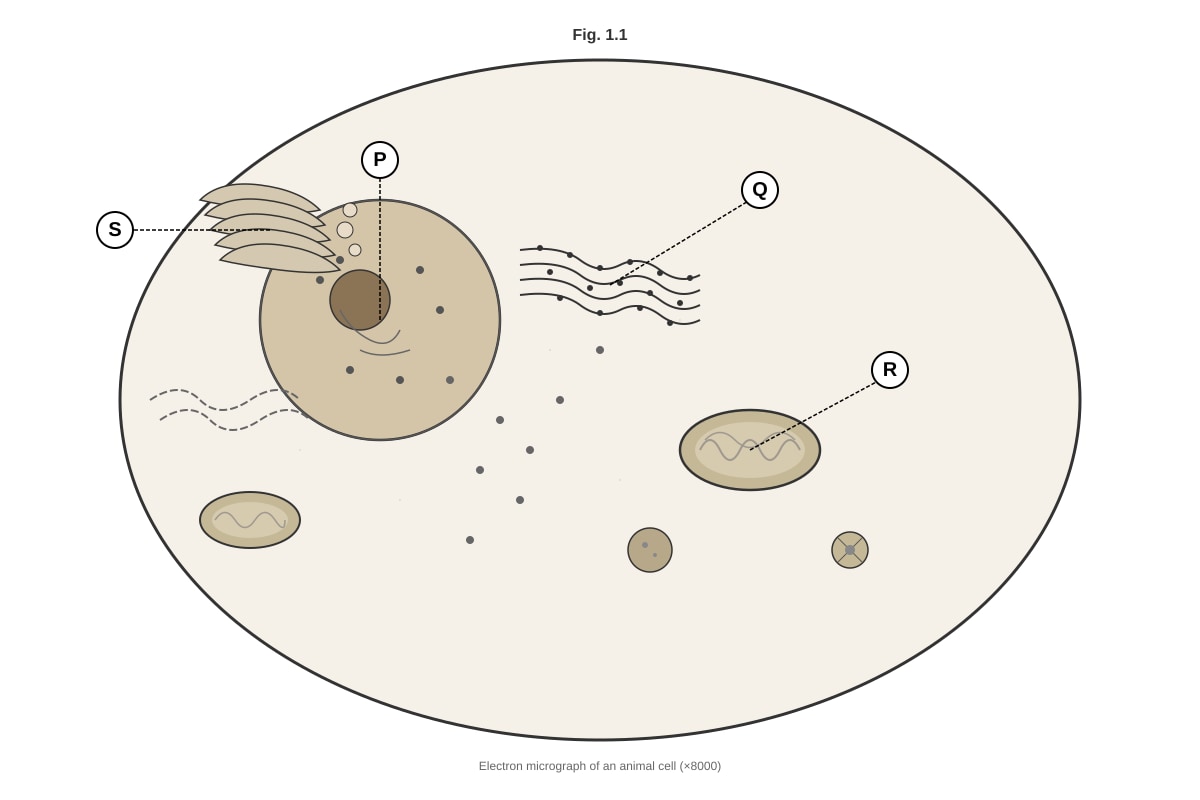
(a) Identify organelles P, Q, R, and S. [4 marks]
| Label | Organelle | Mark |
|---|---|---|
| P | Rough endoplasmic reticulum / Rough ER | 1 |
| Q | Golgi body / Golgi apparatus | 1 |
| R | Mitochondrion / Mitochondria | 1 |
| S | Ribosome(s) | 1 |
Marking notes: Accept "RER" for P. Accept "Golgi complex" for Q. Accept singular or plural forms.
(b) State the function of organelle Q. [1 mark]
Answer: The Golgi body modifies, sorts, and packages proteins (into vesicles) for secretion from the cell / for transport to other parts of the cell. [1 mark]
Marking notes: Must include reference to modifying/packaging proteins. Accept "chemically modifies and packages substances made by the ER."
(c) Explain why organelle R is described as the "powerhouse" of the cell. [2 marks]
Answer: Mitochondria are the sites of aerobic respiration [1 mark], where glucose is broken down to release energy in the form of ATP [1 mark].
Marking notes: Must mention aerobic respiration and ATP/energy release. Accept "site of cellular respiration where energy is released."
(d) Explain why a cell producing digestive enzymes would contain many of organelle P and organelle S. [3 marks]
Answer:
- Ribosomes (S) are the sites of protein synthesis [1 mark]. Digestive enzymes are proteins, so many ribosomes are needed to synthesise large amounts of these enzymes [1 mark].
- Rough endoplasmic reticulum (P) transports the proteins synthesised by ribosomes to the Golgi body for packaging and secretion [1 mark].
Marking notes: Must link ribosomes to protein synthesis and rough ER to transport. Accept reference to the cell needing to produce and secrete large quantities of protein.
Question 22 [10 marks]
(a) Calculate the percentage change in mass for 0.6 mol/dm³. [2 marks]
Answer: Percentage change = (Change in mass ÷ Initial mass) × 100 [1 mark] = (-0.15 ÷ 2.50) × 100 = -6.0% [1 mark]
Marking notes: Award 1 mark for correct formula/working, 1 mark for correct answer with negative sign. The answer is already given in the table; accept if student shows working.
(b) Explain why the potato strip in 0.0 mol/dm³ sucrose solution increased in mass. [3 marks]
Answer:
- The 0.0 mol/dm³ solution (distilled water) has a higher water potential than the potato cell sap [1 mark].
- Water enters the potato cells by osmosis, down the water potential gradient [1 mark].
- The cells become turgid, and the mass of the potato strip increases [1 mark].
Marking notes: Must mention water potential gradient and osmosis. Accept "water moves from a region of higher water potential to a region of lower water potential."
(c) Explain why the potato strip in 0.8 mol/dm³ sucrose solution decreased in mass. [3 marks]
Answer:
- The 0.8 mol/dm³ sucrose solution has a lower water potential than the potato cell sap [1 mark].
- Water moves out of the potato cells by osmosis, down the water potential gradient [1 mark].
- The cells lose turgor / become flaccid, and the mass of the potato strip decreases [1 mark].
Marking notes: Must mention water potential gradient and osmosis. Accept "water moves from a region of higher water potential (inside cells) to a region of lower water potential (outside)."
(d) Estimate the isotonic concentration and explain. [2 marks]
Answer:
- The isotonic concentration is approximately 0.4 mol/dm³ [1 mark].
- At this concentration, there is no net movement of water (0.0% change in mass), indicating the water potential of the solution equals the water potential of the potato cell sap [1 mark].
Marking notes: Accept 0.4 mol/dm³. Must explain that zero change in mass indicates equal water potentials.
Question 23 [10 marks]
(a) Describe the trend between 0°C and 40°C. [2 marks]
Answer:
- As temperature increases from 0°C to 40°C, enzyme activity increases [1 mark].
- The rate of increase is initially slow, then becomes more rapid, reaching a maximum at 40°C [1 mark].
Marking notes: Award 1 mark for stating activity increases, 1 mark for noting the maximum at 40°C or describing the shape.
(b) Explain the trend with reference to kinetic energy and enzyme-substrate complex formation. [3 marks]
Answer:
- As temperature increases, the kinetic energy of enzyme and substrate molecules increases [1 mark].
- This increases the frequency of collisions between enzyme and substrate molecules [1 mark].
- More enzyme-substrate complexes are formed per unit time, increasing the rate of reaction [1 mark].
Marking notes: Must mention kinetic energy, collision frequency, and enzyme-substrate complex formation.
(c) Explain why enzyme activity decreases above 40°C. [3 marks]
Answer:
- Above 40°C, the enzyme begins to denature [1 mark].
- High temperatures break the hydrogen bonds (and other bonds) that maintain the enzyme's specific three-dimensional / tertiary structure [1 mark].
- The active site loses its specific complementary shape, so the substrate can no longer bind / fit into the active site, and enzyme-substrate complexes cannot form [1 mark].
Marking notes: Must mention denaturation, bonds breaking, and active site shape change. Do not accept "enzyme is killed."
(d) State the optimum temperature for enzyme X. [1 mark]
Answer: 40°C [1 mark]
(e) Suggest why human enzymes and hot spring bacteria enzymes have different optimum temperatures. [1 mark]
Answer: Enzymes are adapted to the environmental temperatures in which the organism lives. Human enzymes function best at body temperature (37°C), while bacteria living in hot springs have evolved enzymes that are stable and function optimally at high temperatures. [1 mark]
Marking notes: Accept any reasonable explanation linking enzyme adaptation to the organism's environment.
Question 24 [10 marks]
(a) Identify food substance(s) in solution B. [1 mark]
Answer: Reducing sugar [1 mark]
Marking notes: Accept "glucose" or "reducing sugar." Do not accept just "sugar."
(b) Identify food substance(s) in solution C. [1 mark]
Answer: Starch [1 mark]
(c) Identify food substance(s) in solution D. [1 mark]
Answer: Protein [1 mark]
(d) State what the negative results for solution A indicate. [1 mark]
Answer: Solution A does not contain reducing sugar, starch, protein, or fats / Solution A contains none of the food substances tested for. [1 mark]
Marking notes: Accept "none of the above food substances are present."
(e) Explain why the conclusion that solution B contains both reducing sugar and starch is incorrect. [2 marks]
Answer:
- The iodine test for solution B gave a brown colour, which is a negative result [1 mark].
- If starch were present, the iodine test would have turned blue-black [1 mark].
Marking notes: Must reference the iodine test result and the expected positive result for starch.
(f) Describe how to carry out the ethanol emulsion test for fats. [4 marks]
Answer:
- Add about 2 cm³ of the food sample to a clean, dry test tube [1 mark].
- Add about 2 cm³ of ethanol to the test tube and shake thoroughly / vigorously to dissolve any fats present [1 mark].
- Pour the mixture into another test tube containing about 2 cm³ of water [1 mark].
- Observe: a cloudy white emulsion indicates the presence of fats / lipids [1 mark].
Marking notes: Award marks for: adding ethanol, shaking, adding water, and observing a cloudy white emulsion. Accept alternative wording if the essential steps are clear.
Section C: Free-Response Questions [20 marks]
Question 25 [10 marks]
(a) Describe the structure of an enzyme and explain how its structure is related to its function using the lock-and-key model. [5 marks]
Answer:
Structure:
- Enzymes are proteins made up of long chains of amino acids folded into a specific three-dimensional / tertiary structure [1 mark].
- The enzyme molecule has a specific region called the active site [1 mark].
Function and lock-and-key model:
- The active site has a specific shape that is complementary to the shape of the substrate molecule, like a lock and key [1 mark].
- The substrate molecule binds to the active site, forming an enzyme-substrate complex [1 mark].
- The reaction takes place, and products are formed and released, leaving the enzyme unchanged and able to catalyse another reaction [1 mark].
- The specificity of the active site means each enzyme can only catalyse one specific reaction / act on one specific substrate [1 mark].
Marking notes: Award up to 5 marks for clear explanation covering: protein nature, tertiary structure, active site, complementary shape, enzyme-substrate complex, specificity, and enzyme remaining unchanged. Maximum 5 marks.
(b) Describe how to investigate the effect of pH on amylase activity. [5 marks]
Answer:
Method:
- Prepare buffer solutions at different pH values (e.g., pH 4, 5, 6, 7, 8, 9) [1 mark].
- Place equal volumes of starch solution and buffer solution in test tubes, and add equal volumes of amylase solution [1 mark].
- Use a water bath to maintain a constant temperature (e.g., 37°C) throughout the investigation [1 mark].
- At regular time intervals, remove a sample and test with iodine solution on a white tile. Record the time taken for the iodine to no longer turn blue-black (indicating all starch has been broken down) [1 mark].
- Repeat the experiment at each pH and calculate the rate of reaction (1/time). Plot a graph of rate of reaction against pH to determine the optimum pH (where the rate is highest) [1 mark].
Controlled variables: Temperature, volume and concentration of starch solution, volume and concentration of amylase solution [1 mark].
Marking notes: Award marks for: using different pH buffers, controlling temperature with water bath, testing with iodine, recording time for starch breakdown, and plotting graph to find optimum. Maximum 5 marks.
Question 26 [10 marks]
(a) Distinguish between diffusion, osmosis, and active transport. [6 marks]
Answer:
Diffusion:
- Net movement of particles (molecules or ions) from a region of higher concentration to a region of lower concentration, down a concentration gradient [1 mark].
- Does not require energy (passive process) [0.5 mark].
- Examples: movement of oxygen, carbon dioxide, and dissolved substances [0.5 mark].
Osmosis:
- Net movement of water molecules from a region of higher water potential to a region of lower water potential, through a partially permeable membrane [1 mark].
- Does not require energy (passive process) [0.5 mark].
- Only involves water molecules [0.5 mark].
Active transport:
- Movement of molecules or ions from a region of lower concentration to a region of higher concentration, against a concentration gradient [1 mark].
- Requires energy from respiration (active process) [0.5 mark].
- Requires carrier proteins in the cell membrane [0.5 mark].
Marking notes: Award up to 6 marks. Must clearly distinguish all three processes in terms of direction, energy requirement, and substances involved. Accept a table format.
(b) Explain the importance of active transport in glucose absorption by the villi. [4 marks]
Answer:
- After a meal, the concentration of glucose in the small intestine may be lower than the concentration in the blood / epithelial cells of the villi [1 mark].
- Glucose cannot be absorbed by diffusion alone because the concentration gradient may not be favourable [1 mark].
- Active transport moves glucose from the lumen of the small intestine into the epithelial cells of the villi, against the concentration gradient [1 mark].
- This ensures that all glucose is absorbed from the digested food, even when the concentration in the intestine is low, maximising nutrient uptake [1 mark].
Marking notes: Must mention concentration gradient, active transport against the gradient, and the importance of complete absorption. Accept reference to carrier proteins and energy from respiration.
END OF ANSWER KEY