AI Generated Exam Paper
Secondary 4 Pure Biology Practice Paper 1
Free Sec 4 Pure Biology Practice Paper 1, AI version, with questions, answers, and O Level-style practice for Singapore students.
These static practice materials are generated from the site's syllabus and paper-generation workflow, with source and model context shown so students and parents can evaluate the material before use.
Questions
Free quiz and exam paper access
Enter your details to view this paper
Your access is remembered on this device.
Answers
TuitionGoWhere Practice Paper - Pure Biology Secondary 4 (Answer Key)
TuitionGoWhere Practice Paper (AI) - Marking Scheme
Total Marks: 80
Section A [40 marks]
1. Cell Structure and Specialization [12 marks]
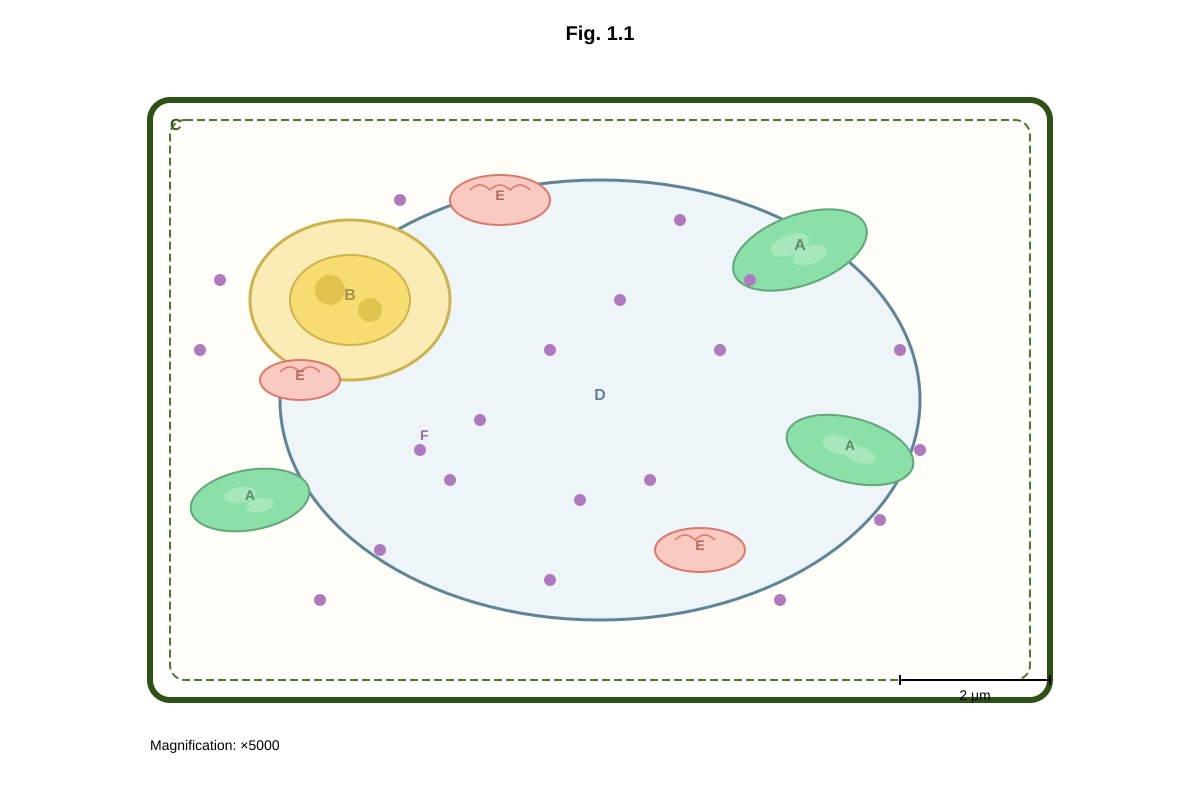
(a) Name the structures [4 marks - 1 mark each]
- A: Chloroplast ✓
- B: Nucleus ✓
- C: Cell wall ✓
- D: Vacuole ✓
(b) Function of structure A [2 marks] Site of photosynthesis ✓ / converts light energy to chemical energy ✓ Accept: makes glucose, contains chlorophyll
(c) Adaptation of structure F [2 marks] Small size allows it to fit in cytoplasm ✓ / can be attached to rough ER for protein synthesis ✓ Accept: made of RNA and protein for function, can be free or bound
(d) Two differences from animal cell [4 marks - 2 marks each]
- Plant cell has cell wall ✓ animal cell has no cell wall ✓
- Plant cell has large permanent vacuole ✓ animal cell has small temporary vacuoles ✓ Also accept: chloroplasts present/absent, different shape
2. Transport Mechanisms [15 marks]
(a) Process name [1 mark] Osmosis ✓
(b) Graph plotting [4 marks]
- Correct axes labeled with units ✓
- Appropriate scale using most of grid ✓
- All points plotted correctly ✓
- Smooth curve through points ✓
(c) Isotonic concentration [1 mark] 0.4 mol/dm³ ✓
(d) Explanation for mass gain [3 marks] Water potential of pure water is higher than cell sap ✓ water moves into cells by osmosis ✓ cells become turgid causing tissue to swell ✓
(e) Microscopic changes in 1.0 mol/dm³ [3 marks] Water moves out of cells by osmosis ✓ cell membrane pulls away from cell wall ✓ plasmolysis occurs ✓
(f) Effect of higher temperature [3 marks] Molecules have more kinetic energy ✓ rate of osmosis increases ✓ changes in mass would occur faster/be greater ✓ Accept: enzyme activity increases, cell membrane more permeable
3. Enzyme Activity [13 marks]
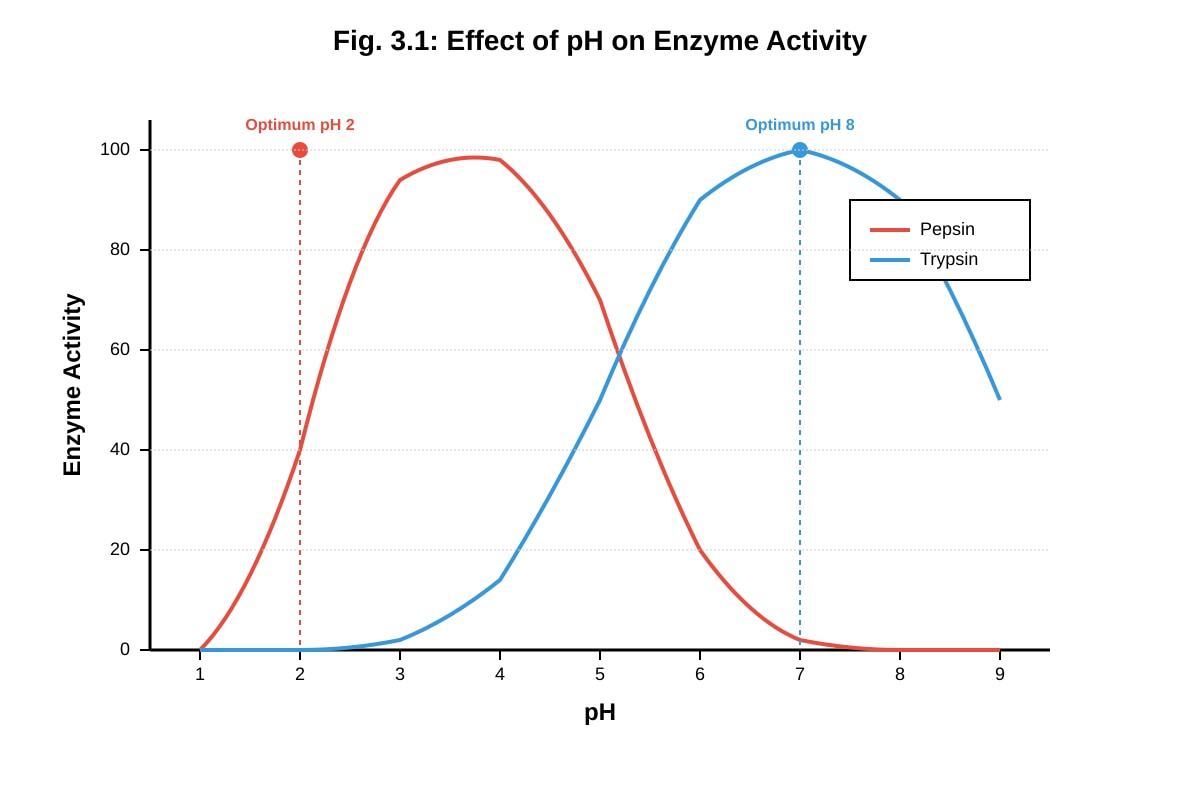
(a) Optimum pH values [2 marks - 1 mark each]
- Pepsin: pH 2 ✓
- Trypsin: pH 8 ✓
(b) Different optimum pH explanation [3 marks] Enzymes have different amino acid sequences ✓ which determine their 3D structure ✓ active site shape is maintained at different pH values ✓ Accept: different protein structure, evolved for different environments
(c) Effect of pH change [3 marks] Hydrogen ions affect ionic bonds in enzyme ✓ enzyme changes shape/denatures ✓ active site no longer complementary to substrate ✓
(d) Relation to digestive system [3 marks] Stomach is acidic (pH 1-2) ✓ suitable for pepsin activity ✓ small intestine is alkaline (pH 8-9) suitable for trypsin ✓
(e) Effect of stomach pH 7 [2 marks] Pepsin would be denatured/inactive ✓ protein digestion would be reduced/stopped ✓
Section B [40 marks]
4. Photosynthesis and Limiting Factors [20 marks]
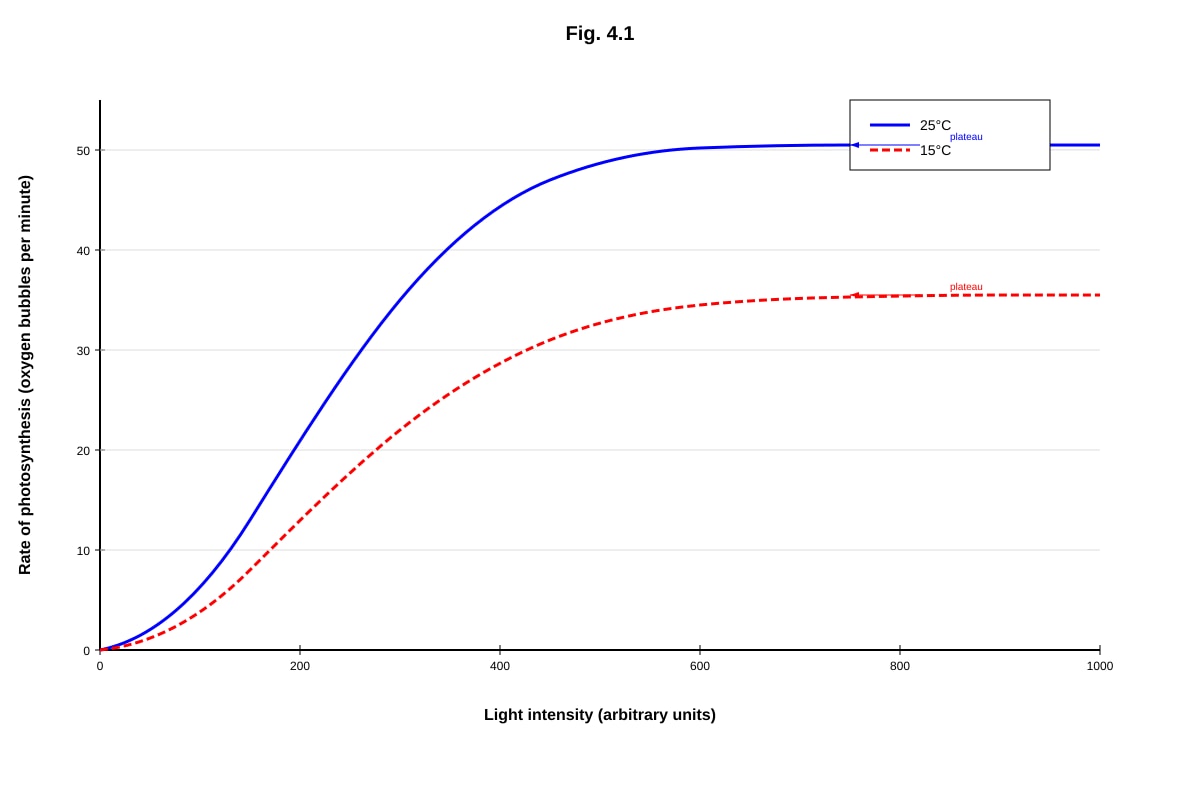
(a) Relationship at 25°C [3 marks] Rate increases with light intensity up to about 800 units ✓ then levels off/remains constant ✓ showing light is initially limiting then another factor becomes limiting ✓
(b) Comparison of temperatures [4 marks] Both show similar pattern of increase then leveling off ✓ rate at 25°C is higher than at 15°C at all light intensities ✓ both level off at high light intensities ✓ 25°C reaches higher maximum rate ✓
(c) Explanation for leveling off [3 marks] Light is no longer the limiting factor ✓ CO₂ concentration or temperature becomes limiting ✓ rate cannot increase further without increasing the limiting factor ✓
(d) Ways to increase rate at point X [2 marks - 1 mark each]
- Increase CO₂ concentration ✓
- Increase temperature ✓ Also accept: add more chlorophyll, increase water availability
(e) Balanced equation [2 marks] 6CO₂ + 6H₂O → C₆H₁₂O₆ + 6O₂ ✓✓ Award 1 mark for correct reactants and products, 1 mark for balancing
(f) Importance of photosynthesis [6 marks] Produces glucose which is food for plants ✓ plants are eaten by animals providing energy ✓ forms basis of all food chains/webs ✓ produces oxygen for aerobic respiration ✓ removes CO₂ from atmosphere ✓ without photosynthesis most life would not exist ✓ Accept any 6 valid points about energy flow, oxygen production, carbon cycle
5. Homeostasis and Blood Glucose Regulation [20 marks]
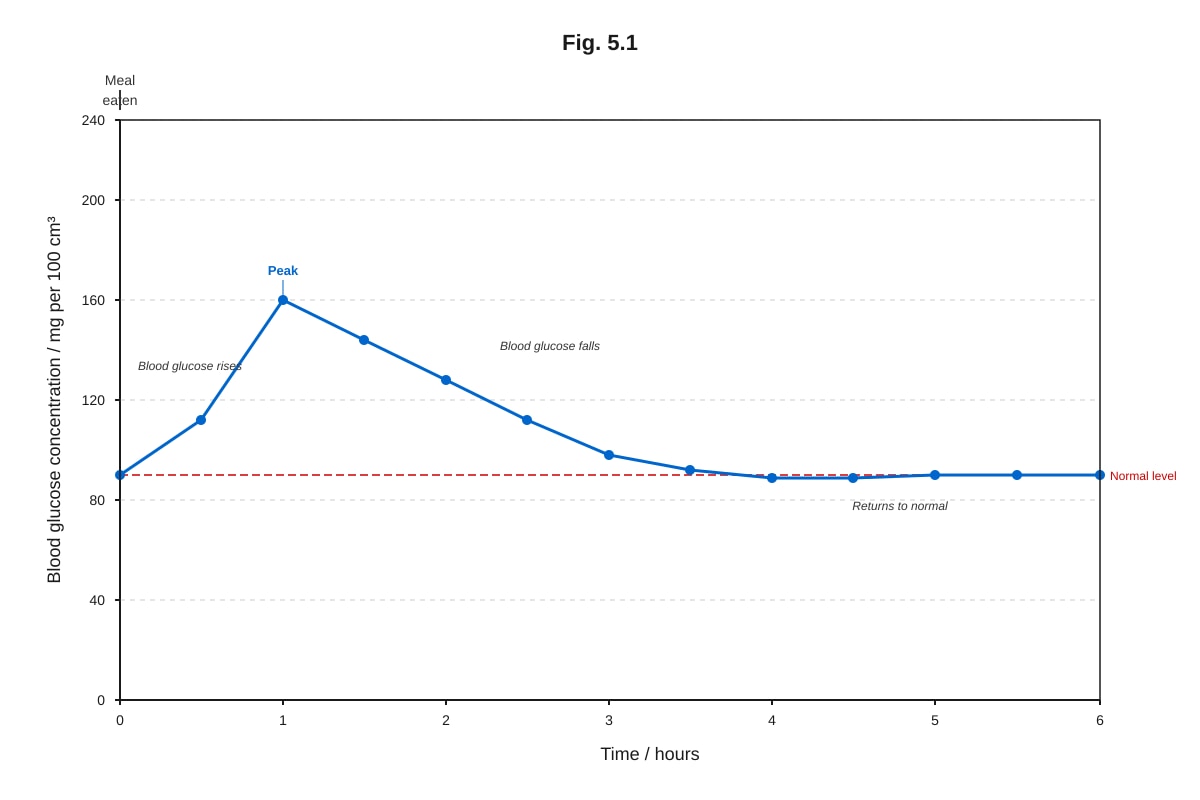
(a) Changes in blood glucose [3 marks] Increases rapidly after meal to peak ✓ then decreases gradually ✓ returns to normal level after about 4 hours ✓
(b) Hormone name [1 mark] Insulin ✓
(c) Organ producing hormone [1 mark] Pancreas ✓
(d) How hormone decreases glucose [4 marks] Insulin binds to receptors on liver cells ✓ stimulates conversion of glucose to glycogen ✓ glycogen stored in liver ✓ glucose removed from blood for storage ✓ Also accept: increases glucose uptake by cells, stimulates respiration
(e) Negative feedback explanation [3 marks] High blood glucose detected by pancreas ✓ insulin released which lowers glucose ✓ response opposes original stimulus returning system to normal ✓
(f) Managing Type 2 diabetes [4 marks] Regular exercise to increase glucose uptake by muscles ✓ reduce carbohydrate intake in diet ✓ eat smaller more frequent meals ✓ maintain healthy body weight ✓ Accept: avoid sugary foods, increase fiber intake, monitor blood glucose
(g) Similarities with temperature regulation [4 marks - 2 marks each]
- Both involve negative feedback ✓ to maintain constant internal environment ✓
- Both have control center that detects changes ✓ and coordinates response through effectors ✓ Also accept: both maintain homeostasis, both involve hormones, both have set points
Marking Guidelines:
- Award marks for scientifically accurate alternative expressions
- Accept correct scientific terminology and abbreviations
- Look for understanding of concepts rather than exact wording
- Deduct marks for factual errors
- Award partial marks for incomplete but correct responses
Grade Boundaries (Suggested):
- A: 72-80 marks (90-100%)
- B: 64-71 marks (80-89%)
- C: 56-63 marks (70-79%)
- D: 48-55 marks (60-69%)
- E: 40-47 marks (50-59%)