From Real Exams Exam Paper
Secondary 4 Pure Biology Preliminary Examination Paper 2
Free Sec 4 Pure Biology Prelim Paper 2, HY3 Exam version, with questions, answers, and O Level-style practice for Singapore students.
These static practice materials are generated from the site's syllabus and paper-generation workflow, with source and model context shown so students and parents can evaluate the material before use.
Questions
Free quiz and exam paper access
Enter your details to view this paper
Your access is remembered on this device.
Answers
TuitionGoWhere Exam Practice (AI) — Pure Biology Secondary 4
PRELIM Practice Paper — Cells & Biomolecules (Version 2) — Answer Key
Total Marks: 60
Section A: Cell Structure and Organisation
1. [1 mark]
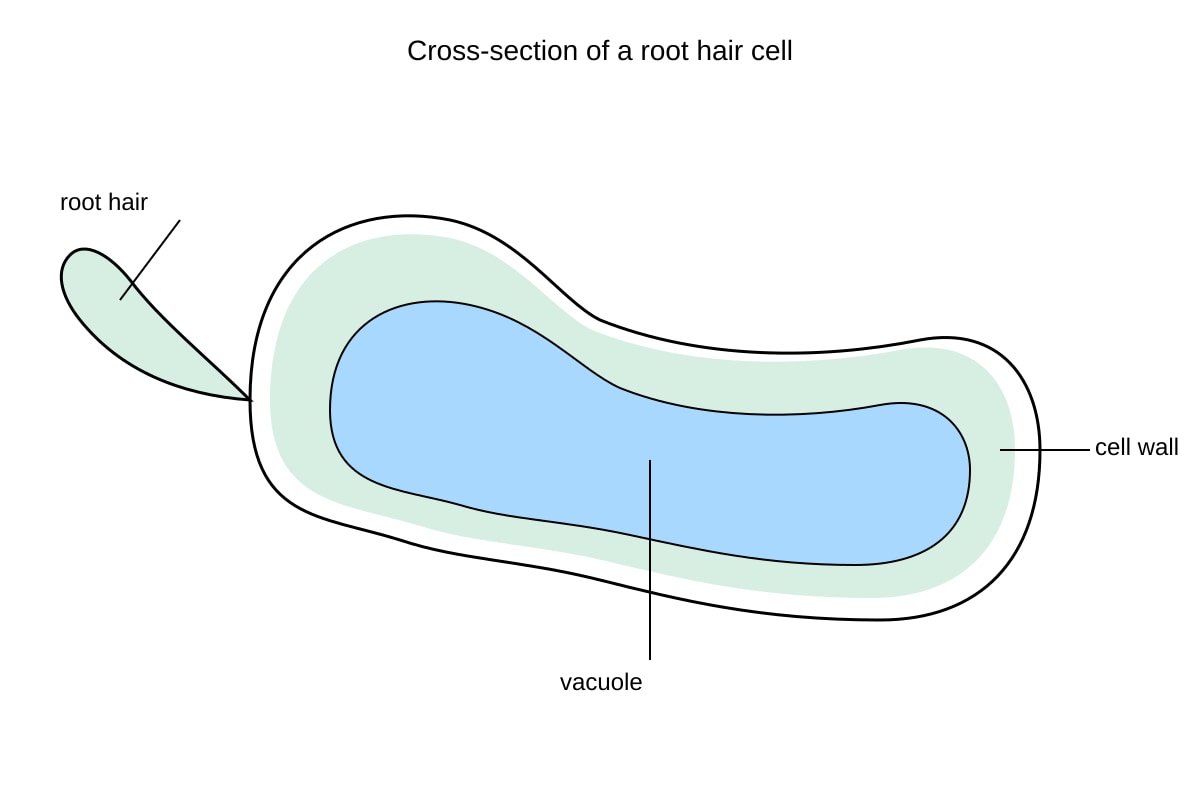
Answer: Root hair cells
Teaching note: Water is absorbed from soil by root hair cells, which are specialised epidermal cells with long projections increasing surface area. Common trap: writing "xylem" (xylem transports water, does not absorb it from soil).
2. [1 mark]
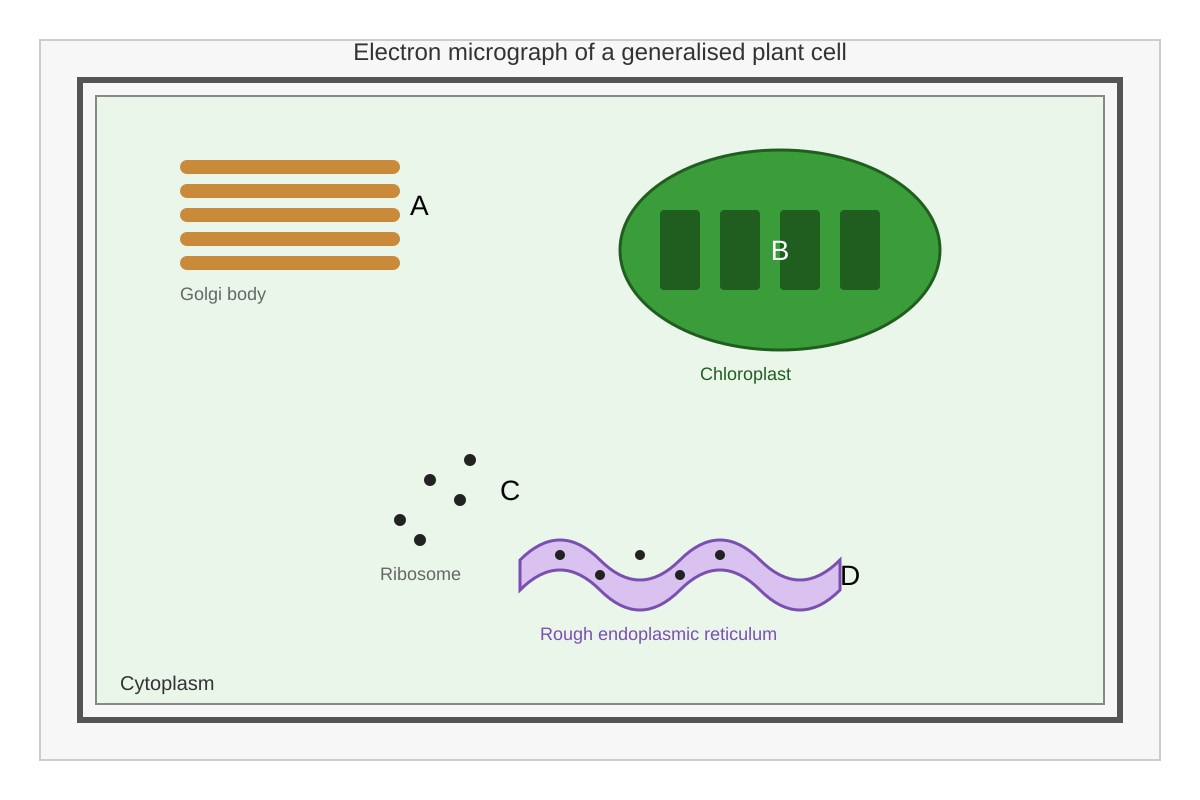
Answer: C
Teaching note: Ribosomes (C, small dots) are the site of protein synthesis. Chloroplast (B) is for photosynthesis; Golgi (A) modifies proteins; rough ER (D) transports them. Trap: confusing ribosome with rough ER.
3. [1 mark]
Answer: Controls cell activities / contains DNA / directs protein synthesis
Teaching note: Nucleus houses genetic material and acts as control centre. Any one correct function accepted.
4. [2 marks]
Answer: More space for haemoglobin (1) → can carry more oxygen (1).
Teaching note: Lack of nucleus increases internal volume for haemoglobin. Mark breakdown: 1 for "more space", 1 for link to oxygen transport.
5. [3 marks]
Answer: Long projection increases surface area (1) → more water and ions absorbed by osmosis/active transport (1); thin wall shortens diffusion path (1).
Teaching note: Root hair cell adaptation: elongated hair = large SA:V; thin wall = short pathway. Marking: SA (1), absorption consequence (1), thin wall (1).
Section B: Movement of Substances
6. [2 marks]
Answer: Net movement of water (1) from region of higher water potential to lower water potential (1) through a partially permeable membrane.
Teaching note: Osmosis is passive, requires membrane, driven by water potential gradient.
7. [2 marks]
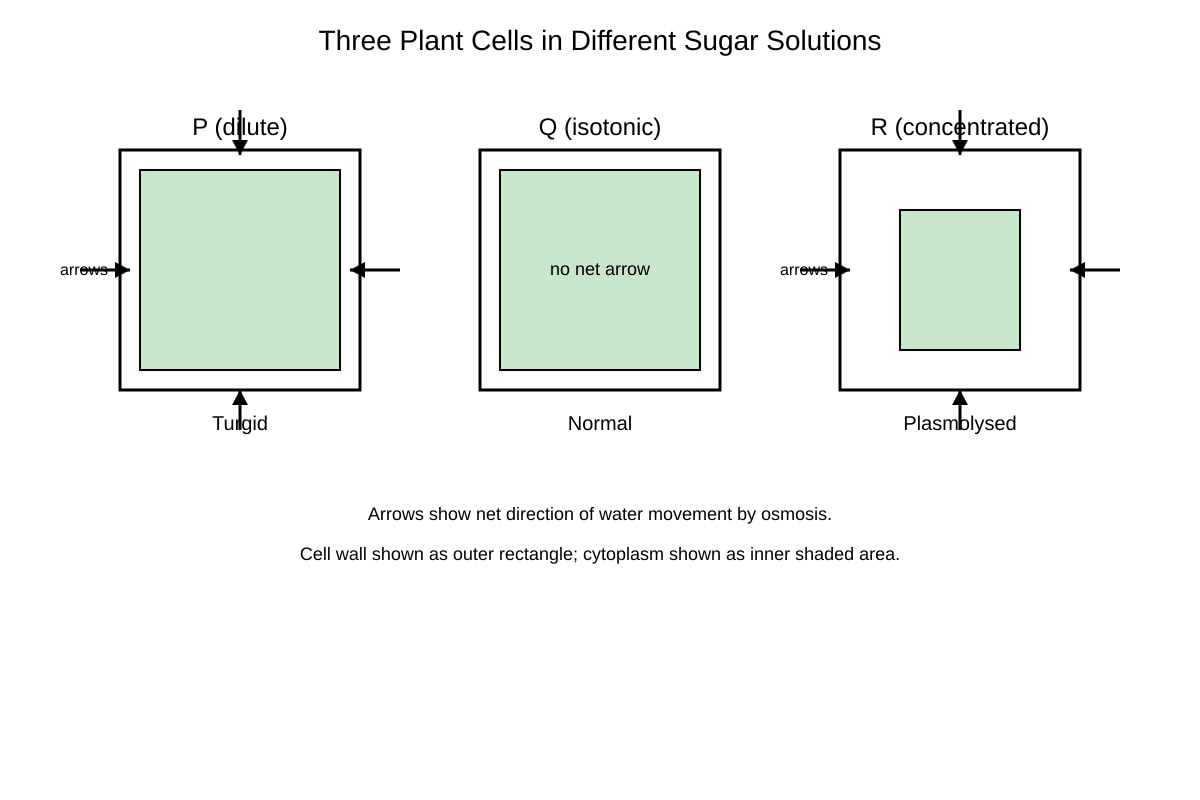
Answer: Outward (1); solution around R is concentrated/hypertonic so water potential outside is lower than inside (1).
Teaching note: Water moves down water potential gradient, out of cell into concentrated solution.
8. [3 marks]
Answer: High glucose lowers blood water potential (1) → water moves out of RBCs by osmosis (1) → cells shrink/crenate, may be damaged (1).
Teaching note: Link solute ↑ → ψ ↓ → water out → crenation. Marking: each step 1 mark.
9. [2 marks]
Answer: Ions moved against concentration gradient (1) requiring ATP from respiration (1).
Teaching note: Active transport needs energy because movement is opposite to diffusion direction.
10. [2 marks]
Working: % change = (final − initial)/initial × 100
= (4.80 − 5.00)/5.00 × 100 = −0.20/5.00 × 100 = −4%
Answer: −4% (2 marks for correct calc; 1 if arithmetic error but method shown)
Teaching note: Negative shows mass loss by osmosis.
Section C: Biological Molecules and Enzymes
11. [1 mark]
Answer: Carbon, hydrogen, oxygen, nitrogen (C, H, O, N)
Teaching note: Some proteins also have S, but CHON is core.
12. [2 marks]
Answer: Iodine test (1); brown/yellow → blue-black (1).
Teaching note: Starch + iodine = blue-black complex.
13. [3 marks]
(a) glucose (1)
(b) amino acids (1)
(c) fatty acids (1)
Teaching note: Starch = polysaccharide of glucose; proteins = polymers of amino acids; fats = glycerol + 3 fatty acids.
14. [3 marks]
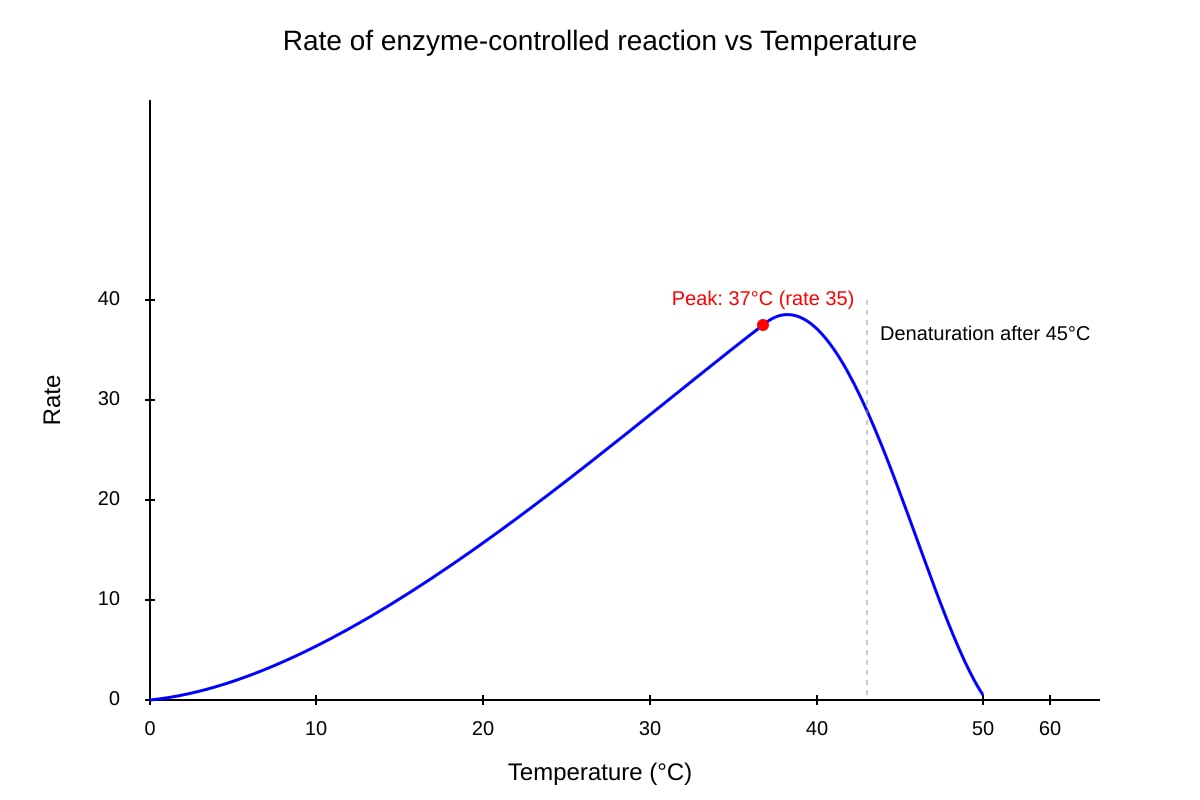
Answer: 37 °C (1); above optimum enzymes denature (1), active site shape lost, fewer ES complexes (1).
Teaching note: Peak at human body temp; high T breaks H-bonds in enzyme.
15. [3 marks]
Answer: Amylase active site shape fits starch (1); protein has different shape (1); cannot bind substrate (1) → no reaction.
Teaching note: Lock-and-key = specificity from complementary shape.
16. [3 marks]
Answer: Oxygen (1); insert glowing splint, relights (1) / limewater not used; O₂ test is glowing splint (1).
Teaching note: Catalase breaks H₂O₂ → H₂O + O₂. Gas = O₂, tested by relighting glowing splint.
17. [3 marks]
Answer: Add Benedict's reagent, heat in water bath (1); high reducing sugar → brick-red precipitate (1); colour from blue to green/red (1).
Teaching note: Reducing sugars reduce Cu²⁺ to Cu₂O on heating.
18. [3 marks]
Answer: Graph plotted with linear rise then plateau (see placeholder). Relationship: product increases with enzyme vol then levels off (1); substrate limiting at high enzyme (1); proportional at low enzyme (1).
Teaching note: 1–3 cm³ proportional; 4 cm³ shows plateau = substrate exhausted.
19. [4 marks]
Answer: At 40 °C enzyme near optimum (1), more kinetic energy, more ES formation (1); at 10 °C slow molecular movement, few collisions (1); protease digests protein stains, better at higher valid temp until denature (1).
Teaching note: Links temp to rate via collision theory and enzyme optimum.
20. [5 marks]
Answer: Milk has lactose (1); without lactase cannot hydrolyse it (1); undigested lactose ferments → bloating/diarrhoea (1); lactase active site fits lactose only (1); lack of enzyme = no key for lock (1).
Teaching note: Lock-and-key explains specificity; absence → substrate unchanged.
End of Answer Key