From Real Exams Exam Paper
Secondary 4 Pure Biology Preliminary Examination Paper 1
Free Sec 4 Pure Biology Prelim Paper 1, HY3 Exam version, with questions, answers, and O Level-style practice for Singapore students.
These static practice materials are generated from the site's syllabus and paper-generation workflow, with source and model context shown so students and parents can evaluate the material before use.
Questions
Free quiz and exam paper access
Enter your details to view this paper
Your access is remembered on this device.
Answers
TuitionGoWhere Exam Practice (AI) — Pure Biology Secondary 4
PRELIM Practice Paper Answers — Cells Biomolecules (Version 1 of 5)
Total Marks: 60
Section A Answers (10 marks)
Q1. Root hair cells [1]
Teaching note: Water is absorbed from the soil by root hair cells, which are specialised epidermal cells of the root with long extensions increasing surface area. Common trap: writing "xylem" (xylem transports water, does not absorb from soil) or "epidermis" (too general).
Q2. Nitrogen (or sulphur) [1]
Teaching note: Proteins contain C, H, O, N (and sometimes S). Carbohydrates contain only C, H, O. So N is present in proteins but not carbohydrates.
Q3. Mitochondrion (mitochondria) [1]
Teaching note: Mitochondria are the sites of aerobic respiration where ATP is produced. Avoid "nucleus" (control centre) or "ribosome" (protein synthesis).
Q4. Iodine test [1]
Teaching note: Iodine solution turns blue-black in presence of starch. Benedict's is for reducing sugars, biuret for protein.
Q5. Diffusion is the net movement of particles from a region of higher concentration to a region of lower concentration. [1]
Teaching note: Must mention "net movement" and concentration gradient. In living organisms this occurs across membranes for gases and small molecules.
Section B Answers (30 marks)
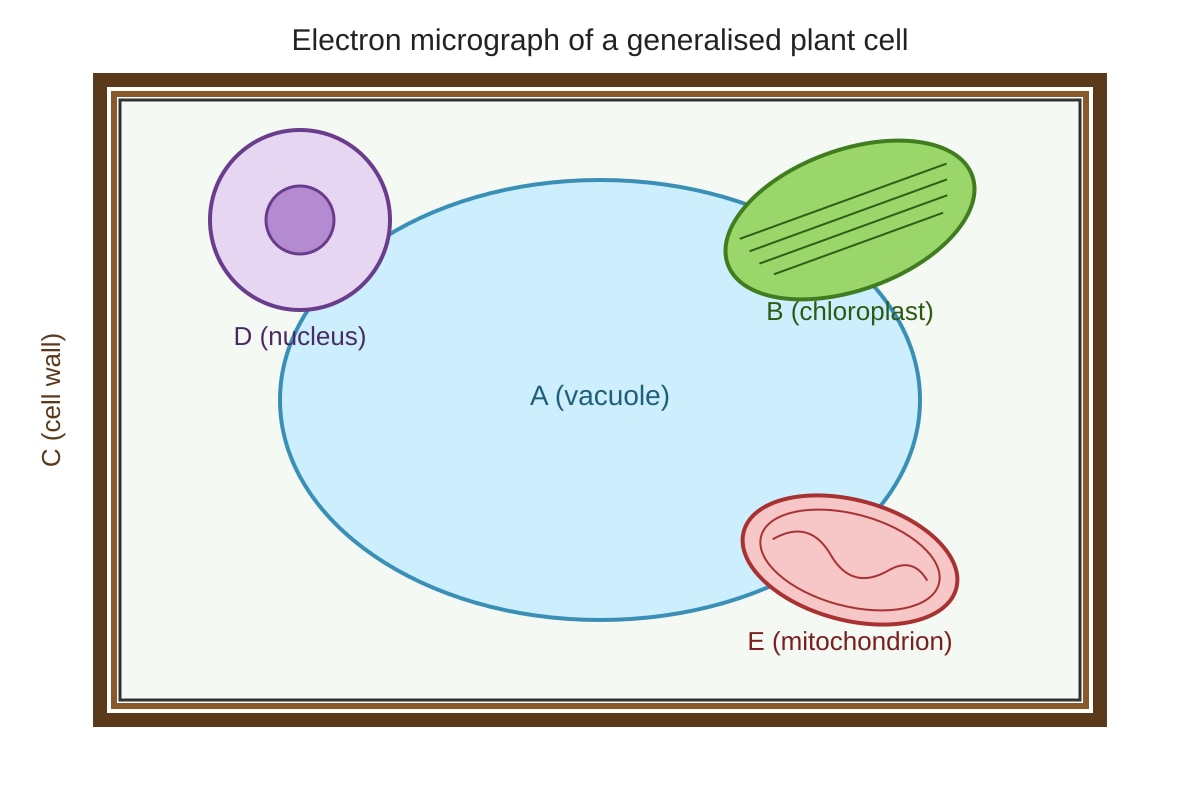
Q6. (a) B [1]
(b) Ribosomes [1]; they are the site of protein synthesis (not labelled here but in a real EM would be small dots; if E is mitochondrion and no ribosome labelled, accept "not shown but ribosome is correct site" – based on figure given, none of A–E is ribosome, so answer: none labelled / ribosome not shown, explain site is ribosome) [1]
Teaching note: Chloroplast (B) is for photosynthesis. Protein synthesis occurs at ribosomes, which are not labelled in this micrograph. Marking: 1 for identifying B, 1 for stating ribosome is site and noting not labelled.
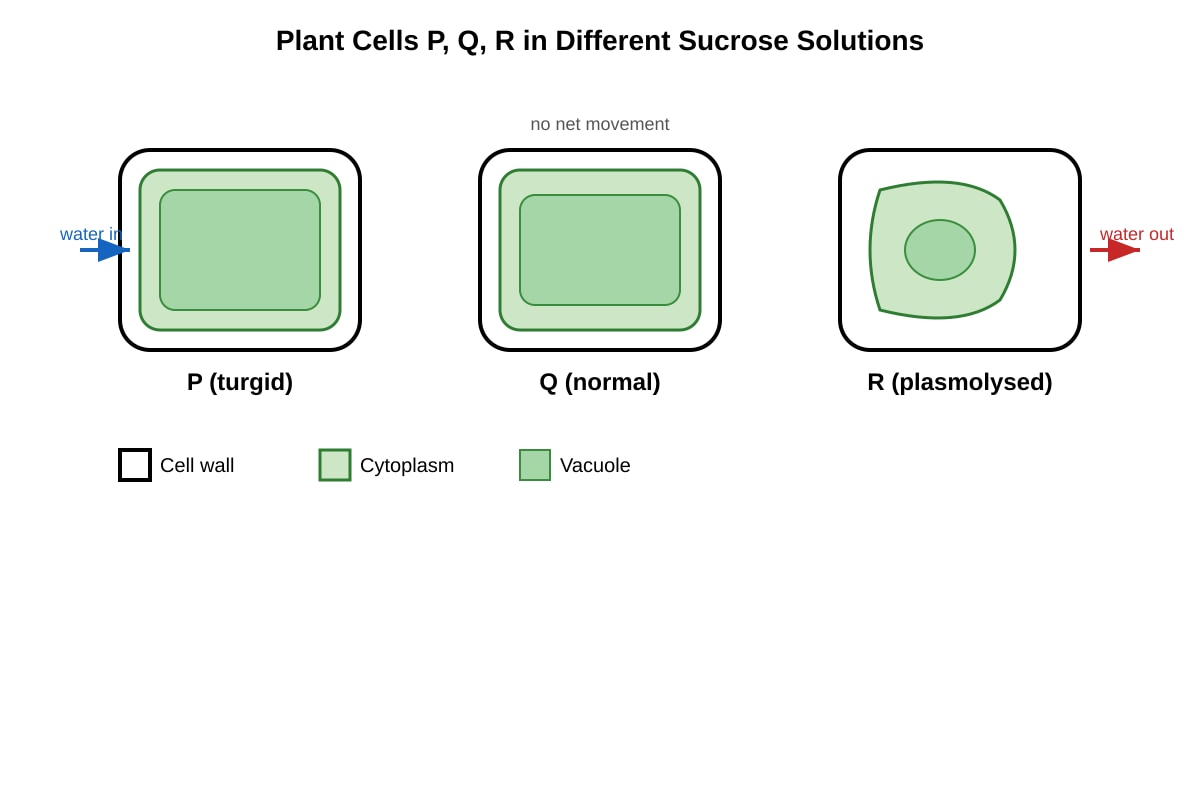
Q7. (a) R [1]
(b) Cell P is in a hypotonic solution (higher water potential outside), so water moves into the cell by osmosis down the water potential gradient, making it turgid. [2]
Teaching note: Osmosis is water moving from high to low water potential. R is plasmolysed → water left. P turgid → water entered.
Q8. [3]
- Long projection (hair) increases surface area for absorption [1]
- Thin wall / short distance for water and ions to diffuse [1]
- Many mitochondria for active transport of ions [1]
Teaching note: Adaptations link structure to function.
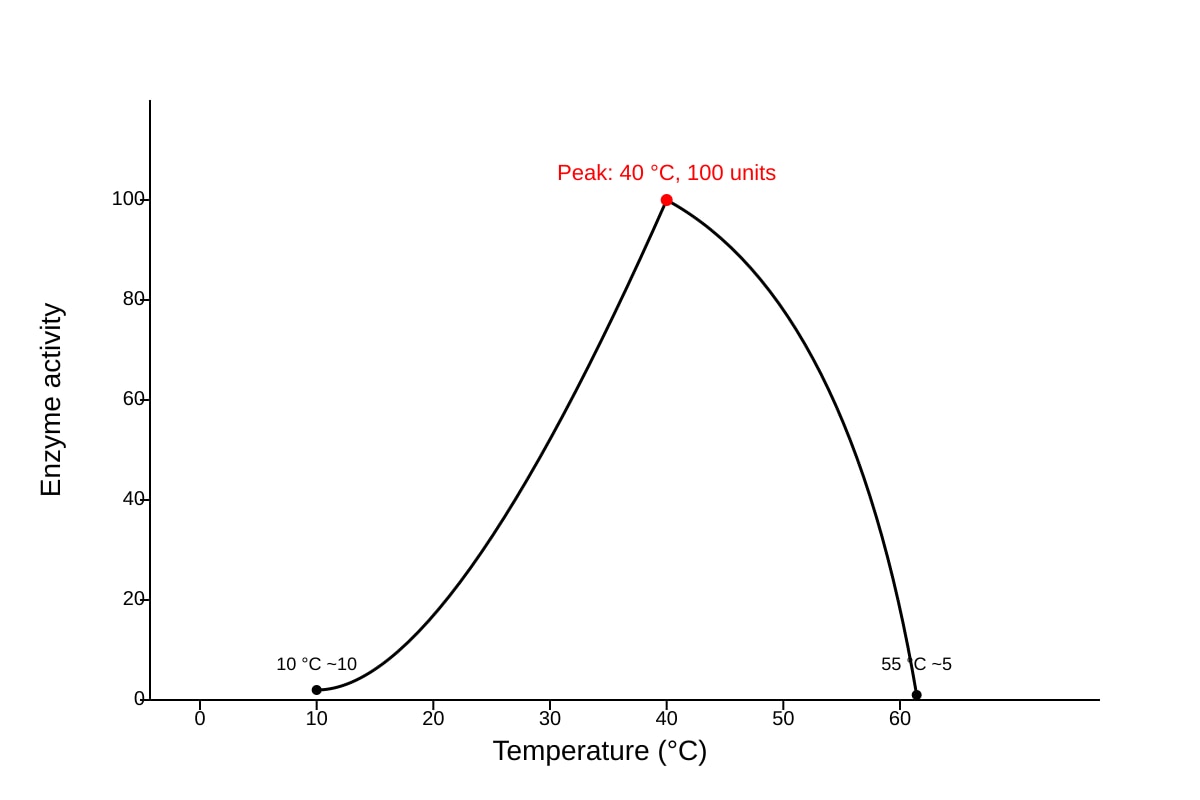
Q9. (a) 40 °C [1]
(b) Above 45 °C the enzyme denatures; tertiary structure breaks, active site loses shape, so substrate cannot bind. [2]
Teaching note: Peak at 40 °C from graph. Denaturation is irreversible change in protein structure.
Q10. [3]
- High glucose lowers water potential of solution [1]
- Water moves out of RBC by osmosis (to lower water potential) [1]
- RBC shrinks / crenates, may be damaged [1]
Teaching note: Connects Template 3 evidence pattern.
Q11. [3]
Starch: blue-black [1]
Reducing sugar: Benedict's reagent [1]
Protein: Biuret reagent [1]
Q12. (a) Glucose (or maltose) [1]
(b) Amino acids [1]
Q13. [2]
- Amylase active site shape is complementary only to starch (specific) [1]
- Protein shape does not fit amylase active site (lock-and-key) [1]
Teaching note: Enzyme specificity from lock-and-key model.
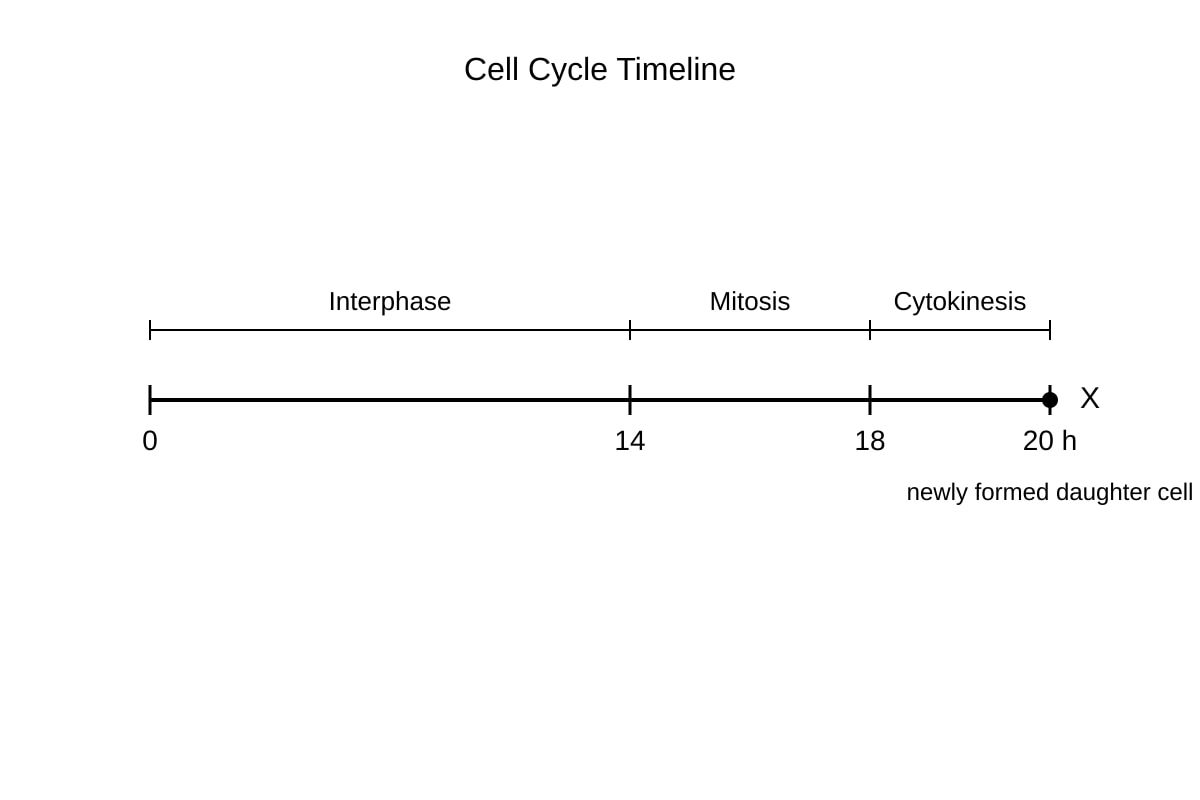
Q14. [2]
- Draw line from 18 h to 20 h on timeline [1]
- Label X at 20 h with "formation of cell X" [1]
Teaching note: Cytokinesis ends at 20 h, daughter cell formed.
Q15. [2]
- Plant cell has cell wall, animal cell does not [1]
- Plant cell has chloroplast, animal cell does not [1]
(Other: plant has large vacuole, animal has smaller/no vacuole)
Section C Answers (20 marks)
Q16. [4]
- High blood glucose decreases water potential of blood [1]
- Water potential outside RBC now lower than inside? Actually blood lower → water leaves RBC [1]
- Water moves out by osmosis [1]
- RBC loses water, shrinks, crenates, damaged [1]
Teaching note: Use all three terms as requested.
Q17. [4]
- Independent variable: pH (e.g., 3,5,7,9) [1]
- Dependent: rate of O₂ production / H₂O₂ breakdown [1]
- Controlled: temp, enzyme conc, H₂O₂ conc [1]
- Method: measure gas volume at each pH, compare [1]
Teaching note: Standard biology experiment design.
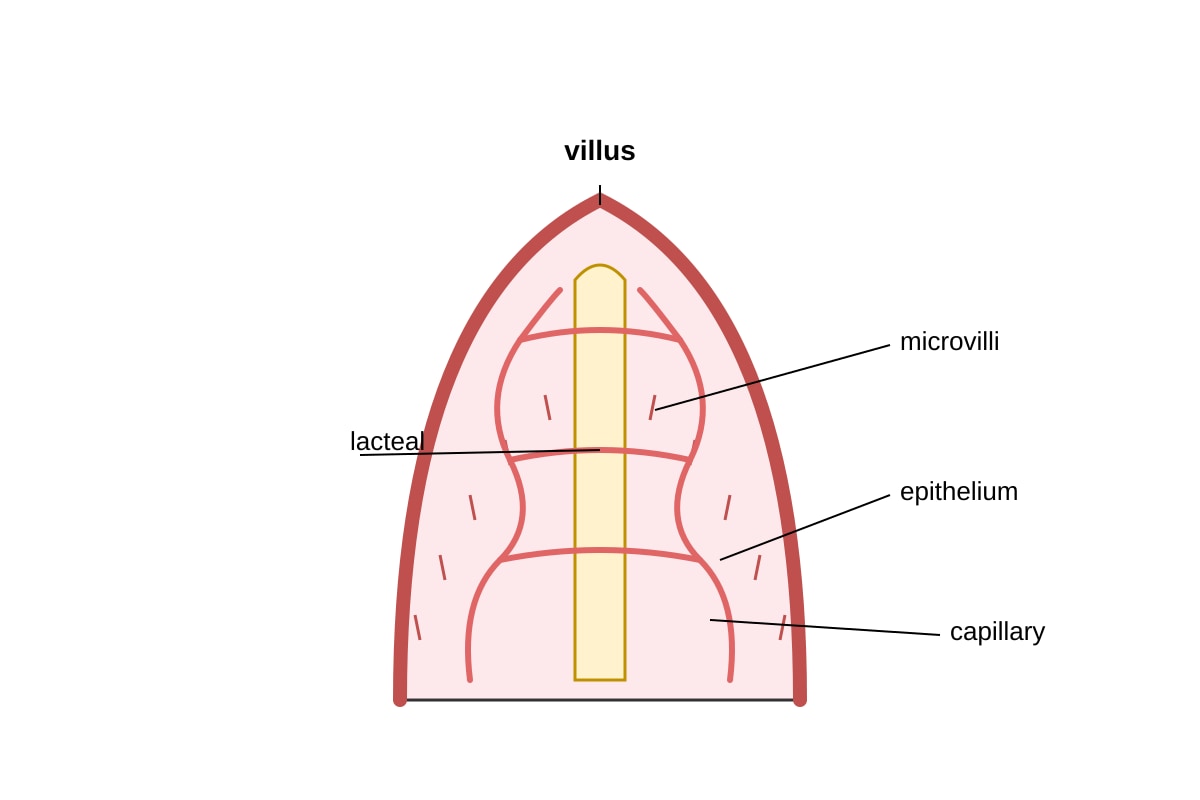
Q18. [4]
- Large surface area from finger-like shape [1]
- Thin epithelium short diffusion path [1]
- Capillary network maintains concentration gradient [1]
- Microvilli increase surface area further [1]
Q19. (a) A, C, D [1]
(b) E [1]
(c) C (green) < D (orange) < A (brick red) [2]
Teaching note: Benedict's colour: blue (none) → green (low) → orange (med) → brick red (high).
Q20. [4]
- Ions often at lower conc in soil than root cell [1]
- Active transport moves ions against gradient using energy (ATP) [1]
- Diffusion only moves down gradient, insufficient [1]
- Mitochondria provide ATP for this process [1]