From Real Exams Exam Paper
Secondary 4 Pure Biology Preliminary Examination Paper 1
Free Sec 4 Pure Biology Prelim Paper 1, DeepSeek Exam version, with questions, answers, and O Level-style practice for Singapore students.
These static practice materials are generated from the site's syllabus and paper-generation workflow, with source and model context shown so students and parents can evaluate the material before use.
Questions
Free quiz and exam paper access
Enter your details to view this paper
Your access is remembered on this device.
Answers
TuitionGoWhere Practice Paper - Pure Biology Secondary 4
PRELIMINARY EXAMINATION - Version 1
ANSWER KEY AND MARKING SCHEME
Subject: Pure Biology (6093) Level: Secondary 4 Total Marks: 80
Section A: Structured Questions (40 marks)
Question 1: Cell Structure and Function (8 marks)
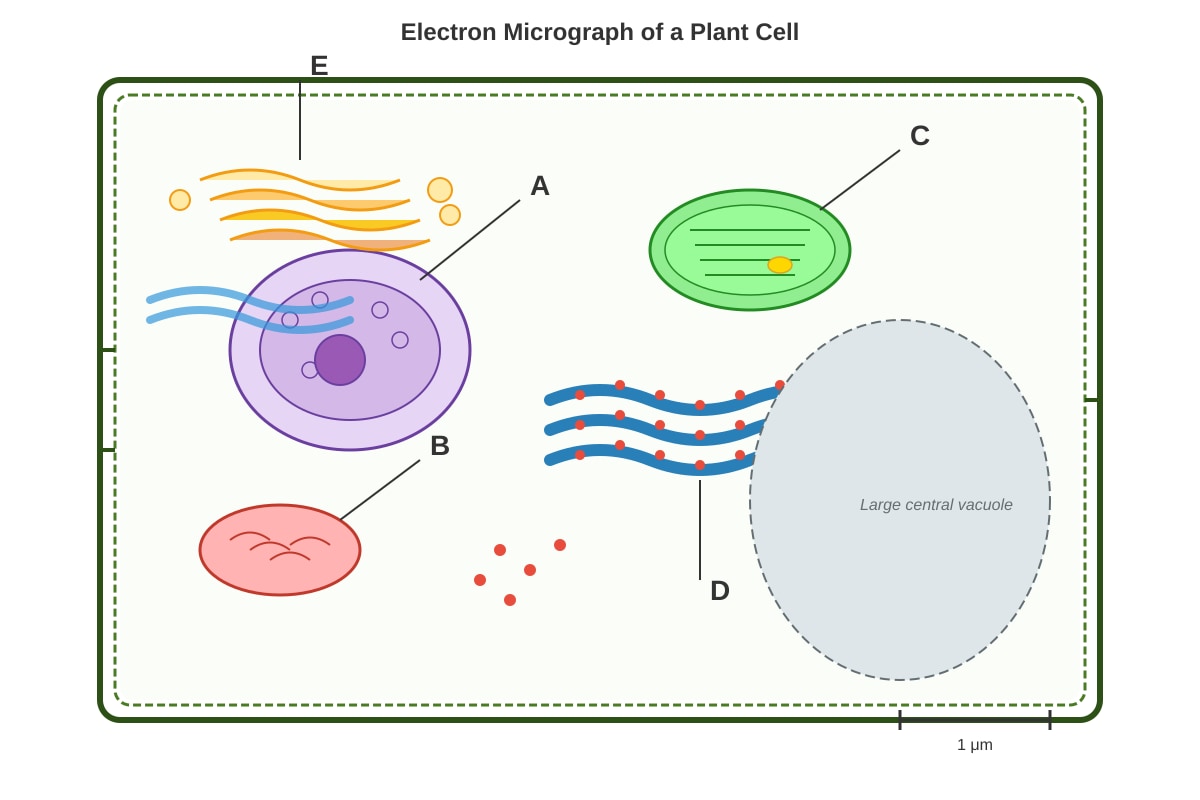
(a)(i) Identify structures A, B, and C. [3]
- A: Nucleus [1]
- B: Mitochondrion [1]
- C: Chloroplast [1]
Marking notes: Accept "mitochondria" for B. Spelling must be recognisable. Do not accept "nucleolus" for A.
(a)(ii) State the function of structure D (rough endoplasmic reticulum). [1]
- Transports proteins made by ribosomes (on its surface) to the Golgi body / transports proteins within the cell [1]
Marking notes: Must mention protein transport. Accept "synthesises and transports proteins" or "transports proteins to Golgi body".
(a)(iii) Explain why structure C (chloroplast) is not found in animal cells. [2]
- Chloroplasts are the site of photosynthesis [1]
- Animal cells do not carry out photosynthesis / animals obtain food by feeding (heterotrophic nutrition) [1]
Marking notes: Award 1 mark for stating chloroplast function, 1 mark for explaining why animals do not need them. Accept "animals do not make their own food".
(a)(iv) Describe how structure E (Golgi body) is involved in the secretion of enzymes from the cell. [2]
- The Golgi body modifies and packages proteins (enzymes) received from the rough endoplasmic reticulum [1]
- The packaged enzymes are transported in vesicles to the cell membrane for secretion (exocytosis) [1]
Marking notes: Must mention packaging/modification AND transport/secretion. Accept "Golgi body packages enzymes into vesicles which fuse with cell membrane".
Question 2: Movement of Substances (7 marks)
(a)(i) Calculate percentage change in mass for 0.2 mol/dm³ sucrose solution. [2]
- Percentage change = (Change in mass / Initial mass) × 100% [1]
- = (+0.15 / 2.45) × 100% = +6.12% (accept 6.1% or 6.12%) [1]
Marking notes: Award 1 mark for correct formula, 1 mark for correct answer with sign. Accept answers between 6.1% and 6.2%. Must show working.
(a)(ii) Explain why the potato strip in 0.0 mol/dm³ sucrose solution gained mass. [2]
- The water potential of the sucrose solution (0.0 mol/dm³ = distilled water) is higher than the water potential of the potato cells [1]
- Water enters the potato cells by osmosis (down the water potential gradient), causing the cells to become turgid and the strip to gain mass [1]
Marking notes: Must mention water potential difference AND osmosis. Accept "water moves from higher water potential to lower water potential".
(a)(iii) State the approximate concentration with the same water potential as potato cells. [2]
- Approximately 0.4 mol/dm³ [1]
- At this concentration, there is no change in mass, indicating no net movement of water / the water potentials are equal [1]
Marking notes: Must state 0.4 mol/dm³ AND explain that zero mass change indicates equal water potentials.
(a)(iv) Predict what would happen to a red blood cell in 0.8 mol/dm³ sucrose solution. [1]
- The red blood cell would shrink / crenate / lose water [1]
Marking notes: Accept "crenate", "shrink", "lose water by osmosis". Do not accept "burst" or "swell".
Question 3: Biological Molecules and Enzymes (10 marks)
(a) Complete the table of chemical elements. [3]
| Biological molecule | Chemical elements present |
|---|---|
| Carbohydrate | Carbon, hydrogen, oxygen [1] |
| Fat | Carbon, hydrogen, oxygen [1] |
| Protein | Carbon, hydrogen, oxygen, nitrogen (and sometimes sulfur) [1] |
Marking notes: Award 1 mark for each correct row. Protein must include nitrogen. Accept "C, H, O" for carbohydrate and fat. Accept "C, H, O, N" for protein. Sulfur is optional.
(b)(i) Identify biological molecules present in the unknown solution. [2]
- Reducing sugar (glucose) [1]
- Fat (lipid) [1]
Marking notes: Award 1 mark for each correct molecule. Accept "reducing sugar" or "glucose". Accept "lipid" or "oil".
(b)(ii) Explain why the iodine test result indicates starch is absent. [1]
- Iodine solution remains brown in the absence of starch / iodine turns blue-black only in the presence of starch [1]
Marking notes: Must state that brown colour indicates absence of starch. Accept "no colour change to blue-black means no starch present".
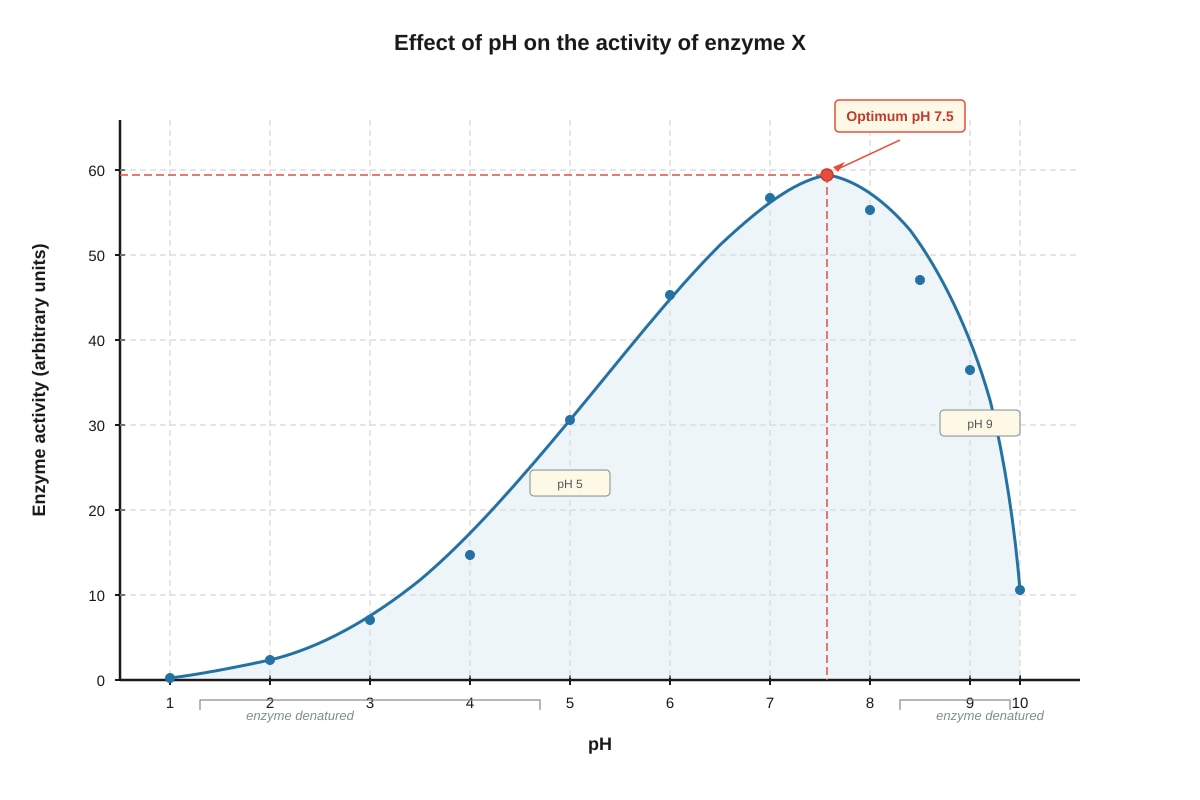
(c)(i) State the optimum pH for enzyme X. [1]
- pH 7.5 [1]
Marking notes: Accept "7.5" only.
(c)(ii) Explain why enzyme X shows very low activity at pH 5. [3]
- At pH 5, the pH is far from the optimum pH of enzyme X [1]
- The change in pH alters the charges on the amino acids at the active site / alters the ionic and hydrogen bonds that maintain the three-dimensional shape of the enzyme [1]
- This causes the active site to lose its specific shape / the enzyme denatures, so the substrate can no longer fit into the active site / enzyme-substrate complexes cannot form [1]
Marking notes: Award 1 mark for stating pH is far from optimum, 1 mark for explaining effect on enzyme structure/bonds, 1 mark for linking to loss of active site shape/denaturation. Must mention active site shape change.
Question 4: Cell Specialisation (6 marks)
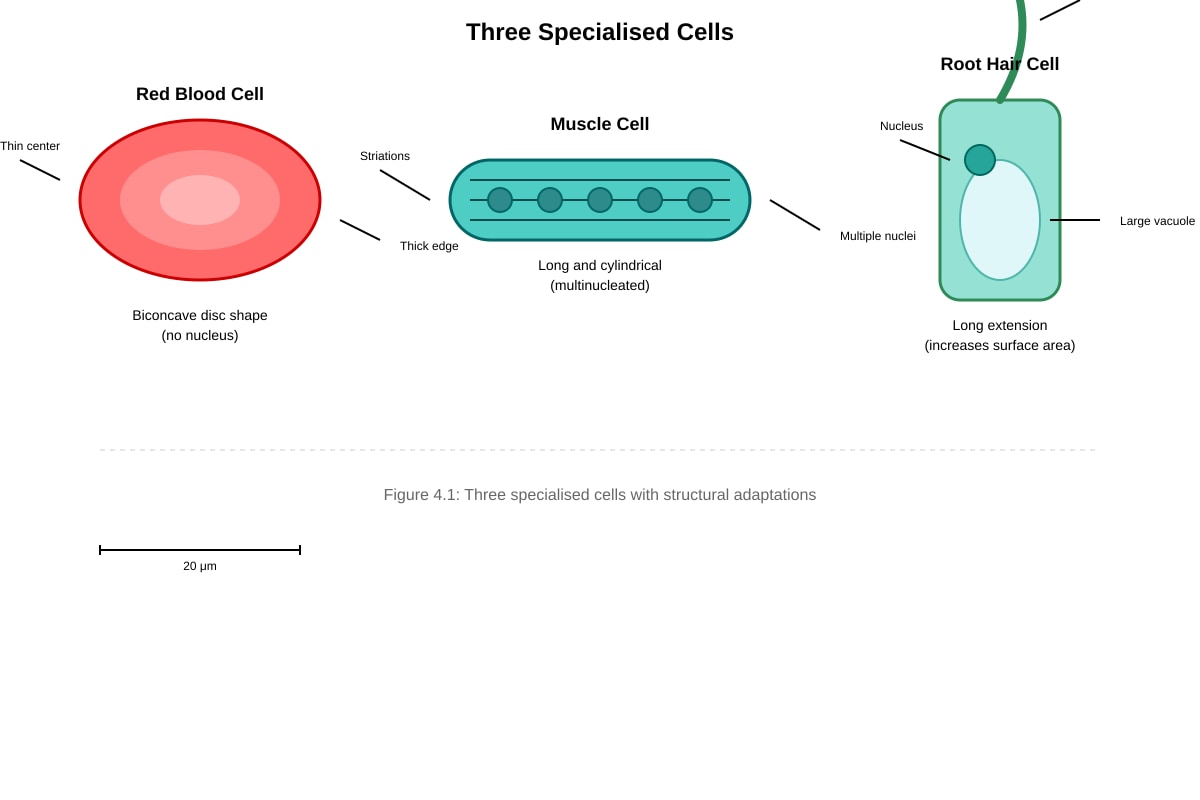
(a)(i) State one structural adaptation of a red blood cell and explain how it helps its function. [2]
- Red blood cells have no nucleus [1]
- This allows more space for haemoglobin to carry oxygen / increases the oxygen-carrying capacity [1]
OR
- Red blood cells have a biconcave shape [1]
- This increases the surface area to volume ratio for faster diffusion of oxygen [1]
Marking notes: Award 1 mark for adaptation, 1 mark for linked explanation. Accept either adaptation with correct explanation.
(a)(ii) Explain why muscle cells contain many mitochondria. [2]
- Muscle cells require a lot of energy for contraction [1]
- Mitochondria are the site of aerobic respiration, which releases energy (ATP) for muscle contraction [1]
Marking notes: Must link energy requirement to mitochondrial function. Accept "mitochondria release energy through respiration".
(a)(iii) Describe how the structure of a root hair cell is adapted for absorption of water and mineral ions. [2]
- The root hair cell has a long, narrow extension (root hair) that increases the surface area to volume ratio [1]
- This increases the rate of absorption of water (by osmosis) and mineral ions (by active transport/diffusion) [1]
Marking notes: Must mention increased surface area AND link to absorption. Accept "large surface area for faster absorption".
Question 5: Diffusion and Active Transport (9 marks)
(a) Define the term diffusion. [2]
- Diffusion is the net movement of particles (molecules or ions) [1]
- From a region of higher concentration to a region of lower concentration / down a concentration gradient [1]
Marking notes: Must mention "net movement" AND "down concentration gradient". Accept "movement from high to low concentration".
(b) Explain how diffusion is involved in the absorption of oxygen from alveoli into the blood. [3]
- The concentration of oxygen in the alveoli (inhaled air) is higher than the concentration of oxygen in the blood (deoxygenated blood) [1]
- This creates a concentration gradient for oxygen [1]
- Oxygen diffuses from the alveoli into the blood down the concentration gradient [1]
Marking notes: Must mention concentration gradient AND direction of diffusion. Accept reference to partial pressure gradient.
(c)(i) Explain why active transport is necessary for complete absorption of glucose from the small intestine. [2]
- After a meal, the concentration of glucose in the small intestine may be lower than in the blood [1]
- Diffusion alone cannot absorb glucose against the concentration gradient, so active transport (using energy) is needed to absorb all glucose [1]
Marking notes: Must mention concentration gradient reversal AND need for energy. Accept "active transport moves glucose against concentration gradient".
(c)(ii) State two differences between diffusion and active transport. [2]
| Feature | Diffusion | Active Transport |
|---|---|---|
| Energy requirement | Does not require energy (passive) [1] | Requires energy (ATP) [1] |
| Direction of movement | Down concentration gradient [1] | Against concentration gradient [1] |
OR any two valid differences.
Marking notes: Award 1 mark for each correct difference. Accept: diffusion does not need carrier proteins but active transport does; diffusion occurs in non-living systems but active transport only in living cells.
Section B: Data-Based Questions (25 marks)
Question 6: Enzyme Activity Investigation (13 marks)
(a) Plot a graph of the results. [4]
Marking notes for graph:
- Correct axes: x-axis = Temperature (°C), y-axis = Volume of oxygen produced in 2 minutes (cm³) [1]
- Appropriate scales using more than half the grid [1]
- All points plotted correctly (± half small square) [1]
- Points joined with a smooth curve (not straight lines) [1]
(b) Describe the relationship between temperature and oxygen produced (10°C to 40°C). [2]
- As temperature increases from 10°C to 40°C, the volume of oxygen produced increases [1]
- The rate of increase is not constant / the increase is greater between 20°C and 30°C than between 10°C and 20°C [1]
Marking notes: Award 1 mark for stating positive correlation, 1 mark for describing the pattern of increase. Accept "oxygen production increases with temperature up to 40°C".
(c) Explain why oxygen production increases from 10°C to 40°C. [3]
- As temperature increases, the kinetic energy of enzyme and substrate molecules increases [1]
- This increases the frequency of effective collisions between enzyme and substrate molecules [1]
- More enzyme-substrate complexes form per unit time, increasing the rate of reaction [1]
Marking notes: Must mention kinetic energy, collision frequency, AND enzyme-substrate complex formation. Accept "molecules move faster, collide more often, more reactions occur".
(d) Explain why no oxygen is produced at 70°C. [2]
- At 70°C, the high temperature has denatured the enzyme catalase [1]
- The active site has lost its specific shape permanently, so hydrogen peroxide (substrate) can no longer bind / enzyme-substrate complexes cannot form [1]
Marking notes: Must mention denaturation AND loss of active site shape. Accept "enzyme denatured, active site destroyed".
(e) Suggest one way to improve the reliability of the results. [2]
- Repeat the experiment at each temperature and calculate the mean (average) volume of oxygen produced [1]
- This reduces the effect of random errors / identifies anomalous results [1]
OR
- Control variables such as pH, enzyme concentration, and substrate concentration [1]
- To ensure that only temperature affects the results [1]
Marking notes: Award 1 mark for suggestion, 1 mark for explanation. Accept any valid improvement with justification.
Question 7: Osmosis and Plant Cells (12 marks)
(a) Calculate percentage change in length for 3 g/100cm³ salt solution. [2]
- Percentage change = (Change in length / Initial length) × 100% [1]
- = (-3 / 50) × 100% = -6% [1]
Marking notes: Award 1 mark for correct formula, 1 mark for correct answer with negative sign. Must show working.
(b) Explain why the potato strip in 0 g/100cm³ salt solution increased in length. [3]
- The water potential of the salt solution (0 g/100cm³ = distilled water) is higher than the water potential of the potato cells [1]
- Water enters the potato cells by osmosis (down the water potential gradient) [1]
- The cells become turgid, causing the potato strip to increase in length [1]
Marking notes: Must mention water potential difference, osmosis, AND turgidity. Accept "water moves from higher to lower water potential".
(c) Explain why the potato strip in 5 g/100cm³ salt solution decreased in length. [3]
- The water potential of the salt solution (5 g/100cm³) is lower than the water potential of the potato cells [1]
- Water leaves the potato cells by osmosis (down the water potential gradient) [1]
- The cells become flaccid / plasmolyzed, causing the potato strip to decrease in length [1]
Marking notes: Must mention water potential difference, osmosis, AND flaccidity/plasmolysis. Accept "water moves out of cells".
(d) State the approximate concentration with the same water potential as potato cells. [2]
- Approximately 2 g/100cm³ [1]
- At this concentration, there is no change in length, indicating no net movement of water / the water potentials are equal [1]
Marking notes: Must state 2 g/100cm³ AND explain that zero length change indicates equal water potentials.
(e) Suggest why it is important to use potato strips of the same initial length. [2]
- Using the same initial length ensures a fair test / controls the variable of initial length [1]
- This allows valid comparison of results / ensures that any change in length is due to the salt concentration only [1]
Marking notes: Must mention fair test/controlled variable AND valid comparison. Accept "to ensure results are comparable".
Section C: Extended Response Questions (15 marks)
Question 8: Enzymes and Their Importance (15 marks)
(a) Describe the lock-and-key model of enzyme action. Use a labelled diagram. [5]
Marking notes:
Diagram [2 marks]:
- Clear diagram showing enzyme with active site of specific shape [1]
- Substrate shown fitting into active site to form enzyme-substrate complex [1]
Accept simple shapes. Must show complementarity between active site and substrate.
Description [3 marks]:
- The active site of an enzyme has a specific three-dimensional shape that is complementary to the shape of its specific substrate [1]
- The substrate binds to the active site, forming an enzyme-substrate complex (like a key fitting into a lock) [1]
- The reaction occurs, products are formed, and the products leave the active site; the enzyme remains unchanged and can be reused [1]
Marking notes: Must mention active site specificity, enzyme-substrate complex formation, AND enzyme reusability.
(b) Explain how a change in pH can affect the rate of an enzyme-catalysed reaction. [4]
- Each enzyme has an optimum pH at which it works best [1]
- Changes in pH alter the charges on the amino acids at the active site / disrupt the ionic and hydrogen bonds that maintain the three-dimensional shape of the enzyme [1]
- This changes the shape of the active site, so the substrate can no longer fit / enzyme-substrate complexes cannot form [1]
- At extreme pH values, the enzyme denatures (permanently loses its shape) and the reaction stops [1]
Marking notes: Must mention optimum pH, effect on bonds/shape, substrate binding, AND denaturation at extremes.
(c) Discuss the importance of enzymes in living organisms with specific examples. [6]
Marking notes: Award marks for:
- Enzymes are biological catalysts that speed up chemical reactions in living organisms without being used up [1]
- Without enzymes, metabolic reactions would be too slow to sustain life [1]
Specific examples (up to 4 marks for two well-explained examples):
Example 1: Digestive enzymes (e.g., amylase)
- Amylase breaks down starch into maltose in the mouth and small intestine [1]
- This allows large, insoluble starch molecules to be broken down into smaller, soluble sugars that can be absorbed [1]
Example 2: Catalase
- Catalase breaks down hydrogen peroxide (a toxic by-product of metabolism) into water and oxygen [1]
- This prevents the accumulation of hydrogen peroxide, which would damage cells [1]
OR other valid examples: proteases (protein digestion), lipases (fat digestion), DNA polymerase (DNA replication)
Marking notes: Award up to 6 marks total. Must include at least two specific enzyme examples with substrates and products. Must explain why the reaction is important for the organism.
END OF ANSWER KEY
© TuitionGoWhere Secondary School (AI) - Preliminary Examination 2024