From Real Exams Exam Paper
Secondary 4 Pure Biology Preliminary Examination Paper 1
Free Sec 4 Pure Biology Prelim Paper 1, Exam version, with questions, answers, and O Level-style practice for Singapore students.
These static practice materials are generated from the site's syllabus and paper-generation workflow, with source and model context shown so students and parents can evaluate the material before use.
Questions
Free quiz and exam paper access
Enter your details to view this paper
Your access is remembered on this device.
Answers
TuitionGoWhere Practice Paper - Pure Biology Secondary 4 - Mark Scheme
Total Marks: 65
Section A: Multiple Choice Questions [10 marks]
1. C - Site of protein synthesis [2 marks] Marking: Protein synthesis occurs at ribosomes, not the cell membrane
2. A - Active site [2 marks] Marking: X represents the specific region where substrate binds
3. C - Active transport [2 marks] Marking: Only active transport requires ATP energy to move substances against concentration gradients
4. D - Mitochondrion [2 marks] Marking: Mitochondria are the site of aerobic respiration
5. B - Cell → Tissue → Organ → System → Organism [2 marks] Marking: Correct hierarchical organization from smallest to largest
Section B: Structured Questions [55 marks]
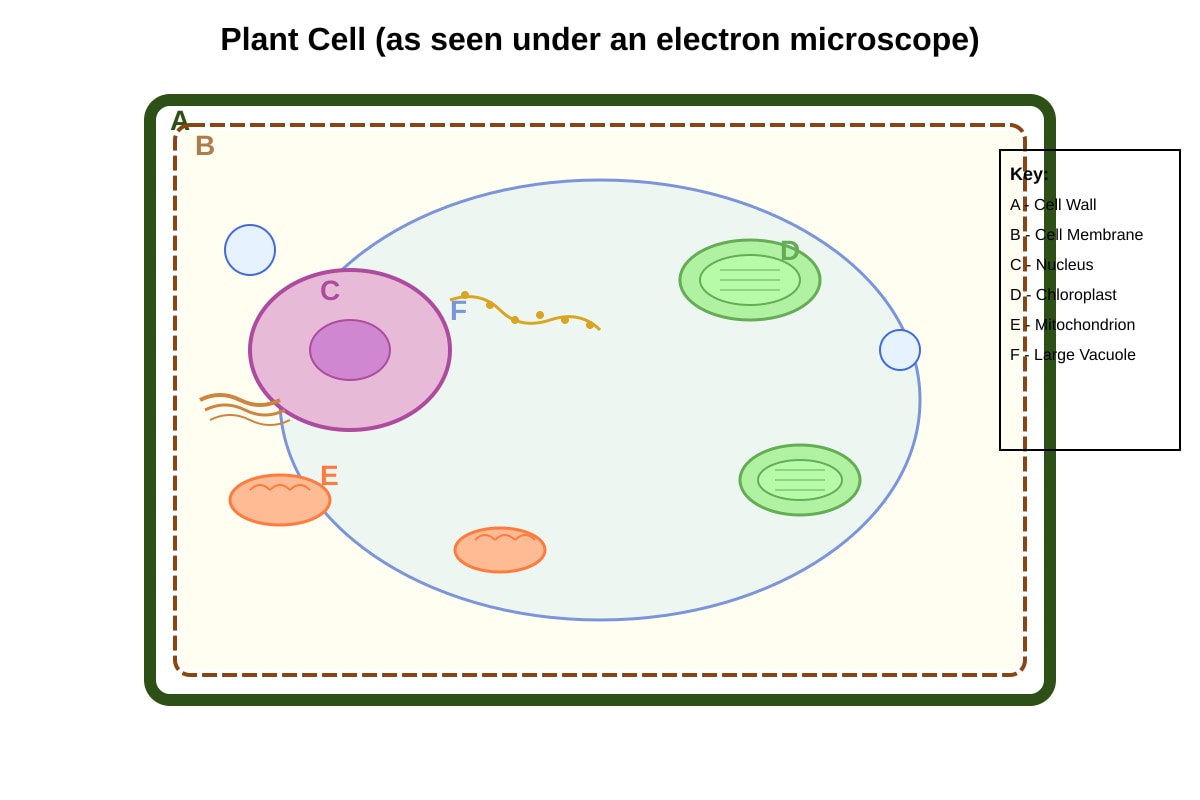
6(a) Complete the table [6 marks]
| Letter | Name of structure | Function |
|---|---|---|
| A | Cell wall | Provides structural support / Protection |
| C | Nucleus | Controls cell activities / Contains DNA |
| D | Chloroplast | Site of photosynthesis |
Marking: 1 mark for each correct name, 1 mark for each correct function (6 marks total)
6(b) Two reasons why this could not be an animal cell [2 marks] Answer:
- Presence of cell wall (animal cells do not have cell walls)
- Presence of chloroplasts (animal cells do not have chloroplasts) Alternative: Large permanent vacuole (animal cells have small temporary vacuoles)
Marking: 1 mark for each correct reason with explanation
6(c) Two adaptations for photosynthesis [2 marks] Answer:
- Contains chloroplasts which contain chlorophyll to absorb light
- Large surface area to maximize light absorption Alternative: Thin cell wall allows light to penetrate easily
Marking: 1 mark for each correct adaptation
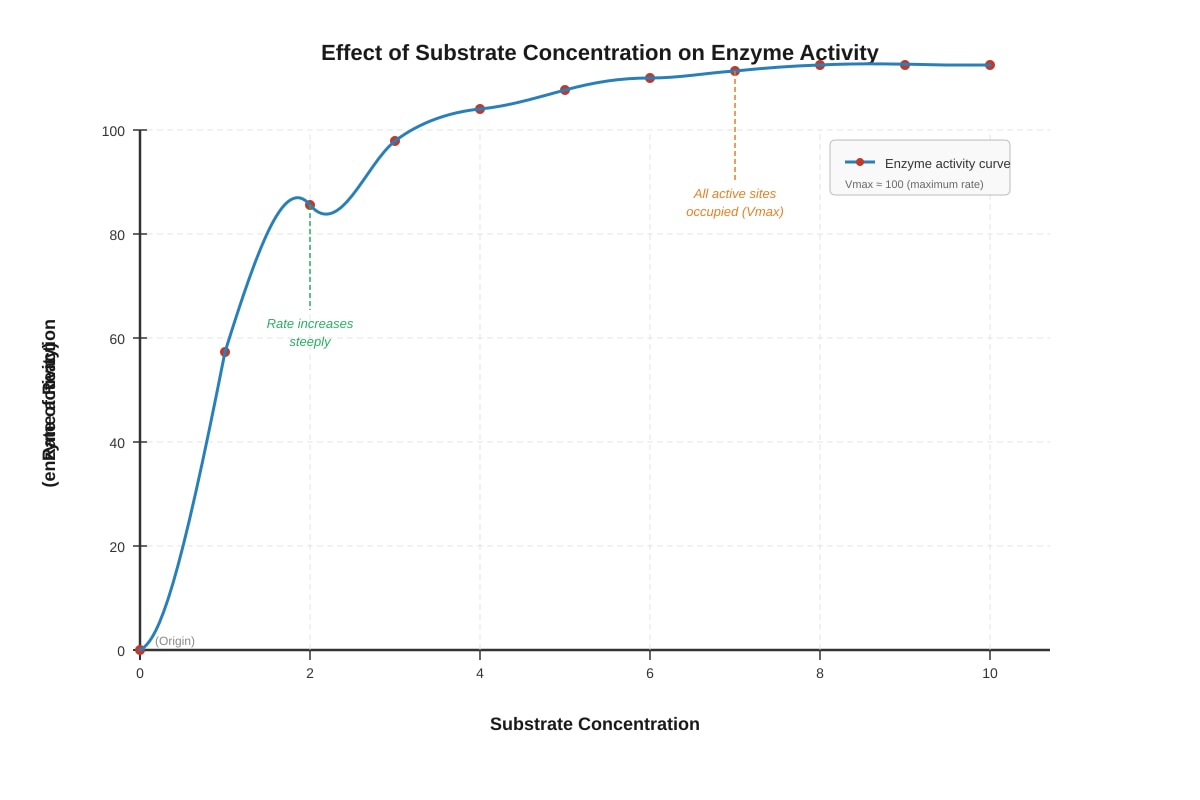
7(a) Relationship between substrate concentration and enzyme activity [3 marks] Answer: As substrate concentration increases, enzyme activity increases rapidly at first, then the rate of increase slows down, and eventually levels off at high concentrations.
Marking:
- 1 mark for initial increase
- 1 mark for leveling off
- 1 mark for describing the overall trend
7(b) Why rate levels off at high substrate concentrations [3 marks] Answer: At high substrate concentrations, all enzyme active sites are occupied (enzyme saturation). The enzyme cannot work any faster as it is working at maximum capacity.
Marking:
- 1 mark for enzyme saturation
- 1 mark for all active sites occupied
- 1 mark for maximum capacity reached
7(c) Drawing line for higher temperature [2 marks] Answer: Line should be drawn above the original line, showing higher initial rate but leveling off at approximately the same maximum rate.
Marking:
- 1 mark for line starting higher than original
- 1 mark for correct shape (steeper initial slope, similar maximum)
7(d) Two constant variables [2 marks] Answer: Any two from: Temperature, pH, enzyme concentration, volume of solutions, time intervals
Marking: 1 mark for each appropriate variable
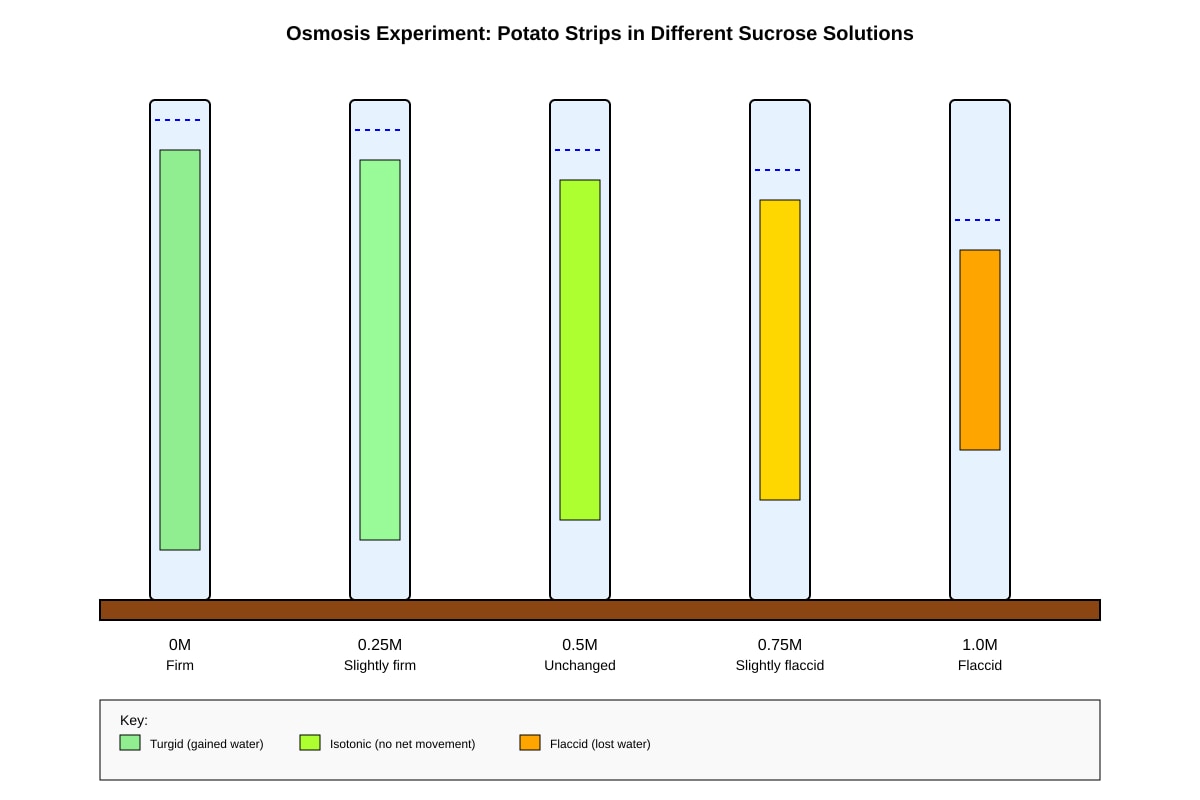
8(a) Sucrose concentration with same water potential [3 marks] Answer: 0.5M sucrose solution. At this concentration, there would be no net movement of water, indicating that the water potential of the potato cells equals the water potential of the solution.
Marking:
- 1 mark for 0.5M
- 1 mark for no net water movement
- 1 mark for equal water potentials
8(b) What happens in 1.0M sucrose solution [4 marks] Answer: The potato cells lose water by osmosis because the external solution has a lower water potential than the cell contents. Water moves out of the cells, causing them to lose turgor pressure and become flaccid. The cell membrane may pull away from the cell wall (plasmolysis).
Marking:
- 1 mark for water loss by osmosis
- 1 mark for lower water potential outside
- 1 mark for loss of turgor/become flaccid
- 1 mark for plasmolysis
8(c) Transfer to distilled water [3 marks] Answer: Water would move into the potato cells by osmosis because distilled water has a higher water potential than the cell contents. The cells would regain turgor pressure and become firm again.
Marking:
- 1 mark for water moves in by osmosis
- 1 mark for higher water potential in distilled water
- 1 mark for cells become turgid/firm
9(a) Nutrients present in food samples [6 marks]
| Food sample | Starch | Reducing sugar | Protein | Fat |
|---|---|---|---|---|
| A | Present | Absent | Absent | Present |
| B | Absent | Present | Absent | Absent |
| C | Absent | Absent | Present | Absent |
Marking: 1 mark for each correct entry (6 marks total)
9(b) What food sample A could be [1 mark] Answer: Butter / Margarine / Oil / Any fatty food containing starch Marking: 1 mark for appropriate food containing starch and fat
9(c) Importance of using a control [2 marks] Answer: A control shows what a negative result looks like / To compare with the test results / To ensure the test reagents are working properly.
Marking: 1 mark for comparison purpose, 1 mark for ensuring test validity
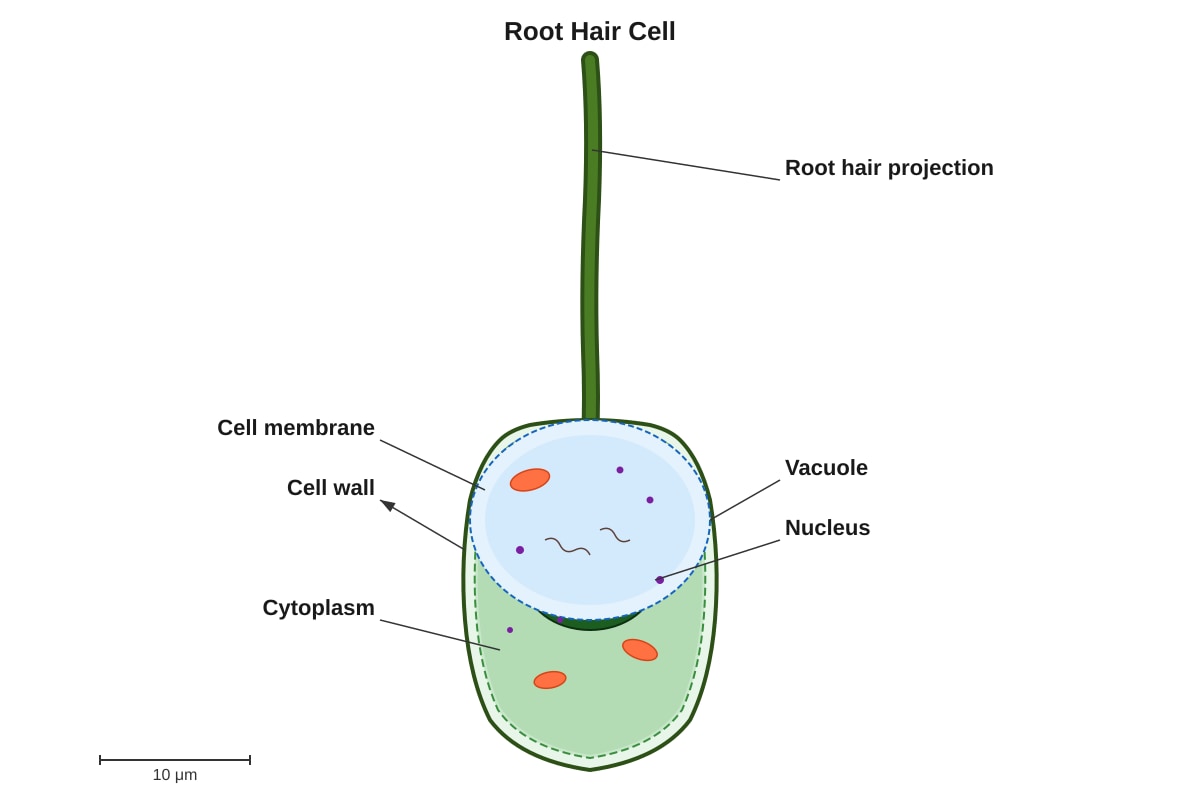
10(a) Adaptations of root hair cell [4 marks] Answer:
- Long projection (root hair) increases surface area for absorption
- Thin cell wall allows easy passage of water and minerals
- Many mitochondria provide energy for active transport of minerals
- Large vacuole stores absorbed water and minerals
Marking: 1 mark for each correct adaptation with explanation (maximum 4 marks)
10(b) Process for water entry [1 mark] Answer: Osmosis Marking: 1 mark for osmosis
10(c) Why active transport needed for mineral ions [3 marks] Answer: Mineral ion concentration in the soil is often lower than in the root hair cell. Active transport can move ions against the concentration gradient from low to high concentration, which requires energy from ATP.
Marking:
- 1 mark for concentration gradient (lower outside)
- 1 mark for movement against gradient
- 1 mark for requires energy/ATP
11(a) Calculate average rate of water loss [2 marks] Answer: Distance moved between 2-4 hours = 72 - 28 = 44 mm Time = 4 - 2 = 2 hours Average rate = 44 ÷ 2 = 22 mm per hour
Marking:
- 1 mark for correct working
- 1 mark for correct answer with units
11(b) Two environmental factors [2 marks] Answer: Any two from: Temperature, humidity, light intensity, wind speed, air pressure
Marking: 1 mark for each correct factor
11(c) How factors affect water loss [4 marks] Answer: Factor 1 (e.g., Temperature): Higher temperature increases kinetic energy of water molecules, increasing evaporation rate from leaf surfaces.
Factor 2 (e.g., Humidity): Lower humidity increases the concentration gradient for water vapor, increasing the rate of water loss from leaves.
Marking: 2 marks for each factor - 1 mark for direction of effect, 1 mark for mechanism
11(d) Why repeat experiment [1 mark] Answer: To obtain reliable results / To calculate an average / To identify anomalous results
Marking: 1 mark for any appropriate reason for repetition