From Real Exams Quiz
Secondary 4 Principles of Accounts Financial Statements Quiz
Free Sec 4 POA Financial Statements quiz, HY3 Exam version, with questions, answers, and O Level-style practice for Singapore students.
These static practice materials are generated from the site's syllabus and paper-generation workflow, with source and model context shown so students and parents can evaluate the material before use.
Questions
Free quiz and exam paper access
Enter your details to view this paper
Your access is remembered on this device.
Answers
Secondary 4 Principles of Accounts Quiz - Financial Statements (Answer Key)
Total Marks: 40
Topic: Financial Statements
Section A: Knowledge and Comprehension
1. [1 mark]
Answer: Assets = Capital + Liabilities
Teaching note: The accounting equation shows what the business owns (assets) is funded by owner's capital and debts (liabilities). This underpins the SFP.
2. [2 marks]
(a) Income Statement
(b) Statement of Financial Position
(1 mark each) Teaching: IS reports profit/loss; SFP reports financial position at a point in time.
3. [1 mark]
Answer: The total cost of inventory sold during the period.
Teaching: COGS = Opening Inv + Purchases + Carriage Inwards − Closing Inv.
4. [3 marks] (1 each)
(a) SFP (b) IS (c) SFP
Teaching: Expenses on IS; assets/liabilities on SFP.
5. [3 marks]
Answer: To show the financial position of the business at a specific date, listing assets, liabilities, and capital.
Marking: 1 for "position at a point in time", 1 for assets/liabilities, 1 for capital.
Teaching: Unlike IS (period), SFP is a snapshot.
Section B: Application
6. [2 marks]
Working: COGS = 4,000 + 22,000 − 5,000 = 21,000
Answer: $21,000
Teaching: Closing inv deducted because unsold.
7. [1 mark]
Answer: $30,000 (80,000 − 50,000)
Teaching: Gross Profit = Sales − COGS.
8. [4 marks] (1 each)
(a) NCA (b) CL (c) CA (d) C
Teaching: Motor vehicle long-term; overdraft short-term debt.
9. [5 marks]
Mei Ling Studio Income Statement for year ended 31 Dec 2024
Sales: 35,000
Marking: 1 COGS calc, 1 GP, 1 expenses, 1 NP, 1 format.
10. [1 mark]
Answer: Net Profit = Gross Profit − Other Expenses
Teaching: After trading and other expenses.
11. [2 marks]
Working: Capital = (40,000+25,000) − (10,000+15,000) = 65,000 − 25,000 = 40,000
Answer: $40,000
Teaching: A − L = C.
12. [1 mark]
Answer: Gross profit overstated by $2,700.
Teaching: Lower closing inv → lower COGS → higher GP.
13. [2 marks]
(a) 60,000−36,000 = 24,000
(b) 24,000−9,000 = 15,000
Teaching: GP then NP.
Section C: Analysis and Synthesis
14. [6 marks]
Income Statement:
Sales 200,000
COGS: 15,000+120,000+2,000−20,000 = 117,000
GP = 83,000
Exp: Rent 10,000 + Wages 25,000 = 35,000
NP = 48,000
SFP: NCA 50,000; CA: Cash 8,000+TR 18,000+Cl Inv 20,000 = 46,000; Total A 96,000; CL 14,000; Cap = 96,000−14,000 = 82,000 (check with NP added to opening cap).
Marking: IS 3, SFP 3.
15. [3 marks]
Closing inv is unsold goods (asset) on SFP; in IS it reduces COGS (not yet sold). 1+1+1.
16. [2 marks]
A more profitable per dollar (40% vs 25%). Higher margin = more profit per sale.
17. [3 marks]
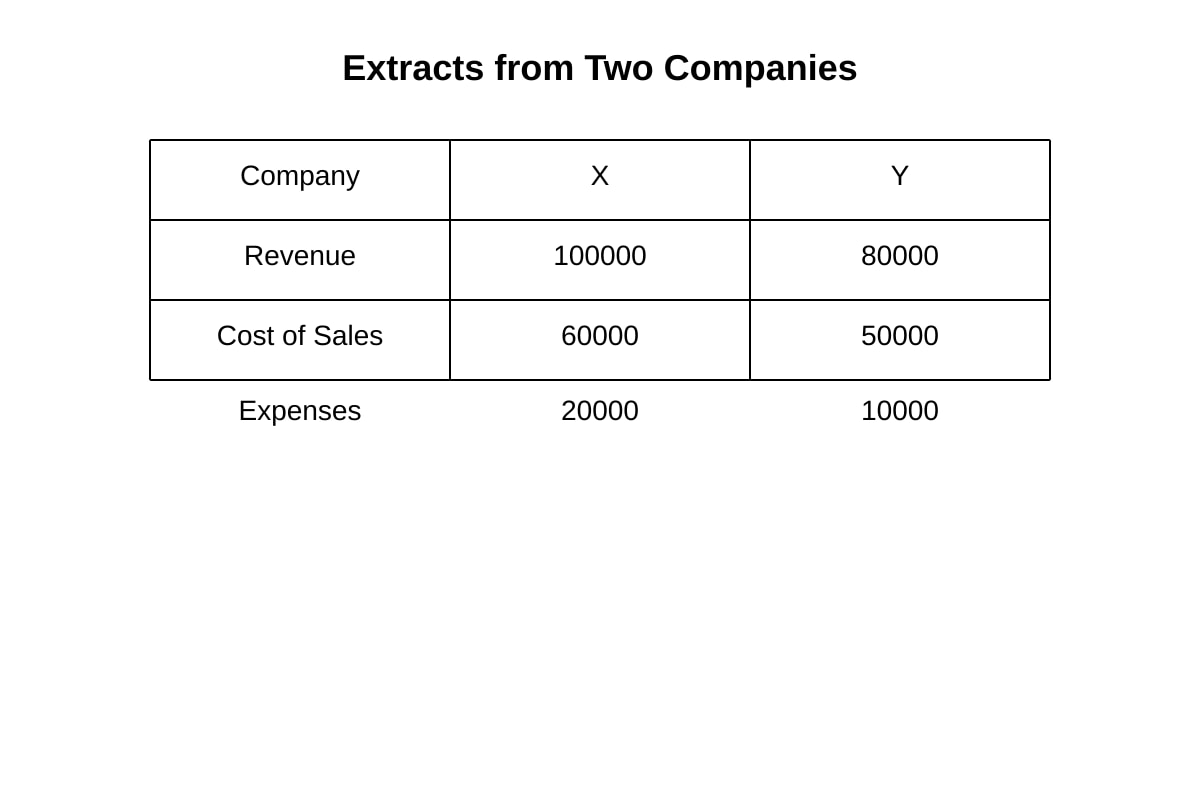
X NP: 100,000−60,000−20,000 = 20,000
Y NP: 80,000−50,000−10,000 = 20,000
Comment: Same NP, but X larger sales; Y more cost-efficient relative to scale.
Table as placeholder shows values.
18. [2 marks]
IS: Expenses understated, profit overstated. SFP: Liabilities understated.
Teaching: Accrual must be recorded.
19. [4 marks]
Joy Cleaners SFP:
NCA 30,000; CA: Inv 8,000 + Other 10,000 = 18,000; Total A 48,000
CL 7,000; Cap = 48,000−7,000 = 41,000 (add NP: Sales 90k−COGS 47k=43k GP−12k=31k NP; opening cap 10k assumed).
Marking: 1 NCA, 1 CA, 1 CL, 1 Cap.
20. [2 marks]
Shows profitability and ability to repay; bank assesses net profit trend. 1 point each.