AI Generated Exam Paper
Secondary 4 Principles of Accounts Practice Paper 5
Free Sec 4 POA Practice Paper 5, HY3 AI version, with questions, answers, and O Level-style practice for Singapore students.
These static practice materials are generated from the site's syllabus and paper-generation workflow, with source and model context shown so students and parents can evaluate the material before use.
Questions
Free quiz and exam paper access
Enter your details to view this paper
Your access is remembered on this device.
Answers
TuitionGoWhere Practice Paper Answers — Principles of Accounts Secondary 4 (Version 5)
Topic: Inventory Costing
Total Marks: 60
Section A: Basic Concepts and Valuation (10 marks)
Q1 [1 mark]
Answer: Lower of cost and net realisable value (NRV).
Teaching note: Inventory must not be overstated. Prudence means we report the lower of what it cost us or what we can sell it for (minus costs to sell).
Q2 [2 marks]
Answer: Net realisable value is the estimated selling price of inventory in the ordinary course of business, less any estimated costs of completion and costs necessary to make the sale (e.g. selling expenses).
Marking: 1 mark for selling price idea, 1 mark for deducting costs to sell.
Common mistake: Confusing NRV with cost price.
Q3 [2 marks]
COGS = Opening Inventory + Purchases − Closing Inventory
= 30,000 − 29,000
Answer: $29,000.
Teaching: Closing inventory is deducted because it is unsold and remains an asset.
Q4 [2 marks]
Answer: Incorrect. If closing inventory is overstated by 800.
Marking: 1 mark correct direction, 1 mark explanation.
Common trap: Reversing the effect.
Q5 [3 marks]
Any two of: (1) avoid overstocking (storage cost, obsolescence), (2) avoid stockouts (lost sales), (3) improve cash flow, (4) meet customer demand efficiently.
[1.5 marks each, max 3]
Section B: FIFO and AVCO Methods (22 marks)
Q6 [3 marks]
FIFO: issues from earliest stock first.
- 12 Mar sale 150: 100 @ 12 = 600 = $1,600
- Remaining: 150 @ $12
- 20 Mar purchase: +100 @ 12, 100 @ $14
- 25 Mar sale 180: 150 @ 14 = 420 = $2,220
- Closing: 70 @ 980
Answer: $980.
Marking: 1 m calc remaining, 1 m sale allocation, 1 m final value.
Q7 [2 marks]
COGS = Total available − Closing = (100×10 + 200×12 + 100×14) − 980 = (2,400+980 = 980 = 3,820.
Q8 [3 marks]
After 20 Mar: total units = 150 (from earlier remaining) + 100 = 250? Wait: after 12 Mar sale, 150@14. Total cost = 150×12 + 100×14 = 1,400=3,200 ÷ 250 = 12.80.
Q9 [2 marks]
After 25 Mar sale 180: 250−180 = 70 units. AVCO closing = 70 × 896.
Answer: $896.
Q10 [2 marks]
During rising prices, FIFO leaves newer (higher) cost units in closing inventory, so closing inventory is higher under FIFO than AVCO. AVCO smooths costs.
Q11 [4 marks]
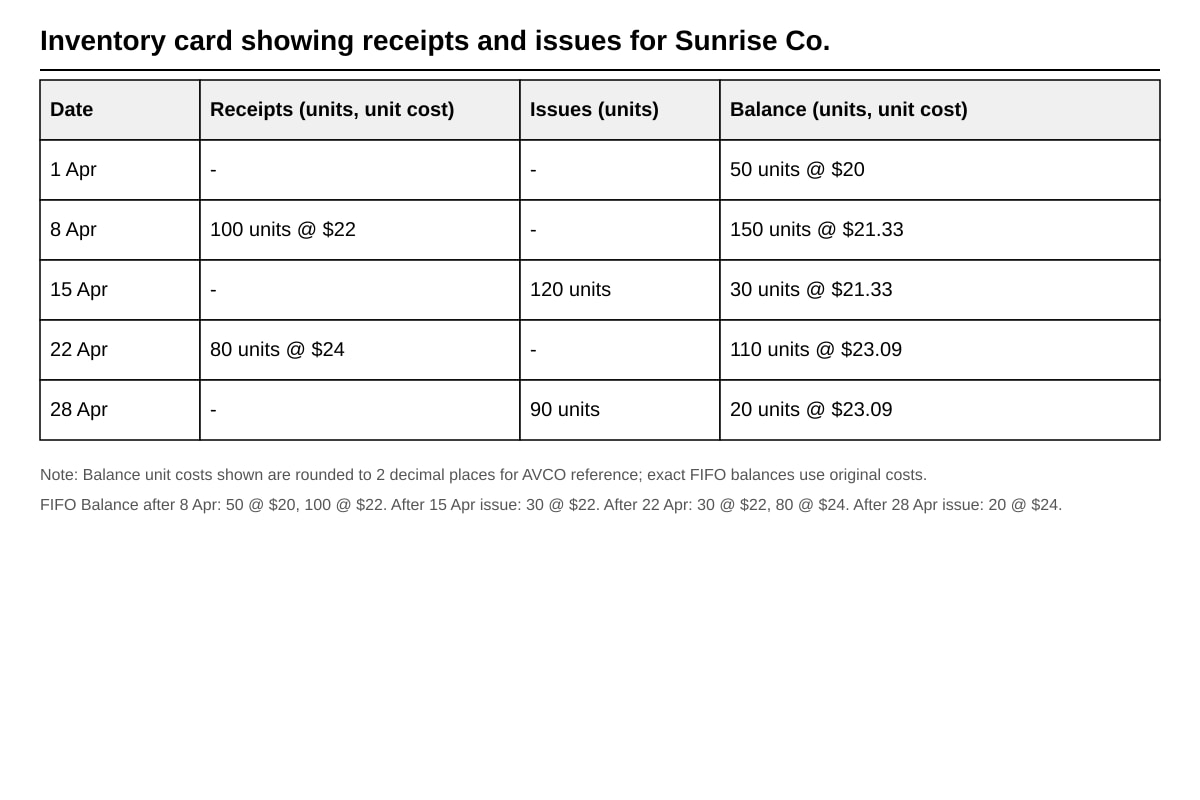
FIFO on card:
- 1 Apr: 50 @ $20
- 8 Apr: +100 @ $22 → bal 150 (50@20, 100@22)
- 15 Apr issue 120: 50@20 + 70@22 → bal 30@22
- 22 Apr: +80@24 → bal 30@22, 80@24
- 28 Apr issue 90: 30@22 + 60@24 → bal 20@24
Closing = 20 × 480.
Answer: $480. [4 m: 1 each step]
Q12 [2 marks]
FIFO gives higher closing inventory in inflation because latest (higher) prices remain in inventory. AVCO averages them down.
Section C: Inventory Turnover and Analysis (14 marks)
Q13 [2 marks]
Avg inv = (21,000)/2 = 120,000 ÷ $18,000 = 6.67 times
Answer: 6.67 times.
Q14 [3 marks]
Calm = 6.67, Swift = 9. Swift is more efficient (faster stock movement, lower holding cost). Calm may be overstocking or slow-moving. [1 compare, 2 comment]
Q15 [3 marks]
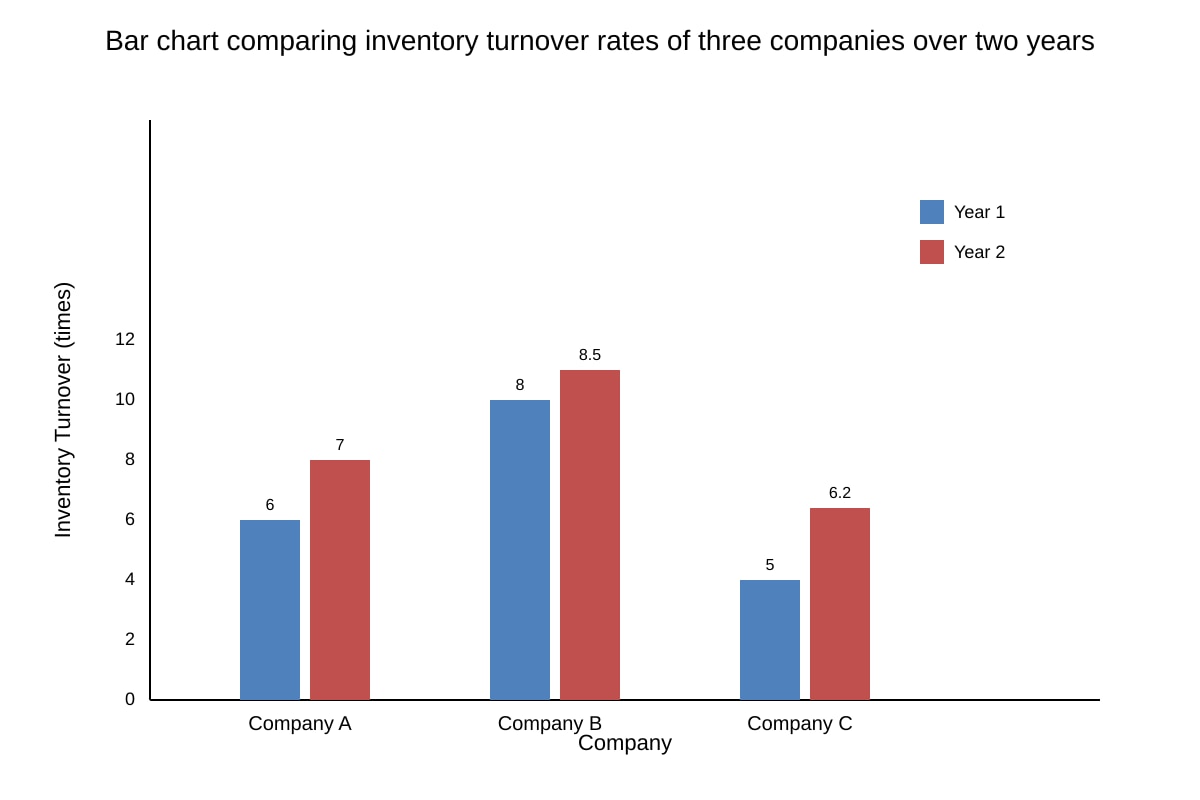
From graph: A 6→7 (+1), B 8→8.5 (+0.5), C 5→6.2 (+1.2). C improved most by 1.2 times.
Answer: Company C, 1.2 times.
Q16 [6 marks]
Two factors (3 marks each):
- Seasonal demand – firm holds stock before peak season.
- Slow-moving / obsolete goods – poor management or niche products.
- High-value items sold infrequently.
(Any two with explanation.)
Section D: Integrated Application (14 marks)
Q17 [3 marks]
COGS = 8,000+52,000−10,000 = 30,000.
Answer: $30,000.
Q18 [3 marks]
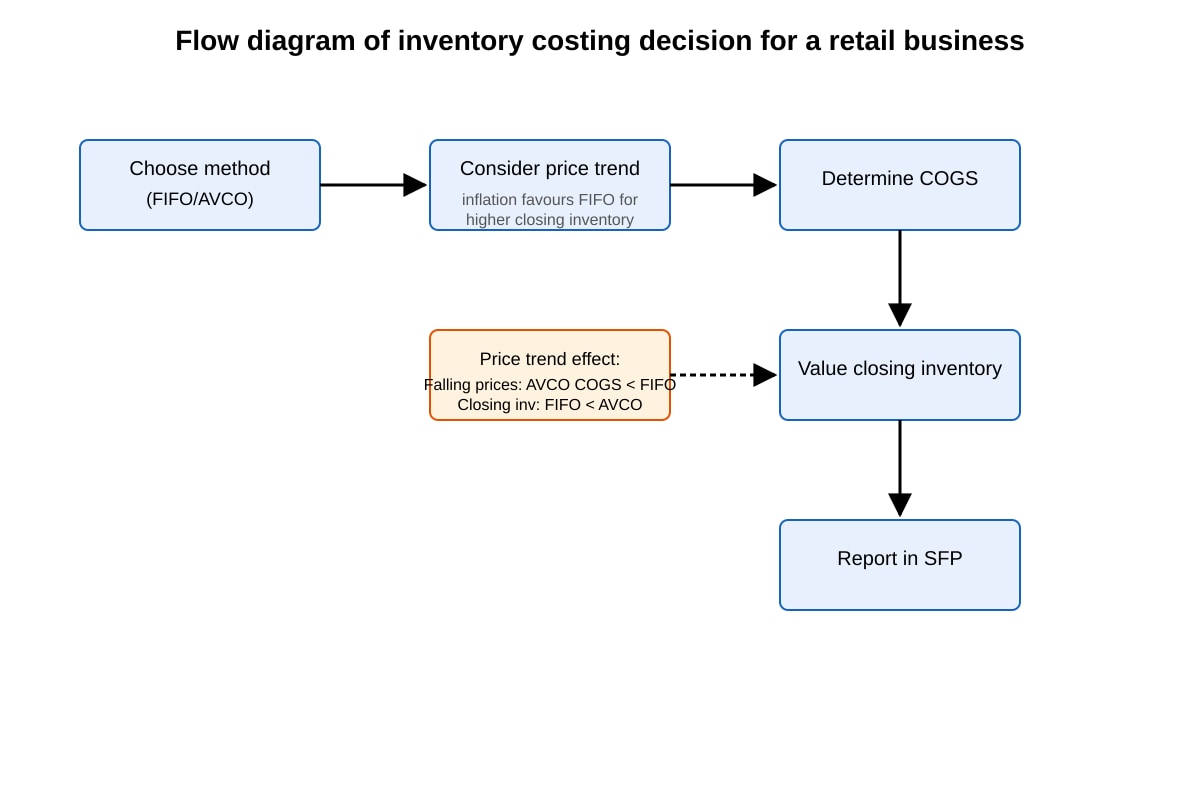
Falling prices: FIFO uses older (higher) costs first, so COGS is higher under FIFO; AVCO lower. Thus FIFO gives higher COGS.
Q19 [2 marks]
NRV = 100 = 300 (lower than cost).
Answer: $300.
Q20 [6 marks]
Method choice changes COGS and closing inventory. FIFO in inflation → higher closing inventory → higher assets on SFP, lower COGS, higher profit. AVCO → smoother. Diagram shows flow to SFP. [2 sequence, 2 effect, 2 link to SFP]