AI Generated Exam Paper
Secondary 4 Principles of Accounts Practice Paper 4
Free Sec 4 POA Practice Paper 4, HY3 AI version, with questions, answers, and O Level-style practice for Singapore students.
These static practice materials are generated from the site's syllabus and paper-generation workflow, with source and model context shown so students and parents can evaluate the material before use.
Questions
Free quiz and exam paper access
Enter your details to view this paper
Your access is remembered on this device.
Answers
TuitionGoWhere Practice Paper — Principles of Accounts Secondary 4 (Version 4) Answer Key
Total Marks: 40
Topic: Inventory Costing
Section A: Basic Concepts and Calculations
1. [1 mark]
Answer: Lower of cost and net realisable value (NRV).
Teaching note: Prudence concept requires assets not to be overstated. Inventory is valued at the lower of what it cost and what it can be sold for (NRV).
2. [2 marks]
Answer: Net realisable value is the estimated selling price of inventory minus any costs expected to be incurred in selling and completing the goods.
Marking: 1 mark for selling price minus costs; 1 mark for clear wording.
Common mistake: Confusing NRV with cost price.
3. [2 marks]
COGS = Opening Inventory + Purchases − Closing Inventory
= 26,000 − 25,000
Teaching note: Cost of sales links inventory used in the period. Method marks for formula.
4. [2 marks]
Purchases = COGS + Closing Inventory − Opening Inventory
= 4,800 − 31,600
Teaching note: Rearranged from COGS formula.
5. [1 mark]
Answer: It would overstate assets and profit, violating prudence / mislead users.
(Any one valid reason.)
6. [1 mark]
Answer: 900 and NRV $700).
7. [2 marks]
Answer: Inventory is expected to be sold or used within one year (operating cycle) to generate cash, so it is a current asset.
Marking: 1 mark for within 12 months / operating cycle; 1 mark for conversion to cash/sale.
8. [2 marks]
Inventory Turnover = COGS ÷ Average Inventory = 6,000 = 8 times.
Teaching note: Average inventory given; shows how many times stock is sold per year.
Section B: FIFO and AVCO Methods
9. [3 marks]
FIFO: Remaining after sale of 250 (100@10 + 150@12) → left: 50@12 + 100@14
Closing inventory = (50 × 14) = 1,400 = $2,000
Marking: 1 mark layers, 2 marks calculation.
10. [2 marks]
COGS FIFO = 100×12 = 1,800 = 4,600 − closing 2,800)
11. [2 marks]
After 5 Mar: Total cost = 2,400 = 3,400 ÷ 300 = $11.33 per unit
Marking: 1 mark total, 1 mark division.
12. [2 marks]
After sale 250: 50 units @ 566.50
Add 100@1,400 → Closing = 1,967)
Teaching note: Weighted average recalculated only at purchase points; sale uses existing average.
13. [2 marks]
In rising prices, FIFO gives lower COGS and higher profit/closing inventory; AVCO smooths cost.
(Any one clear difference.)
14. [3 marks]
FIFO shows higher closing inventory during inflation. Reason: oldest (cheaper) costs are used in COGS, leaving recent (higher) costs in inventory.
Marking: 1 mark method, 2 marks reason.
Section C: Analysis, Errors and Interpretation
15. [2 marks]
Avg Inv = (3,000) ÷ 2 = 25,000 ÷ $2,500 = 10 times.
16. [2 marks]
Cool Bakers = 10 times, Tasty = 10 times → equal efficiency.
Comment: Both sell stock at same rate; no efficiency gap.
(If student notes same, full marks.)
17. [1 mark]
Profit overstated by $1,500 (overstated closing inv → lower COGS → higher profit).
18. [2 marks]
Any two: purchase price, carriage inwards, import duties, direct handling cost.
(1 mark each.)
19. [2 marks]
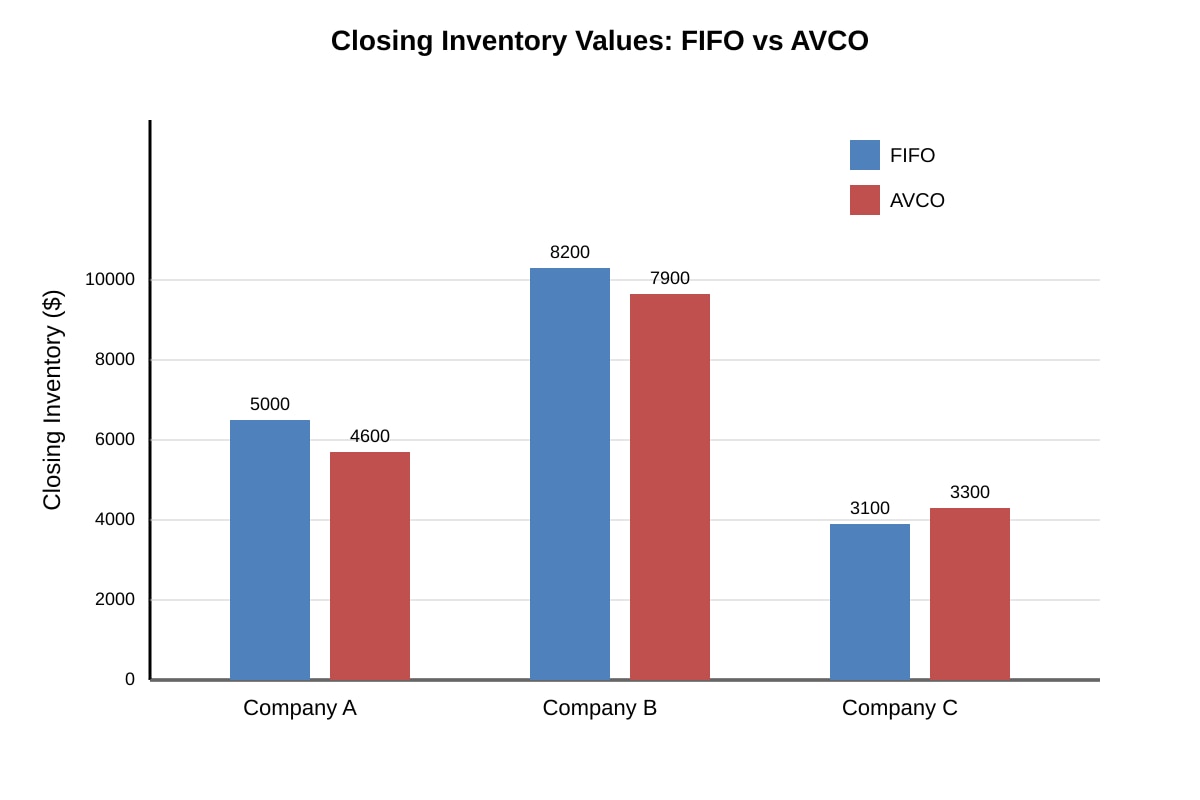
Company C shows AVCO (3,100). Reason: possibly falling prices (recent cheaper costs in AVCO layer).
Marking: 1 mark identify C, 1 mark reason.
20. [1 mark]
Different methods give different COGS/profit, so comparisons without same method are misleading.