AI Generated Exam Paper
Secondary 4 Principles of Accounts Practice Paper 2
Free Sec 4 POA Practice Paper 2, HY3 AI version, with questions, answers, and O Level-style practice for Singapore students.
These static practice materials are generated from the site's syllabus and paper-generation workflow, with source and model context shown so students and parents can evaluate the material before use.
Questions
TuitionGoWhere Practice Paper - Principles of Accounts Secondary 4
TuitionGoWhere Practice Paper (AI) — Version 2 of 5
Subject: Principles of Accounts
Level: Secondary 4
Paper: Practice Paper (Topic: Inventory Costing)
Duration: 1 hour 15 minutes
Total Marks: 40
Name: ________________________
Class: ____________
Date: ____________
Instructions:
- This practice paper contains 20 questions on Inventory Costing.
- Answer all questions in the spaces provided.
- Show all workings clearly. Method marks are awarded.
- Use the lower of cost and net realisable value basis where required.
- This paper is syllabus-first generated content and is not derived from official past-year papers.
Section A: Basic Concepts and Calculations (Questions 1–8) [16 marks]
1. State the basis on which inventory should be valued according to the prudence concept. [1]
2. Define "net realisable value" of inventory in your own words. [2]
3. Calculate the cost of goods sold for the year ended 31 Dec 2025 from the following:
Opening inventory 4,000;Purchases26,000; Carriage inwards 1,200;Closinginventory5,500. [2]
4. A trader's closing inventory was overstated by $800. State the effect on the profit for the year. [1]
5. Given opening inventory 3,000andclosinginventory7,000, calculate the average inventory. [1]
6. Cost of goods sold is 60,000andaverageinventoryis12,000. Calculate the inventory turnover rate. [2]
7. Explain why FIFO is said to issue the oldest items first. [2]
8. Under AVCO, the total cost of 100 units is $2,500. Calculate the weighted average cost per unit. [2]
Section B: FIFO and AVCO Methods (Questions 9–14) [14 marks]
9. The following purchases and sales occurred in January 2025 for M/s Bright Store:
| Date | Details | Units | Unit Cost ($) |
|---|---|---|---|
| 1 Jan | Opening | 50 | 10 |
| 5 Jan | Purchase | 100 | 12 |
| 12 Jan | Sale | 120 | — |
| 20 Jan | Purchase | 80 | 14 |
Using FIFO, calculate the closing inventory value at 31 Jan 2025. [3]
10. Using the same data in Q9, calculate the cost of goods sold under FIFO. [2]
11. Using AVCO (weighted average recalculated only at end of month for simplicity), calculate the closing inventory value for M/s Bright Store at 31 Jan 2025. Total units available = 230, total cost = $2,780. [3]
12. State one advantage of using FIFO during a period of rising prices. [2]
13. A business uses AVCO. Explain how the average cost per unit changes after each purchase. [2]
14. Compare the closing inventory value under FIFO and AVCO from Q9 and Q11. Which is higher and why? [2]
Section C: Analysis and Interpretation (Questions 15–20) [10 marks]
15. Calculate inventory turnover for Year A: COGS 90,000,openinginventory10,000, closing inventory $14,000. [2]
16. For Year B: COGS 90,000,openinginventory16,000, closing inventory $20,000. Calculate inventory turnover and compare with Year A. [2]
17. Explain one reason why a lower inventory turnover may indicate poor inventory management. [2]
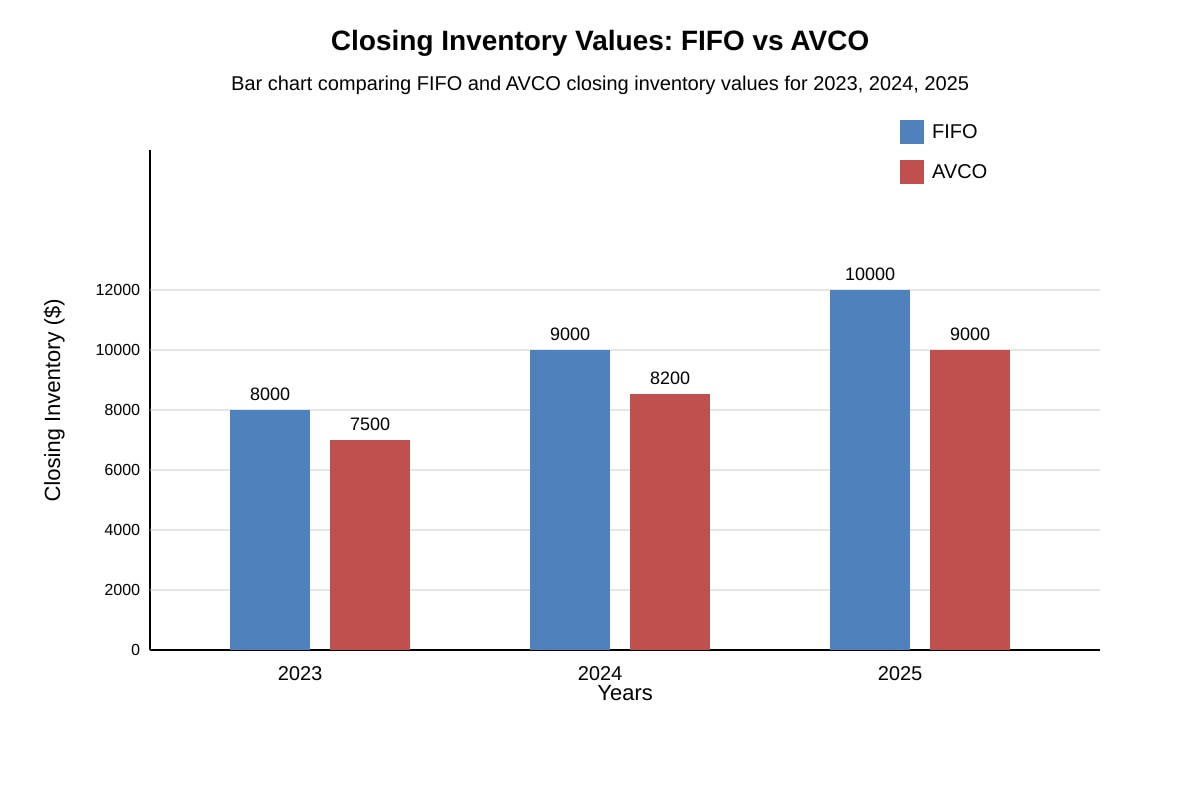
18. The following bar chart shows closing inventory values for a company under FIFO and AVCO over 3 years.
Image pending generation: chart for 18.
Based on the chart, state the trend of FIFO closing inventory compared to AVCO. [1]
19. Given the data in Q18, explain why FIFO closing inventory is consistently higher than AVCO in an inflationary period. [2]
20. A shopkeeper values inventory at selling price. State the accounting error and the correct basis. [1]
Answers
TuitionGoWhere Practice Paper Answers — Principles of Accounts Secondary 4 (Version 2)
Topic: Inventory Costing
Total Marks: 40
Section A Answers (16 marks)
1. [1 mark]
Answer: Lower of cost and net realisable value (NRV).
Teaching note: Prudence concept requires assets not to be overstated. Inventory is recorded at the lower of what it cost or what it can be sold for (NRV).
2. [2 marks]
Answer: Net realisable value is the estimated selling price of inventory minus any costs needed to make the sale (e.g., packaging, transport).
Marking: 1 mark for selling price less costs; 1 mark for clear definition.
Teaching note: NRV shows the cash the business will actually get from the stock.
3. [2 marks]
Working:
COGS = Opening + Purchases + Carriage inwards − Closing
= 4,000 + 26,000 + 1,200 − 5,500 = 25,700Answer:25,700.
Common mistake: Subtracting carriage or adding closing wrongly.
4. [1 mark]
Answer: Profit is overstated by $800.
Teaching note: Overstated closing inventory → lower COGS → higher profit.
5. [1 mark]
Average = (3,000 + 7,000) ÷ 2 = $5,000.
6. [2 marks]
Turnover = COGS ÷ Average Inventory = 60,000 ÷ 12,000 = 5 times.
Answer: 5 times.
7. [2 marks]
Answer: FIFO (First-In-First-Out) assumes the first items bought are the first sold, so closing stock is from latest purchases.
Marking: 1 for definition, 1 for link to closing stock.
8. [2 marks]
Average cost = 2,500 ÷ 100 = $25 per unit.
Section B Answers (14 marks)
9. [3 marks]
FIFO:
- Sold 120: 50 from opening (10) = 500; 70 from 5 Jan (12) = 840.
- Remaining: 30 from 5 Jan (12) = 360; 80 from 20 Jan (14) = 1,120.
Closing = 360 + 1,120 = $1,480.
Marking: 1 for units remaining, 2 for correct valuation.
10. [2 marks]
COGS = 500 + 840 = $1,340.
11. [3 marks]
AVCO: Total cost 2,780/230units=12.087 per unit.
Closing units = 230 − 120 = 110.
Value = 110 × 12.087 = 1,329.57≈1,330.
Marking: 1 avg cost, 1 units, 1 value.
12. [2 marks]
Advantage: FIFO matches older lower costs to COGS, showing higher profit and higher closing inventory in balance sheet during inflation.
13. [2 marks]
After each purchase, total cost ÷ total units available gives new average; it blends old and new costs.
14. [2 marks]
FIFO 1,480>AVCO1,330 because FIFO uses recent higher cost for closing stock.
Section C Answers (10 marks)
15. [2 marks]
Avg inv = (10,000+14,000)/2 = 12,000.
Turnover = 90,000 ÷ 12,000 = 7.5 times.
16. [2 marks]
Avg = (16,000+20,000)/2 = 18,000.
Turnover = 90,000 ÷ 18,000 = 5 times.
Comparison: Year A (7.5) faster than Year B (5).
17. [2 marks]
Lower turnover means stock sits longer → higher storage cost, obsolescence risk, tied-up cash.
18. [1 mark]
FIFO closing inventory is higher than AVCO each year and both rise.
19. [2 marks]
In inflation, recent costs higher; FIFO closing uses recent high cost, AVCO averages down → FIFO higher.
20. [1 mark]
Error: valued at selling price not cost. Correct: lower of cost and NRV.
Free quiz and exam paper access
Enter your details to view this paper
Your access is remembered on this device.