From Real Exams Exam Paper
Secondary 4 Principles of Accounts Semestral Assessment 1 (Mid-Year) Paper 5
Free Sec 4 POA SA1 Paper 5, HY3 Exam version, with questions, answers, and O Level-style practice for Singapore students.
These static practice materials are generated from the site's syllabus and paper-generation workflow, with source and model context shown so students and parents can evaluate the material before use.
Questions
TuitionGoWhere Exam Practice (AI) — SA1 Practice Paper
Principles of Accounts Secondary 4 — Inventory Costing (Version 5 of 5)
School: TuitionGoWhere Secondary School (AI)
Subject: Principles of Accounts
Level: Secondary 4
Paper: SA1 Practice Paper (Version 5)
Duration: 60 minutes
Total Marks: 60
Name: ________________________
Class: ________
Date: ____________
Instructions:
- This paper contains 20 questions across three sections.
- Answer all questions in the spaces provided.
- Show all workings clearly. Method marks are awarded.
- Use the lower of cost and net realisable value basis where inventory valuation is required.
Section A: Inventory Concepts and Errors (Questions 1–5) [10 marks]
1. State the accounting concept that requires inventory to be valued at the lower of cost and net realisable value. [1]
2. Define "net realisable value" of inventory in your own words. [2]
3. Bright Store had closing inventory on 31 Dec 2025 overstated by $800. State the effect of this error on the profit for the year ended 31 Dec 2025. [1]
4. List two items that should be included in the cost of inventory. [2]
5. A business uses FIFO. Explain why FIFO is suitable for a business selling perishable goods. [4]
Section B: Inventory Calculations (Questions 6–13) [24 marks]
6. Calculate cost of sales for the year ended 31 Dec 2025 from the following:
Opening inventory 4,000;Purchases26,000; Closing inventory $5,500. [2]
Working: ________________________________________
Answer: ________________________________________
7. Using the answer from Q6, if revenue was $45,000, calculate gross profit. [2]
Working: ________________________________________
Answer: ________________________________________
8. Compute average inventory given opening inventory 3,200andclosinginventory4,800. [1]
Working: ________________________________________
Answer: ________________________________________
9. Calculate inventory turnover rate for Year 2025: COGS 60,000;Openinginventory7,000; Closing inventory $9,000. [2]
Working: ________________________________________
Answer: ________________________________________
10. The following purchases were made by Lian Hardware:
1 Jan: 100 units @ 515Jan:200units@6
20 Feb: 150 units @ $7
Sales: 250 units in Feb. Using FIFO, calculate cost of goods sold for the 250 units sold. [4]
Working: ________________________________________
Answer: ________________________________________
11. Using AVCO (weighted average) for the same data in Q10, calculate the cost per unit (to 2 decimal places) after all purchases but before sales. [3]
Working: ________________________________________
Answer: ________________________________________
12. A business has opening inventory 2,500,purchases18,000, carriage inwards 500,closinginventory3,000. Calculate COGS. [2]
Working: ________________________________________
Answer: ________________________________________
13. If inventory turnover rate is 6 times and average inventory is $4,000, calculate COGS. [2]
Working: ________________________________________
Answer: ________________________________________
Section C: Interpretation and Structured Response (Questions 14–20) [26 marks]
14. Compare and comment on the inventory turnover of Firm A (8 times) and Firm B (4 times), both in the same retail industry. [3]
15. State how a business should value damaged inventory that cost 1,000butcanonlybesoldfor600 after $50 selling costs. Show the valuation figure. [3]
Working: ________________________________________
Answer: ________________________________________
16. The trial balance of Mega Supplies shows opening inventory 5,000,purchases40,000, closing inventory 6,000,revenue90,000. Prepare the inventory section of the income statement for the year ended 31 Dec 2025. [4]
Working: ________________________________________
Answer: ________________________________________
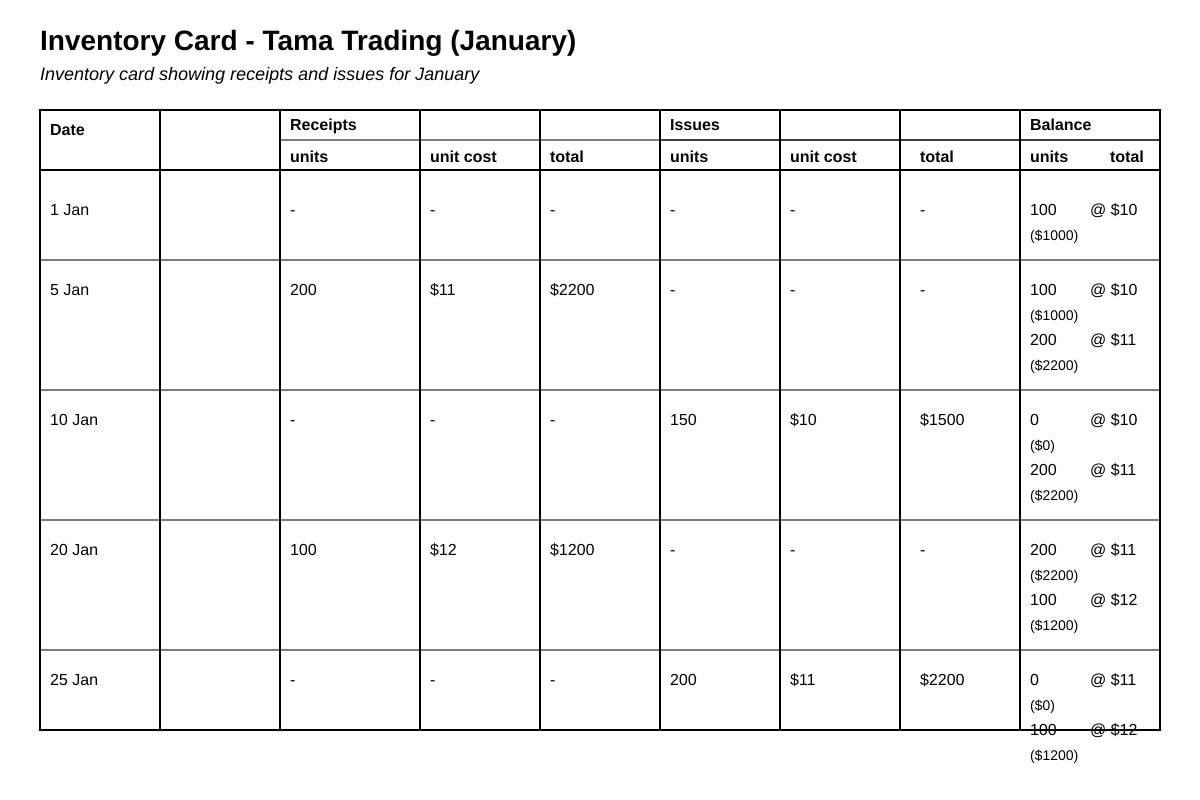
17. An extract from the inventory ledger of Tama Trading is shown below.
Image pending generation: table for 17.
Using FIFO, calculate the closing inventory value at 31 Jan from the card above. [4]
Working: ________________________________________
Answer: ________________________________________
18. Explain why understating closing inventory by $2,000 will understate profit by the same amount. [4]
19. A company can choose FIFO or AVCO. Discuss one advantage and one disadvantage of using AVCO. [4]
20. The following data for two years are given:
Year 1: COGS 50,000,AvgInventory10,000
Year 2: COGS 66,000,AvgInventory11,000
Calculate inventory turnover for both years and comment on the trend. [4]
Working: ________________________________________
Answer: ________________________________________
Comment: ________________________________________
Answers
TuitionGoWhere Exam Practice (AI) — SA1 Practice Paper Answers (Version 5)
Principles of Accounts Secondary 4 — Inventory Costing
Total Marks: 60
Section A Answers (10 marks)
Q1 [1 mark]
Answer: Prudence (or conservatism) concept.
Teaching note: The prudence concept tells us not to overstate assets or profit. Inventory is recorded at lower of cost and NRV so that asset is not overstated.
Q2 [2 marks]
Answer: Net realisable value (NRV) is the estimated selling price of inventory minus any costs needed to make the sale (e.g. selling, distribution costs).
Marking: 1 mark for selling price minus costs; 1 mark for clear definition.
Teaching note: NRV shows what cash the business will actually get from the stock.
Q3 [1 mark]
Answer: Profit is overstated by $800.
Teaching note: COGS = Opening + Purchases − Closing. If closing inventory is overstated, COGS is understated, so profit is overstated.
Q4 [2 marks]
Answer: Any two of: purchase price, carriage inwards, import duties, direct handling costs.
Marking: 1 mark each.
Teaching note: Cost of inventory includes all costs to bring it to saleable condition.
Q5 [4 marks]
Answer: FIFO sells oldest stock first, so perishable goods are issued before they expire; this reduces spoilage and obsolescence; matches physical flow; reduces write-downs.
Marking: 1 mark for FIFO explanation, 3 marks for reasoned links.
Teaching note: FIFO = First-In-First-Out. For perishables, old stock must go first.
Section B Answers (24 marks)
Q6 [2 marks]
Working: COGS = 4,000+26,000 − 5,500=24,500
Answer: $24,500
Teaching note: Formula: Opening + Purchases − Closing.
Q7 [2 marks]
Working: Gross Profit = Revenue − COGS = 45,000−24,500 = 20,500Answer:20,500
Q8 [1 mark]
Working: (3,200+4,800) ÷ 2 = 4,000Answer:4,000
Q9 [2 marks]
Working: Avg Inv = (7,000+9,000) ÷ 2 = 8,000Turnover=60,000 ÷ $8,000 = 7.5 times
Answer: 7.5 times
Q10 [4 marks]
Working (FIFO):
First 100 units @ 5=500
Next 150 units @ 6=900
Total COGS = 500+900 = 1,400Answer:1,400
Marking: 2 marks for layers, 2 for total.
Q11 [3 marks]
Working: Total units = 100+200+150 = 450
Total cost = 500+1,200 + 1,050=2,750
AVCO = 2,750÷450=6.11 (2 dp)
Answer: $6.11
Marking: 1 unit total, 1 cost, 1 division.
Q12 [2 marks]
Working: COGS = 2,500+18,000 + 500−3,000 = 18,000Answer:18,000
Q13 [2 marks]
Working: COGS = Turnover × Avg Inv = 6 × 4,000=24,000
Answer: $24,000
Section C Answers (26 marks)
Q14 [3 marks]
Answer: Firm A turns stock 8 times (faster, less holding cost, better cash flow); Firm B 4 times (slower, more storage, obsolescence risk). Same industry → A more efficient.
Marking: 1 compare, 2 comment.
Q15 [3 marks]
Working: NRV = 600−50 = 550;Cost=1,000 → lower = 550Answer:Valueat550
Marking: 1 NRV, 1 lower, 1 figure.
Q16 [4 marks]
Working:
Opening inventory $5,000
- Purchases 40,000=45,000
− Closing inventory 6,000COGS=39,000
Answer layout:
Revenue 90,000LessCOGS39,000
Gross Profit $51,000
Marking: 2 calc, 2 statement.
Q17 [4 marks]
Expected visual: table with layers as described.
Working (FIFO):
Balance after 10 Jan issue: 150 @ 11(from1Jan100@10 sold, 50 of 5 Jan left) = 1,650;plus200@11? Actually: 1 Jan 100@10, 5 Jan 200@11. Issue 150 → 100@10 + 50@11 sold. Left: 150@11 = 1,650.20Janreceipt100@12→bal150@11+[email protected]Janissue200→150@11+50@12sold.Left:50@12=600.
Answer: $600
Marking: 2 layers, 2 value.
Q18 [4 marks]
Answer: COGS = O + P − C. If C understated by 2,000,COGSoverstatedby2,000, so profit understated by $2,000.
Marking: 2 formula, 2 effect.
Q19 [4 marks]
Answer: Adv: smooths price fluctuations, simple average. Disadv: less matching of physical flow, may hide recent cost changes.
Marking: 2 each.
Q20 [4 marks]
Working: Y1 = 50,000÷10,000 = 5 times; Y2 = 66,000÷11,000 = 6 times.
Comment: Efficiency improved, faster stock movement.
Marking: 1 each calc, 2 comment.
Free quiz and exam paper access
Enter your details to view this paper
Your access is remembered on this device.