From Real Exams Exam Paper
Secondary 4 Principles of Accounts Semestral Assessment 1 (Mid-Year) Paper 4
Free Sec 4 POA SA1 Paper 4, HY3 Exam version, with questions, answers, and O Level-style practice for Singapore students.
These static practice materials are generated from the site's syllabus and paper-generation workflow, with source and model context shown so students and parents can evaluate the material before use.
Questions
TuitionGoWhere Exam Practice (AI) — Principles of Accounts Secondary 4
School: TuitionGoWhere Secondary School (AI)
Subject: Principles of Accounts
Level: Secondary 4
Paper: SA1 Practice Paper (Version 4 of 5)
Duration: 60 minutes
Total Marks: 60
Name: ________________________
Class: ________
Date: ____________
Instructions:
- Answer all questions in the spaces provided.
- Show all workings clearly. Method marks are awarded.
- Use the blank spaces for rough work if needed.
- Write your answers in the units stated.
Section A: Inventory Concepts and Valuation (Questions 1–5) [12 marks]
1. State the accounting basis used to value inventory at the end of a financial period. [1]
2. Explain the concept of "lower of cost and net realisable value" and why it is used. [3]
3. A shop owner found that 10 packets of biscuits were damaged and cannot be sold. State how these should be treated in inventory valuation. [1]
4. Calculate the net realisable value (NRV) of an item with estimated selling price 80andestimatedcoststosell12. [2]
5. "Inventory should always be valued at its original purchase cost." State whether this statement is true or false and give a reason. [2]
Section B: Inventory Calculations (Questions 6–12) [24 marks]
6. Calculate cost of sales for the year ended 31 Dec 2025 from the following:
Opening inventory 4,000;Purchases22,000; Closing inventory $5,500. [2]
7. Using the data below, calculate cost of sales:
Opening inventory 3,200;Purchases18,500; Carriage inwards 300;Purchasesreturns700; Closing inventory $2,800. [3]
8. Compute average inventory if opening inventory is 6,000andclosinginventoryis8,000. [1]
9. Calculate inventory turnover rate for the year ended 31 Dec 2025:
COGS 60,000;Openinginventory7,000; Closing inventory $9,000. [2]
10. The following purchases of Product X were made:
1 Jan: 100 units @ 515Jan:200units@6
28 Feb: 150 units @ $7
Sales during period: 300 units. Using FIFO, calculate the value of closing inventory. [4]
11. Using the same data as Q10, calculate closing inventory value using AVCO (weighted average cost, rounded to 2 decimal places). [4]
12. A business had closing inventory overstated by $2,000. State the effect on profit for the year. [1]
Section C: Analysis and Interpretation (Questions 13–17) [14 marks]
13. Compare and comment on the inventory turnover of Company A (8 times) and Company B (4 times). [3]
14. From the table below, calculate inventory turnover for both years and state the trend. [4]
| Year | COGS ($) | Opening Inv ($) | Closing Inv ($) |
|---|---|---|---|
| 2024 | 50,000 | 5,000 | 7,000 |
| 2025 | 66,000 | 7,000 | 9,000 |
15. Explain how using FIFO instead of AVCO during rising prices affects reported profit. [3]
16. A trader uses AVCO. At start: 50 units @ 10.Bought50units@12. Sold 60 units. Calculate COGS using AVCO. [3]
17. State two reasons why a business should control its inventory levels. [1]
Section D: Integrated Application (Questions 18–20) [10 marks]
18. The following is a summary of inventory records for MegaStore:
Opening inventory 10,000;Purchases70,000; Sales $120,000; Gross profit margin 40%; Closing inventory is unknown.
(a) Calculate COGS using gross profit margin. [2]
(b) Calculate closing inventory. [1]
19. Using the data from Q18, if the closing inventory was accidentally recorded as $5,000 instead of the correct figure, state the effect on gross profit and explain why. [3]
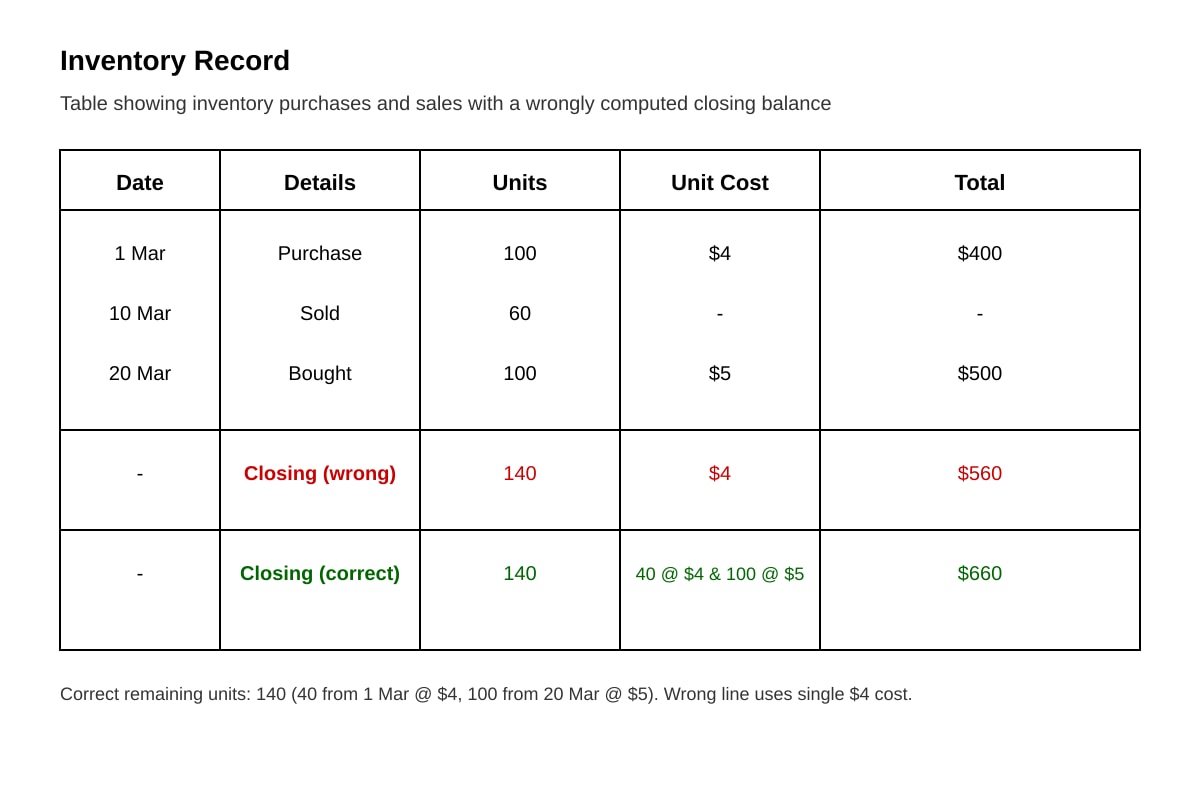
20. A student prepared the following inventory record. Identify the error in the closing inventory calculation.
Image pending generation: table for Q20.
State the mistake and the correct closing inventory value. [4]
End of Paper — Total Marks: 60
Answers
TuitionGoWhere Exam Practice (AI) — Principles of Accounts Secondary 4
SA1 Practice Paper Version 4 — Answer Key
Section A: Inventory Concepts and Valuation
1. [1 mark]
Answer: Lower of cost and net realisable value (NRV).
Teaching note: Inventory is never shown above what it can be sold for, to avoid overstating assets.
2. [3 marks]
Answer:
- Basis: inventory is valued at lower of cost or NRV. (1)
- Cost = purchase price + costs to bring to saleable condition. (1)
- NRV = selling price − costs to sell. We use lower figure for prudence. (1)
Teaching note: Prudence concept stops businesses from overstating profit/assets.
3. [1 mark]
Answer: Exclude from inventory (or value at NRV 0ifnotsaleable).Teachingnote:DamagedgoodsnotsaleablehaveNRV0, so not counted as asset.
4. [2 marks]
NRV = 80−12 = $68. (2 for working + answer)
Teaching note: NRV formula subtracts selling costs from selling price.
5. [2 marks]
Answer: False. (1) Because if NRV is lower than cost, we must use NRV (prudence). (1)
Section B: Inventory Calculations
6. [2 marks]
COGS = 4,000 + 22,000 − 5,500 = $20,500. (2)
Working: Open + Pur − Close.
7. [3 marks]
Net purchases = 18,500 − 700 = 17,800. (1)
Add carriage = 17,800 + 300 = 18,100. (1)
COGS = 3,200 + 18,100 − 2,800 = $18,500. (1)
8. [1 mark]
Average = (6,000 + 8,000) ÷ 2 = $7,000.
9. [2 marks]
Avg inv = (7,000 + 9,000) ÷ 2 = 8,000. (1)
Turnover = 60,000 ÷ 8,000 = 7.5 times. (1)
10. [4 marks]
FIFO: sold 300 from earliest: 100 @5 + 200 @6 = 500+1,200 = 1,700 cost of sales.
Remaining: 0 from first two, 150 @7 = $1,050. (4 for correct closing value)
Teaching: FIFO uses oldest cost first for COGS, newest for closing.
11. [4 marks]
Total units = 450, total cost = 500+1,200+1,050 = 2,750.
AVCO = 2,750 ÷ 450 = 6.11(2dp).(2)Remaining150units×6.11=916.67. (2)
12. [1 mark]
Profit understated by $2,000. (Overstated closing inv → lower COGS → higher profit; so reverse)
Section C: Analysis and Interpretation
13. [3 marks]
A turns stock 8 times (faster, less holding cost). (1) B 4 times (slower). (1) A more efficient working capital use. (1)
14. [4 marks]
2024 avg = 6,000; TO = 50,000/6,000 = 8.33 times. (2)
2025 avg = 8,000; TO = 66,000/8,000 = 8.25 times. (2)
Trend: slight decrease in efficiency.
15. [3 marks]
FIFO uses older lower cost → COGS lower → profit higher. (2) AVCO smooths cost → moderate profit. (1)
16. [3 marks]
Avg = (50×10 + 50×12)/100 = 11.(1)COGS=60×11=660. (2)
17. [1 mark]
Any two: avoid obsolescence, reduce storage cost, improve cash flow.
Section D: Integrated Application
18. [3 marks]
(a) COGS = 120,000 × (1 − 0.40) = 72,000.(2)(b)Closing=10,000+70,000−72,000=8,000. (1)
19. [3 marks]
Recorded closing 5,000→COGShigherby3,000 → gross profit understated $3,000. (3)
20. [4 marks]
Mistake: used 4forall140unitsbut40boughtat5. (2)
Correct: 100 @4 = 400 + 40 @5 = 200 → $600. (2)
Image must show table with mixed cost lines.
Total Marks: 60 — End of Answer Key
Free quiz and exam paper access
Enter your details to view this paper
Your access is remembered on this device.