From Real Exams Exam Paper
Secondary 4 Principles of Accounts Semestral Assessment 1 (Mid-Year) Paper 3
Free Sec 4 POA SA1 Paper 3, HY3 Exam version, with questions, answers, and O Level-style practice for Singapore students.
These static practice materials are generated from the site's syllabus and paper-generation workflow, with source and model context shown so students and parents can evaluate the material before use.
Questions
TuitionGoWhere Exam Practice (AI) — Principles of Accounts Secondary 4
School: TuitionGoWhere Secondary School (AI)
Subject: Principles of Accounts
Level: Secondary 4
Paper: SA1 Practice Paper (Version 3 of 5)
Duration: 60 minutes
Total Marks: 60
Name: ___________________________
Class: ________
Date: ____________
Instructions:
- This paper contains 20 questions on Inventory Costing.
- Answer all questions in the spaces provided.
- Show all workings clearly. Method marks are awarded.
- Use the lower of cost and net realisable value basis where required.
Section A: Basic Concepts and Errors (Questions 1–5) [12 marks]
1. State the basis on which inventory should be valued according to the prudence concept. [1]
2. Jasmine Trading's closing inventory on 31 Dec 2025 was overstated by $800. State the effect of this error on the profit for the year ended 31 Dec 2025. [1]
3. Give one reason why a business uses the FIFO method for inventory costing. [1]
4. Explain what is meant by "net realisable value" of inventory. [2]
5. A shop owner counted inventory before goods sold on 30 Jun 2025 were delivered. The goods were still in the warehouse. Should these goods be included in closing inventory? State yes or no and give a reason. [2]
Section B: Calculations — COGS and Inventory Turnover (Questions 6–11) [18 marks]
6. Calculate the cost of sales for Ravi Store for the year ended 31 Mar 2025 using the following:
- Opening inventory: $4,200
- Purchases: $28,500
- Closing inventory: $3,900 [2]
Working:
Answer: $__________
7. Using the answer from Q6, if average inventory is $4,050, calculate inventory turnover rate. [2]
Working:
Answer: __________ times
8. Lina Pet Supplies has the following:
- Opening inventory (1 Apr 2025): $6,000
- Purchases (net): $40,000
- Carriage inwards: $1,000
- Closing inventory (31 Mar 2026): $5,500
Calculate cost of sales. [2]
Working:
Answer: $__________
9. From Q8, calculate inventory turnover rate if average inventory = $5,750. [2]
Working:
Answer: __________ times
10. Compare the inventory turnover of Ravi Store (from Q7) and Lina Pet Supplies (from Q9). State which is more efficient. [3]
11. Mei Hardware had opening inventory 9,000,closinginventory7,000, purchases 52,000,carriageinwards2,000. Calculate cost of sales and inventory turnover (average inventory = $8,000). [3]
Working for COGS:
Working for turnover:
Answers: COGS $__________, Turnover __________ times
Section C: FIFO and AVCO Methods (Questions 12–16) [18 marks]
12. The following purchases were made by Cool Drinks Co:
- 1 Jan: 100 units @ $5
- 15 Jan: 200 units @ $6
- 20 Jan: 150 units @ $7
On 31 Jan, 300 units were sold. Using FIFO, calculate the cost of closing inventory. [3]
Working:
Answer: $__________
13. Using the same data as Q12, calculate cost of goods sold under FIFO. [2]
Working:
Answer: $__________
14. Using AVCO (weighted average) for the data in Q12, calculate the average cost per unit (round to 2 decimal places). [3]
Working:
Answer: $__________ per unit
15. From Q14, calculate closing inventory value under AVCO if 300 units sold. [2]
Working:
Answer: $__________
16. Explain one effect on reported profit when prices are rising and a business switches from FIFO to AVCO. [3]
Section D: Valuation, Analysis and Interpretation (Questions 17–20) [12 marks]
17. State how Tan Electrics should value inventory that cost 2,000butcanonlybesoldfor1,500 after $200 selling costs. Show the NRV calculation. [3]
Working for NRV:
Value to use: $__________
18. The following table shows inventory figures:
| Business | COGS | Avg Inventory |
|---|---|---|
| A | $50,000 | $10,000 |
| B | $80,000 | $20,000 |
Calculate and compare their inventory turnover rates. [3]
Working:
Comment:
19. Ben's Bookstore discovered closing inventory was understated by $1,200 in 2025. State the effect on 2025 profit and on 2026 profit (assuming error not corrected before 2026 accounts). [2]
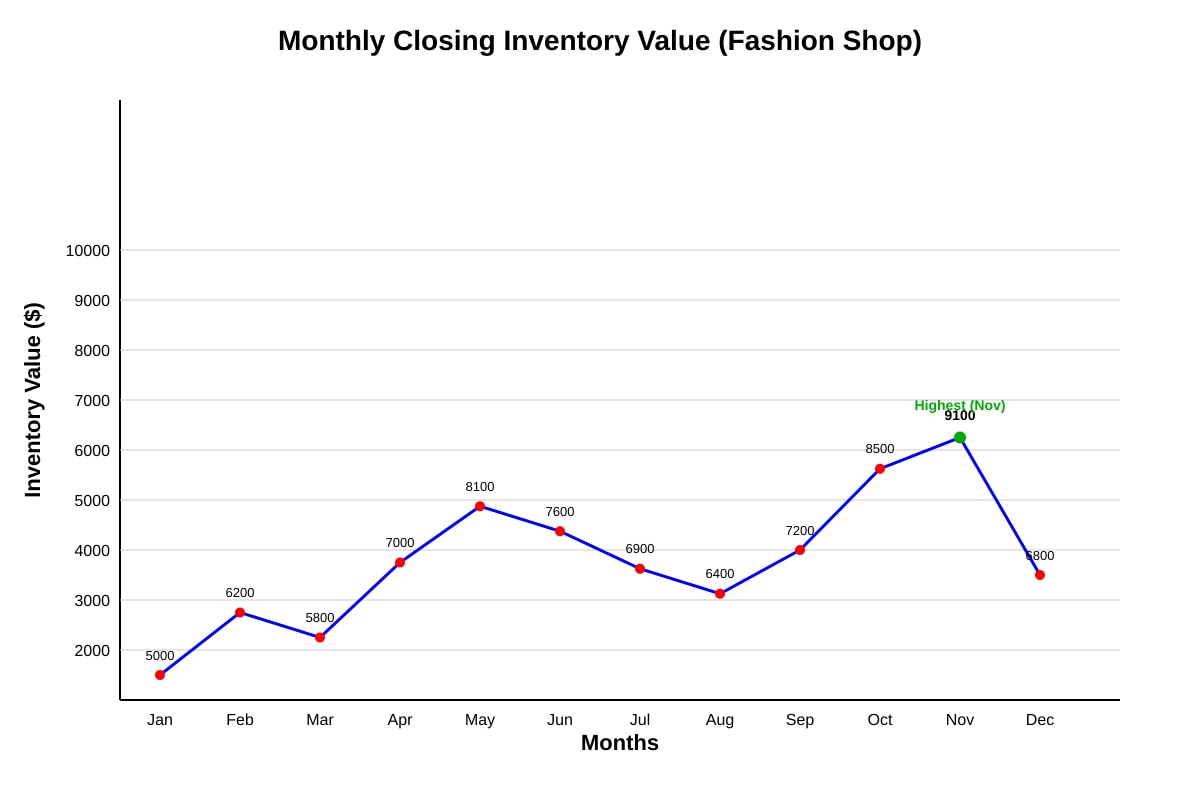
20. A chart shows monthly inventory levels for a fashion shop.
Image pending generation: graph for Q20.
Using the graph, state the month with highest inventory and suggest one reason for the December drop. [4]
End of Paper — Total Marks: 60
Answers
TuitionGoWhere Exam Practice (AI) — Principles of Accounts Secondary 4
SA1 Practice Paper Version 3 — Answer Key
Total Marks: 60
Section A: Basic Concepts and Errors
1. [1 mark]
Answer: Lower of cost and net realisable value (NRV).
Teaching note: Inventory must not be overstated. Prudence means we choose the lower of what it cost us or what we can sell it for (minus costs to sell).
2. [1 mark]
Answer: Profit is overstated by $800.
Teaching note: Closing inventory is subtracted in COGS. If closing inventory is too high, COGS is too low, so profit is too high.
3. [1 mark]
Answer: It assumes oldest items are sold first, matching actual flow for perishable goods / simplest to apply. (Any one valid reason)
Teaching note: FIFO = First In First Out. Common in businesses with perishable stock.
4. [2 marks]
Answer: NRV = estimated selling price − estimated costs to sell (e.g. marketing, delivery). [1] It is the amount the business expects to receive from selling the inventory. [1]
Teaching note: This prevents overstating assets.
5. [2 marks]
Answer: Yes [1], because goods sold but not yet delivered still belong to the seller until delivered (ownership not transferred). [1]
Teaching note: Inventory includes goods owned by the business even if not physically moved.
Section B: Calculations — COGS and Inventory Turnover
6. [2 marks]
COGS = Opening + Purchases − Closing
= 4,200 + 28,500 − 3,900 = $28,800 [2]
Teaching note: No carriage given, so ignore.
7. [2 marks]
Turnover = COGS ÷ Avg Inv = 28,800 ÷ 4,050 = 7.11 times [2]
Teaching note: Round to 2 dp acceptable.
8. [2 marks]
COGS = 6,000 + 40,000 + 1,000 − 5,500 = $41,500 [2]
9. [2 marks]
Turnover = 41,500 ÷ 5,750 = 7.22 times [2]
10. [3 marks]
Ravi = 7.11, Lina = 7.22 [1]. Lina is slightly more efficient (higher turnover) [1]. Means stock sells slightly faster, lower holding cost [1].
11. [3 marks]
COGS = 9,000 + 52,000 + 2,000 − 7,000 = $56,000 [2]
Turnover = 56,000 ÷ 8,000 = 7.00 times [1]
Section C: FIFO and AVCO Methods
12. [3 marks]
Total units = 450. Sold 300, so 150 left. FIFO: remaining from latest batch (150 @ 7)=1,050 [3]
Teaching note: 100@5 + 200@6 sold first.
13. [2 marks]
COGS = (100×5)+(200×6) = 500+1,200 = $1,700 [2]
14. [3 marks]
Total cost = 500+1,200+1,050 = 2,750;totalunits450.Avg=2,750÷450=6.11 [3]
15. [2 marks]
Closing units = 150. 150 × 6.11 = $916.50 [2]
16. [3 marks]
When prices rise, AVCO gives lower COGS than FIFO [1], so reported profit is lower [1]. This is more prudent [1].
Section D: Valuation, Analysis and Interpretation
17. [3 marks]
NRV = 2,000 selling − 200 costs = 1,800?Waitcost2,000, NRV = 1,500 − 200 = 1,300[1].Lower=1,300 [2].
Teaching note: Use NRV = 1,500 − 200 = 1,300; cost 2,000; lower is 1,300.
18. [3 marks]
A: 50,000÷10,000 = 5 times [1]
B: 80,000÷20,000 = 4 times [1]
A more efficient (higher turnover) [1].
19. [2 marks]
2025 profit understated by 1,200[1];2026profitoverstatedby1,200 (opening too low) [1].
20. [4 marks]
Highest: November ($9,100) [2]. Dec drop due to post-peak season sales / clearance before year-end [2].
Free quiz and exam paper access
Enter your details to view this paper
Your access is remembered on this device.