From Real Exams Exam Paper
Secondary 4 Principles of Accounts Semestral Assessment 1 (Mid-Year) Paper 2
Free Sec 4 POA SA1 Paper 2, HY3 Exam version, with questions, answers, and O Level-style practice for Singapore students.
These static practice materials are generated from the site's syllabus and paper-generation workflow, with source and model context shown so students and parents can evaluate the material before use.
Questions
TuitionGoWhere Exam Practice (AI) — SA1 Practice Paper
Principles of Accounts Secondary 4 — Inventory Costing (Version 2 of 5)
School: TuitionGoWhere Secondary School (AI)
Subject: Principles of Accounts
Level: Secondary 4
Paper: SA1 Practice (Version 2)
Duration: 60 minutes
Total Marks: 60
Name: ______________________
Class: ____________
Date: ____________
Instructions:
- This paper contains 20 questions on Inventory Costing.
- Show all workings clearly. Method marks are awarded.
- Write your answers in the spaces provided.
- Use the lower of cost and net realisable value basis where required.
Section A: Fundamentals of Inventory Costing (Questions 1–5) — 12 marks
1. State the accounting concept that governs how inventory should be valued at the end of a financial period. (1 mark)
2. Define "net realisable value" of inventory in your own words. (2 marks)
3. Calculate the cost of sales for the year ended 31 December 2025 from the following:
- Opening inventory: $8,400
- Credit purchases: $52,000
- Purchases returns: $2,000
- Carriage inwards: $1,200
- Closing inventory: $9,100
(2 marks)
Working: ______________________________________________
Answer: ______________________________________________
4. A trader's closing inventory was overstated by $3,000. State the effect of this error on the reported profit for the year. (1 mark)
5. Explain why inventory is recorded as a current asset in the Statement of Financial Position. (2 marks)
6. Given the following inventory records, calculate the value of closing inventory using the FIFO method:
- 1 Jan: 100 units @ $5.00
- 15 Jan: 200 units @ $5.50
- 20 Feb: sold 150 units
- 10 Mar: 150 units @ $6.00
- 25 Mar: sold 200 units
(2 marks)
Working: ______________________________________________
Answer: ______________________________________________
Section B: FIFO and AVCO Methods (Questions 7–12) — 16 marks
7. Using the data in Question 6, calculate closing inventory value using the AVCO (weighted average cost) method, applied at each purchase. (3 marks)
Working: ______________________________________________
Answer: ______________________________________________
8. Compare FIFO and AVCO in terms of the value of closing inventory during a period of rising prices. (2 marks)
9. Compute the cost of goods sold for the transactions below using FIFO:
- Opening: 50 units @ $10
- Purchase: 100 units @ $12
- Sale: 120 units
- Purchase: 80 units @ $14
- Closing: 110 units
(3 marks)
Working: ______________________________________________
Answer: ______________________________________________
10. A company uses AVCO. Opening inventory 200 units @ 4.00.Purchase300units@4.40. Sale 250 units. Purchase 100 units @ $4.60. Calculate the cost of the 350 units remaining. (3 marks)
Working: ______________________________________________
Answer: ______________________________________________
11. State one reason why a business might prefer FIFO over AVCO for reporting. (1 mark)
12. Explain the effect of using FIFO (instead of AVCO) on gross profit when prices are increasing. (2 marks)
Section C: Inventory Turnover and Analysis (Questions 13–17) — 16 marks
13. Calculate the inventory turnover rate for Joo Leong Traders for the year ended 31 Dec 2025:
- COGS: $120,000
- Opening inventory: $18,000
- Closing inventory: $22,000
(2 marks)
Working: ______________________________________________
Answer: ______________________________________________ times
14. Compare the inventory turnover of Firm A (8 times) and Firm B (4 times). Comment on efficiency. (3 marks)
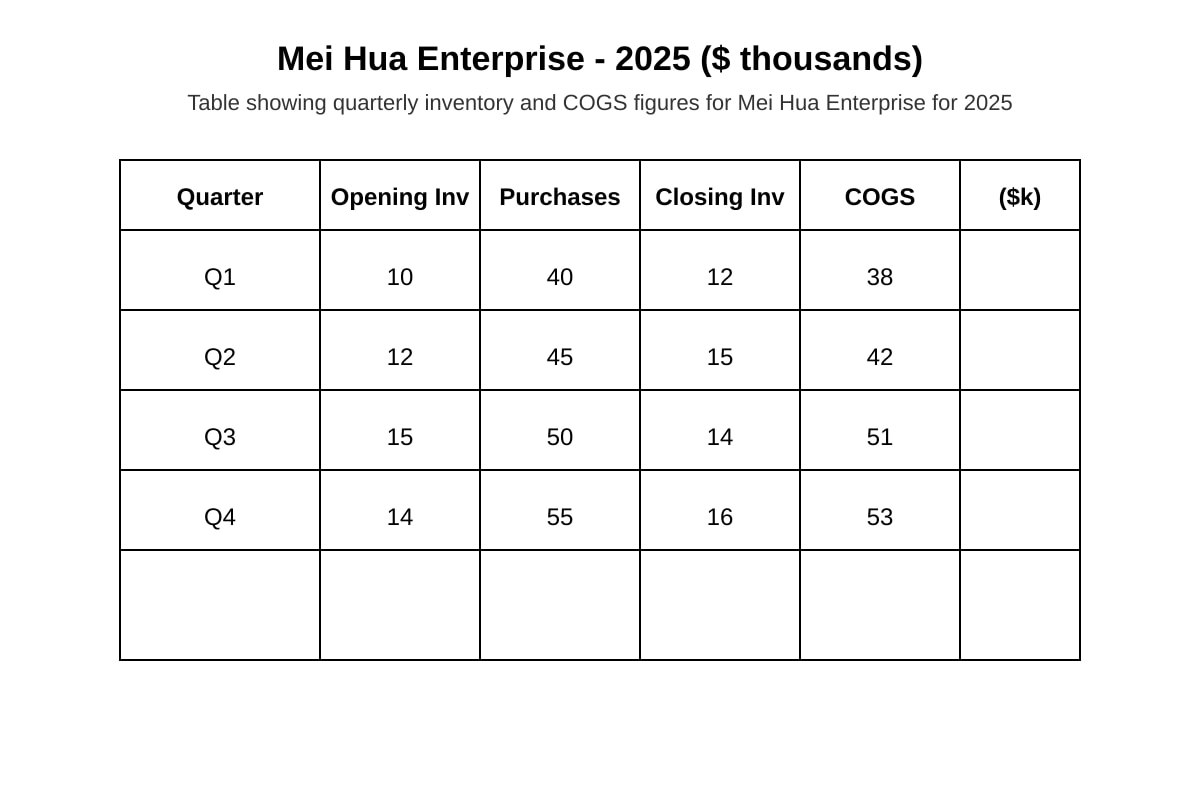
15. The following extract is from the records of Mei Hua Enterprise:
Image pending generation: table for 15.
Using the table, calculate the average inventory for the year and the annual inventory turnover. (3 marks)
Working: ______________________________________________
Answer: Avg Inv ________ ; Turnover ________ times
16. An error caused closing inventory to be understated by $5,000. State the effect on inventory turnover ratio. (2 marks)
17. Explain how a high inventory turnover rate may indicate both good and bad business outcomes. (3 marks)
Section D: Integrated Application (Questions 18–20) — 16 marks
18. Hup Chuan Stores provided:
- Sales: $200,000
- Opening inventory: $20,000
- Purchases: $140,000
- Closing inventory: $30,000 Calculate gross profit and inventory turnover. (4 marks)
Working: ______________________________________________
Answer: GP ________ ; Turnover ________ times
19. A fire destroyed part of inventory. Opening 15,000,purchases90,000, sales $160,000, normal gross profit margin 25%. Estimate closing inventory. (4 marks)
Working: ______________________________________________
Answer: ______________________________________________
20. "Lower of cost and NRV prevents overstatement of profit." Explain this statement with an inventory example of damaged goods costing 1,000,NRV600. (4 marks)
END OF PAPER
Answers
TuitionGoWhere Exam Practice (AI) — SA1 Practice Paper (Version 2)
Principles of Accounts Secondary 4 — Inventory Costing: Answer Key
Total Marks: 60
Section A Answers (12 marks)
Q1 (1 mark): Prudence concept (or conservatism).
Teaching note: Inventory must not be overstated; prudence means recognizing losses early.
Q2 (2 marks): Net realisable value = estimated selling price minus estimated costs to complete and sell.
Marking: 1 mark definition of selling price less cost; 1 mark mention of costs to sell.
Q3 (2 marks):
COGS = 8,400 + (52,000 − 2,000) + 1,200 − 9,100 = $50,500
Working: Open 8,400 + Net Pur 50,000 + Carriage 1,200 = 59,600 − Close 9,100.
Common mistake: adding purchases returns instead of deducting.
Q4 (1 mark): Profit is overstated by $3,000.
Reason: Overstated closing inventory reduces COGS, increasing profit.
Q5 (2 marks): Inventory is owned, expected to be sold within 12 months → current asset.
Marking: 1 mark ownership/expected sale; 1 mark current (within year).
Q6 (2 marks): FIFO: remaining 100 units from 10 Mar @ 6=600.
Working: Sold 150 (100@5,[email protected]), sold 200 ([email protected],50@6). Left: 100@6.
Section B Answers (16 marks)
Q7 (3 marks):
After 15 Jan avg = (500+1100)/300=5.333.Aftersale150left[email protected]Maravg=(800+900)/250=6.80. After sale 200 left [email protected].
Closing: [email protected] +150@6 = 340+900=$1,240.
Marking: 1 each for averages and final.
Q8 (2 marks): FIFO gives higher closing inventory and lower COGS in rising prices. AVCO smooths cost.
Q9 (3 marks): COGS: 50@10 +70@12 = 500+840=1,340.Closing110(30@12+80@14)=1,640.
Marking: 1 method, 2 answer.
Q10 (3 marks): Avg1=(800+1320)/500=4.24.Aftersale[email protected]left250.Avg2=(1060+460)/350=4.457. 350×4.457=$1,560.
Marking: steps 2, final 1.
Q11 (1 mark): Matches physical flow / simpler.
Q12 (2 marks): FIFO uses older lower costs → lower COGS → higher gross profit when prices rise.
Section C Answers (16 marks)
Q13 (2 marks): Avg Inv = (18+22)/2=20k. Turnover=120/20=6 times.
Q14 (3 marks): A turns faster → more efficient, lower holding cost. B slower → possible overstock. Context needed.
Marking: compare 1, efficiency 1, caution 1.
Q15 (3 marks): Avg inv = (10+12+15+14+16)/5? Use year avg = (10+16)/2=13k or qtr avg 13k. Turnover = total COGS 184k /13k =14.15.
From table: COGS sum=38+42+51+53=184. Avg=(10+16)/2=13.
Marking: avg 1, turnover 2.
Q16 (2 marks): Understated closing inv → higher COGS → lower avg inv → turnover overstated (too high).
Q17 (3 marks): Good: liquid, less obsolescence. Bad: stockouts, lost sales.
Marking: each point 1.5.
Section D Answers (16 marks)
Q18 (4 marks): COGS=20+140−30=130k. GP=200−130=70k. Avg inv=25k. Turn=200? COGS/avg=130/25=5.2.
Marking: COGS1 GP1 Turn2.
Q19 (4 marks): COGS = 160×75% =120k. Closing =15+90−120=−15 → est 0 (or loss). Actually 15+90=105; 105−120=−15 impossible → fire loss 15k. Closing est $0.
Marking: margin1 COGS1 calc1 ans1.
Q20 (4 marks): Cost 1000 NRV 600 → value at 600. Loss 400 recognized. Prevents overstating asset/profit.
Marking: basis1 amount1 effect1 explain1.
END OF ANSWER KEY
Free quiz and exam paper access
Enter your details to view this paper
Your access is remembered on this device.