AI Generated Quiz
Secondary 4 History Singapore Southeast Asia Quiz
Free Sec 4 History Singapore SEA quiz, Qwen3.6 AI version, with questions, answers, and O Level-style practice for Singapore students.
These static practice materials are generated from the site's syllabus and paper-generation workflow, with source and model context shown so students and parents can evaluate the material before use.
Questions

Free quiz and exam paper access
Enter your details to view this paper
Your access is remembered on this device.
Answers
Secondary 4 History Quiz - Singapore Southeast Asia (Answer Key)
Topic: Singapore and Southeast Asia (British Malaya Case Study)
Total Marks: 40
Section A: Extension of European Control
1. Explain two reasons why the British intervened in Perak in the 1870s. [4]
Marking: 2 marks per reason (1 mark for identification, 1 mark for explanation).
- Reason 1: Protection of Economic Interests/Tin Trade. The Larut Wars (conflicts between Chinese secret societies) disrupted tin mining production. Since tin was a major export for the Straits Settlements (Singapore/Penang), the British merchants suffered financial losses and pressured the government to intervene to restore order and secure revenue.
- Reason 2: Political Instability/Succession Dispute. There was a dispute over the succession of the Perak throne between Raja Abdullah and Raja Ismail. This created a power vacuum and lawlessness. The British used the Pangkor Engagement (1874) to resolve the dispute by recognizing Raja Abdullah as Sultan in exchange for accepting a British Resident, thereby extending political control.
2. Explain why the Malay rulers initially resisted the introduction of the Residential System. [2]
- They feared losing their traditional power and authority. Under the Residential System, the Sultan had to consult the British Resident on all matters except religion and custom, effectively reducing the Sultan to a figurehead while the Resident held real administrative power.
3. What does Source A tell you about the motives of British merchants in the Straits Settlements? [2]
- It tells us that their primary motive was economic profit. The merchant complains that "chaos" is "ruining our trade" and causing "tin prices to fluctuate."
- It shows they viewed British political intervention as a means to secure their business interests ("We cannot make a profit if... Government does not step in").
4. How did the introduction of the Residential System change the power of the Malay Sultans? [2]
- Their power was significantly reduced. They retained authority only over matters of Malay religion and custom.
- All other administrative, legal, and financial matters required the advice and consent of the British Resident, who effectively controlled the state administration.
5. Explain one social impact of British colonial rule on the population of Malaya. [2]
- Development of a Plural Society: British economic policies (tin mining and rubber plantations) led to mass migration of Chinese and Indian laborers. This changed the demographic makeup of Malaya, creating a multi-ethnic society where different races lived side-by-side but often in separate economic and social spheres.
6. What does Source B suggest about the social hierarchy in colonial Malaya? [2]
- It suggests a racial and economic hierarchy. The European manager lives in a superior position (bungalow on the hill), overseeing the laborers.
- It implies that Europeans held positions of authority and wealth, while the local/migrant workers performed the manual labor, reflecting the colonial structure of command.
7. Why was the Federated Malay States (FMS) formed in 1896? [2]
- To centralize administration and reduce costs. The four states (Perak, Selangor, Negeri Sembilan, Pahang) had similar problems and inefficient separate administrations.
- To ensure uniformity in laws, infrastructure development, and economic policies, making it easier for the British to manage the region and attract investment.
8. Explain how the development of infrastructure (roads and railways) benefited the British economy in Malaya. [2]
- It facilitated the efficient transport of raw materials (tin and rubber) from the interior mines/plantations to the ports for export.
- This reduced transport costs and time, increasing the profitability of British commercial enterprises in Malaya.
Section B: The Japanese Occupation
9. Explain why the British surrender in Singapore in 1942 was considered a shock. [2]
- The British had portrayed Singapore as an "impregnable fortress" and a symbol of British military superiority.
- The rapid defeat by the Japanese shattered the myth of European invincibility, causing the local population to lose confidence in British ability to protect them.
10. How useful is Source C to a historian studying the impact of the Japanese Occupation on the Chinese community? [3]
- Useful for Content: It provides firsthand evidence of the fear and persecution faced by the Chinese. It mentions the separation of men (Sook Ching screenings) and the arbitrary arrest of "anti-Japanese elements," which aligns with historical records of the purge.
- Limitation (Provenance/Perspective): It is a personal diary of one individual (a schoolteacher). It reflects his personal trauma and may not represent the experience of all Chinese (e.g., those who collaborated or lived in rural areas). It is subjective and emotional.
- Conclusion: It is useful for understanding the personal impact and atmosphere of terror, but should be cross-referenced with official records or other accounts for a broader picture.
11. Explain one way in which the Japanese Occupation changed the attitudes of Malays towards the British. [2]
- Malays realized the British could not protect them. The swift defeat showed that British power was limited.
- This led to a rise in Malay nationalism and a desire for self-determination, as they no longer viewed British rule as permanent or benevolent. Some Malays also collaborated with the Japanese, hoping for greater political recognition.
12. Why did the Japanese promote the slogan "Asia for Asians"? [2]
- To gain local support and legitimacy for their occupation. By positioning themselves as liberators from Western colonialism, they hoped to reduce resistance.
- To justify their imperialist expansion and resource extraction under the guise of the "Greater East Asia Co-Prosperity Sphere," masking their true intent of exploiting Southeast Asian resources for Japan’s war effort.
Section C: Decolonisation
13. Explain why the Malayan Union proposal of 1946 was strongly opposed by the Malays. [2]
- It threatened the sovereignty of the Malay Sultans, who were reduced to figureheads with power transferred to a British Governor.
- It offered liberal citizenship terms (jus soli) to non-Malays (Chinese and Indians), which Malays feared would dilute their political dominance and special position in their own land.
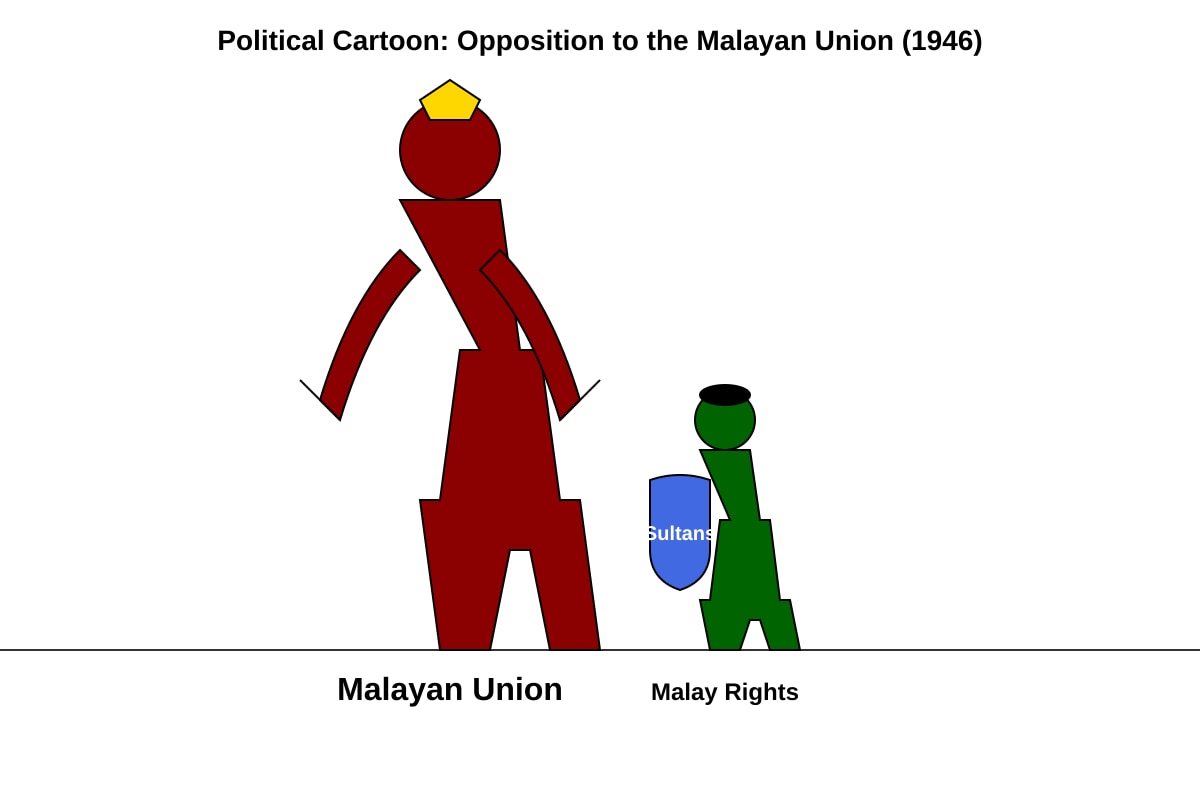
14. What is the message of Source D regarding the Malayan Union? [2]
- The cartoon conveys that the Malayan Union was a threat to Malay rights and the Sultans.
- It depicts the Union as an aggressive force ("crushing") that disregards traditional Malay authority, reflecting the strong opposition and fear among the Malay community at the time.
15. Explain two reasons why the British replaced the Malayan Union with the Federation of Malaya in 1948. [4]
- Reason 1: Strong Malay Opposition. The United Malays National Organisation (UMNO), led by Onn Jaafar, mobilized massive protests against the Malayan Union. The British realized they could not govern effectively without Malay cooperation.
- Reason 2: Need for Stability/Counter Communism. With the rise of communist threats, the British needed a stable political environment. By restoring the Sultans' prestige and tightening citizenship requirements (protecting Malay special rights), they secured Malay loyalty and isolated the communists, who largely drew support from the Chinese community.
16. Why did the British declare a State of Emergency in Malaya in 1948? [2]
- The Malayan Communist Party (MCP) launched an armed insurgency, attacking rubber estates and tin mines to disrupt the economy and overthrow the colonial government.
- The British needed emergency powers (detention without trial, curfews, forced resettlement) to combat the guerrilla tactics of the communists, which ordinary laws could not handle effectively.
17. Explain how the "Hearts and Minds" strategy helped the British defeat the Communist insurgency. [2]
- It involved winning the support of the rural population (squatters) who were the main source of supplies and information for the communists.
- By providing land titles, education, and medical care in the New Villages (where squatters were resettled), the British cut off the communists' supply lines and intelligence network, isolating the guerrillas in the jungle.
18. What does Source E suggest about the approach of the Alliance Party towards independence? [2]
- It suggests a approach based on multi-racial cooperation and moderation. Tunku Abdul Rahman emphasizes representing "Malays, Chinese, and Indians" together.
- It indicates a preference for negotiation and constitutional means ("not through violence") to achieve independence, reassuring the British that the transition of power would be stable.
19. Explain why the formation of the Alliance Party was significant for Malaya’s journey to Merdeka. [2]
- It demonstrated to the British that the different ethnic groups could work together politically, addressing British concerns that independence would lead to racial conflict.
- It provided a unified moderate voice that could negotiate effectively with the British, contrasting with the radical/communist alternatives, thus accelerating the timeline for independence.
20. "The Malayan Emergency was the main reason why Malaya achieved independence in 1957." How far do you agree? [4]
- Agree (Emergency as Catalyst): The Emergency forced the British to realize that military victory alone was impossible without political legitimacy. To defeat the communists (who claimed to fight for independence), the British had to prove they were genuine about granting independence. This led to the formation of the Alliance Party and the acceleration of constitutional talks.
- Disagree (Other Factors): The rise of nationalism and the formation of strong political parties (UMNO, MCA, MIC) were crucial. The Alliance Party’s electoral victory in 1955 gave them the mandate to negotiate. Also, post-WWII global trends (decline of European empires, UN pressure) made decolonisation inevitable regardless of the Emergency.
- Judgment: The Emergency was a significant accelerant because it linked security to political reform, but it was not the sole reason. The organized political leadership of the Alliance and the broader global context of decolonisation were equally important. Without the Alliance’s ability to unite the races, the British might have delayed independence due to fears of instability.
(Award marks for balanced argument, use of historical knowledge, and a clear conclusion.)