AI Generated Quiz
Secondary 4 History Conflict International Relations Quiz
Free Sec 4 History Conflict IR quiz, HY3 AI version, with questions, answers, and O Level-style practice for Singapore students.
These static practice materials are generated from the site's syllabus and paper-generation workflow, with source and model context shown so students and parents can evaluate the material before use.
Questions
Free quiz and exam paper access
Enter your details to view this paper
Your access is remembered on this device.
Answers
Secondary 4 History Quiz - Answer Key (Conflict International Relations)
Total Marks: 40
Topic: Conflict and International Relations
Section A: Source-Based (Q1–5)
Q1 [2 marks]
Answer: The source messages that American aid was not genuine help but a way to control or exploit Europe (buying their soul).
Teaching note: Source A is a Soviet cartoon; the bag of dollars over a starving man with caption "buys your soul" shows USSR view that US aid = domination. 1 mark for identifying criticism of US aid; 1 mark for explaining "buys your soul" = loss of independence.
Q2 [4 marks]
Answer: They are very different. Source A (Soviet cartoon) shows US aid as selfish and soul-destroying; Source B (Marshall speech) says US policy is against hunger and for free institutions.
Marking: 1 mark for stating difference; 2 marks for using detail from A (dollars/buys soul) and B (against hunger/free institutions); 1 mark for explaining difference due to source type (propaganda vs speech).
Teaching note: Always compare content + perspective. A is hostile caricature; B is official benevolent framing.
Q3 [3 marks]
Answer: Yes, Source C agrees with Source A. Both see US aid as a trap/enslavement.
Marking: 1 mark agree; 2 marks for linking C "trap/enslave" with A "buys your soul".
Teaching note: Both are Soviet-aligned; show similarity in anti-US interpretation.
Q4 [6 marks]
Answer: Sources partially support. Source A and C blame US for Cold War tension (imperialism). Source B shows US as helpful, not responsible. Knowledge: USSR also responsible (Berlin blockade, Eastern Europe takeover).
Marking descriptors: 1 mark use A/C to show US blame; 1 mark use B to show alternative; 2 marks own knowledge of Soviet actions; 2 marks balanced judgement "partially".
Teaching note: Do not say "solely" — sources contradict; add both sides.
Q5 [3 marks]
Answer: Not surprised. US did launch Marshall Plan for reconstruction, but also to contain communism — expected dual motive.
Marking: 1 mark not surprised; 2 marks context (Marshall Plan 1947, containment).
Teaching note: "Surprise" needs baseline expectation from knowledge.
Section B: Structured (Q6–13)
Q6 [8 marks]
Answer: Germans hated TOV because: (1) War guilt clause (Article 231) — blamed solely, felt shame; (2) Reparations — huge sum ruined economy; (3) Territorial loss — Alsace-Lorraine, Polish Corridor split country; (4) Military limits — army 100k, no airforce, humiliation.
Marking: 2 marks each x4 points with explanation of hatred.
Teaching note: Explain emotional impact not just clause.
Q7 [4 marks]
(a) Rearmed Rhineland 1936 (broke 100km demilitarised zone) [2]
(b) Built Luftwaffe / conscription 1935 (broke army limit) [2]
Teaching note: Also Anschluss 1938 possible.
Q8 [4 marks]
Answer: Manchuria showed Japan's aggression; League failed to act (only condemned); encouraged further expansion into China; increased fear in US/UK.
Marking: 1 mark League failure; 3 marks explanation of tension spiral.
Q9 [4 marks]
Answer: League had no army; sanctions incomplete (no oil/coal); Britain/France feared war; US not member; selfish interests.
Marking: 1 mark each for 3–4 reasons.
Q10 [2 marks]
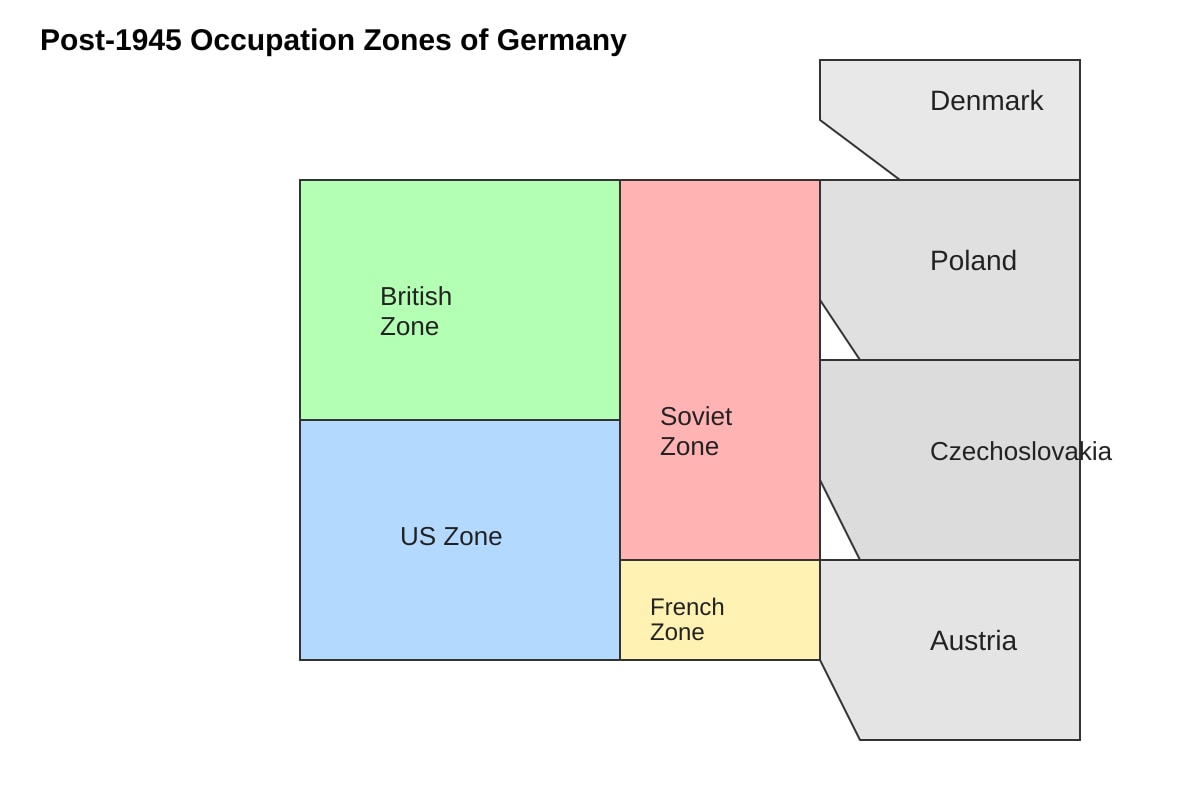
(a) Poland (east) (b) Czechoslovakia (south-east)
Teaching note: Map must show Soviet Zone east; neighbours as listed. 1 mark each.
Q11 [4 marks]
Answer: Pact freed Hitler to invade Poland (no two-front war); Stalin gained land; showed secret deal; emboldened aggression → WWII Sept 1939.
Marking: 2 marks no two-front; 2 marks enabled Poland invasion.
Q12 [4 marks]
Answer: Giving Sudetenland 1938 showed Hitler could demand more; he saw West as weak; continued to take rest of Czechoslovakia 1939.
Marking: 2 marks example; 2 marks link to aggression.
Q13 [3 marks]
Answer: It was proxy war: North Korea (USSR/China support) vs South (US/UN). Shows superpower rivalry without direct fight.
Marking: 1 mark proxy; 2 marks explanation.
Section C: Extended (Q14–20)
Q14 [12 marks]
Answer: Agree partly. Stalin: Sovietisation of E Europe, Berlin blockade 1948, cominform. Truman: Truman Doctrine, Marshall Plan, NATO. Both responsible.
Marking: 3 marks Stalin points; 3 marks Truman points; 4 marks balanced analysis; 2 marks judgement.
Teaching note: Must use both sides + conclusion.
Q15 [8 marks]
Answer: USSR placed nuclear missiles in Cuba (90km from US); US blockade; risk of launch; nearly fired; Khrushchev–Kennedy standoff.
Marking: 2 marks each for 4 developed points.
Q16 [9 marks]
Answer: Sources A/C say not kind (trap); B says kind. Knowledge: helped economies but contained communism. Partial support.
Marking: 2 A/C; 2 B; 3 knowledge; 2 judgement.
Q17 [8 marks]
Answer: Military took govt, Manchuria 1931, China war 1937, Tripartite Pact, Pearl Harbor 1941.
Marking: 2 marks each for 4 steps.
Q18 [12 marks]
Answer: Agree: humiliation, revanchism, Hitler used it. Disagree: Hitler's ambition, failure of League, appeasement.
Marking: 3+3 content; 4 analysis; 2 conclusion.
Q19 [4 marks]
(a) Korea: direct N invasion; Vietnam: civil war + communism spread.
(b) Korea: UN authorised; Vietnam: US gradual escalate.
2 marks each.
Q20 [8 marks]
Answer: Showed nuclear power; started arms race with USSR; Cold War intensified; Japan surrendered; UN formed.
Marking: 2 marks each for 4 points.