AI Generated Quiz
Secondary 4 History Ancient Civilisations Quiz
Free Sec 4 History Ancient Civilisations quiz, Qwen3.7 AI version, with questions, answers, and O Level-style practice for Singapore students.
These static practice materials are generated from the site's syllabus and paper-generation workflow, with source and model context shown so students and parents can evaluate the material before use.
Questions
Free quiz and exam paper access
Enter your details to view this paper
Your access is remembered on this device.
Answers
Secondary 4 History Quiz - Ancient Civilisations (Answer Key)
Section A: Source-Based Case Study
1. Study Source A. What does Herodotus suggest about the relationship between the Nile River and Egyptian agriculture? [2 marks]
- Answer: Herodotus suggests that Egyptian agriculture is entirely dependent on the Nile River. He states that without the annual flooding (inundation), the land would be barren desert. The river provides the necessary water and fertile silt, making farming easy and productive with minimal labor.
- Marking Notes:
- 1 mark for identifying dependence/dependency.
- 1 mark for mentioning the benefit (fertile silt/easy farming/barren without it).
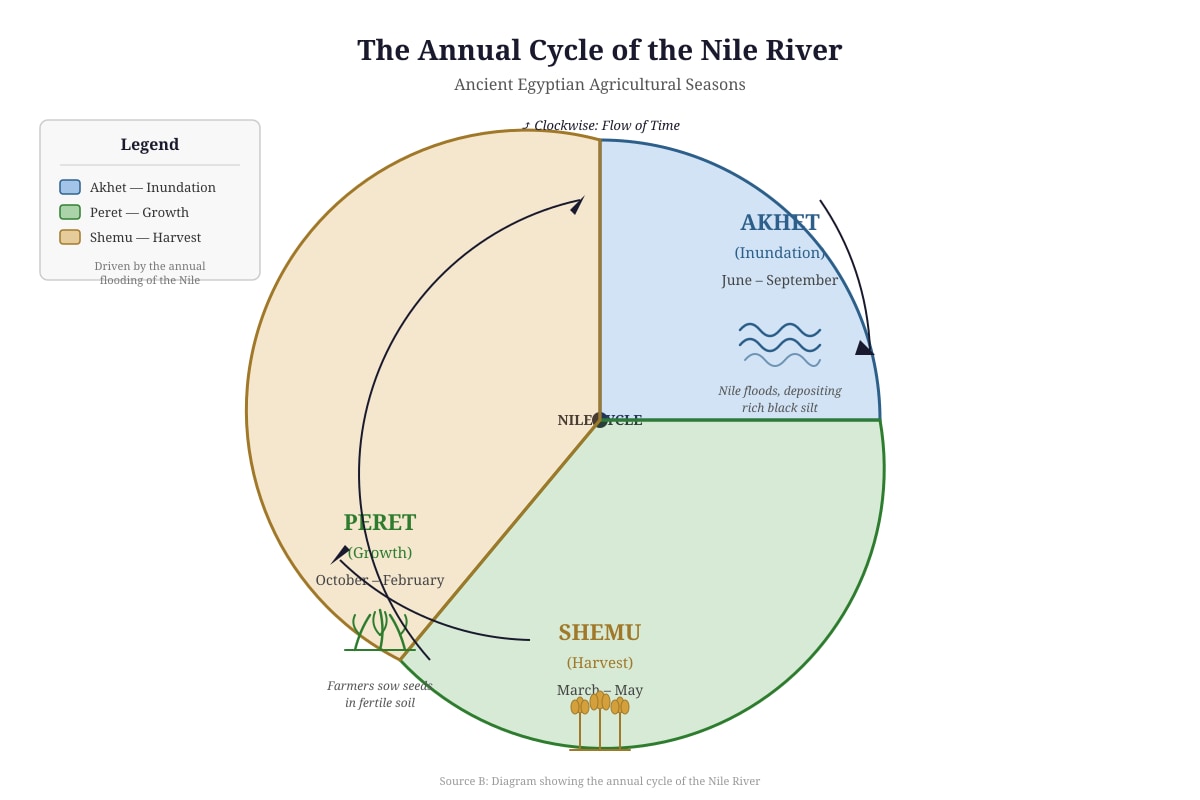
2. Study Source B. How does the diagram illustrate the concept of 'Continuity' in Egyptian farming practices? [2 marks]
- Answer: The diagram illustrates continuity by showing a repetitive, predictable annual cycle (Akhet, Peret, Shemu) that remained consistent for thousands of years. The clockwise flow indicates that this pattern repeated year after year, dictating the rhythm of life and farming activities without significant change.
- Marking Notes:
- 1 mark for explaining continuity (repetitive cycle/predictability).
- 1 mark for linking it to the diagram specifically (mentioning the seasons/cycle).
3. Study Source A. Explain why Herodotus describes Egypt as the "gift of the Nile." [2 marks]
- Answer: Herodotus calls it a "gift" because the Nile provided everything needed for survival and prosperity without much human effort. The annual flood deposited rich, black silt that fertilized the soil naturally, allowing for abundant harvests with minimal labor compared to other lands.
- Marking Notes:
- 1 mark for mentioning natural fertility/silt.
- 1 mark for mentioning minimal labor/abundant harvest.
4. Study Sources A and C. How far does Source C support the view in Source A that the Nile is solely a "gift" to Egypt? [5 marks]
- Answer: Source C only partially supports Source A.
- Support: Source C acknowledges benefits like "hydroelectric power" and "water for irrigation year-round," which aligns with Source A’s view of the Nile as beneficial/gift-like by ensuring water security.
- Challenge: However, Source C challenges the idea of it being solely a gift by highlighting negative consequences: the need for "chemical fertilizers" due to lack of silt, and "coastal erosion." This suggests the Nile’s management has created new problems, unlike the purely positive "gift" described by Herodotus.
- Marking Notes:
- 1 mark for stating the extent (partially supports/does not fully support).
- 2 marks for explaining how C supports A (benefits/power/irrigation).
- 2 marks for explaining how C challenges A (negative impacts/fertilizers/erosion).
5. Study Sources B, C, and D. "The control of the Nile has brought more benefits than problems to Egypt." How far do these sources support this statement? Use the sources and your own knowledge to support your answer. [9 marks]
- Answer Guide:
- Benefits (Supported by Sources C & D):
- Source C mentions "hydroelectric power" and "water for irrigation year-round."
- Source D notes "Low risk of drought" and "Multiple cycles possible," leading to higher food security and economic stability.
- Own Knowledge: Enabled industrialization, reduced famine risk, allowed for population growth.
- Problems (Supported by Sources C & D):
- Source C mentions "stopped natural deposition of fertile silt," leading to reliance on "chemical fertilizers" (costly/polluting) and "coastal erosion."
- Source D confirms "Artificial Fertilizers Required."
- Own Knowledge: Displacement of people during dam construction, loss of archaeological sites, spread of water-borne diseases like schistosomiasis.
- Conclusion: While control has solved the ancient problem of unpredictable flooding (Source B/A), it has introduced modern environmental and economic costs. Whether benefits outweigh problems depends on the priority given to food security vs. environmental sustainability. Most historians argue the economic stability (benefits) has been crucial for modern Egypt's survival, despite the ecological costs.
- Benefits (Supported by Sources C & D):
- Marking Notes:
- L1 (1-3 marks): Simple listing of points from sources without evaluation.
- L2 (4-6 marks): Explains benefits and problems using sources. Some own knowledge.
- L3 (7-9 marks): Balanced argument using all sources and own knowledge. Evaluates the weight of benefits vs. problems with a clear conclusion.
Section B: Structured Questions
6. Define the term 'Theocracy' in the context of Ancient Egyptian government. [1 mark]
- Answer: A system of government where the ruler (Pharaoh) is considered a divine figure or god-king, and religious law is civil law.
- Marking Notes: 1 mark for "divine ruler" or "god-king."
7. Identify ONE role of the Pharaoh in Ancient Egyptian religion. [1 mark]
- Answer: The Pharaoh acted as the intermediary between the gods and the people, or was believed to be the living embodiment of Horus.
- Marking Notes: 1 mark for any valid religious role (intermediary/god-incarnate/high priest).
8. Identify TWO specific contributions of the Indus Valley Civilisation to urban planning. [2 marks]
- Answer:
- Advanced drainage and sewage systems (covered drains in streets).
- Grid-pattern street layout.
- Marking Notes: 1 mark for each valid contribution.
9. State ONE feature of the Great Bath at Mohenjo-Daro. [1 mark]
- Answer: It was a large, watertight pool lined with bricks and sealed with bitumen, likely used for ritual purification.
- Marking Notes: 1 mark for any valid feature (watertight/brick-lined/ritual use).
10. Explain ONE reason why the Code of Hammurabi is considered significant in the history of law. [2 marks]
- Answer: It is significant because it was one of the first written legal codes, making laws public and known to all citizens rather than being arbitrary decisions by rulers. This established a standardized system of justice.
- Marking Notes:
- 1 mark for identifying it as a written code.
- 1 mark for explaining the impact (public knowledge/standardization).
11. Identify the principle of 'lex talionis' found in Mesopotamian law. [1 mark]
- Answer: The law of retaliation, often summarized as "an eye for an eye."
- Marking Notes: 1 mark for "retaliation" or "eye for an eye."
12. Describe the social hierarchy of Ancient Mesopotamia. Identify the group at the top. [1 mark]
- Answer: The King and Priests were at the top of the social hierarchy.
- Marking Notes: 1 mark for identifying King/Priests.
13. Identify the group at the bottom of the Ancient Mesopotamian social hierarchy. [1 mark]
- Answer: Slaves (often prisoners of war or debtors).
- Marking Notes: 1 mark for Slaves.
14. Explain how the geography of Mesopotamia differed from that of Egypt regarding river flooding. [2 marks]
- Answer: The Tigris and Euphrates rivers in Mesopotamia flooded unpredictably and violently, often causing destruction. In contrast, the Nile in Egypt flooded predictably and gently, depositing fertile silt without causing widespread damage.
- Marking Notes:
- 1 mark for Mesopotamia (unpredictable/violent).
- 1 mark for Egypt (predictable/gentle).
15. Explain how the geography of Egypt contributed to a sense of security among its people. [2 marks]
- Answer: Egypt was protected by natural barriers, such as deserts to the east and west and the Mediterranean Sea to the north. These barriers made invasion difficult, leading to a sense of safety and stability.
- Marking Notes:
- 1 mark for identifying natural barriers (deserts/sea).
- 1 mark for linking to security/protection from invasion.
16. "Geography determined the development of Ancient Civilisations." Explain how the open geography of Mesopotamia affected its political development. [2 marks]
- Answer: The lack of natural barriers in Mesopotamia made it vulnerable to frequent invasions. This led to political instability, constant warfare, and the rise of fortified city-states rather than a unified, long-lasting empire like Egypt.
- Marking Notes:
- 1 mark for vulnerability to invasion.
- 1 mark for political result (instability/city-states/warfare).
17. Why was the invention of writing (Cuneiform/Hieroglyphs) a turning point for ancient societies? Give ONE reason related to administration. [2 marks]
- Answer: Writing allowed for accurate record-keeping of taxes, trade, and agricultural surplus. This enabled the growth of complex bureaucracies and the management of large-scale states.
- Marking Notes:
- 1 mark for record-keeping (taxes/trade).
- 1 mark for linking to bureaucracy/state management.
18. Give ONE reason why writing was important for the preservation of culture in ancient societies. [2 marks]
- Answer: Writing allowed laws, religious texts, and historical events to be recorded permanently. This ensured that knowledge and cultural values could be passed down accurately to future generations, rather than relying on oral tradition which might change.
- Marking Notes:
- 1 mark for recording laws/religion/history.
- 1 mark for accurate transmission/preservation over time.
19. Identify ONE difference between the religious beliefs of Ancient Egyptians and Mesopotamians regarding their gods. [1 mark]
- Answer: Egyptians generally viewed their gods as benevolent and orderly, reflecting the predictable Nile. Mesopotamians viewed their gods as capricious and unpredictable, reflecting the violent flooding of their rivers.
- Marking Notes: 1 mark for any valid contrast (benevolent vs. capricious / orderly vs. chaotic).
20. Explain why the Nile River was more predictable than the Tigris and Euphrates rivers. [1 mark]
- Answer: The Nile's flooding was caused by seasonal rains in the Ethiopian highlands, which occurred at a regular time each year, whereas the Tigris and Euphrates were fed by snowmelt and irregular rainstorms.
- Marking Notes: 1 mark for mentioning seasonal regularity/source consistency.