AI Generated Quiz
Secondary 4 History Ancient Civilisations Quiz
Free Sec 4 History Ancient Civilisations quiz, HY3 AI version, with questions, answers, and O Level-style practice for Singapore students.
These static practice materials are generated from the site's syllabus and paper-generation workflow, with source and model context shown so students and parents can evaluate the material before use.
Questions
Free quiz and exam paper access
Enter your details to view this paper
Your access is remembered on this device.
Answers
Secondary 4 History Quiz - Ancient Civilisations (Answer Key)
Total Marks: 40
Duration: 50 minutes
Section A: Short Structured Questions (1 mark each)
1. Nile River valley (1m)
Teaching note: Ancient Egyptian civilisation developed along the Nile because of predictable flooding and fertile soil. Common mistake: writing "Tigris" (that is Mesopotamia).
2. Cuneiform (1m)
Teaching note: Mesopotamians (Sumerians) used wedge-shaped marks on clay tablets. Common mistake: "hieroglyphs" (that is Egyptian).
3. Code of Hammurabi (1m)
Teaching note: Hammurabi was a Babylonian king who issued one of the earliest written law codes.
4. Indus Valley civilisation (1m)
Teaching note: Mohenjo-daro was a major city of the Indus Valley civilisation in present-day Pakistan.
5. Democracy (1m)
Teaching note: Athens developed direct democracy where citizens voted on laws.
6. Ancient Egyptians (1m)
Teaching note: The Giza pyramids were built as tombs for Egyptian pharaohs.
7. Papyrus (1m)
Teaching note: Made from papyrus reed growing along the Nile.
8. Ancient Greeks (Athens) (1m)
Teaching note: Democracy began in Athens around 5th century BC.
9. India (1m)
Teaching note: Indus Valley covered northwest India and Pakistan.
10. Civilisation (1m)
Teaching note: A civilisation has cities, government, and writing (not just villages).
Section B: Source-Based Questions (2 marks each)
11. Irrigation canals controlled flooding and produced surplus crops, which supported specialised workers like priests and scribes. (2m)**
Marking: 1m for flood control / surplus crops, 1m for specialised workers.
Teaching note: Source A explicitly states both outcomes.
12. The Nile's yearly floods gave rich soil that fed the people; Egypt depended on it ("gift of the Nile"). (2m)**
Marking: 1m for flooding/soil, 1m for feeding people / dependence.
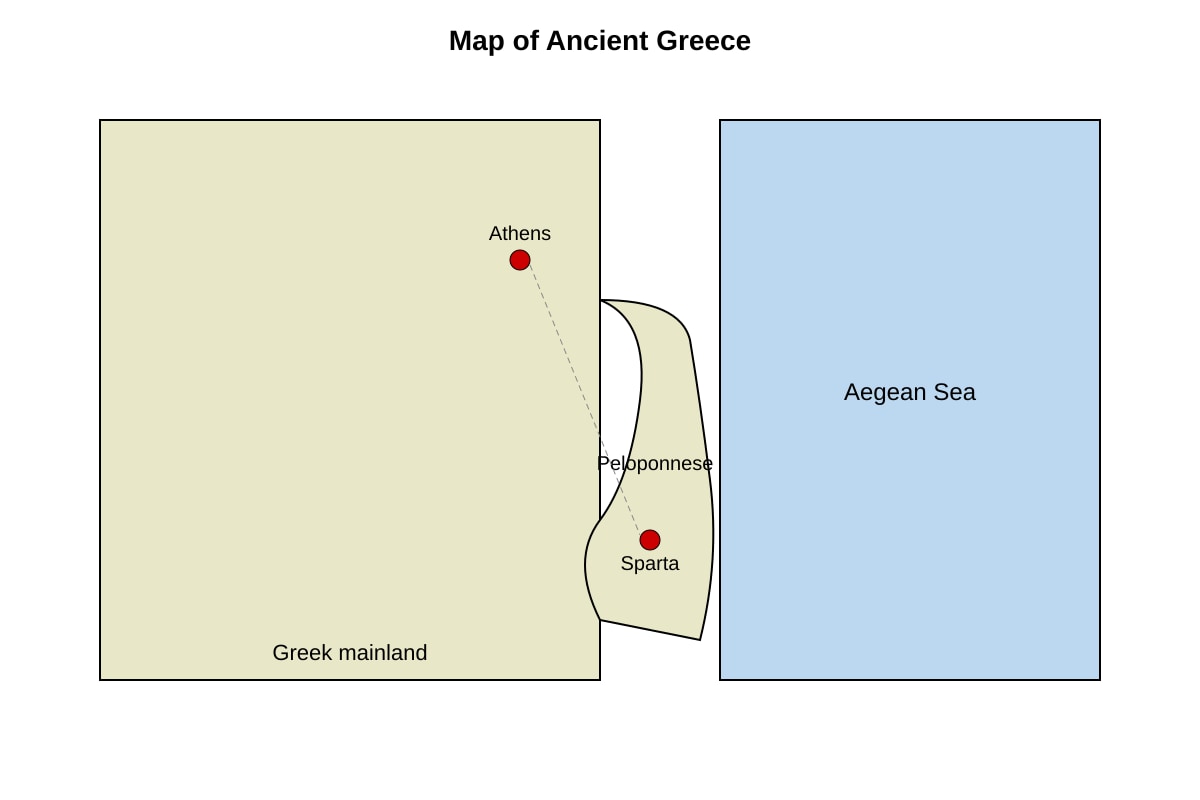
13. Athens was on the east coast of the Greek mainland; Sparta was in the Peloponnese peninsula south of the mainland. (2m)**
Marking: 1m per correct geographical difference from map.
Visual needed: map shows Athens on mainland east, Sparta south in Peloponnese.
14. "Eye for eye, bone for bone" – retaliation / lex talionis (punishment matches crime). (2m)**
Marking: 1m for principle name, 1m for explanation.
15. Uniform bricks and planned towns (no random layout) suggest central authority. (2m)
Marking: 1m for uniformity of bricks, 1m for town planning.
16. Written records let us know laws, events, and administration; without them we cannot prove complex society. (2m)
Marking: 1m for record-keeping purpose, 1m for linking to civilisation definition.
Section C: Extended Response Questions (5 marks each)
17. Geography of Mesopotamia (5m)
Marking descriptors:
- 2m: Two correct geographical details (Tigris/Euphrates rivers, flat plains, flooding).
- 3m: Explanation of how each aided civilisation (irrigation → surplus; plains → trade/communication).
Sample answer: Mesopotamia lay between Tigris and Euphrates (1m). Unpredictable floods meant irrigation was needed (1m). This produced surplus food (1m) and supported cities (1m). Open plains allowed trade between cities (1m).
18. Nile most important? (5m)
Marking:
- Agree side: Nile gave water, fertile soil, transport (2m).
- Other factors: pyramids show organisation, not just river (1m).
- Conclusion with balanced view (2m).
Teaching note: A good answer says Nile was vital but not the only factor (e.g., strong pharaohs).
19. Athens vs Sparta government (5m)
Marking:
- Athens: democracy, citizens voted (2m).
- Sparta: oligarchy, two kings + council (2m).
- Clear contrast stated (1m).
Sample: Athens had direct democracy; Sparta had military oligarchy. Different goals: Athens culture, Sparta war.
20. Advanced Indus features (5m)
Marking: 2 features × 2m + 1m explanation.
Features: grid town planning, drainage systems, uniform bricks, Great Bath.
Sample: Planned streets in grids (2m) and covered drainage (2m) show engineering skill (1m).