Secondary 4 History Quiz - Ancient Civilisations
Name: ___________________________
Class: ___________________________
Date: ___________________________
Score: ___________ / 40
Duration: 50 minutes
Total Marks: 40
Instructions: Answer all 20 questions. Section A is short recall. Section B is structured response. Section C is source-based. Write your answers in the spaces provided.
Section A: Recall (Questions 1–5, 1 mark each)
-
Which river valley is most associated with the development of Ancient Egyptian civilisation?
-
Name the written code of laws introduced by the Babylonian king Hammurabi.
-
What was the primary building material used in most Ancient Greek temples?
-
Which ancient civilisation built the stepped pyramids known as ziggurats?
-
What form of government was practised in Athens during its classical period?
Section B: Structured Response (Questions 6–15)
-
Explain one key feature of the caste system in Ancient Indian civilisation. (2 marks)
-
Describe two contributions of the Ancient Greeks to modern mathematics or science. (2 marks)
-
Why was the invention of writing important for the administration of Ancient Mesopotamian city-states? (3 marks)
-
Study the map below and name two major river systems that supported ancient civilisations in China. (2 marks)
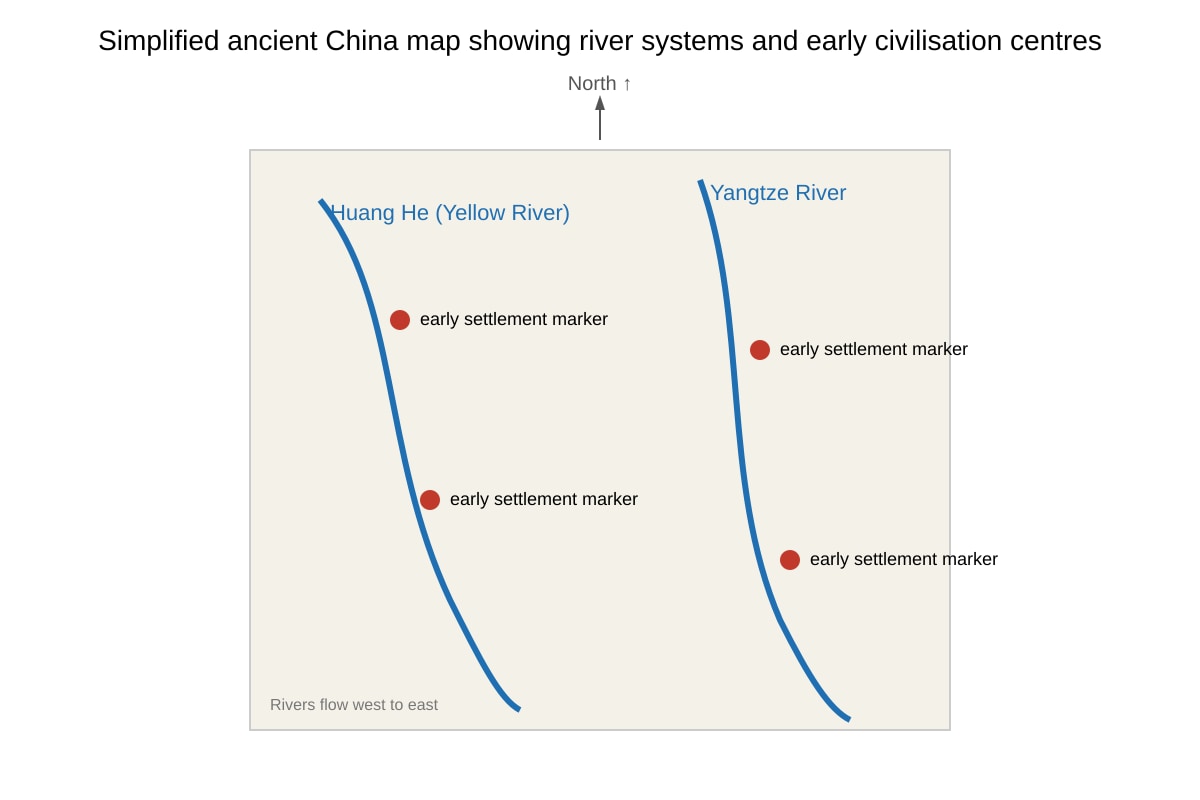
Generated map for Q9.
-
Explain how the geography of Ancient Egypt helped protect it from invasion. (3 marks)
-
What were two main reasons for the decline of the Roman Empire? (2 marks)
-
Describe the role of religion in the daily life of Ancient Mesopotamians. (3 marks)
-
How did the Phoenicians influence later civilisations through their innovations? (2 marks)
-
Explain why trade was important to the development of Ancient Greek city-states. (3 marks)
-
Identify one similarity and one difference between the legal codes of Hammurabi and those of Ancient Rome. (2 marks)
Section C: Source-Based (Questions 16–20)
Study Source A below.
"The pharaoh is the son of Ra, the sun god. He alone speaks for the gods on earth and commands the Nile's flooding. All land belongs to him, and the people labour so that Ma'at – order – is kept." – Inscription from a temple wall at Karnak, c. 1300 BCE
-
What does Source A tell you about the religious basis of the pharaoh's power? (2 marks)
-
Is the view presented in Source A surprising for an ancient civilisation? Explain your answer using the source and your knowledge. (3 marks)
Study Sources B and C below.
Source B: "Our polis thrives because every free man may speak in the assembly. We are not ruled by one, but by the many." – Athenian playwright, 440 BCE
Source C: "The Senate and the people of Rome govern through law and the legions. The consul holds power only for a year, lest tyranny arise." – Roman senator, 100 BCE
-
How similar are Sources B and C in their views on government? Explain your answer using details from the sources. (3 marks)
-
Would the writer of Source B agree with the writer of Source C? Give one reason from the sources. (2 marks)
-
Study all the sources (A, B, C). "Ancient civilisations were always ruled by single all-powerful kings." How far do these sources support this statement? Use the sources and your knowledge. (5 marks)
</stage3_quiz_answers_md>
<stage3_quiz_answers_md>
Secondary 4 History Quiz - Ancient Civilisations (Answer Key)
Total Marks: 40
Topic: Ancient Civilisations
Section A: Recall (1 mark each)
Q1. Nile River Valley
Teaching note: Ancient Egyptian civilisation developed along the Nile because its floods provided fertile soil. Accept "Nile".
Q2. Code of Hammurabi
Teaching note: Hammurabi was a Babylonian king who created one of the earliest written law codes. Accept "Hammurabi's Code".
Q3. Marble (or stone)
Teaching note: Greek temples such as the Parthenon used marble; limestone also acceptable. Core idea: durable stone, not wood.
Q4. Sumerians / Mesopotamians
Teaching note: Ziggurats were stepped temple towers built in Mesopotamia (Sumer). Accept "Mesopotamia".
Q5. Democracy
Teaching note: Athens practised direct democracy where citizens voted in assembly. Accept "direct democracy".
Section B: Structured Response
Q6. (2 marks)
Answer: One key feature – society was divided into fixed hierarchical groups (Brahmins, Kshatriyas, Vaishyas, Shudras, untouchables) with limited mobility.
Marking: 1 mark for naming caste levels, 1 mark for explaining fixed/social order.
Teaching note: The caste system linked religious duty (dharma) to birth.
Q7. (2 marks)
Answers (any two): Pythagoras' theorem; Euclidean geometry; Archimedes' principles; early astronomy.
Marking: 1 mark each correct contribution with brief detail.
Teaching note: Greeks systematised maths as proofs, influencing modern science.
Q8. (3 marks)
Answer: Writing (cuneiform) let officials keep tax records, laws, and temple inventories; enabled communication across cities; reduced reliance on memory.
Marking: 1 mark record-keeping, 1 mark administration across distance, 1 mark stability/complex state.
Teaching note: Mesopotamians used clay tablets; writing supported bureaucracy.
Q9. (2 marks)
Answer: Huang He (Yellow River) and Yangtze River.
Marking: 1 mark each correctly named from map.
Teaching note: Early Chinese civilisation arose on these floodplains.
Q10. (3 marks)
Answer: Deserts (east/west) and Mediterranean Sea gave natural barriers; cataracts on Nile hindered invaders; isolation allowed stable growth.
Marking: 1 mark per valid point (max 3).
Teaching note: Geography shaped Egypt's defensive security.
Q11. (2 marks)
Answers (any two): invasion by Germanic tribes; economic crisis; political corruption; overexpansion; disease.
Marking: 1 mark each.
Teaching note: Rome declined from internal and external pressures.
Q12. (3 marks)
Answer: Gods controlled natural forces; priests held power; temples central to life; myths explained world.
Marking: 1 mark each up to 3.
Teaching note: Religion was woven into Mesopotamian daily routine.
Q13. (2 marks)
Answer: Phoenicians invented alphabet (22 letters) aiding trade/literacy; established Mediterranean trade networks.
Marking: 1 mark alphabet, 1 mark trade/colonies.
Teaching note: Their script influenced Greek alphabet.
Q14. (3 marks)
Answer: Greece had poor farmland → needed grain imports; trade brought resources; built naval power; connected city-states.
Marking: 1 mark per point (max 3).
Teaching note: Geography forced maritime trade.
Q15. (2 marks)
Similarity: both written legal codes (1). Difference: Hammurabi's was retributive ("eye for eye"); Roman law more systematic/citizen-based (1).
Teaching note: Shows evolution of legal thought.
Section C: Source-Based
Q16. (2 marks)
Answer: Pharaoh's power came from god Ra; he was divine mediator; land/the Nile under his command.
Marking: 1 mark religious legitimacy, 1 mark absolute authority via god.
Teaching note: Source shows theocratic kingship.
Q17. (3 marks)
Answer: Not surprising – most ancient civilisations claimed divine rule (e.g., Mesopotamian kings). Source A typical of Egyptian ma'at ideology.
Marking: 1 mark stance, 2 marks explanation with knowledge.
Teaching note: Divine kingship common; student must link source to pattern.
Q18. (3 marks)
Answer: Both value shared rule (many/not one). B = assembly democracy; C = republican limits (consul 1 yr). Differ: Athens direct, Rome mixed.
Marking: 1 sim, 2 diff/detail from text.
Teaching note: Compare content + system type.
Q19. (2 marks)
Answer: Partly yes – both fear single ruler. Reason: B rejects "one", C limits consul.
Marking: 1 agree stance, 1 evidence.
Teaching note: Both anti-tyranny.
Q20. (5 marks)
Answer: Sources B & C contradict statement (Athens/Rome not single king). Source A supports (pharaoh). Knowledge: Persia/China had kings, but Greece/Rome show alternatives.
Marking: 1 identify support, 1 identify contradiction, 2 use sources, 1 own knowledge.
Teaching note: Balanced judgement required; not all ancient civs were monarchies.
</stage3_quiz_answers_md>
<stage3_quiz_md>
Secondary 4 History Quiz - Ancient Civilisations
Name: ___________________________
Class: ___________________________
Date: ___________________________
Score: ___________ / 40
Duration: 50 minutes
Total Marks: 40
Instructions: Answer all 20 questions. Section A is short recall. Section B is structured response. Section C is source-based. Write your answers in the spaces provided.
Section A: Recall (Questions 1–5, 1 mark each)
-
Which river valley is most associated with the development of Ancient Egyptian civilisation?
-
Name the written code of laws introduced by the Babylonian king Hammurabi.
-
What was the primary building material used in most Ancient Greek temples?
-
Which ancient civilisation built the stepped pyramids known as ziggurats?
-
What form of government was practised in Athens during its classical period?
Section B: Structured Response (Questions 6–15)
-
Explain one key feature of the caste system in Ancient Indian civilisation. (2 marks)
-
Describe two contributions of the Ancient Greeks to modern mathematics or science. (2 marks)
-
Why was the invention of writing important for the administration of Ancient Mesopotamian city-states? (3 marks)
-
Study the map below and name two major river systems that supported ancient civilisations in China. (2 marks)
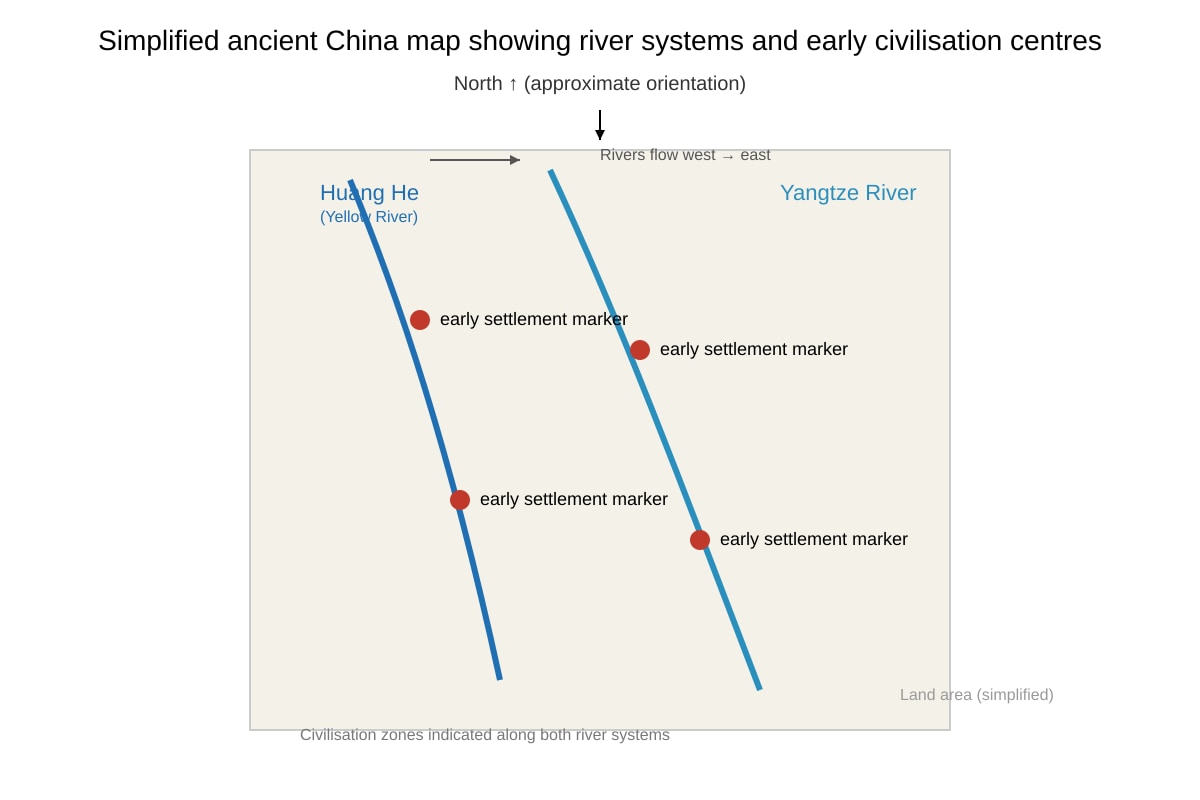
Generated map for Q9.
-
Explain how the geography of Ancient Egypt helped protect it from invasion. (3 marks)
-
What were two main reasons for the decline of the Roman Empire? (2 marks)
-
Describe the role of religion in the daily life of Ancient Mesopotamians. (3 marks)
-
How did the Phoenicians influence later civilisations through their innovations? (2 marks)
-
Explain why trade was important to the development of Ancient Greek city-states. (3 marks)
-
Identify one similarity and one difference between the legal codes of Hammurabi and those of Ancient Rome. (2 marks)
Section C: Source-Based (Questions 16–20)
Study Source A below.
"The pharaoh is the son of Ra, the sun god. He alone speaks for the gods on earth and commands the Nile's flooding. All land belongs to him, and the people labour so that Ma'at – order – is kept." – Inscription from a temple wall at Karnak, c. 1300 BCE
-
What does Source A tell you about the religious basis of the pharaoh's power? (2 marks)
-
Is the view presented in Source A surprising for an ancient civilisation? Explain your answer using the source and your knowledge. (3 marks)
Study Sources B and C below.
Source B: "Our polis thrives because every free man may speak in the assembly. We are not ruled by one, but by the many." – Athenian playwright, 440 BCE
Source C: "The Senate and the people of Rome govern through law and the legions. The consul holds power only for a year, lest tyranny arise." – Roman senator, 100 BCE
-
How similar are Sources B and C in their views on government? Explain your answer using details from the sources. (3 marks)
-
Would the writer of Source B agree with the writer of Source C? Give one reason from the sources. (2 marks)
-
Study all the sources (A, B, C). "Ancient civilisations were always ruled by single all-powerful kings." How far do these sources support this statement? Use the sources and your knowledge. (5 marks)