AI Generated Exam Paper
Secondary 4 History Practice Paper 3
Free Sec 4 History Practice Paper 3, HY3 AI version, with questions, answers, and O Level-style practice for Singapore students.
These static practice materials are generated from the site's syllabus and paper-generation workflow, with source and model context shown so students and parents can evaluate the material before use.
Questions
Free quiz and exam paper access
Enter your details to view this paper
Your access is remembered on this device.
Answers
TuitionGoWhere Practice Paper — History Secondary 4 (Version 3) Answer Key
Topic Focus: Essay Explanation (Essay-Explanation)
Level: Secondary 4
Total Marks: 60 (Section A: 21, Section B: 21, Section C: 18)
Section A: Explaining Causes (Q1–7) — [21 marks]
Q1. Explain why the Treaty of Versailles created resentment among Germans. [3]
- Answer: Germans hated Clause 231 (War Guilt) which forced them to accept full blame; they lost 13% of land and colonies; the army was limited to 100,000 men; reparations of £6.6 billion damaged the economy.
- Teaching note: Define "resentment" as anger at unfair treatment. Three clear points expected: (1) War Guilt clause humiliated Germany; (2) territorial and military restrictions weakened pride; (3) reparations caused economic collapse. 1 mark per valid explained point.
- Common mistake: Stating only "it was unfair" without saying how.
Q2. Explain why the British extended control over Malaya in the 1870s–1920s. [3]
- Answer: (1) Tin and rubber profits attracted British investors; (2) local rulers requested help against internal conflict (Pangkor Engagement 1874); (3) strategic location on route to China protected trade.
- Teaching note: Link to syllabus "economic interests" and "Resident system". Show cause → effect: economic need led to intervention. 1 mark each.
- Marking: 1 mark per explained reason with link to syllabus.
Q3. Explain why the Nazi Party rose to power in Germany by 1933. [3]
- Answer: (1) Weimar weakness — proportional representation produced unstable governments; (2) Great Depression 1929 — 6 million unemployed blamed government; (3) Hitler's speeches promised to undo Versailles and restore pride.
- Teaching note: Use causation language: "Because of…". Explain each factor's role. 1 mark per factor.
- Common mistake: Listing events without explaining link to rise.
Q4. Explain why Japan became militaristic in the 1920s–1930s. [3]
- Answer: (1) Economic crisis after 1929 made democracy seem weak; (2) army had strong influence and defeated civilian government; (3) need for resources drove expansion into Manchuria 1931.
- Teaching note: Connect to syllabus "militarist Japan". Show how economic + political problems = militarism. 1 mark each.
Q5. Explain why the Cold War began after 1945. [3]
- Answer: (1) Ideological conflict — USA (capitalism) vs USSR (communism); (2) Soviet control of Eastern Europe broke trust; (3) US policy of containment (Truman Doctrine) increased tension.
- Teaching note: "After 1945" = end of WWII alliance. Explain each cause clearly. 1 mark per point.
Q6. Explain why the Korean War broke out in 1950. [3]
- Answer: (1) Korea divided at 38th parallel after 1945; (2) Stalin backed North, USA backed South; (3) Kim Il-sung invaded South on 25 Jun 1950 to unite country by force.
- Teaching note: Use chronology: division → external backing → invasion. 1 mark each.
Q7. Explain why decolonisation accelerated in Southeast Asia after 1945. [3]
- Answer: (1) Japanese occupation weakened European prestige; (2) UN supported self-determination; (3) Nationalist leaders (Sukarno, Nehru) used wartime unity to demand independence.
- Teaching note: Link to syllabus "decolonisation". 1 mark per reason.
Section B: Explaining Consequences and Change (Q8–14) — [21 marks]
Q8. Explain how the Resident System changed traditional Malay rulership. [3]
- Answer: (1) Real power moved from Sultan to British Resident; (2) rulers lost control of finance and external affairs; (3) traditional advice councils were sidelined.
- Teaching note: Define Resident = advisor with real authority. Explain change from "ruler" to "figurehead". 1 mark per clear change.
Q9. Explain how Nazi propaganda affected German society. [3]
- Answer: (1) Radio and rallies spread Nazi ideology; (2) Youth groups taught loyalty to Hitler; (3) Jews were blamed for problems, increasing acceptance of persecution.
- Teaching note: Effect = control of thought and action. 1 mark per effect explained.
Q10. Explain how the Great Depression contributed to the rise of authoritarian regimes. [3]
- Answer: (1) Mass unemployment made democracy seem to fail; (2) extremists (Hitler, militarists) promised order and jobs; (3) fear of communism made business leaders support dictators.
- Teaching note: Show chain: economic crisis → loss of faith in democracy → support for extremes. 1 mark each.
Q11. Explain how the atomic bombing of Hiroshima and Nagasaki affected the post-war world. [3]
- Answer: (1) Showed nuclear weapons changed warfare; (2) USSR accelerated its own bomb, starting arms race; (3) Japan's surrender let USA occupy and reshape Japan.
- Teaching note: Link to Cold War start. 1 mark per consequence.
Q12. Explain how the Marshall Plan changed Western Europe after 1948. [3]
- Answer: (1) US gave $13 billion to rebuild economies; (2) stopped spread of communism by recovery; (3) tied Western Europe to US trade and politics.
- Teaching note: Explain "change" = recovery + alliance. 1 mark each.
Q13. Explain how British colonial rule changed the population structure of Malaya. [3]
- Answer: (1) Chinese brought for tin mines; (2) Indians for plantations and railways; (3) Malays remained in villages — plural society formed.
- Teaching note: Use term "plural society". 1 mark per group explained.
Q14. Explain how the Vietnam War affected US foreign policy. [3]
- Answer: (1) Showed limits of US power → Nixon Doctrine; (2) Congress cut war powers; (3) USA avoided large ground wars (e.g. Grenada small).
- Teaching note: Effect = more cautious policy. 1 mark each.
Section C: Essay Explanation Structure and Evaluation (Q15–20) — [18 marks]
Q15. "A good History essay explanation must balance cause and consequence." Explain what this means and why it is important. [3]
- Answer: It means not only stating what happened but also why (cause) and what resulted (consequence). Important because it shows full understanding, not just recall.
- Teaching note: 1 mark definition, 2 marks for importance (avoids descriptive-only answers; shows analysis).
- Marking: 1 + 2.
Q16. Study the student paragraph below… Explain one way the student could improve this essay explanation. [3]
- Answer: The student gives a cause (blame) but does not explain how the treaty helped Hitler — e.g. economic crisis + fear of communists. Add linking words and evidence (e.g. reparations, Munich Putsch).
- Teaching note: 1 mark identify weakness (no explanation of "how"), 2 marks suggest improvement with example.
- Common mistake: Saying "add more" without stating method.
Q17. Explain why a History essay should use specific evidence such as dates and names. [3]
- Answer: Specific evidence proves the point, shows precision, and prevents vague generalisation. Example: "Hitler became Chancellor in Jan 1933" is stronger than "Hitler rose to power".
- Teaching note: 1 mark reason, 2 marks example. 1 mark each part.
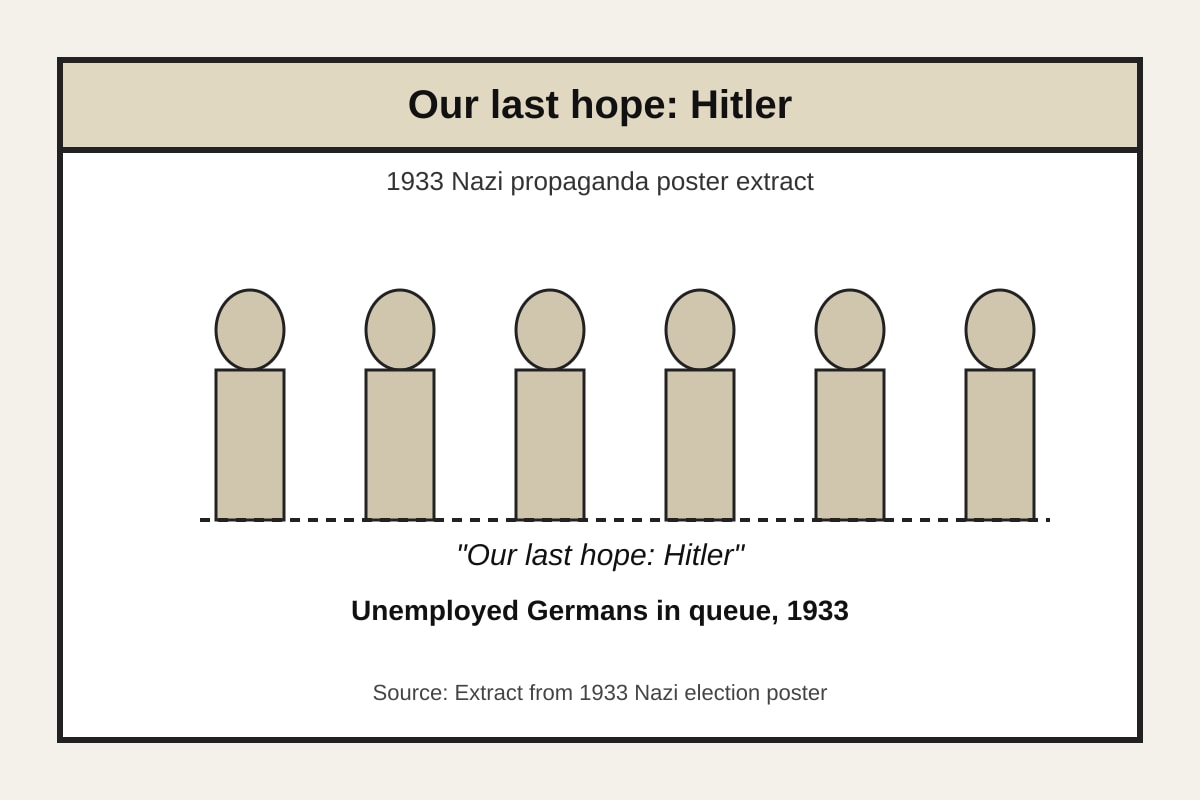
Q18. Explain how a student could use Source X as evidence in an essay about Nazi rise to power. [3]
- Answer: Student can say the poster shows Nazis used unemployment fear (1933) to gain support. It is propaganda so must be used with caution — not full truth. Supports idea that economic crisis helped Nazis.
- Teaching note: 1 mark identify message, 1 mark link to essay point, 1 mark note bias/reliability. Image shows date 1933, unemployed men, Hitler name.
- Marking: 1 + 1 + 1.
Q19. Explain the difference between describing and explaining in a History essay. Use one syllabus example. [3]
- Answer: Describing = states what happened ("Hitler became Chancellor in 1933"). Explaining = says why ("Weimar weakness + Depression let Hitler become Chancellor"). Example: Nazi rise — explain causes not just event.
- Teaching note: 1 mark definition each, 1 mark example. 3 marks total.
Q20. "The Cold War was caused mainly by ideological differences." Explain why this essay explanation is too simple, and what a better explanation would include. [3]
- Answer: Too simple because it ignores power rivalry, USSR security fears, and US economic aims. Better explanation includes: ideology + spheres of influence + atomic bomb + mistrust after 1945.
- Teaching note: 1 mark say why weak, 2 marks show better factors. 3 marks.
Total: 60 marks. Section totals: A=21, B=21, C=18. Matches stated Total Marks.