AI Generated Exam Paper
Secondary 4 History Practice Paper 1
Free Sec 4 History Practice Paper 1, DeepSeek AI version, with questions, answers, and O Level-style practice for Singapore students.
These static practice materials are generated from the site's syllabus and paper-generation workflow, with source and model context shown so students and parents can evaluate the material before use.
Questions
Free quiz and exam paper access
Enter your details to view this paper
Your access is remembered on this device.
Answers
TuitionGoWhere Practice Paper - History Secondary 4
Answer Key and Marking Scheme (Version 1)
Total Marks: 50
Section A: Source-Based Case Study (30 marks)
Question 1(a) [4 marks]
What does Source A tell you about the reasons Germans supported the Nazi Party?
Award 4 marks for a developed inference supported by source details.
| Level | Marks | Descriptor |
|---|---|---|
| L1 | 1-2 | Simple inference(s) without source support, or source lifting without inference. |
| L2 | 3 | Developed inference with some source support. |
| L3 | 4 | Developed inference with specific source details and clear explanation. |
Possible inferences:
- Economic desperation: The worker describes being dismissed, no work available, and surviving on "thin soup and bread." This shows that mass unemployment and poverty drove Germans to support the Nazis, who "promise jobs and bread."
- Loss of faith in Weimar government: The worker states "the government in Berlin does nothing" and "they argue among themselves while we starve." This indicates that the Weimar Republic was seen as ineffective and unable to solve the crisis.
- Appeal of Nazi promises: The worker mentions Hitler's promises to "tear up the Treaty of Versailles and make Germany strong again," showing that Nazi nationalism and rejection of Versailles resonated with desperate Germans.
- Sense of hopelessness: The phrase "What do we have to lose?" suggests that Germans felt they had reached rock bottom and were willing to try extreme solutions.
Sample L3 answer: Source A tells me that Germans supported the Nazi Party because of economic desperation and loss of faith in the Weimar government. The worker describes being dismissed and surviving on "thin soup and bread," showing the severe impact of unemployment and poverty. He also says the government "does nothing" and "argue among themselves," indicating that Germans saw the Weimar Republic as ineffective. The worker notes that Nazis "promise jobs and bread" and that Hitler says he will "tear up the Treaty of Versailles," showing that Nazi promises of economic recovery and national pride appealed to desperate Germans. The final question, "What do we have to lose?" suggests a sense of hopelessness that made people willing to support extreme solutions.
Question 1(b) [5 marks]
How useful is Source A as evidence about why Germans supported the Nazi Party? Explain your answer.
Award 5 marks for a balanced evaluation of usefulness, considering strengths and limitations.
| Level | Marks | Descriptor |
|---|---|---|
| L1 | 1-2 | Simple statement about usefulness without explanation, or one-sided evaluation. |
| L2 | 3-4 | Evaluation of usefulness with some explanation of strengths and/or limitations. |
| L3 | 5 | Balanced evaluation of usefulness, explaining both strengths and limitations with reference to source content and context. |
Possible points:
Strengths (useful):
- It is a first-hand account from a German worker in 1932, providing direct evidence of the economic conditions and attitudes at the time.
- It reveals the emotional state of ordinary Germans (desperation, hopelessness) that made them receptive to Nazi promises.
- It shows specific reasons for Nazi support (jobs, bread, tearing up Versailles) from the perspective of a typical supporter.
Limitations (less useful):
- It is only one person's account and may not represent all Germans' views (some supported other parties, some opposed Nazis).
- As a newspaper account, it may have been selected or edited to present a particular viewpoint.
- It does not explain other factors in Nazi rise (propaganda, Hitler's charisma, elite support, Weimar weaknesses).
- The worker's account focuses on economic factors and does not mention ideological attraction to Nazism (anti-Semitism, nationalism).
Sample L3 answer: Source A is useful in some ways but has limitations. It is useful because it is a first-hand account from 1932, providing direct evidence of the economic desperation that drove many Germans to support the Nazis. The worker's description of unemployment, poverty, and government inaction shows why Nazi promises of "jobs and bread" were appealing. However, the source is less useful because it represents only one person's perspective and may not reflect the views of all Germans. Many Germans supported other parties or opposed the Nazis. The source also focuses only on economic reasons and does not explain other factors in the Nazi rise, such as propaganda, Hitler's leadership, or support from industrialists. Additionally, as a newspaper account, it may have been selected to present a particular viewpoint. Overall, Source A provides valuable insight into the economic motivations of Nazi supporters but needs to be used alongside other sources for a complete understanding.
Question 2 [5 marks]
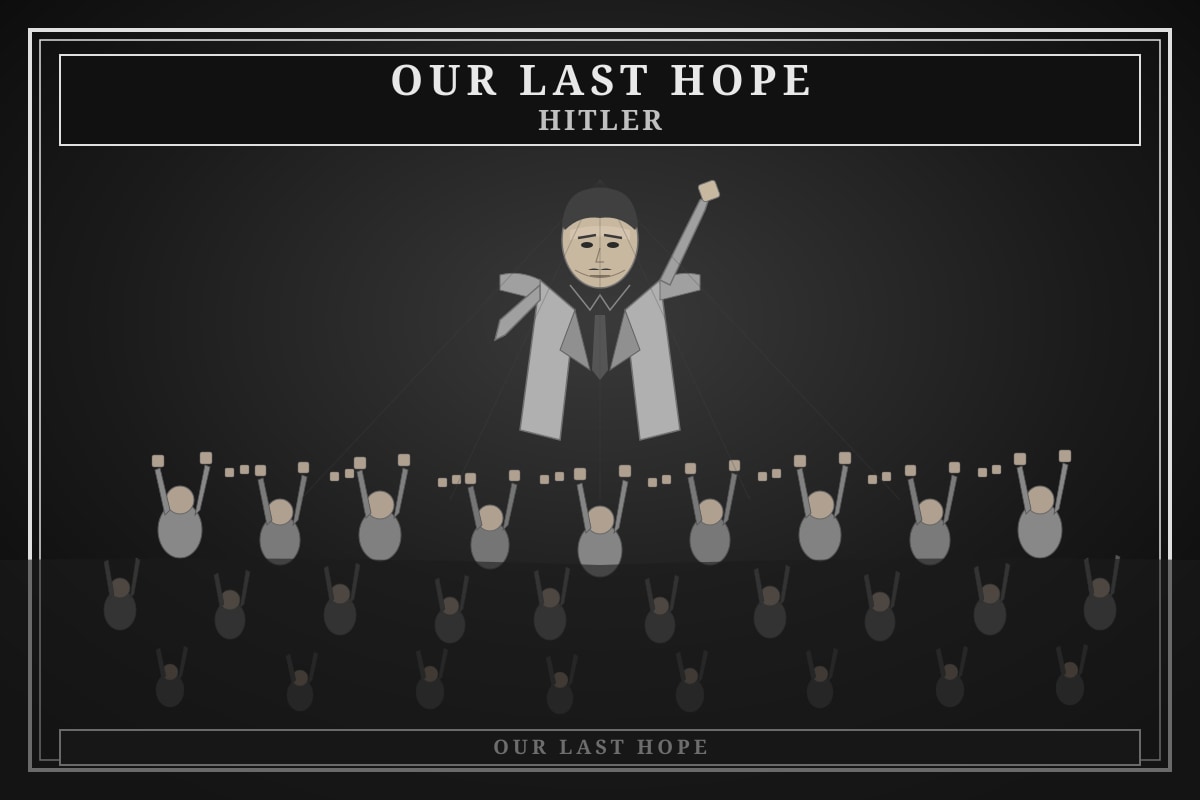
What is the message of Source B? Explain your answer, using details from the source.
Award 5 marks for a clear identification of message supported by source details.
| Level | Marks | Descriptor |
|---|---|---|
| L1 | 1-2 | Simple message without source support, or description of source without identifying message. |
| L2 | 3-4 | Message identified with some source support. |
| L3 | 5 | Clear message identified with specific source details and explanation of how details convey the message. |
Possible messages:
- The Nazi Party/Hitler is the only hope for Germany in a time of crisis.
- Hitler is a strong leader who can save the German people from their suffering.
- Ordinary Germans are desperate and look to Hitler for salvation.
- The Weimar Republic has failed and only the Nazis can provide leadership.
Sample L3 answer: The message of Source B is that Hitler and the Nazi Party are the only hope for Germany in a time of crisis. The text "Our Last Hope: Hitler" directly states this message, using the word "last" to suggest there are no other options. The image reinforces this by showing Hitler standing tall and determined above a crowd of desperate-looking Germans who reach their hands toward him. This visual contrast between the strong, confident leader and the suffering masses conveys that Hitler has the strength and vision to save Germany. The dark background suggests a time of crisis and despair, while Hitler appears as a figure of light and hope. The poster is Nazi propaganda designed to convince voters that only Hitler can solve Germany's problems.
Question 3 [6 marks]
How different are these two sources in their views about the Nazi Party? Explain your answer, using details from both sources.
Award 6 marks for a developed comparison identifying both similarities and differences with source support.
| Level | Marks | Descriptor |
|---|---|---|
| L1 | 1-2 | Simple statement of difference or similarity without source support. |
| L2 | 3-4 | Comparison with some source support, but may be one-sided (only differences or only similarities). |
| L3 | 5-6 | Developed comparison identifying both similarities and differences, with specific source details and explanation. |
Possible points:
Differences:
- Source A supports the Nazi Party, while Source C opposes it.
- Source A sees Nazis as offering hope ("promise jobs and bread," "make Germany strong again"), while Source C sees Nazis as exploiting misery ("exploit the misery of the people for their own gain").
- Source A blames the Weimar government for problems, while Source C defends the Weimar Republic ("has given Germany democracy, freedom, and social welfare").
- Source A presents Nazi promises positively, while Source C warns that Nazi "solutions are violence and dictatorship."
Similarities:
- Both sources acknowledge that Germans are suffering and desperate (Source A: "thin soup and bread"; Source C: "misery of the people").
- Both recognise that the Nazis are gaining support by addressing this suffering.
- Both acknowledge that the Nazis blame others (Source A implies blame on government/Versailles; Source C states Nazis "blame the Jews, the communists, and the Treaty of Versailles").
Sample L3 answer: Sources A and C are very different in their views about the Nazi Party, though they share some common ground. The main difference is that Source A supports the Nazis while Source C opposes them. Source A presents the Nazis as offering hope, with the worker noting they "promise jobs and bread" and that Hitler will "make Germany strong again." In contrast, Source C argues the Nazis "exploit the misery of the people for their own gain" and warns their "solutions are violence and dictatorship." Source A blames the Weimar government for doing nothing, while Source C defends the Weimar Republic as having given Germany "democracy, freedom, and social welfare." However, the sources are similar in that both acknowledge Germans are suffering. Source A describes surviving on "thin soup and bread," while Source C refers to the "misery of the people." Both also recognise that the Nazis are gaining support by addressing this suffering. Overall, the sources offer opposing views on whether Nazi support is justified, but agree that economic hardship is driving Germans toward the party.
Question 4 [5 marks]
How far does Source D help you understand why the Nazi Party rose to power? Use the source and your knowledge to explain your answer.
Award 5 marks for a balanced evaluation of the source's contribution to understanding, using contextual knowledge.
| Level | Marks | Descriptor |
|---|---|---|
| L1 | 1-2 | Simple statement about usefulness without explanation, or source lifting without evaluation. |
| L2 | 3-4 | Evaluation with some explanation, using source and/or knowledge. |
| L3 | 5 | Balanced evaluation explaining how the source helps understanding and what it leaves out, using both source details and contextual knowledge. |
Possible points:
How Source D helps understanding:
- It provides a historian's analysis that identifies multiple factors: propaganda, Hitler's charisma, support from industrialists, Weimar's proportional representation system, the Great Depression, political instability, and resentment over Versailles.
- It explains how factors combined: "The Great Depression was the spark, but the kindling had been laid by years of political instability."
- It offers a balanced, academic perspective that goes beyond single-factor explanations.
What Source D leaves out / limitations:
- It does not provide specific examples or details about Nazi propaganda techniques (rallies, posters, Goebbels' methods).
- It mentions industrialist support but does not name specific industrialists or explain their motivations in detail.
- It does not discuss the role of violence and intimidation by the SA/SS in suppressing opposition.
- It does not explain why the German people found Hitler personally charismatic.
- As a modern historian's account, it is an interpretation and may reflect current historical debates.
Sample L3 answer: Source D helps me understand the Nazi rise to power to a large extent because it provides a multi-factor explanation from a historian's perspective. The source identifies several causes: "sophisticated propaganda, the charismatic appeal of Hitler, and the support of powerful industrialists who feared a communist revolution." It also notes the Weimar Republic's "proportional representation system" made stable government difficult. Importantly, it explains how factors combined, stating the "Great Depression was the spark, but the kindling had been laid by years of political instability and resentment over Versailles." From my knowledge, I know this is accurate: the Depression caused unemployment to reach 6 million, which made Germans desperate. However, the source does not provide specific examples of Nazi propaganda, such as Goebbels' use of radio, rallies, and posters. It also does not discuss the role of SA violence in intimidating political opponents, which my knowledge tells me was important in suppressing opposition to the Nazis. Overall, Source D provides a useful framework for understanding the Nazi rise, but needs to be supplemented with specific evidence.
Question 5 [5 marks]
Study all the sources. "The Nazi Party rose to power mainly because of the Great Depression." How far do these sources support this statement? Use the sources and your knowledge to support your answer.
Award 5 marks for a synthesised evaluation using multiple sources and contextual knowledge.
| Level | Marks | Descriptor |
|---|---|---|
| L1 | 1-2 | Simple agreement or disagreement with the statement, using one or two sources without synthesis. |
| L2 | 3-4 | Evaluation using multiple sources with some synthesis, but may be unbalanced or lack contextual knowledge. |
| L3 | 5 | Balanced evaluation using multiple sources, cross-referencing between them, and integrating contextual knowledge to reach a reasoned conclusion. |
Possible points:
Sources that support the statement:
- Source A: The worker's account focuses entirely on economic desperation (unemployment, poverty) as the reason for supporting Nazis.
- Source B: The poster shows desperate Germans reaching toward Hitler, implying economic crisis created the conditions for Nazi support.
- Source E: The election results show Nazi vote share jumping from 2.6% (1928, before Depression) to 18.3% (1930, after Depression began) and 37.3% (July 1932, at Depression's peak), suggesting a strong link between economic crisis and Nazi support.
Sources that challenge or qualify the statement:
- Source C: While acknowledging "misery of the people," it suggests Nazis exploited this rather than the Depression being the sole cause.
- Source D: Explicitly states the Depression was "the spark, but the kindling had been laid by years of political instability and resentment over Versailles," and identifies other factors (propaganda, Hitler's charisma, industrialist support, Weimar system).
- Source E: Shows Nazi vote declined to 33.1% in November 1932, suggesting economic factors alone did not determine support.
Contextual knowledge:
- The Great Depression caused US loans to be withdrawn, leading to bank failures and mass unemployment (6 million by 1932).
- However, Nazis also benefited from fear of communism (which drove industrialists to fund them), effective propaganda under Goebbels, and Hitler's personal appeal as a strong leader.
- The Weimar Republic's weaknesses (Article 48, proportional representation) predated the Depression and created conditions for extremism.
- Resentment over the Treaty of Versailles was a long-standing grievance that Nazis exploited.
Sample L3 answer: The sources partially support the statement but suggest a more complex picture. Sources A, B, and E strongly link the Depression to Nazi support. Source A shows a worker driven to Nazis by unemployment and poverty. Source B depicts desperate Germans looking to Hitler as their "last hope." Source E shows Nazi vote share rising dramatically from 2.6% in 1928 to 37.3% in July 1932, correlating with the Depression's impact. However, other sources qualify this view. Source C acknowledges "misery" but argues Nazis exploited it, implying other factors were at work. Source D explicitly states the Depression was "the spark, but the kindling had been laid" by political instability and Versailles resentment, and identifies propaganda, Hitler's charisma, and industrialist support as additional factors. My knowledge supports this balanced view: the Depression was crucial because it created mass desperation, but the Nazis would not have succeeded without effective propaganda, the weakness of the Weimar system, and long-standing grievances over Versailles. Source E also shows Nazi support fell to 33.1% in November 1932, suggesting economic crisis alone did not guarantee continued growth. Overall, the sources suggest the Depression was a necessary condition for Nazi success but not sufficient on its own.
Section B: Essay Questions (20 marks)
Question 6 [20 marks]
"The Treaty of Versailles was the most important cause of World War II in Europe." How far do you agree with this statement? Explain your answer.
Marking scheme for essay questions:
| Level | Marks | Descriptor |
|---|---|---|
| L1 | 1-5 | Describes events without addressing the question directly. May list causes without evaluation. Lacks structure. |
| L2 | 6-10 | Provides a one-sided argument or describes causes with some explanation. Limited evaluation. Basic structure. |
| L3 | 11-15 | Presents a balanced argument with evidence on both sides. Clear structure. Some evaluation of relative importance. |
| L4 | 16-20 | Well-structured, balanced argument with specific evidence. Evaluates the relative importance of factors. Reaches a reasoned, nuanced conclusion. |
Expected content:
Arguments supporting the statement (Treaty as most important cause):
- The Treaty created deep German resentment that Hitler exploited to gain support. The "war guilt" clause (Article 231), reparations (132 billion gold marks), territorial losses (Alsace-Lorraine, Polish Corridor), and military restrictions humiliated Germany.
- The Treaty weakened the Weimar Republic from the start, as it was associated with the "shameful" peace. This made democracy vulnerable to extremist attacks.
- Hitler's foreign policy aims (overturning Versailles, gaining Lebensraum) were directly driven by the Treaty. His early successes (rearmament, remilitarisation of the Rhineland) involved breaking Treaty terms.
- The harshness of the Treaty made Britain and France feel guilty, contributing to the policy of appeasement. They were reluctant to enforce Treaty terms against Hitler.
Arguments challenging the statement (other important causes):
- Hitler's aggression and ideology: Hitler's aims went beyond revising Versailles. He sought vast territorial expansion (Lebensraum) in Eastern Europe, as outlined in Mein Kampf. This was not simply a response to Versailles but a radical ideological programme.
- Failure of the League of Nations: The League failed to stop Japanese aggression in Manchuria (1931) and Italian aggression in Abyssinia (1935), encouraging Hitler to believe he could act without consequences.
- Policy of Appeasement: Britain and France's policy of giving in to Hitler's demands (Rhineland 1936, Anschluss 1938, Sudetenland 1938) encouraged further aggression. Hitler believed they would not stop him.
- The Great Depression: The economic crisis helped Hitler rise to power in 1933. Without Hitler as Chancellor, German foreign policy might have been different.
- Nazi-Soviet Pact (1939): This pact gave Hitler the confidence to invade Poland, knowing the USSR would not intervene. It removed the threat of a two-front war.
Sample L4 conclusion: While the Treaty of Versailles was a very important cause of World War II, it was not the most important single cause. The Treaty created the conditions of German resentment and political instability that Hitler exploited, and it shaped his early foreign policy goals. However, the Treaty alone did not make war inevitable. It was Hitler's aggressive ideology, combined with the failure of the international community to stop him (appeasement, weak League of Nations), that directly led to war. The Treaty was the underlying cause, but Hitler's actions and the failures of other powers were the immediate causes. Therefore, I agree that the Treaty was a crucial factor, but I disagree that it was the most important cause on its own.
Question 7 [20 marks]
"Stalin's rule brought more harm than good to the Soviet Union." How far do you agree with this statement? Explain your answer.
Marking scheme: Same levels as Question 6.
Expected content:
Arguments supporting the statement (more harm):
- Human cost of collectivisation: Forced collectivisation of agriculture led to the Holodomor (1932-33), a man-made famine that killed millions of Ukrainians and others. Peasants who resisted were labelled "kulaks" and executed or deported to labour camps.
- The Great Purges (1936-38): Stalin eliminated perceived enemies through show trials and executions. Millions were sent to the Gulag (forced labour camps). The purges decimated the Red Army officer corps, weakening the military before WWII.
- Totalitarian control: Stalin created a police state where the NKVD (secret police) spied on citizens. There was no freedom of speech, press, or political opposition. A culture of fear pervaded society.
- Forced industrialisation's human cost: Five-Year Plans set unrealistic targets. Workers faced harsh conditions, long hours, and severe punishments for failure. Consumer goods were neglected, so living standards remained low despite industrial growth.
Arguments challenging the statement (some good):
- Industrial transformation: The Five-Year Plans rapidly industrialised the USSR, turning it from a backward agrarian country into a major industrial power. Steel, coal, and oil production increased dramatically. This industrial base enabled the USSR to defeat Nazi Germany in WWII.
- Military strength: Industrialisation supported military modernisation. By 1941, the USSR had a large army and weapons industry, which ultimately proved crucial in defeating Germany.
- Education and social welfare: Under Stalin, literacy rates increased significantly. Free education and healthcare were provided. Women were given more opportunities in the workforce.
- National pride and stability: Stalin restored a sense of Russian national pride. The USSR emerged from WWII as a superpower, which many Soviets saw as a source of pride.
- Full employment: Unlike capitalist countries during the Great Depression, the USSR had full employment under the planned economy.
Sample L4 conclusion: I largely agree that Stalin's rule brought more harm than good, though some benefits must be acknowledged. The human cost of Stalin's policies was enormous: millions died in the famine caused by collectivisation, the Great Purges eliminated countless innocent people, and the Gulag system created a society based on fear. These harms were not accidental but resulted from deliberate policies. On the other hand, Stalin's industrialisation did transform the USSR into a superpower capable of defeating Nazi Germany, and education and healthcare improved. However, these achievements came at an unacceptable human price and were often achieved through coercion rather than genuine progress. The terror and suffering inflicted on the Soviet people outweigh the economic and military gains. Therefore, while Stalin's rule was not entirely without benefits, the harm it caused was far greater.
END OF ANSWER KEY
This answer key was generated by TuitionGoWhere AI. It provides model answers and marking guidance for the corresponding practice paper.